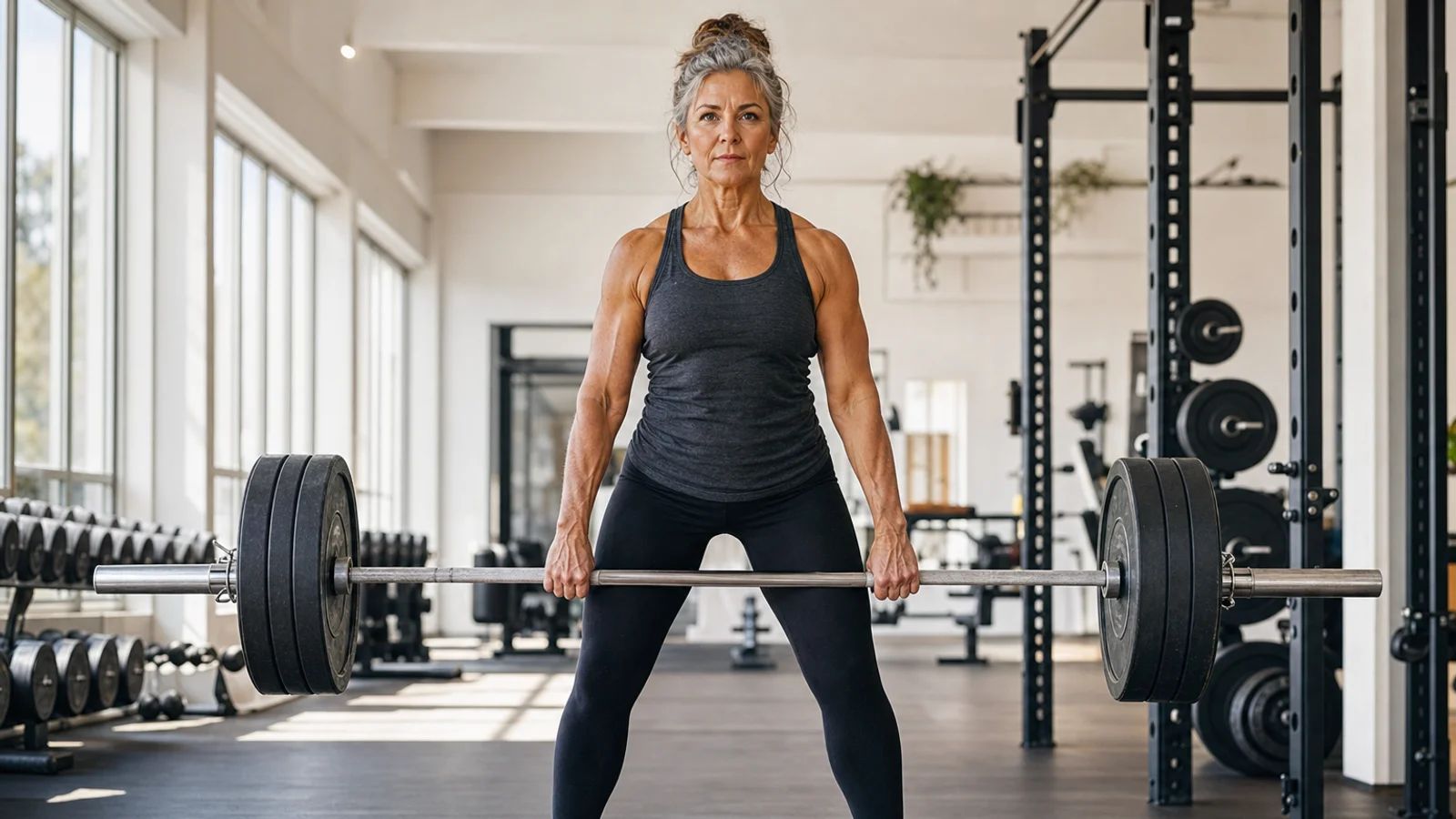
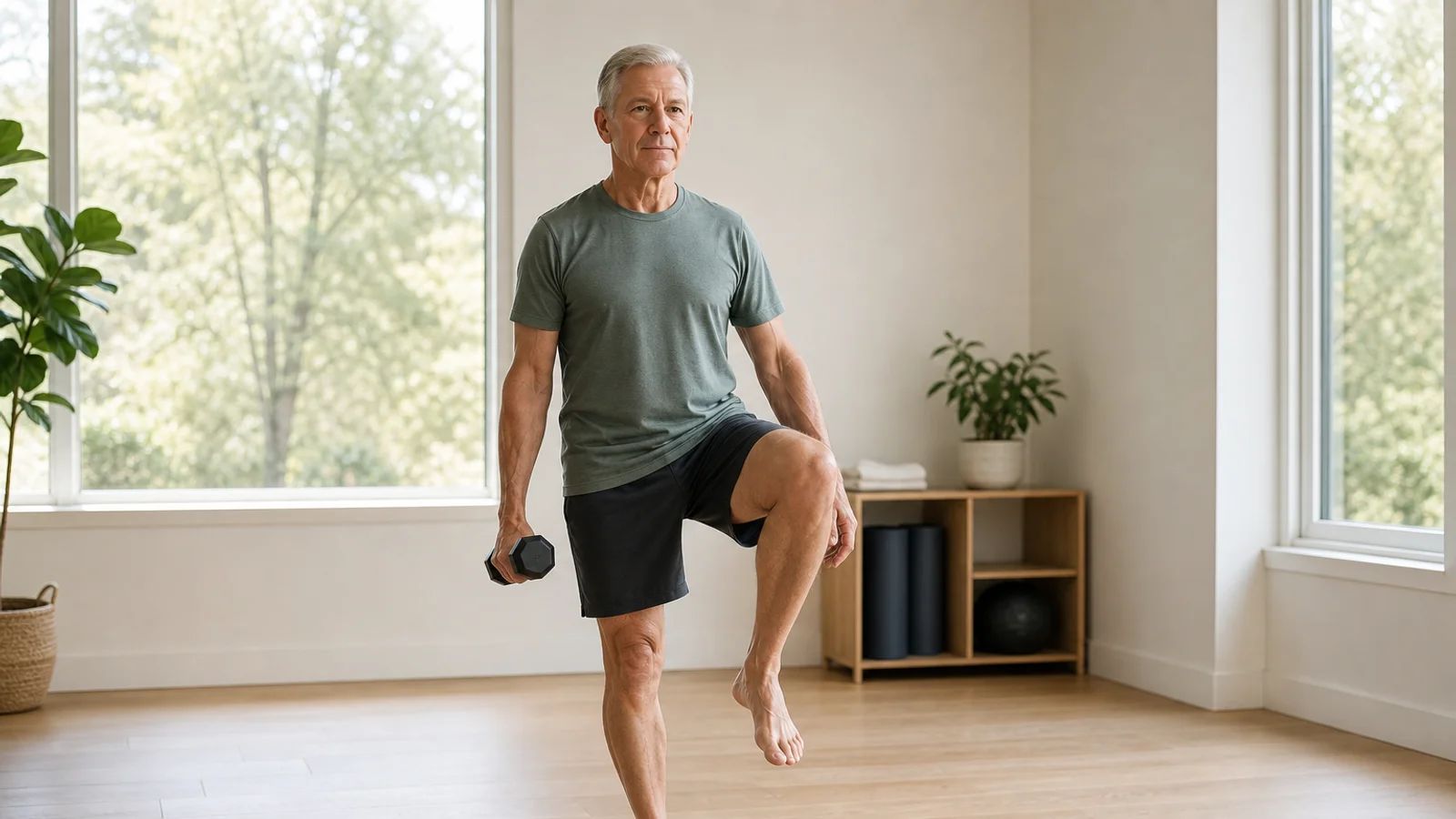
Strength training for seniors: where to start at any age
Twice a week, every major muscle, until the last reps feel hard. A 30-second chair test sets your starting point, then how to choose help that fits.
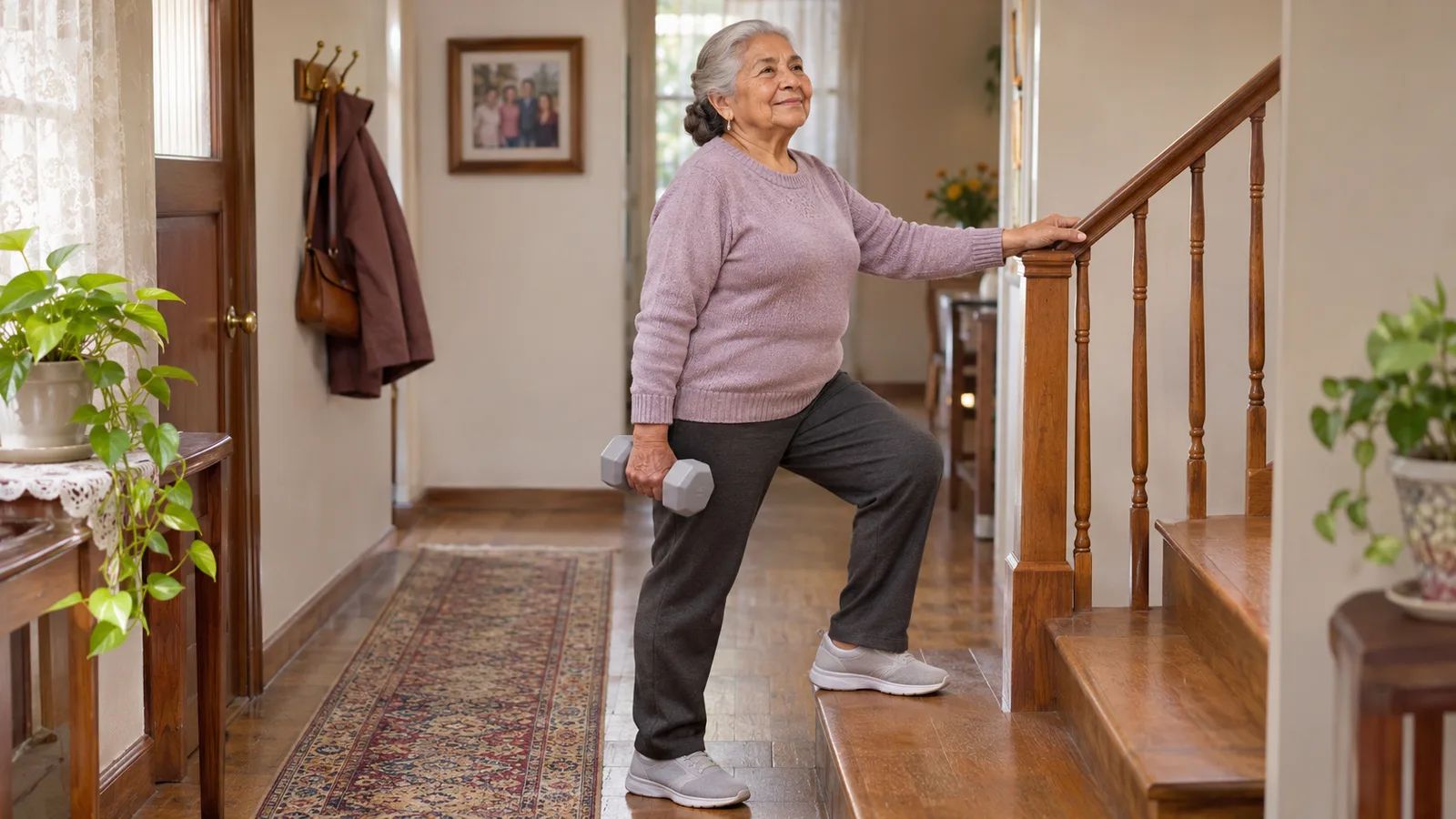
In this article10
Strength training for seniors comes down to a few numbers. Two sessions a week that work every major muscle group. About 8 to 12 reps a set, with a weight heavy enough that the last couple of reps are genuinely hard. Balance practice in each session and on a couple of other days, with your usual walking on top. Start lighter than that for a week or two and build up. Age doesn't rule you out: in one small trial, healthy people averaging 87 grew as much thigh muscle in 12 weeks as people nearly 20 years younger.1
Maybe you're reading this for yourself, because a doctor said "do some weights" or the sofa has started taking two goes. Maybe it's for a mom or dad. Or you're 64, play golf twice a week and doubt the word "seniors" means you. It does, and training in your 60s is the harder version of this page.
Is it safe, and do you need a doctor first?
For healthy older adults, yes, it's safe. In the big review of strength training in older adults, serious problems were rare and none was put down to the exercise itself, though sore muscles and achy joints were common.2 The NSCA, the strength coaches' professional body, says a well-designed program is safe for healthy older adults when it comes with instruction on technique and proper spotting.3 At home with nobody beside you, keep a wall, a counter or a chair within reach whenever you might wobble.
A doctor first: usually not, for the easy first weeks. You generally don't need medical clearance for light or moderate activity, no harder than a brisk walk, if you have no medical reason to avoid it.4 Your first week or two should feel about that easy. Before you push the last reps to hard, fill in the one-page PAR-Q+ questionnaire, which tells you whether you're an exception. Our guide to training in your 70s walks through its questions.
See your doctor first if you have a heart condition, or blood pressure that isn't under control.5
See a physical therapist first if:
- you've fallen in the past year, or you feel unsteady walking
- you've just come out of hospital, or had surgery or a joint replaced
- you've broken a bone in a minor fall, or have a fracture in your spine
- you need another person to help you up from a chair (pushing up with your own hands is fine: that's start A below)
That isn't a "no". A physical therapist can get you to the point where the rest of this page fits. If a doctor or other provider certifies that you need it, Medicare Part B helps pay, and you pay 20% of the approved amount after the deductible.6
Once you're going, stop the session and get checked if you feel dizzy, far more out of breath than the effort deserves, chest pain or pressure, or a racing or fluttering heartbeat.5 Tired muscles don't count.
Start from what you can do, not your birthday
Two people of 75 can be worlds apart in what their legs can do, so age is a poor guide to where you start. A better one takes 30 seconds and a dining chair.
Push a sturdy armless chair against a wall
Sit in the middle of the seat, feet flat, arms crossed on your chest. Have someone beside you the first time.
Stand all the way up and sit back down, as many times as you can in 30 seconds
Count the full stands. If you need your hands to push up, stop there: that's your answer, and it puts you at A.
Write the number down with today's date
It's the number you'll beat in two or three months.
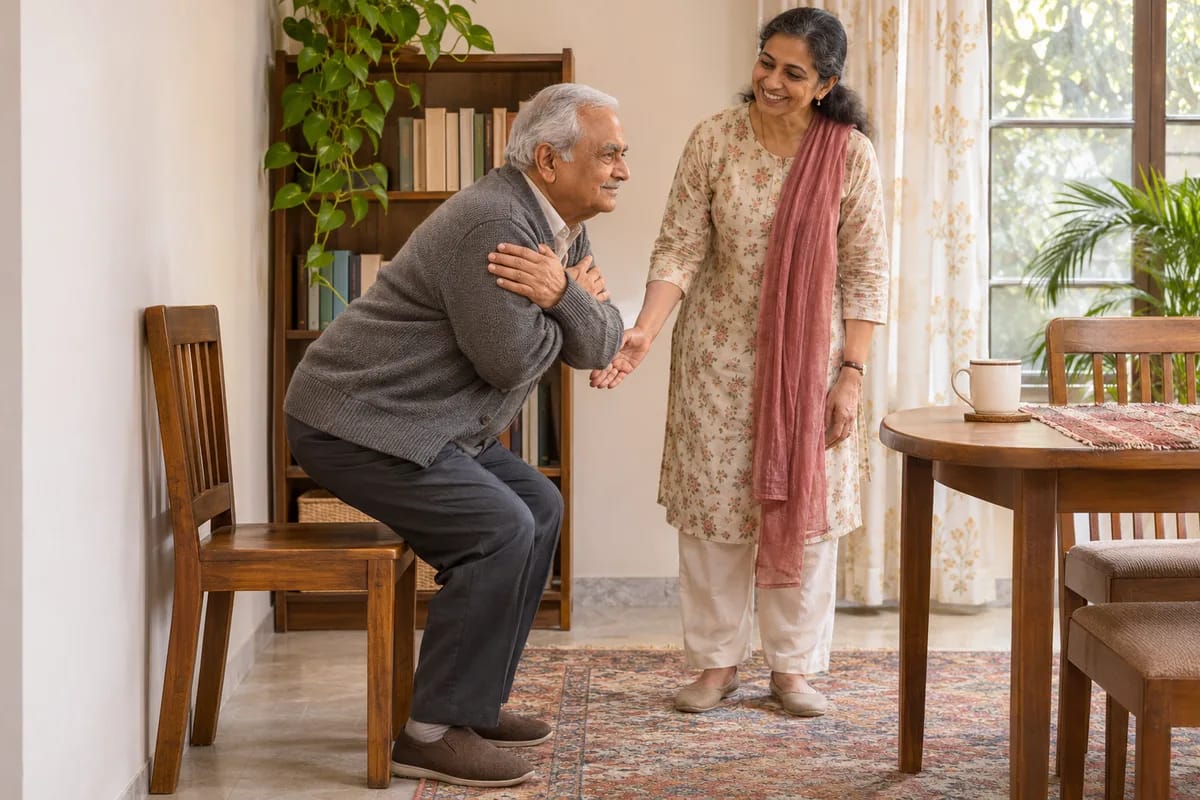
The CDC counts a score as below average when it's under the number for your age.7 Below average is a sign of higher fall risk, which is exactly what the training below works on.
| Age | Men | Women |
|---|---|---|
| 60 to 64 | 14 | 12 |
| 65 to 69 | 12 | 11 |
| 70 to 74 | 12 | 10 |
| 75 to 79 | 11 | 10 |
| 80 to 84 | 10 | 9 |
| 85 to 89 | 8 | 8 |
| 90 to 94 | 7 | 4 |
Our sit-to-stand test guide explains what each score means. For now, find your starting point:
| Your result | Start at | Then read |
|---|---|---|
| You needed your hands to stand | A | Building muscle at 80 and beyond |
| You stood, but under the number for your age | B | Training in your 70s, which has the full seven-move session |
| At or above the number | C | Training in your 60s, whatever your age |
One session, three versions
If you only do one move, make it standing up from a chair. It's the one that keeps you independent. Around it, four more jobs cover most of daily life: pushing, pulling, carrying and staying upright. Each list below is a whole session.
A: from a higher seat
- Legs: stand up from a chair with a firm cushion on the seat, hands on your thighs if you need them
- Push: push-up against a wall
- Pull: sitting, a resistance band looped around your feet, pull your elbows back
- Carry: walk the hallway with one light bag, your free hand near the wall
- Balance: feet together at the counter, fingertips on it, 30 seconds
B: from the chair
- Legs: stand up with no hands, taking three seconds to sit back down
- Push: push-up against the kitchen counter
- Pull: one hand on a chair back, row a bag with a few cans in it toward your hip
- Carry: two evenly loaded shopping bags, about 30 seconds
- Balance: heel to toe at the counter, 30 seconds, then swap feet
C: adding weight
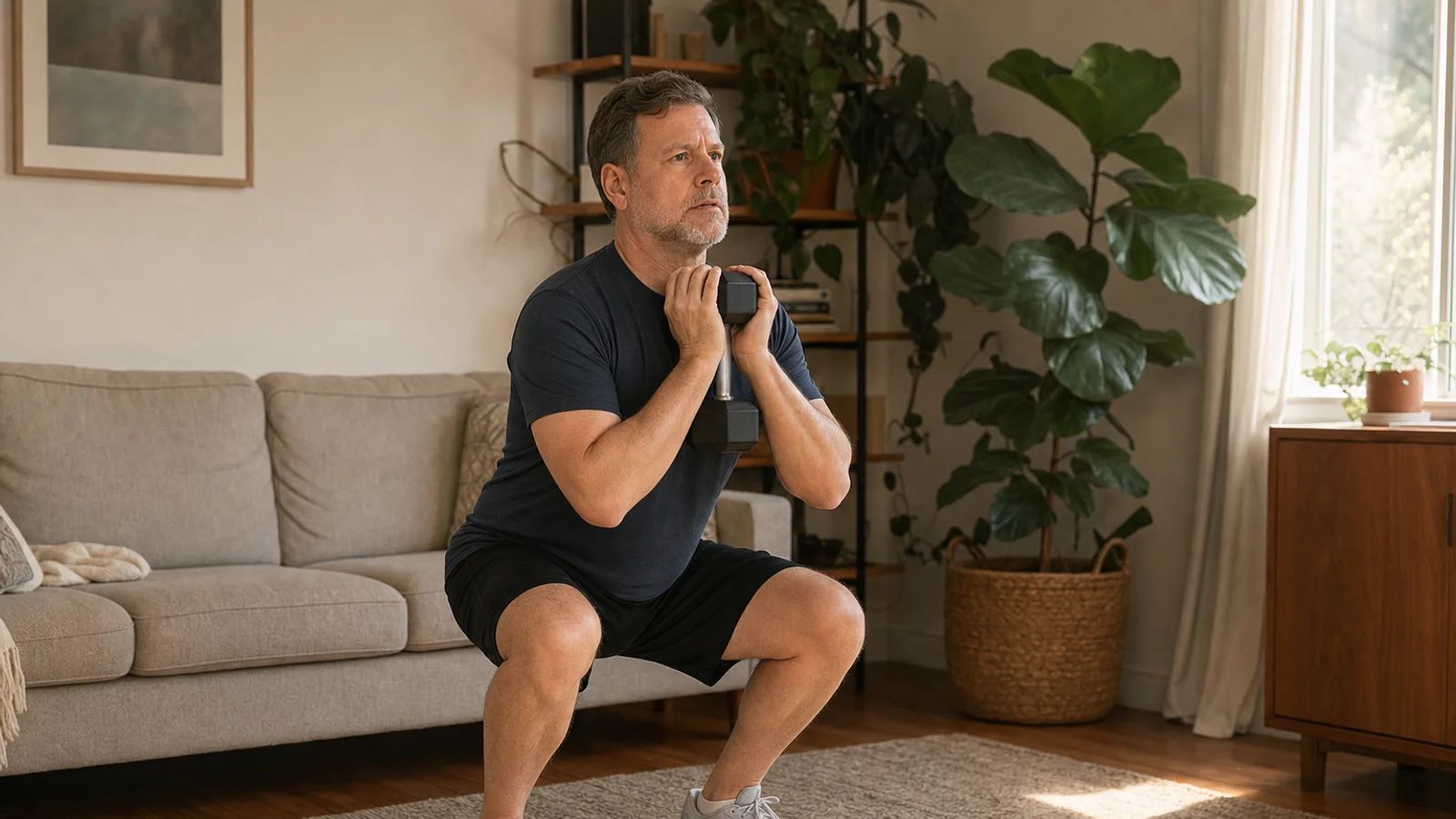
- Legs: the same stand, holding a dumbbell or a bag of cans at your chest
- Push: push-up against a sturdy table, or a dumbbell pressed overhead
- Pull: the same row with a heavier dumbbell
- Carry: heavier bags or dumbbells, up to a minute
- Balance: one foot, hands hovering over the counter, up to 30 seconds each side
How to do the five moves
- The stand. Feet flat, hip-width apart, a little behind your knees. Lean forward until your nose is over your toes, then push through your heels to stand tall. Lower yourself slowly instead of dropping into the seat.
- The push-up. Hands on the wall or edge, a bit wider than your shoulders, feet back far enough that you lean in. Keep one straight line from head to heels, bend your elbows to bring your chest toward your hands, then push away. The lower the surface, the harder it gets.
- The row. Standing, lean forward a little with a flat back, knees soft, one hand on the chair. Let the bag hang, then pull it to your hip with your elbow close to your side, and lower it slowly. Do both arms. Seated with a band, sit tall and pull your elbows back past your ribs.
- The carry. Stand tall with your shoulders down and walk at your normal pace, without leaning toward the bag. Turn with small steps.
- Balance. Rest your fingertips on the counter, don't grip it, and look at a fixed point ahead. As it gets easier, lift your fingertips off for a few seconds at a time.
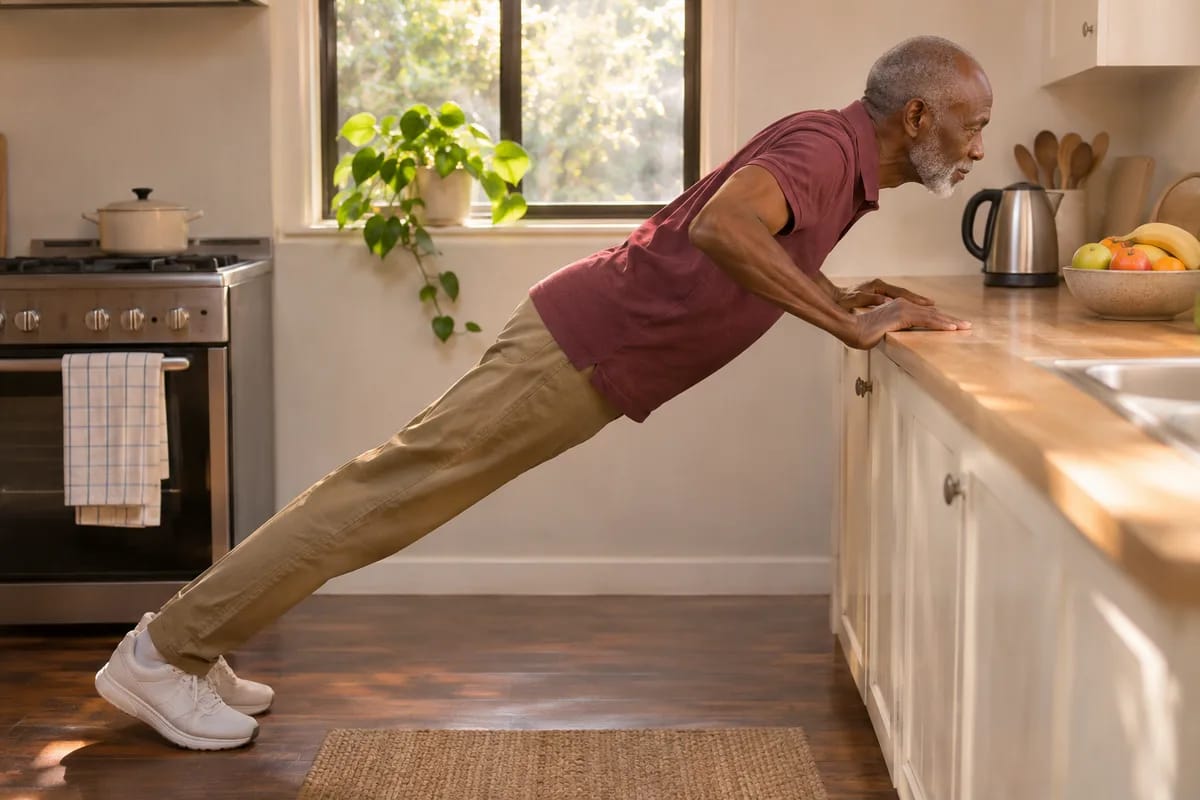
Warm up with five minutes of marching in place or walking around the house. Then go down your list once: 8 to 12 reps of each move (the carry and balance are timed), resting about a minute between them. That's about 15 minutes with the warm-up. After two or three weeks, go through it twice, which takes about 25. Breathe out as you push or stand, and don't hold your breath.
When a move gets easy, take that one job up to the next list. You'll often be in two lists at once, say B for your legs and A for push-ups, and that's normal.
Rather follow along with someone on screen? The National Institute on Aging has free videos on YouTube, including 4 lower body and 6 upper body strength exercises for older adults. Use the next section to judge how hard to go.
How hard is hard enough
This is the part many exercise pages for older adults leave out, and it decides whether any of this works. The CDC's wording is that you work "to the point where it's hard to do another repetition without help".8 The NSCA says to start at a weight you can handle and build toward genuinely heavy over time, while stopping short of all-out failure to spare your joints.3
Starting easy is right. Staying easy is how people do their exercises faithfully for six months and feel no different. Gentle is a fine first week and a poor sixth.
Too easy to change much
- You finish 10 reps and could happily do 20
- The last rep moves as fast as the first
- Your breathing barely changes
- You've used the same weight or version for two months
Doing its job
- The last two reps slow down
- You could do one or two more in good form, not five
- You can still chat between sets
- The muscles feel worked the next day, the joints don't complain
Too hard looks different: your knees cave in or your back rounds, your shoulders hike toward your ears, you hold your breath, or a joint (not the muscle around it) aches into your next session. Any of those means dropping back a step, not pushing through.
To know when to go up, the American Heart Association's "2 for 2" rule is the simplest: when you can do two more reps than your target in the last set, two sessions in a row, make it a little harder.5 If your target is 10 stands and your last set reaches 12 on Monday and again on Thursday, hold a bag with two cans in it next time. The 70s guide covers what to do when the next dumbbell up is too big a jump.
A week that covers it
Strength twice a week is the target for every adult over 65, along with about 150 minutes of moderate activity, like brisk walking, and balance practice.9 Here's how we'd lay that out at three levels of ambition. Pick the column you'll actually do.
| Enough to start | The target | If you're keen | |
|---|---|---|---|
| Strength | 1 session, with sets that are hard by the end | 2 sessions, with a day off between | 2 sessions, plus a short extra on a third day |
| Balance | Inside each strength session | Plus 5 minutes at the counter on two other days | Most days |
| Walking or other movement | What you do now, plus a little | About 30 minutes on five days | The same, with a few faster stretches |
Balance has its own row for a reason. In the main review of falls in older people living at home, programs that mixed balance and strength work probably cut the rate of falls by about a third. Strength training on its own hasn't been shown to.10 Balance practice has harder versions for when the counter gets easy.
Five ways to get help, and what each costs
This page is enough to start on your own. Some people want more: company, someone who checks, or someone who decides.
| Option | Rough cost | Suits you if |
|---|---|---|
| On your own, with this page or the free NHS strength exercises | Free | You're steady on your feet and good at keeping habits |
| A class, with an instructor watching the room: SilverSneakers, or a strength class at a local Y or community center | Free with some Medicare Advantage plans, a small fee with others; not part of Original Medicare11 | You like company and you're steady |
| A physical therapist, in the room | Part B helps pay when a provider certifies it's needed6 | Any of the "physical therapist first" reasons above |
| An in-person trainer, in the room | About $50 to $90 a session,12 so roughly $433 to $780 a month at twice a week | You want hands-on help or like going to a gym |
| A live video coach (that's us), watching every session on camera | $299 a month, about $35 a session at twice a week; a third session costs nothing extra | You're steady enough to train at home, two or more times a week |
If you're choosing a trainer for a parent, personal trainer for seniors covers what to check and what to ask on the first call.
If you're reading this for a parent
You can't do the training for them, and nagging rarely helps. What you can do is make the first week easy to start and the next ten easy to keep.
Helping a parent get going
- Set the space up once: an armless chair against a wall, a clear stretch of counter, a pair of light dumbbells or two bags of cans
- Print the PAR-Q+ and go through it with them before their next appointment, so the doctor gets real answers
- Do the chair test with them on day one, standing right beside them, and put a retest date in both your calendars about ten weeks out
- Ask about the things they want to keep doing, the stairs, the garden, the grandchildren, rather than about exercise
- Ask how many sessions happened this week, not how heavy the dumbbell is
- If they fall, feel newly dizzy or have a joint that gets worse week on week, pause and call their doctor
If you live far away, the ten-week retest is your best evidence. A higher chair-stand count, and stairs or car seats that are easier, mean it's working.
What changes with a coach on the call
Everything above works on your own, with a chair and a notebook. What it leaves to you is the judgment in the "how hard" section, made alone, mid-set, by the person who'd quite like to stop. For older beginners that's where it usually goes wrong: too gentle for too long, or too much on a bad day.
The research backs having someone watch. Older adults who trained with supervision gained more strength, and more balance on most measures, than people doing the same program alone.13 And in a small trial, a coach on live video matched a coach in the room for leg strength and power, though not on every measure.14
Here's what a coach on the call means at Bespoke Fit:
- A real coach, live, every session. A 1‑on‑1 video call in our own app on iPhone, Android or a browser, so a tablet or laptop works as well as a phone.
- Your coach decides how hard. They write your program onto your training calendar and settle the weights by watching your sets. If you wear an Apple Watch or a Bluetooth heart rate strap, they see your heart rate live and use it to decide how hard to push and when you rest.
- A coach who knows you. Each coach has 12 members at most, and we hold to it when we assign coaches. You start with a 30-minute call with a head coach, who matches you with a coach, so tell them anything your doctor has said. Every coach spends 90 days in onboarding with our founder before taking a member.
- Someone expecting you. Each session is a calendar invite with reminders the day before and shortly before. Between sessions you can message your coach, photos included.
- Progress you can see. After each session a recap shows what you lifted, your sets and any records, and your top lifts build into a trend.
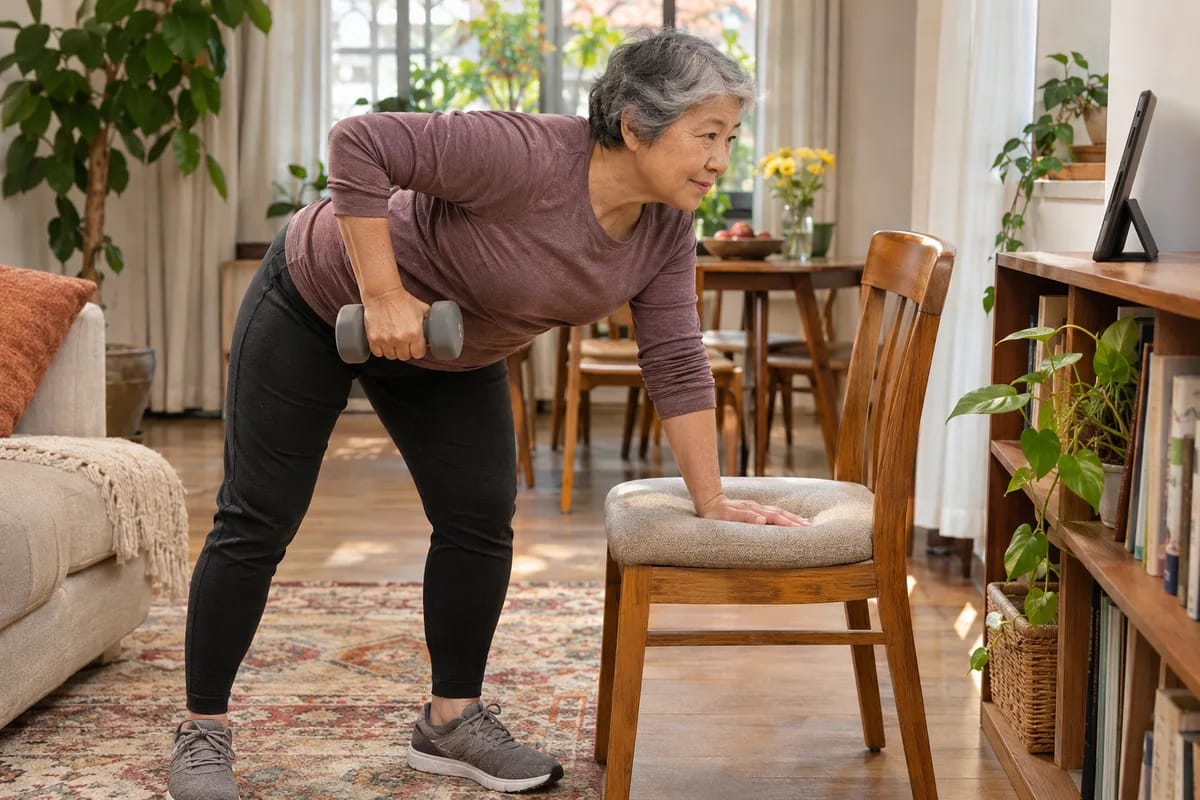
With nobody in the room, the setup does the steadying: the chair against a wall, the counter in reach, and the camera placed where it sees all of you. Your coach watches how you move and picks what's safe to do on your own, and the stop signs above still apply.
Say you're at B for legs. On Tuesday the last of your sit-to-stands are still quick, so your coach has you hold a bag of cans for the next set. On Friday you slept badly, your heart rate runs high in the warm-up, and the same coach keeps the weight where it was and gives you longer rests. Both calls are right, and neither is one you'd easily make alone.
Sessions run 45 to 90 minutes at the same price, and most people settle at around an hour, rests and balance work included.
"I was skeptical about doing training over video at my age, but it has been much easier than I expected. My trainer is patient and adjusts everything to what my body can handle. I have exercised more in the past two months than in the last ten years. My friends can see the difference."
Wanda, 70, a Bespoke Fit member
The price, and who should skip it
It's 14 days free, then $299 a month, for as many sessions as you book, and you can cancel anytime. You add a card to start. The 14 days start at your first session, not at signup, and a reminder goes out 3 days before the first charge.
Skip it if:
- you need someone in the room to steady you, or any of the "first" reasons above apply. Your coach watches through the camera and can't catch you, so start with your doctor or a physical therapist and come back when you're steady.
- you're already training regularly with this page on your own. Keep going; it's free.
- $299 a month would be a strain. The free options and classes in the table above will serve you well.
- you want meal plans. Our coaches don't do nutrition.
If it's for a parent, your part is the setup. Sit beside them for the 30-minute matching call, and get the tablet, phone or browser working where the camera sees them. After that their coach books each session with them, every session arrives as a calendar invite with reminders, and the recap after each one is the thing to ask to see.
Where to go next
| If your question is | Read |
|---|---|
| Am I too old to build muscle? | Can you still build muscle at 80? |
| I'm in my 50s and have never lifted | Starting to lift at 50 |
| What weight should I buy? | How much weight to start with |
| I have osteoporosis | How lifting builds bone |
| I have arthritis | Lifting with arthritis |
| I've had a hip or knee replaced | Strength training after a joint replacement |
| I'm afraid of falling | Why power matters more than strength for falls |
| How much protein do I need? | Protein after 40 |
| Do I need more rest days now? | Do older lifters need more recovery? |
Common questions
Can I do strength training sitting down? Yes. The NSCA supports adapting programs for people with mobility limits, and seated versions work. Our picks: a band row with the band looped around your feet, a light dumbbell press, knee straightening with an ankle weight, and heel raises, as long as the last reps of each set are hard. Keep practicing standing up from the chair too, with whatever help you need.
Is there a free printable plan? We don't make a PDF. Screenshot or print the list for your starting point on this page: each one is a complete session. The NHS also has a free page of seven gentle strength exercises, most of them done holding a chair, which suits the very start. Its rep counts are low, so once they feel easy, use the how-hard-is-hard-enough signs above to keep progressing.
Sources
-
Marzuca-Nassr and colleagues, 2023. Muscle mass and strength gains following resistance exercise training in older adults 65-75 years and older adults above 85 years. International Journal of Sport Nutrition and Exercise Metabolism. Twelve healthy people averaging 87 and 17 averaging 68 did the same training three times a week; thigh muscle grew about 11% and 10%. ↩
-
Liu and Latham, 2009. Progressive resistance strength training for improving physical function in older adults. Cochrane Database of Systematic Reviews. 121 trials, about 6,700 people. Side effects were often poorly recorded. ↩
-
Fragala and colleagues, 2019. Resistance training for older adults: position statement from the National Strength and Conditioning Association. Journal of Strength and Conditioning Research. Full text (PDF). Recommendation 1 covers safety ("appropriate instructions for exercise technique and proper spotting"); Table 1 covers starting loads, progression and avoiding failure; recommendation 10 covers adapting programs for frailty and mobility limits. The seated exercises named in our FAQ are our own picks. ↩ ↩2
-
Bull and colleagues, 2020. World Health Organization 2020 guidelines on physical activity and sedentary behaviour. British Journal of Sports Medicine. Medical clearance is "generally unnecessary" before light or moderate activity no harder than brisk walking or everyday living, for people without contraindications. ↩
-
Paluch and colleagues, 2024. Resistance exercise training in individuals with and without cardiovascular disease: 2023 update. A scientific statement from the American Heart Association. Circulation. People with relative contraindications should get medical consultation and clearance first; the warning signs and the "2 for 2" rule are in the full text. ↩ ↩2 ↩3
-
Medicare.gov. Physical therapy services. Part B helps pay for medically necessary outpatient physical therapy that a doctor or other provider certifies; after the Part B deductible you pay 20% of the approved amount. Read November 12, 2026. ↩ ↩2
-
Centers for Disease Control and Prevention, STEADI, 2017. Assessment: 30-second chair stand. The table of below-average scores and "a below average score indicates a risk for falls". ↩
-
Centers for Disease Control and Prevention. What counts as physical activity for older adults. Also the source for 8 to 12 reps as one set. Read November 12, 2026. ↩
-
Centers for Disease Control and Prevention. Physical activity guidelines for older adults. The three-level week is our own layout of these guidelines. ↩
-
Sherrington and colleagues, 2019. Exercise for preventing falls in older people living in the community. Cochrane Database of Systematic Reviews. 108 trials, 23,407 people, average age 76. Programs mixing several types of exercise, most often balance plus strength, probably cut the rate of falls by 34% (moderate certainty); the effect of programs that were mainly strength training was uncertain. ↩
-
Humana, updated October 2, 2026. SilverSneakers and Medicare. Free with some Medicare Advantage plans, a small monthly fee with others, extra fees for some classes; not included with Original Medicare. Read November 12, 2026. ↩
-
Bark, updated January 16, 2026. How much does a personal trainer cost? An average of $50 to $90 a session. Read November 12, 2026. The monthly figures and the $35 a session are our arithmetic, at about 8.7 sessions a month for twice a week. ↩
-
Lacroix and colleagues, 2017. Effects of supervised vs. unsupervised training programs on balance and muscle strength in older adults: a systematic review and meta-analysis. Sports Medicine. 11 studies of healthy adults 65 and over, of middling quality. Supervised training did better for strength and power and for most balance measures, but not for standing still in one position; the gap was biggest against programs with no supervised sessions. The authors recommend supervising about two of every three weekly sessions. ↩
-
Langeard and colleagues, 2022. Non-inferiority of a home-based videoconference physical training program in comparison with the same program administered face-to-face in healthy older adults: the MOTION randomised controlled trial. Age and Ageing. 41 people randomised: 15 trained face to face, 13 by video and 13 didn't train; an hour twice a week for 16 weeks. Video was non-inferior for knee-extension strength and leg power, but wasn't shown to be for muscle mass, grip, trunk-extension or knee-flexion strength. ↩