How much weight should a beginner lift? The 10 rep test
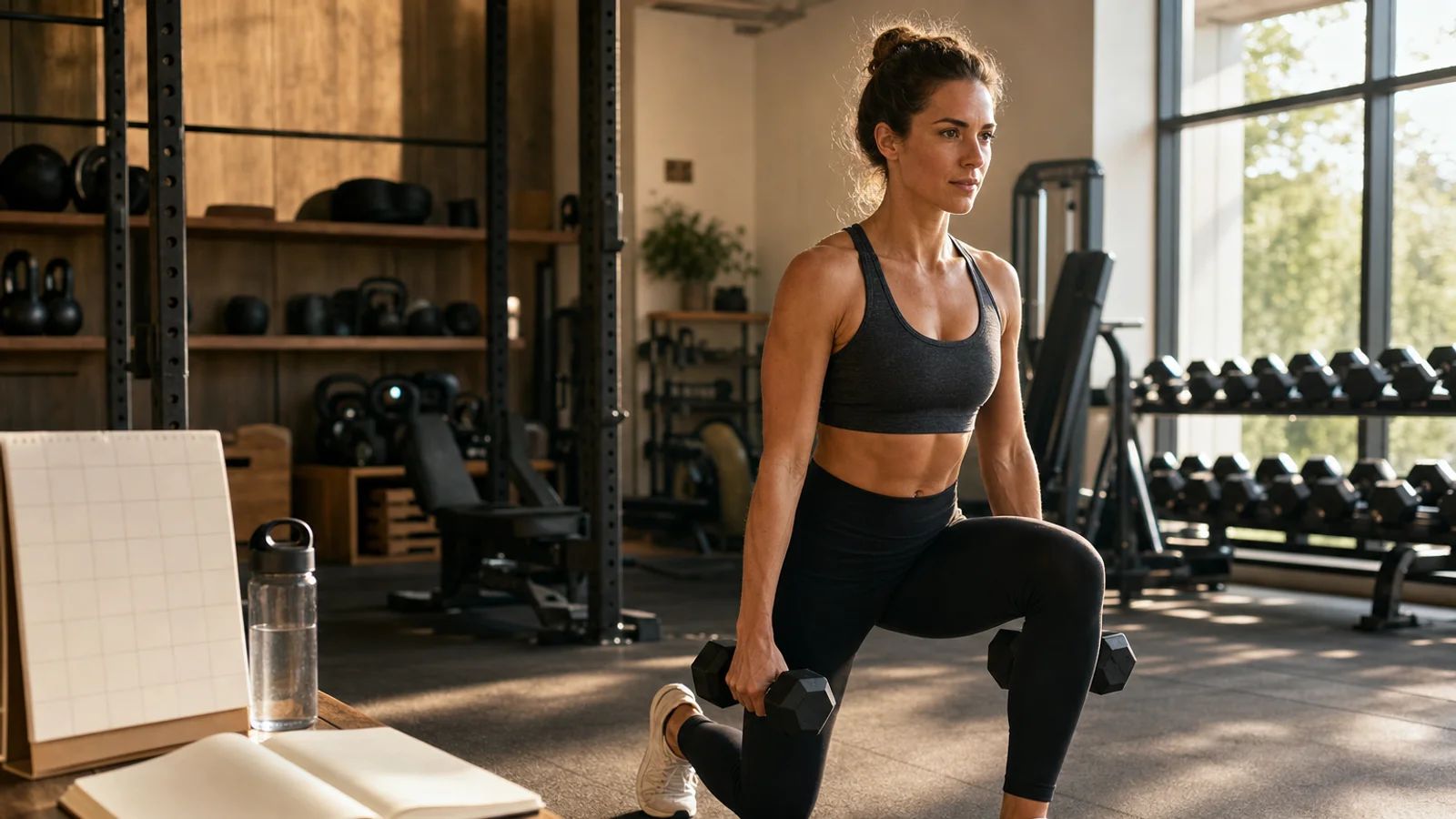
Pick a load you can move 10 times with 2 or 3 reps left, for most beginners a light dumbbell or an empty bar, then let your form decide when to add weight.
Updated
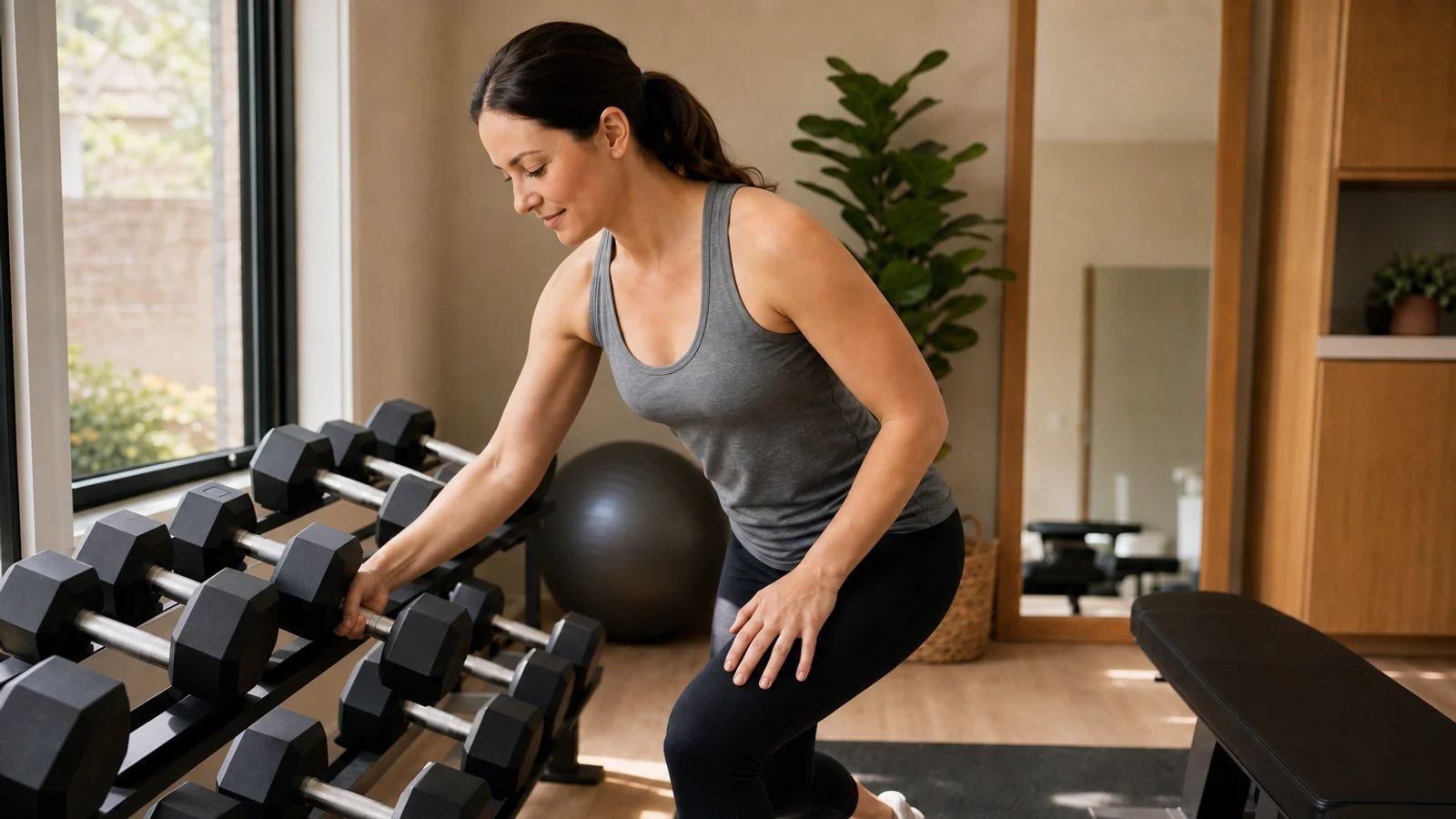
About 10 reps, with 2 or 3 left in you at the end. That's the whole answer, and for most beginners it lands on a weight that feels a little embarrassing.
Load it anyway. In your first weeks you're not really lifting a weight, you're teaching your body a movement, and the load that lets you practice it well is the one that makes you strong fastest. So the question isn't what you can lift today. It's what you can lift 10 times cleanly, then add to next week.
Finding your number in one session
You don't calculate this, you test it. Pick something you're sure is too light and do a set of 10. Then judge it on two things: how the last couple of reps felt, and whether rep 10 looked like rep 1.
- All 10 easy, form never wavered? Go up next set.
- Could you probably have got 12 or 13? Stop there. That's roughly two or three reps in reserve, which is exactly the zone you want, and it's the same feel behind rating your effort with reps in reserve.
- Technique fell apart at rep 6? Take weight off. You're calibrating, not testing a max.
On a brand new movement, start below even that and do one feeler set. It tells you more than any chart will. And for barbell lifts, plenty of people should start with the empty bar or the bar plus the smallest plates in the rack. An Olympic bar is 20 kg on its own, about 44 lb, which is real load when you've never squatted before. The bar is there to groove the pattern. It isn't a scoreboard.
What you're actually training in month one
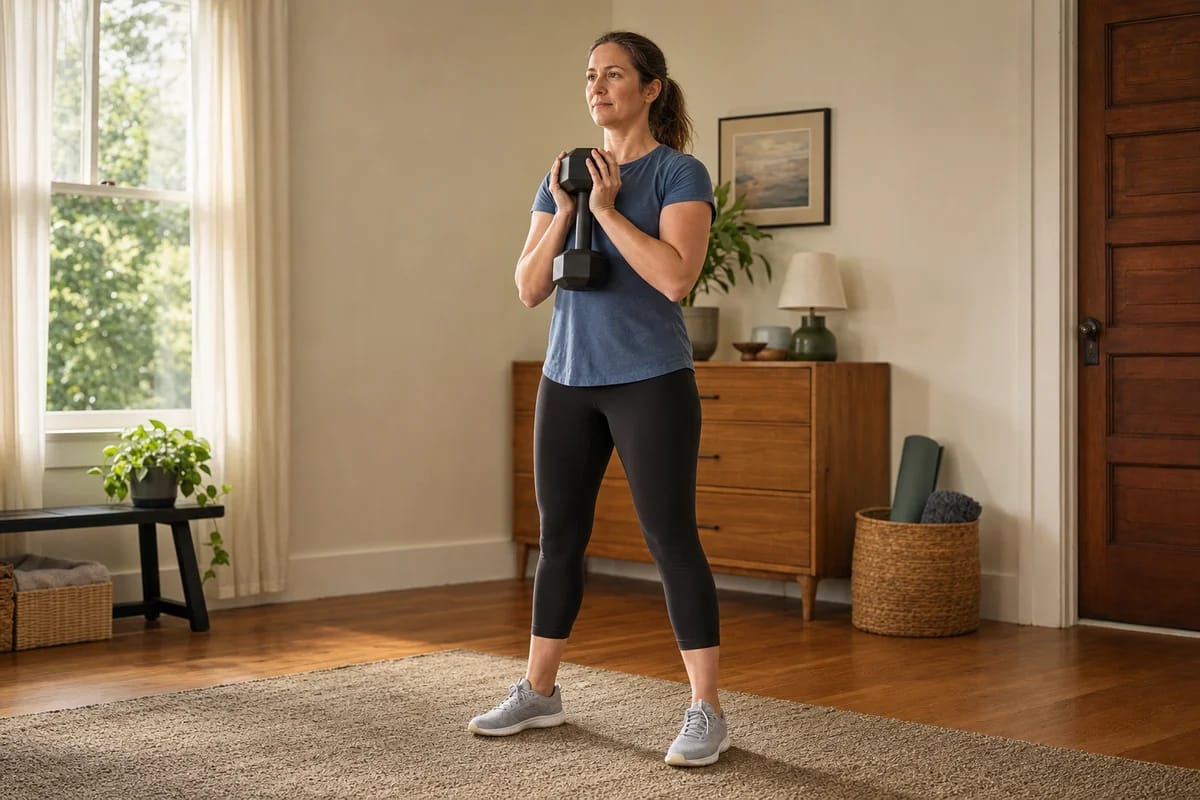
Most of what improves early isn't muscle. It's your nervous system learning to drive the muscle you already have: recruiting more fibers at once, firing them faster, and getting the timing right between the ones that move the joint and the ones that hold everything else steady. We go deeper on that wiring in why your first strength gains are neural, not muscle. The practical part is short. Every rep is a rehearsal.
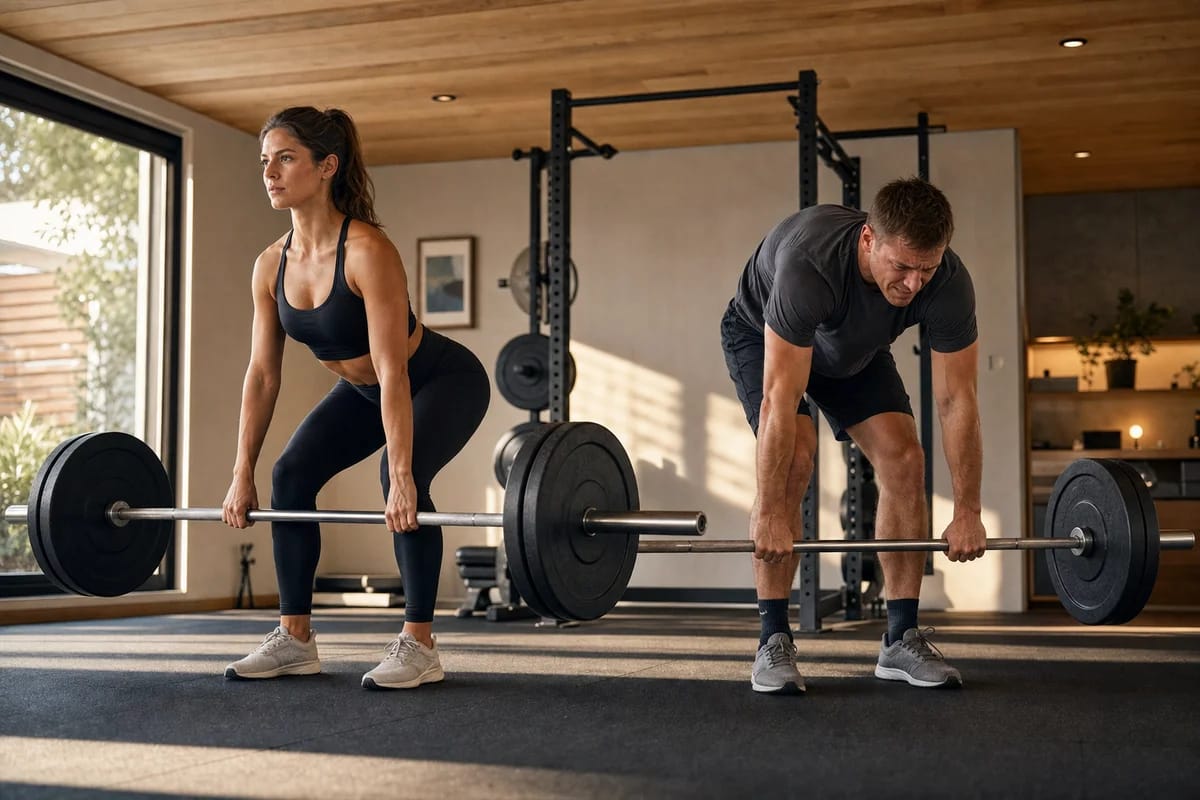
Rehearse with a load you control and you're practicing the lift you want. Go too heavy and your body finds workarounds. The hips shoot up early out of the squat, the low back rounds on the deadlift, the bar drifts forward on the press. Your nervous system records those just as faithfully as the good version. A month of that and you've got a pattern to unlearn before you can safely add real weight.
Do light weights really build muscle?
They do, which surprises people who assume growth needs a loaded bar. A 2017 meta-analysis in the Journal of Strength and Conditioning Research pooled 21 studies and found muscle growth was similar on lighter and heavier loads, as long as the sets were taken close to failure.1 Maximal strength, the one-rep-max number, did favor the heavier training. But your one-rep max isn't what you're chasing in month one. Muscle and movement are, and lighter loads give you both.
You also don't have to grind every set into the ground. Researchers pooled 15 trials on this in 2022 and found that stopping short of failure worked about as well as going all the way for strength and size in young adults, with the gap sitting near zero.2 Leaving two or three reps in the tank isn't a soft option, it's a legitimate way to train that happens to protect your technique. Training to failure and how close is close enough has the longer version.
Why heavy feels like progress
Because the plate is the only part anyone can see from across the room. Reps don't show up on a barbell. So the instinct is to chase the number, and a weight you can only move by heaving, bouncing and cutting the range short stops training the muscle you loaded it for. It trains you to cheat the lift.
Then the trap shuts. Start too heavy and you can't add weight next week, because you're already past what your technique can hold. You either stall there repeating ugly reps, or you add anyway and they get uglier. Both roads end in a plateau, and often a sore back or a cranky shoulder.
There's a quieter version of the same problem. Judging how many reps you have left is genuinely hard, and people are worse at it than they think. In a study of 81 adults, guesses were decent close to failure, within about a rep, but drifted off by more than two reps when there were still seven to ten left in the tank.3 Early in a set your gut is mostly guessing. By the time a weight feels heavy, you may already be past clean.
Letting clean reps earn the next plate
The rule is short. Add weight when your current load still looks clean on every rep, not just the first few. Smooth from rep 1 to rep 10 and you've earned a bump. Wobbly at rep 8 and you repeat that weight until it isn't.
Keep the bump small. For most people that means the smallest plates you own, often 1 to 2.5 kg a side on a barbell, roughly 2 to 5 lb, or one step up the dumbbell rack once you hit your target reps cleanly. Some weeks you add nothing at all, which is normal. A steady drip of increases your form can absorb is the whole idea behind progressive overload without the spreadsheet.
Think of it as letting the movement pull the weight up, rather than shoving the weight up and hoping your technique follows. When all your reps feel genuinely easy, your body is telling you it's ready for a bit more. When they don't, more weight just buys you worse reps.
Where this gets fuzzy
Ten reps with a few in reserve is a sensible default, not a law. Different lifts and different bodies land on slightly different numbers, and the feel for "two or three left" sharpens over months, so don't expect to read it precisely on day one. The load research deserves the same caution: it was done mostly in younger adults training close to failure, and it measured muscle size, not the movement skill a beginner needs most. Clean form is also the hardest thing to judge about yourself, because you can't see your own bar path or feel a hip shift the way an outside eye catches it. The principle holds up well. The exact numbers are a starting point you'll adjust.
Common questions
Is it bad to start with just the empty barbell? Not at all. An Olympic bar is 20 kg before you add anything, which is plenty for a beginner learning a squat or a press, and many people should start lighter still. You get to practice the whole movement, balance included, before plates enter the picture. Adding weight later is easy. Unlearning a bad pattern isn't.
How do I know a weight is too heavy? Watch the last few reps. If your range shrinks, momentum creeps in, or some other body part starts helping, you're past what your technique can control. A good starting weight looks nearly identical on rep 10 and rep 1. If it doesn't, take some off.
Do I have to lift heavy to build muscle? No. Lighter loads build muscle much like heavy ones when the set gets reasonably close to failure. Heavy has the edge for maximal strength, but a beginner picks up plenty of both from moderate weights and good technique. Start where your form holds and go from there.
Should I train to failure to be sure it's working? You don't have to. Stopping a couple of reps short works about as well as grinding to the last rep for size and strength in most people, and it keeps your form cleaner and your recovery easier. Leave two or three in reserve while you're still learning the lifts.
Nobody can see their own rep 8
Put your phone on the floor and film a set from the side. You'll catch a lot of what a coach would catch: the hips rising early, the bar drifting forward, the rep where your range quietly shrank. Anyone who'll actually rewatch that footage, start lighter than their ego wants, and put the weight down when rep 8 looks wrong can get through the whole beginner phase under their own steam.
What the footage can't do is speak up mid-set. That's the gap a Bespoke Fit session fills. A real coach, never AI, watches your first reps live over HD video, calibrates your starting load in minutes, and tells you the week your form has room for more weight and the weeks it doesn't. Since early training is mostly skill practice, getting those first loads right pays off for months. How it works walks through a session. Your first month is $49, then founding members lock in $299 a month for life, 25 spots, with $499 the standard rate after, and there's a 30-day money-back guarantee.
Sources
-
Schoenfeld BJ, Grgic J, Ogborn D, Krieger JW, 2017. Strength and hypertrophy adaptations between low- vs. high-load resistance training: a systematic review and meta-analysis. Journal of Strength and Conditioning Research. ↩
-
Grgic J, Schoenfeld BJ, Orazem J, Sabol F, 2022. Effects of resistance training performed to repetition failure or non-failure on muscular strength and hypertrophy: a systematic review and meta-analysis. Journal of Sport and Health Science. ↩
-
Hackett DA, Cobley SP, Davies TB, Michael SW, Halaki M, 2017. Accuracy in estimating repetitions to failure during resistance exercise. Journal of Strength and Conditioning Research. ↩