How to train for skiing: an 8-week plan, or a 3-week one
How to train for skiing at home with six moves for ski legs, a plan for however many weeks you have left, and how to pace day one so your legs last.
In this article7
The short version
Two short strength sessions a week of squats, lunges and slow step-downs, taking three seconds on every way down, plus two easy cardio sessions. Eight weeks is ideal. Three weeks may still spare you some soreness. Under two, plan a gentle first day.
The trip's booked, and you remember how your thighs felt by lunch on day two last time. Or you've never skied, and someone told you to "get your legs ready" without saying how. Either way, the fix is smaller than most ski workout lists make it look: six moves at home, and one idea behind all of them. Train the lowering.
On skis your thighs spend a lot of each turn braking. When researchers measured racers, the outside leg spent about a second of every turn bending under load, working close to as hard as it could, and only half a second pushing back up.1 The snowplow turns beginners learn first work the same muscles hard too.2 Braking under load is the work untrained legs hate, the same work your thighs do walking down stairs. How slow to go on the way down has more on the counting.
How many weeks until your trip?
The full plan is further down: weeks 1 and 2 teach the moves, and it builds from there to an easy week 8. Find your row to see which of its weeks to do.
| Weeks until you ski | Plan weeks to do | Notes |
|---|---|---|
| 8 | 1 to 8 | More than 8 away? Repeat weeks 3 and 4 until 8 are left. |
| 7 | 1, 3, 4, 5, 6, 7, 8 | Skip week 2. |
| 6 | 1, 3, 4, 5, 7, 8 | Skip weeks 2 and 6. |
| 5 | 1, 3, 5, 7, 8 | Hops arrive in your third week. |
| 4 | 1, 3, 4, 8 | Step-and-stick throughout. No hops, no blaster. |
| 2 or 3 | Week 1, every week | This is about soreness, not strength, and it may still help. |
| Under 2 | One or two sessions of week 1 squats and step-downs | Last one three or four days before you ski. Then read the week you go. |
Why bother with two or three weeks? Soreness is most common at the start of a season, lowering work causes more of it than other effort, and one review advises easing that work in over a week or two first so it sets you back less.3 Week 1 is exactly that. Working out with sore muscles covers the ache itself.
The six moves
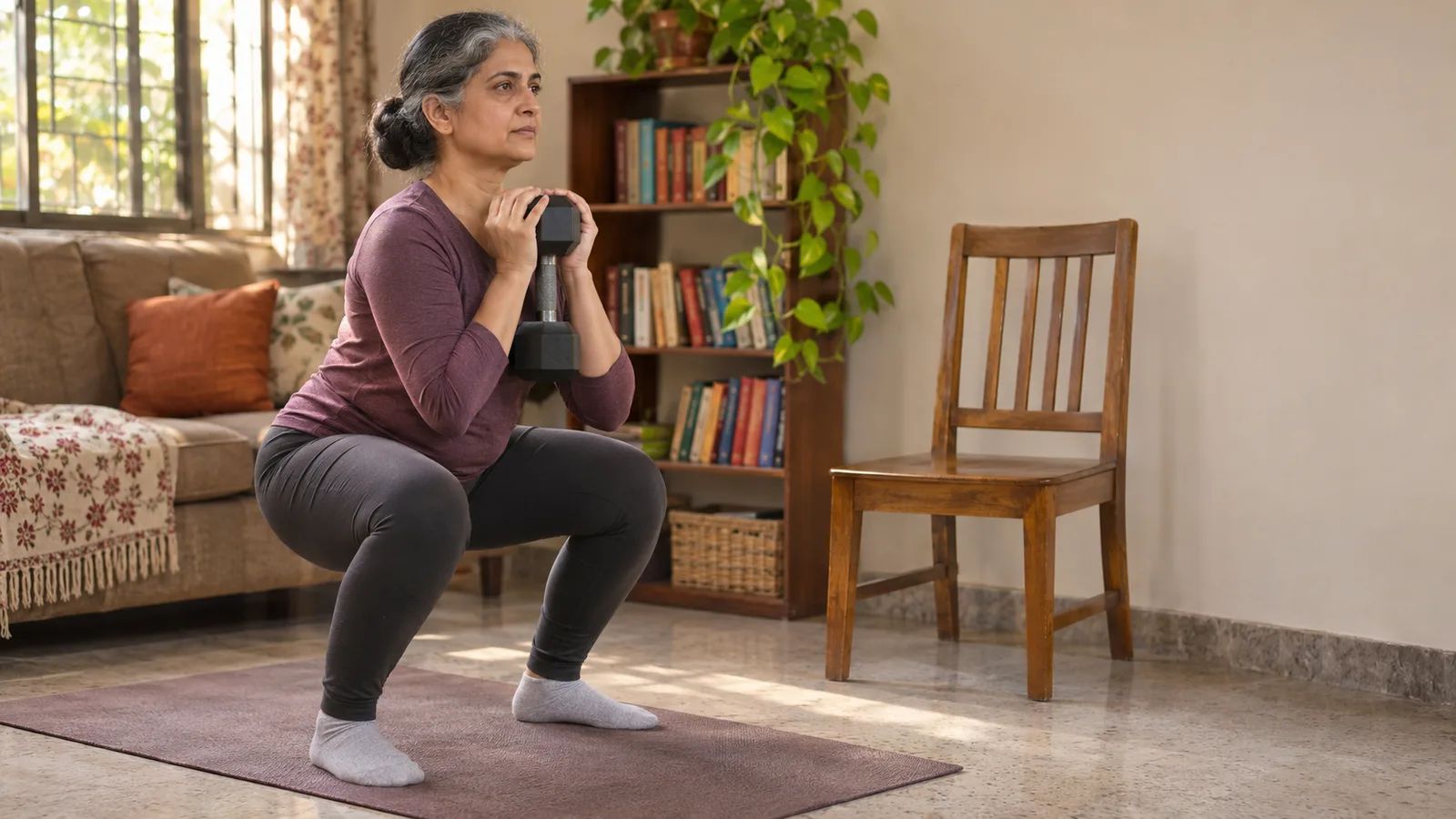
A sturdy chair or wall helps with balance, and a dumbbell of 10 to 25 lb (5 to 11 kg) helps from week 3.
| Move | The cue | The common fault |
|---|---|---|
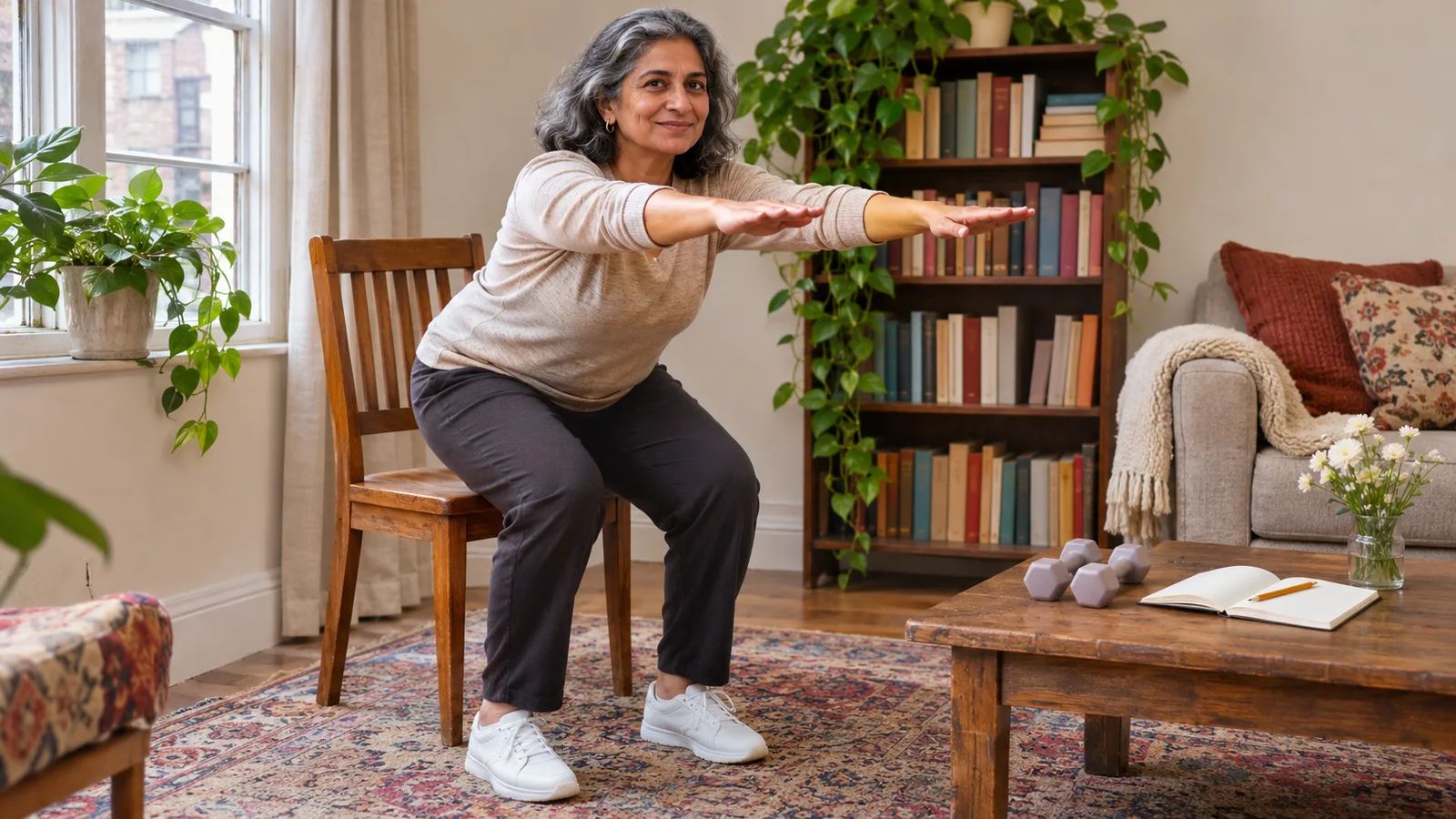
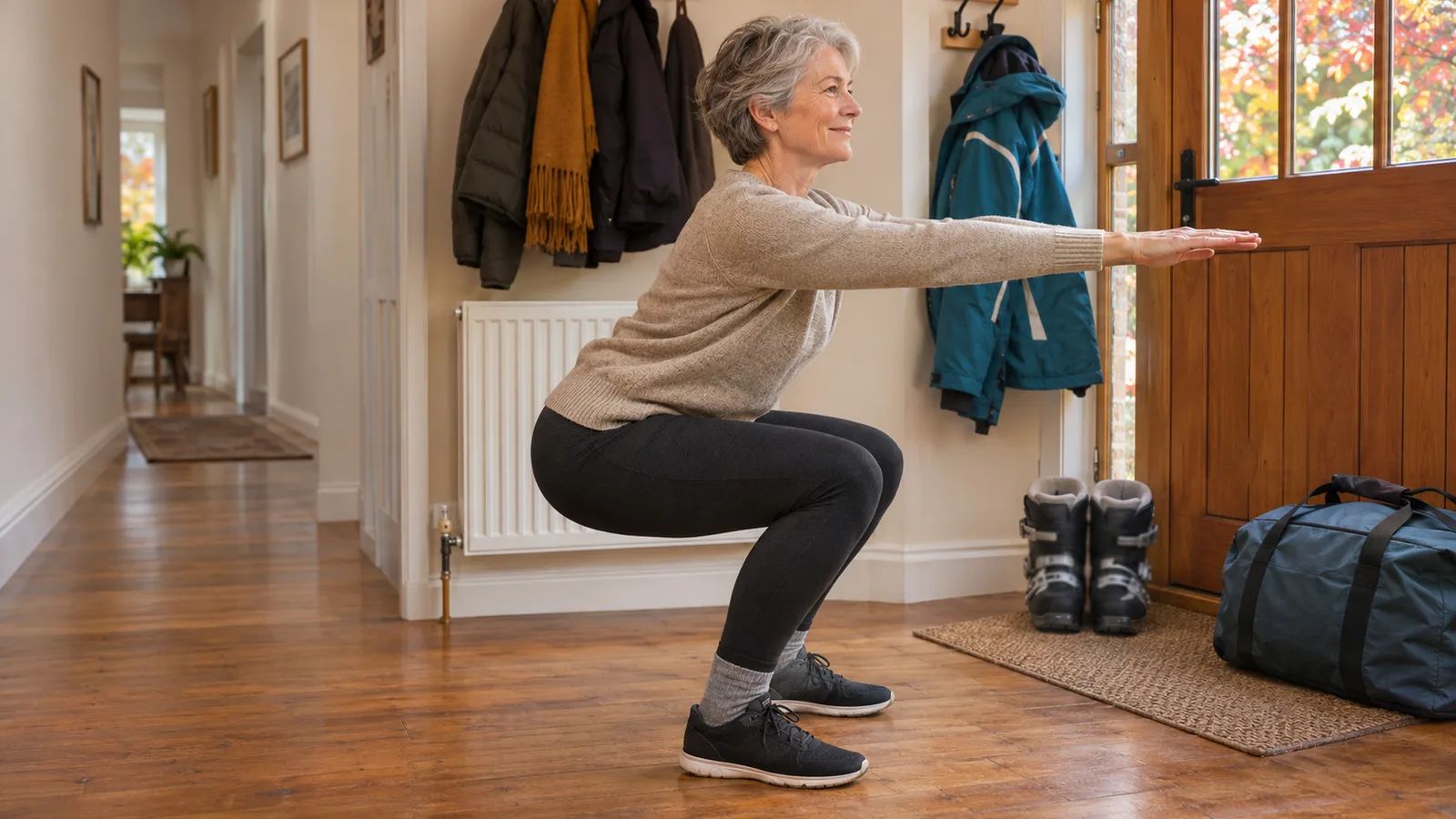
| Slow squat, bodyweight or a dumbbell at your chest. The basic braking pattern. | Sit back and down for a count of three, stand up at normal speed | Dropping the last few inches fast |
| Reverse lunge. One leg brakes, like your outside ski. | Step back long, lower the back knee toward the floor slowly | Front knee drifting in as you lower |
| Step-down off a stair. The purest braking drill there is. | On the bottom stair on one leg, lower the other heel to the floor in three seconds, tap, stand back up | Hip dropping on the free side, or the standing knee caving in |
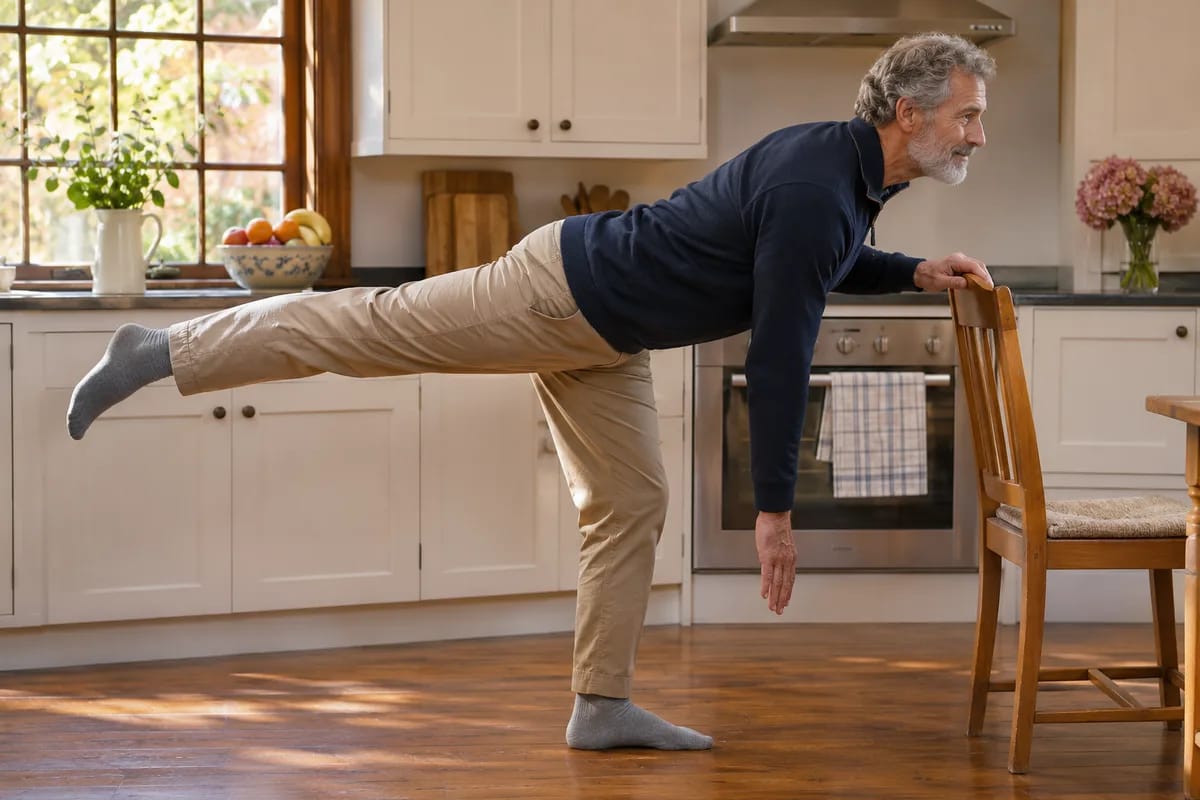
| Single-leg Romanian deadlift. Hamstrings and balance on one foot. | Hinge at the hip with a flat back, free leg reaching behind you, fingertips on a chair if you need it | Rounding your back to reach lower |
| Wall sit. Holding the crouch. | Back flat on the wall, thighs a little above level, knees over ankles | Sliding so low your knees ache, or so high it's standing |
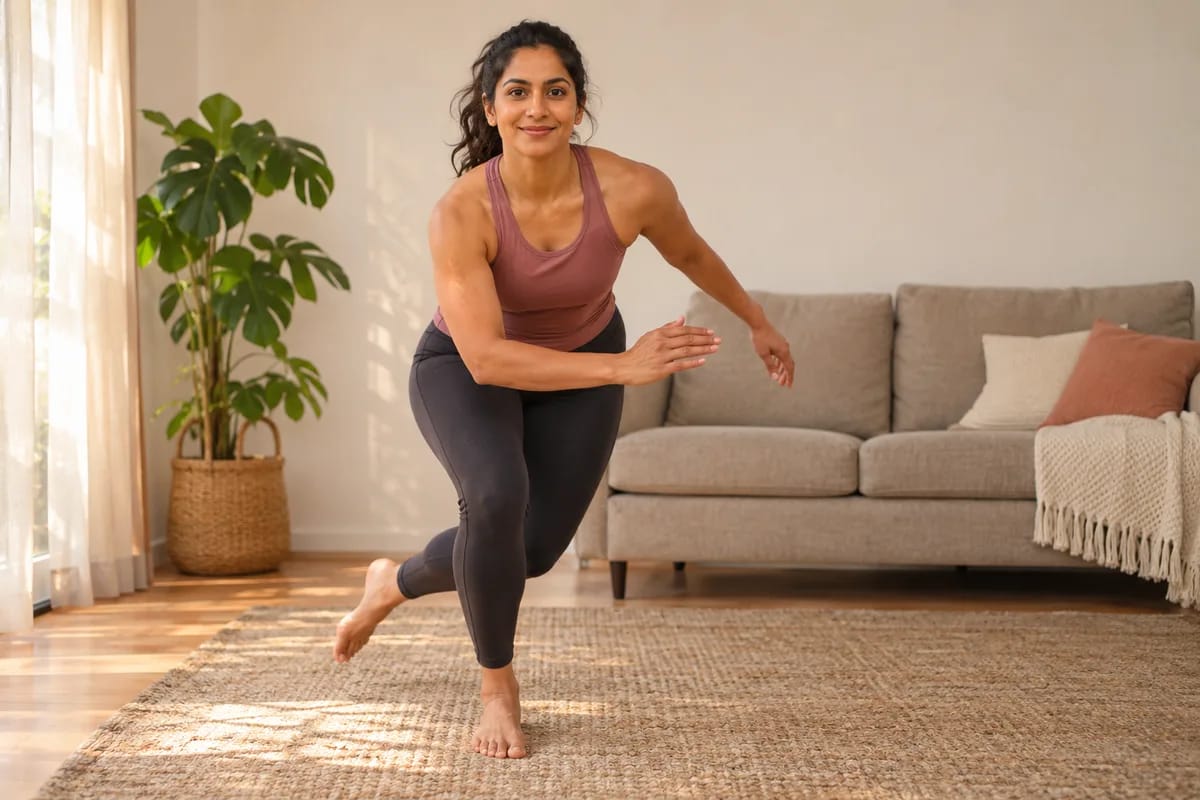
| Skater hop. Edge to edge, landing on one leg. | Hop sideways onto one foot, land soft and quiet, hold still for a second | Landing stiff-legged, or the knee caving in |
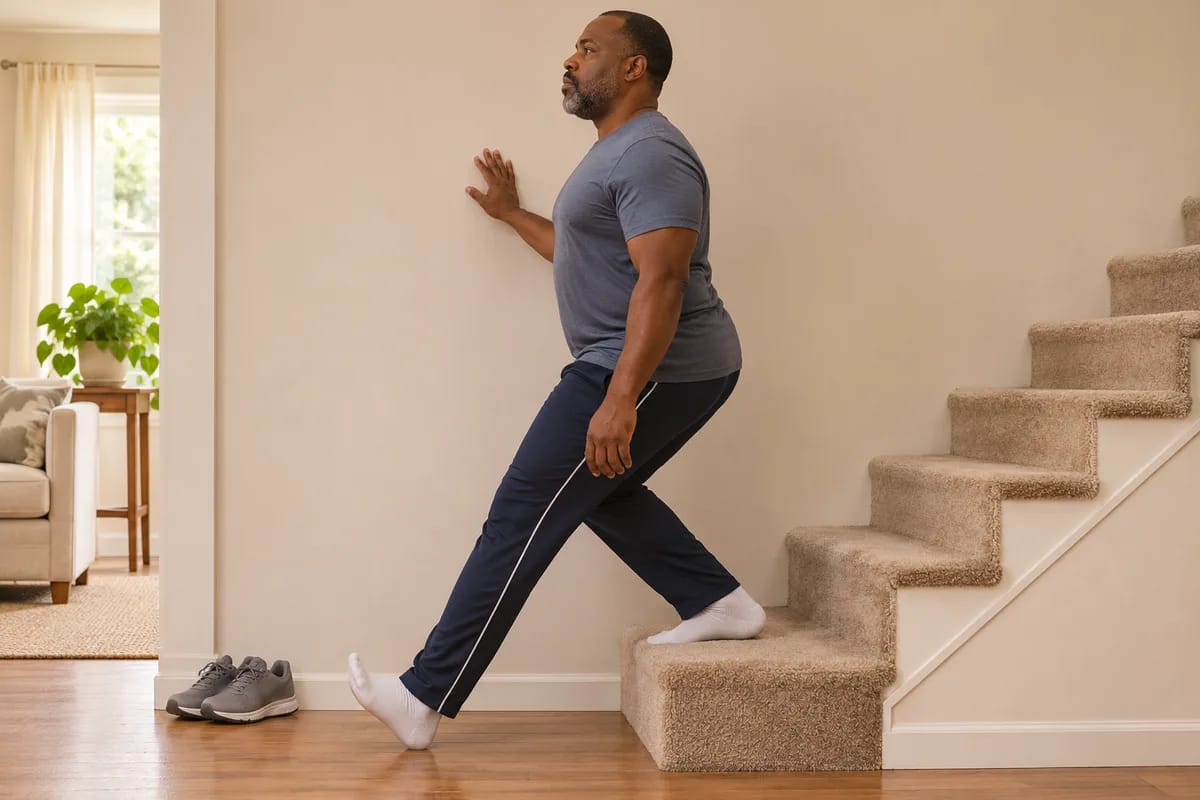
Starting from very little? If standing up from a chair without your hands is work right now, start there: squat to a chair seat, hold a counter for the lunges, use the lowest step. The plan works the same with a shorter way down.
The knee fault shows up in three of the six. To check, prop your phone at knee height in front of you and film a set.
If the knee caves, go lighter, go slower or take a smaller hop until it stays in line. If you'd rather not jump at all, swap the skater hop for a lateral step-and-stick: a big step sideways onto one foot, sink into the landing and hold it for two seconds. It trains the same balance with no flight time.
No separate core work? The one-leg moves and hops already make your trunk hold you steady. If you like planks, one or two at the end of a session won't hurt.
You'll see leg blasters everywhere: a ski-prep circuit of squats, lunges and jumps done without rest. Several full rounds the first time is how people end up walking down stairs backwards for three days. Our mini version comes in at week 5.
Eight weeks, two sessions a week
Each session, in this order:
- Warm up for a few minutes: easy marching, stairs or a bike.
- Skater hops (or step-and-stick) first, while your legs are fresh. Tired thighs are when knees cave on landing.
- The other five moves in the order of the moves table, with about a minute's rest between sets.
End every set with two or three reps still in the tank; this is practice, not a test. Sessions take about 30 minutes in weeks 1 and 2 and about 40 from week 3.
Sets × reps by plan week. One-leg moves are per leg or per side.
| Move | Wk 1-2 | Wk 3-4 | Wk 5-6 | Wk 7 | Wk 8 |
|---|---|---|---|---|---|
| Step-and-stick | 2 × 6 | 3 × 6 | – | – | 2 × 6 |
| Skater hop | – | – | 3 × 6 | 3 × 6 | – |
| Slow squat | 2 × 10 | 3 × 10 | 3 × 10 | 3 × 10 | 2 × 10 |
| Reverse lunge | 2 × 8 | 3 × 10 | 3 × 10 | 3 × 10 | 2 × 10 |
| Step-down | 2 × 6 | 3 × 8 | 3 × 8 | 3 × 8 | 2 × 8 |
| Single-leg RDL | 2 × 8 | 3 × 10 | 3 × 10 | 3 × 10 | 2 × 10 |
| Wall sit | 2 × 30 s | 3 × 45-60 s | 3 × 60-90 s | 3 × 90-120 s | 2 × 45-60 s |
| Mini blaster | – | – | 1 session | Both sessions | – |
Weeks 1 and 2 are bodyweight only. From week 3, hold a dumbbell for squats and lunges if bodyweight feels easy. Week 7 is the hardest. Week 8 is easy on purpose, with the last session three or four days before you ski: seven weeks of strength don't vanish in one, and rested legs matter more on the mountain than one last hard session. What a deload week is explains why.
The mini blaster (our version, deliberately modest): 10 slow squats, 5 reverse lunges a leg, then 5 step-and-sticks a side, straight through. No hops here, because your legs are already tired. Rest until your breathing settles, about two minutes, and do it once more. Two rounds is the whole thing.
Add easy cardio on two other days, 30 to 45 minutes at a pace where you can still talk: a brisk walk on hills or a treadmill incline, stairs, or a bike. A week might be strength on Tuesday and Saturday and a hill walk on Thursday and Sunday. A ski day is hours of on-and-off effort, and this keeps your afternoon runs from feeling like your last. Cycling builds that engine but barely trains the braking, so it doesn't replace the strength days. What zone 2 training is has more on that talking pace.
The week you go
Training gets your legs ready. How you pace the first two days decides how the rest of the week feels.
Altitude is a separate problem, and fitness doesn't touch it. About one in four visitors who sleep above 8,000 ft (2,450 m) in Colorado get acute mountain sickness, which feels like a hangover, and the CDC says training and fitness don't change your risk. Keep the first 48 hours easy and alcohol-free, which on skis means a short first day.4 If you have coronary artery disease, chronic lung disease, sleep apnea or sickle cell trait, the CDC says to see a doctor who knows altitude medicine before you go.
The week you travel
- Flying to a high resort? Sleep a night lower on the way up if the trip allows it
- Plan a half day, or a long lunch, for day one
- First time on skis? Book a lesson for the first morning
- Get rental boots fitted the day before, so the first morning starts on snow, not in a queue
- Warm up before the first run: a few minutes of walking, then a few slow squats in your boots
- When your thighs burn mid-run, stand a little taller between turns and stop for a breather
- Expect to be sorest on day two or three, and make that a gentler morning
- Call it a day before your last run gets sloppy
Training through a longer trip? A vacation workout with two dumbbells fits a hotel room.
What training can't promise
Many ski workout lists promise their moves prevent knee injuries. We'd like that to be true, but the review we relied on can't back it. The knee is the most commonly injured part of a skier, up to 41% of injuries, and the one measure that review calls proven against serious knee injuries is teaching ski staff how those injuries happen. It doesn't test any workout as a way to prevent them, for or against.5
So train for the reasons that hold up: longer ski days, less aching, and getting down the stairs to dinner. For safety, the two steps worth taking aren't workouts:
- Have a shop check and set your bindings. In a trial, binding checks cut lower-leg equipment injuries. Bindings weren't designed to protect the knee, so this is about your shins and ankles.5
- Learn how knee injuries happen on skis. Vermont Ski Safety, the group that has promoted that awareness training since 1971,5 publishes free tips: keep your arms forward and your hips above your knees, and if you fall, keep your knees bent and stay down until you've stopped sliding.6 It doesn't claim they prevent injury, and neither do we.
Ski prep with a coach on the call
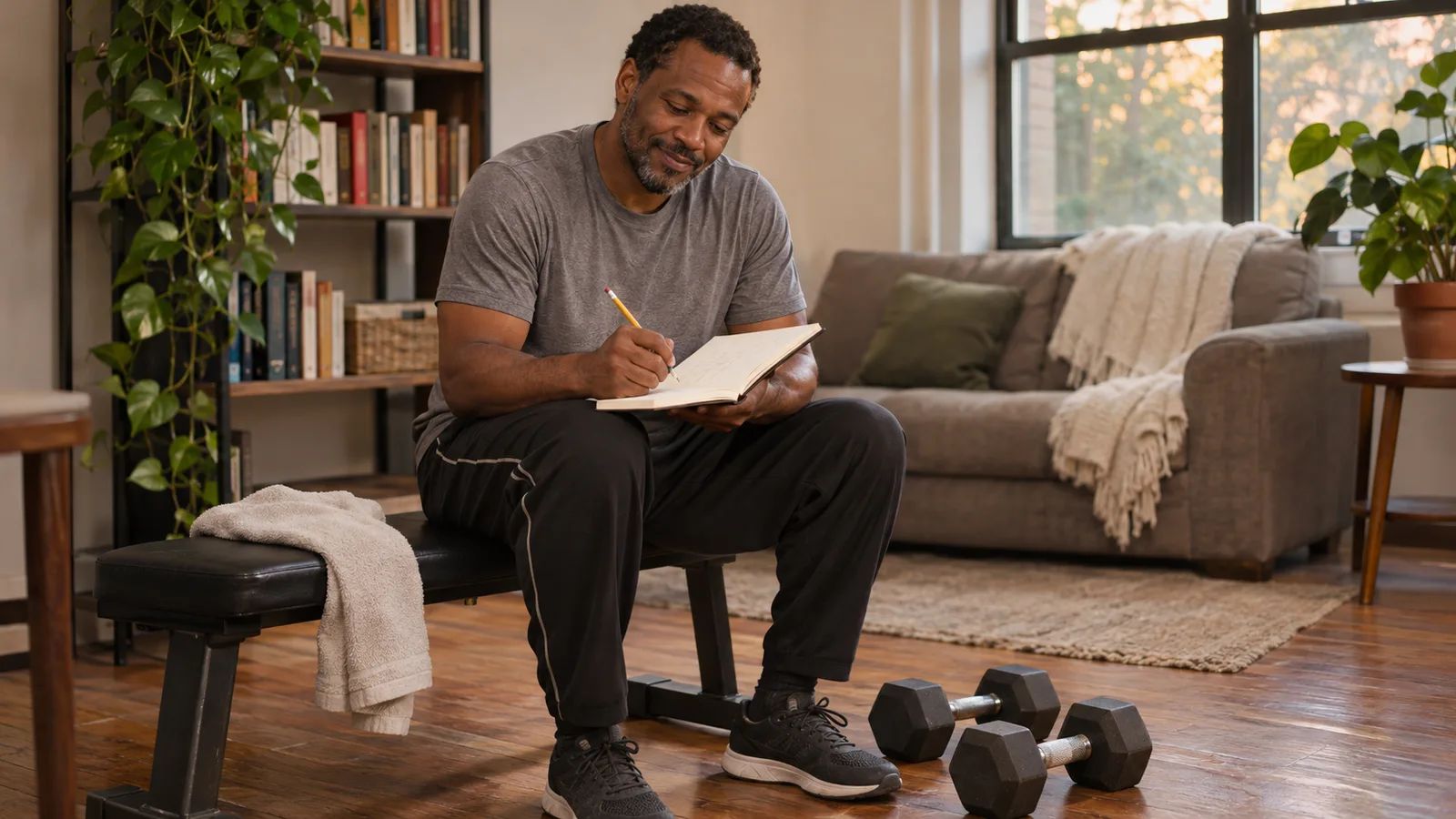
Everything above works on your own with a notebook. It tends to come apart in the middle: week 4 lands in a busy week, you're not sure you're ready for hops, and nobody would know if Saturday didn't happen.
Every session is a live 1‑on‑1 video call with your own coach at a set time, in our app on iPhone, Android or a browser. It sits in your calendar with reminders, and skipping means telling a person who is expecting you. You start with a 30-minute strategy call with a head coach, who matches you to a coach; tell them your trip date. Your coach writes the plan into your training calendar, so today's session is waiting when you open the app.
Week 5, Tuesday evening. Your phone is propped at knee height, and the first set of skater hops starts. On the third landing your right knee drifts in and you land stiff. Your coach says so before the next hop, and after one more wobbly set swaps you back to step-and-stick for the week and adds a set of step-downs. Hops come back next week, once the landings are quiet. Whether you're ready is the hardest call to make about yourself.
In week 7, your coach sees your heart rate live from an Apple Watch or a Bluetooth heart rate strap, and starts your second blaster round when it has come back down, not when two minutes are up. Each coach has 12 members at most, and we hold to that when we assign coaches, so yours remembers which knee wobbled in week 5. Mark your ski week as away dates in the app, and your coach plans around it.
The price, and when to save it for lift tickets
14 days free, then $299 a month, cancel anytime. You add a card to start, the 14 days begin at your first session, not at signup, and we send a reminder three days before the first charge. For a skier, the free stretch covers weeks 1 and 2 of the plan, when your coach teaches the six moves and watches your knees. If your trip is two or three weeks out, book the strategy call the day you sign up; counted from your first session, the free 14 days can cover most of what's left.
The price covers unlimited sessions of 45 to 90 minutes, and most people settle at around an hour. Two calls a week works out at about $35 a session, and a third costs nothing extra. An eight-week run-up with a week-long trip at the end is the free 14 days plus two monthly payments: $598. If you stay on, your coach keeps writing the weeks after the trip, so spring doesn't start from zero.
Save your money and use the plan above if:
- You already lift twice a week. Swap in the step-downs, skater hops and wall sits for a few weeks.
- You ski most weekends all season. By January, skiing is your best training.
- You want someone in the room, a gym floor or a class. We're on video, and nobody is there to spot you.
- $299 a month is a stretch next to lift tickets. If it's a choice between us and an extra day on the mountain, take the day.
Sources
-
Berg, H.E., Eiken, O. & Tesch, P.A., 1995. Involvement of eccentric muscle actions in giant slalom racing. Medicine and Science in Sports and Exercise. Top-level male racers. Outside leg: lowering phase 1.0 ± 0.2 s against push-off 0.5 ± 0.1 s, with muscle activity while lowering similar to a maximal knee extension in the lab: "dominated by slow eccentric muscle actions performed at near maximum voluntary force". Recreational skiers were not measured. ↩
-
Hintermeister, R.A., O'Connor, D.D., Lange, G.W., Dillman, C.J. & Steadman, J.R., 1997. Muscle activity in wedge, parallel, and giant slalom skiing. Medicine and Science in Sports and Exercise. Six skiers, 12 muscles. Average activity was above 50% of maximal voluntary contraction for the vastus medialis, vastus lateralis, biceps femoris, gluteus maximus and adductors in wedge (snowplow), parallel and giant slalom turns. ↩
-
Cheung, K., Hume, P. & Maxwell, L., 2003. Delayed onset muscle soreness: treatment strategies and performance factors. Sports Medicine. DOMS "is most prevalent at the beginning of the sporting season", and eccentric (lowering) activities "induce micro-injury at a greater frequency and severity"; and they "should be introduced progressively over a period of 1 or 2 weeks at the beginning of, or during, the sporting season in order to reduce the level of physical impairment and/or training disruption". Whether that eases soreness on a ski trip in particular was not studied; that part is our reasoning. ↩
-
Centers for Disease Control and Prevention, High-altitude travel and altitude illness, CDC Yellow Book, read November 12, 2026: acute mountain sickness affects "25% of all visitors sleeping at altitudes >2,450 m (>8,000 ft) in Colorado", with symptoms like "an alcohol hangover"; "Training and physical fitness do not affect risk"; "Participate in only mild exercise for the first 48 hours at altitude"; "Avoid alcohol for the first 48 hours"; avoid going from low altitude to a sleeping altitude above 2,750 m (9,000 ft) in one day (the reason to sleep a night lower on the way up); people with coronary artery disease, chronic lung disease, obstructive sleep apnea or sickle cell trait "should consult a physician familiar with high-altitude medical issues". ↩
-
Davey, A., Endres, N.K., Johnson, R.J. & Shealy, J.E., 2019. Alpine skiing injuries. Sports Health. The knee is "the most common site of injury, with reports ranging from 27% to 41% of all injuries"; "awareness training is the only proven intervention to reduce the incidence of severe knee injuries", shown in ski instructors and patrollers at 20 ski areas, and "a similar study has not been performed in the general population"; Vermont Ski Safety Equipment has promoted injury awareness training "since 1971"; a randomized trial of binding checks and adjustment found fewer lower-leg equipment-related injuries, but bindings "were not designed to protect the knee from sprains". ↩ ↩2 ↩3
-
Vermont Ski Safety, ski injury awareness tips, read November 12, 2026: "Keep hips above knees"; "Keep arms forward"; "Don't fully straighten your legs when you fall. Keep your knees flexed"; "Don't try to get up until you've stopped sliding". The page makes no claim that the tips prevent injury. ↩