How to create a workout plan: 6 steps a coach follows
Pick the days you can count on, fill four slots, set the dose and write the rule for adding weight. Two worked examples and a blank plan to copy.
In this article8
The whole method
Pick the days you can manage in a bad week. Give each session a squat, a hinge, a push and a pull. Do 2 or 3 sets of 8 to 12, stopping with 2 or 3 reps left. Write down when you'll add weight.
That's the whole thing, and it works whether you're 25 or 75, at home or in a gym. The six steps below turn it into your plan on paper in about 15 minutes, and then you'll see the same steps produce two very different plans for two very different people.
If you have a heart or other medical condition, are pregnant, or are recovering from surgery or an injury, the PAR-Q+, a short questionnaire, tells you whether to see a doctor or a qualified exercise professional first.
The six decisions
Grab paper or a notes app. Each step ends with something to write down.
Count the days you can manage in a bad week
Not a good week. The one with the late meeting, the sick kid and the trip. For most people starting out that's two or three, and two is a real plan: it meets the US guideline of strength work on at least 2 days a week.1 Pick the actual days and times and put them in your calendar. Write: your days, your times.
Let that number pick the shape of each session
Two or three days: full body, the same session each time, with at least a day between them. Four days: alternate an upper-body day and a lower-body day, so each session stays shorter. Five or more is for people who've lifted steadily for six months; the workout split guide covers every option. Write: full body, or upper/lower.
Fill four slots, plus one if you like
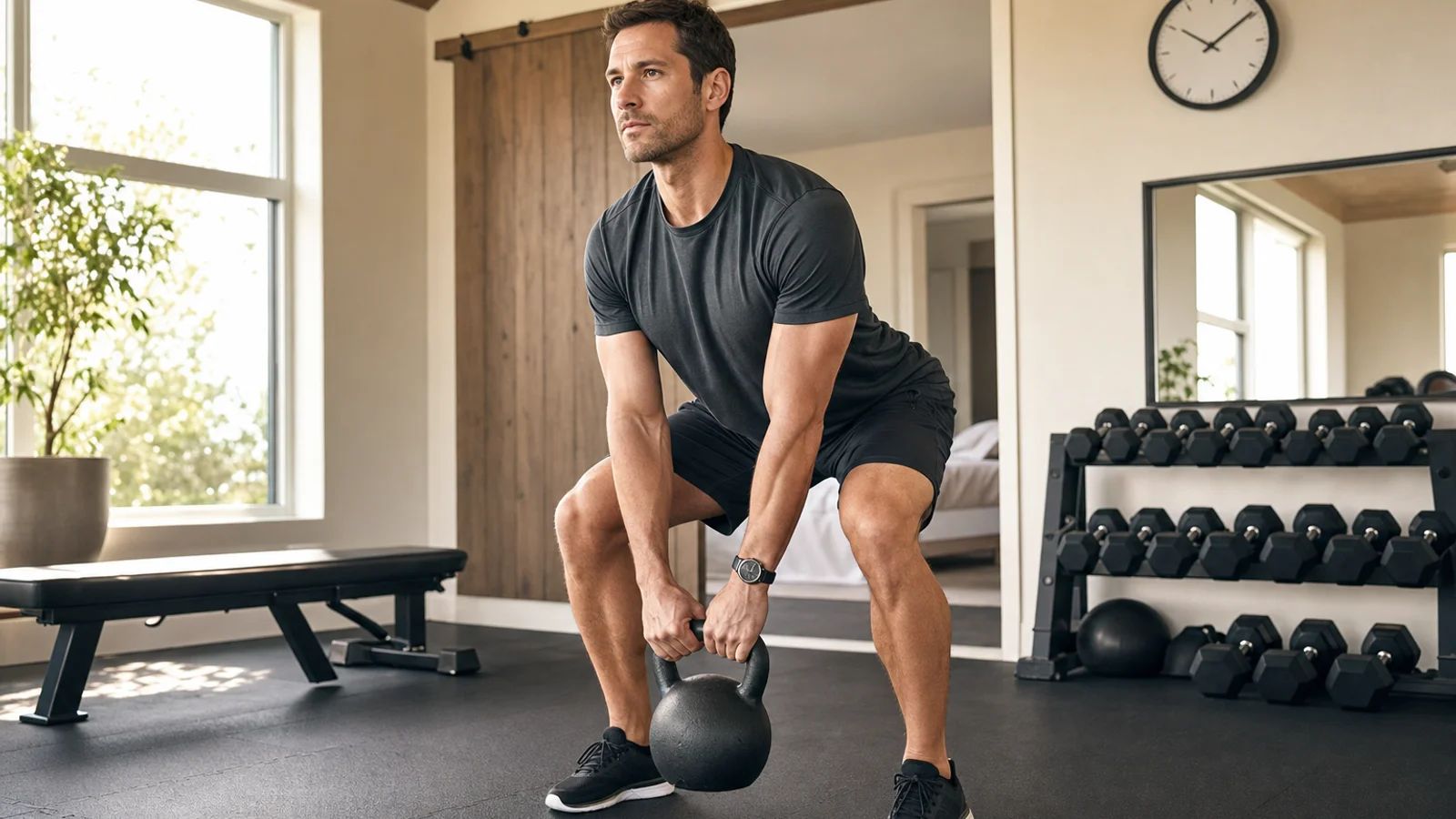
A squat (sit down and stand up), a hinge (bend at the hips, as if lifting a box off the floor), a push (press something away from you) and a pull (draw something toward you). Between them they cover your legs, hips, back, chest, shoulders and arms. Add one extra if you have time: a carry, a trunk exercise or a one-leg move. Pick the version from the menu below that you can do today, and put the squat or hinge first while you're fresh.2 Write: one move per slot, in order.
Set the dose
Warm up with five minutes of walking or marching on the spot, then a light first set of your first move. After that, 2 sets of each move for your first two weeks, then 3. A weight you can lift 8 to 12 times. End every set with two or three reps still in you, which is hard without grinding to failure.3 Rest a minute or two between sets, longer if you need it. Four moves at 2 sets, plus the warm-up, takes about 30 minutes. To find your starting weights, the three-set test takes a few minutes per move. Write: sets × reps, and today's weight for each move.
Write the rule for next time on the plan itself
This is the step most plans skip, and it's the one that makes you stronger. A common rule: when you reach 12 reps on every set, use the smallest weight step you have next session and drop back to 8. For what to do when the next dumbbell is a big jump, see how to track workouts for progressive overload. Write: the rule, word for word.
Write the short version and the missed-day rule
The short version is your first two moves, 2 sets each. It takes about 15 or 20 minutes, and it's what you do on a day when the full session won't happen, instead of nothing. The missed-day rule: run the plan as a list, not a calendar. Missed Tuesday? Do Tuesday's session on your next free day and carry on in order. Write: both.
The slot menu
In the first four rows, each box runs from easiest to harder. Start with the first move you can do 8 good reps of.
| Slot | At home | In a gym |
|---|---|---|
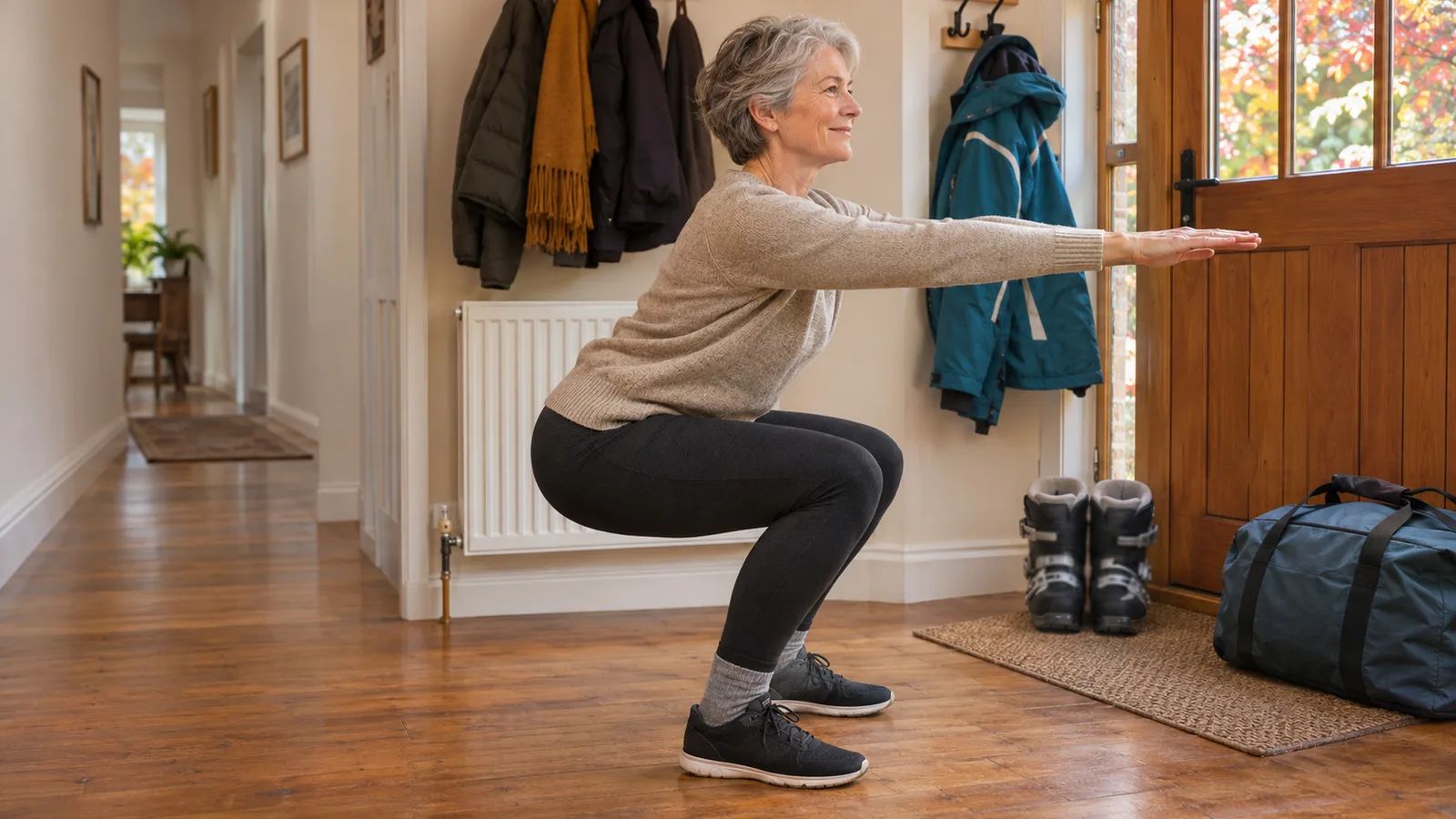
| Squat | Sit-to-stand from a chair, then a goblet squat holding one dumbbell at your chest | Leg press, goblet squat, barbell squat |
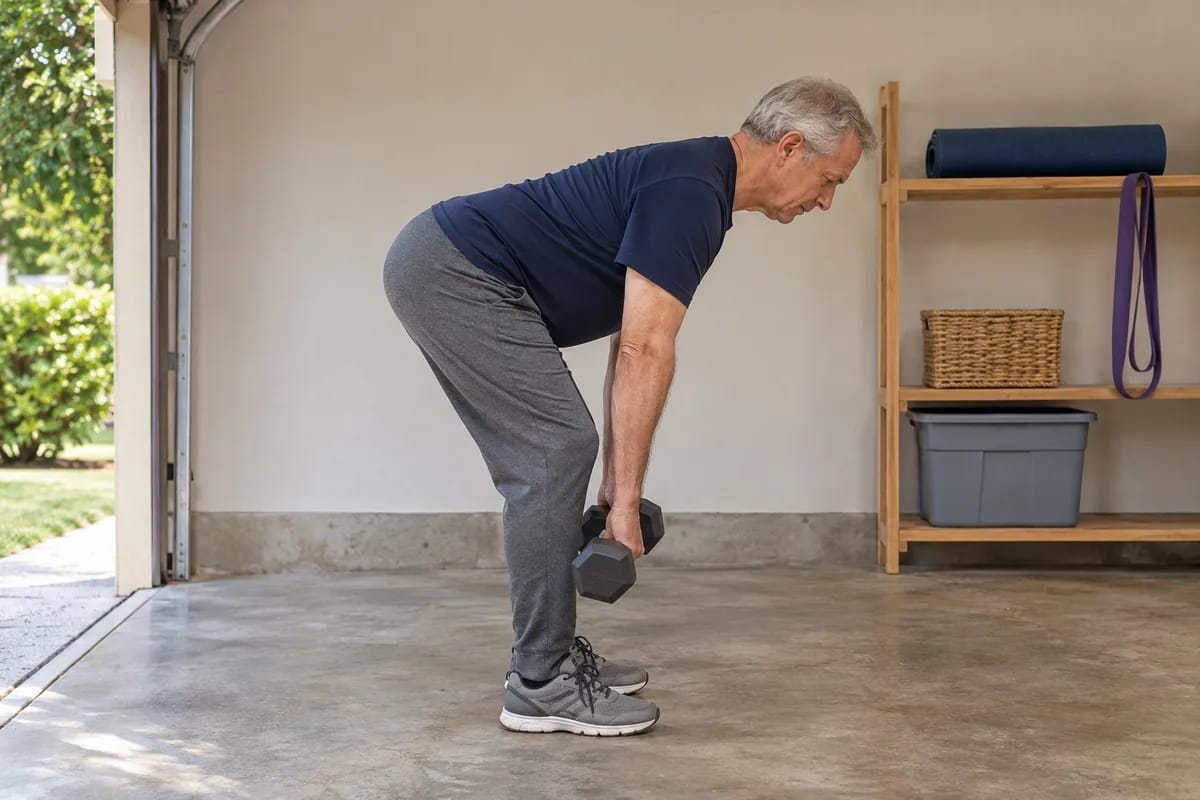
| Hinge | Glute bridge on the floor, then a dumbbell Romanian deadlift | Hip thrust, dumbbell Romanian deadlift, barbell Romanian deadlift |
| Push | Push-up against a wall, then a countertop, then the floor | Chest press machine, dumbbell bench press, barbell bench press |
| Pull | Band row with the band around a sturdy post, then a one-arm dumbbell row | Cable row or lat pulldown, then assisted pull-up |
| Extra | Suitcase carry (one dumbbell, walk the hallway), side plank, split squat | Farmer carry, plank, split squat |
The gym column isn't the better column. The American College of Sports Medicine's latest review of the research found no consistent strength difference between machines and free weights.3 What matters is that the set is hard and gets harder over time.
Cardio sits around all of this rather than inside it. The US guidelines suggest at least 150 minutes of moderate activity a week,1 and brisk walking counts. Walks can go on any day, lifting days included.
What about your goal? The strength base stays the same for almost any goal. The goal changes what goes around it. To lose weight or help your heart, add walking and look at what you eat, which this plan doesn't cover. Training for a race, your running plan sits alongside, and cardio and lifting together covers which to do first. Want bigger muscles: once you've settled in, add sets and sessions, working toward about 10 sets per muscle a week.
Two people, the same six steps
These are made-up examples, built to show how far apart two plans can land.
Example 1: 58, never lifted, two mornings at home
Answers to the six steps: two days she can count on, Tuesday and Saturday mornings at 8. Full body. She has a pair of 10 lb (4.5 kg) dumbbells, a resistance band and a dining chair.
| Slot | Move | Sets × reps | Starting weight |
|---|---|---|---|
| Squat | Sit-to-stand from the chair | 2 × 8 to 12 | Body weight |
| Hinge | Dumbbell Romanian deadlift | 2 × 8 to 12 | 10 lb (4.5 kg) in each hand |
| Push | Countertop push-up | 2 × 8 to 12 | Body weight |
| Pull | Band row, band around a stair post | 2 × 8 to 12 | Light band |
| Extra | Suitcase carry down the hallway | 2 rounds each side | One 10 lb (4.5 kg) dumbbell |
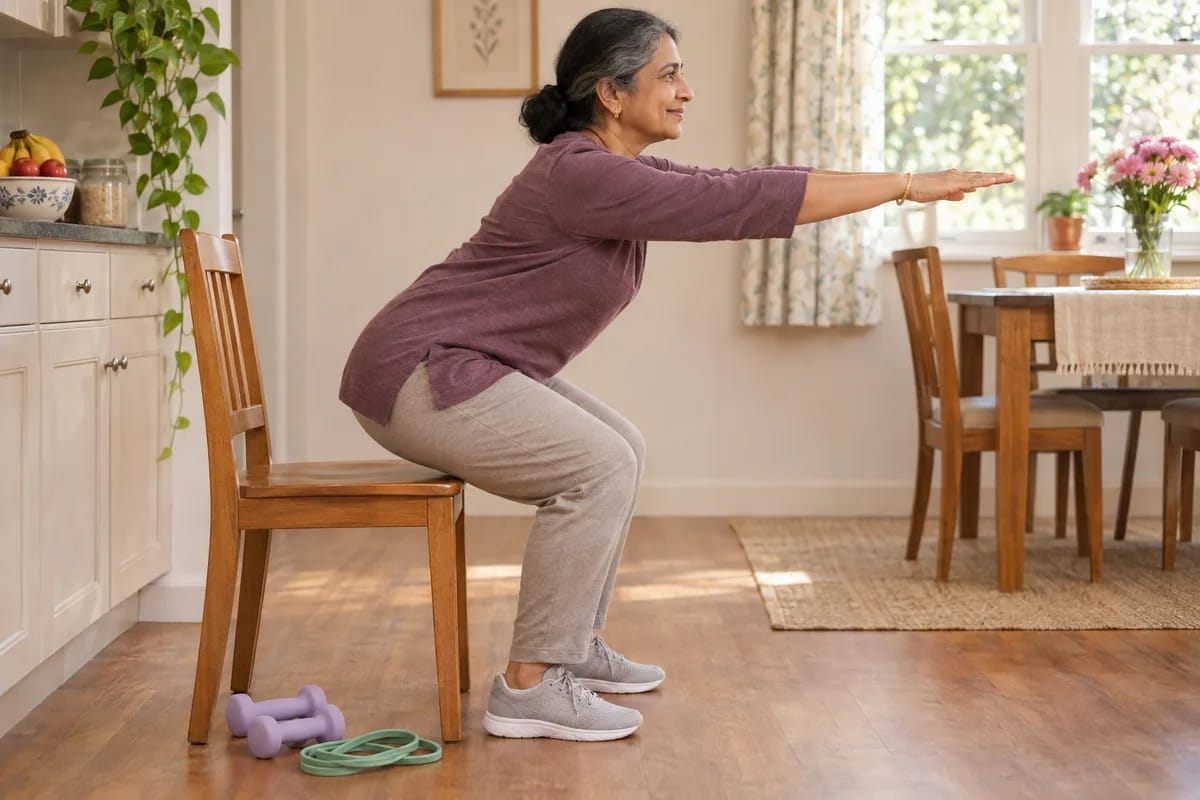
- Rule for next time: at 12 on every set, make the move harder. Sit-to-stand: hold a dumbbell at your chest. Push-up: a lower surface, like the arm of a sofa. Band row: step back or use a firmer band. With only one pair of dumbbells, the deadlift climbs to 15 reps, then she lowers for a slow three seconds, then buys the next pair. Progressive overload at home has more ways to stretch one pair.
- Short version: sit-to-stand and Romanian deadlift, 2 sets each. About 15 minutes.
- Cardio: a 30-minute walk on five days, Tuesday and Saturday included.
Whole session: 30 to 35 minutes with the warm-up. If she wants a complete four-week version of this kind of plan, with every move described, the beginner workout plan is written for exactly her.
Example 2: 41, lifted in his 20s, a gym at work
Answers: four lunch breaks he can count on even in a bad week, 45 minutes each, Monday, Tuesday, Thursday and Friday. Four days means upper/lower. He finds his starting weights with the three-set test on day one, does 2 sets of each move for two weeks as step 4 says, and moves to the 3 below in week three.
| Day | Moves, in order | Sets × reps |
|---|---|---|
| Upper (Mon, Thu) | Dumbbell bench press, cable row, seated dumbbell overhead press, lat pulldown | 3 × 8 to 12 each |
| Lower (Tue, Fri) | Leg press, Romanian deadlift, split squat, farmer carry | 3 × 8 to 12; carry 3 rounds |
- Rule for next time: at 12 on every set, the next pair of dumbbells or the next plate on the machine, then back to 8. On the leg press and deadlift, add 10 lb (4.5 kg).
- Short version: the first two moves of the day, 3 sets each. About 20 minutes.
- Missed day: a lost Tuesday becomes Wednesday's lower day, and Thursday and Friday stay as they are.
Same six steps, two plans with almost nothing in common, and both are right for the person holding them.
Your blank plan
Screenshot this, or copy it onto paper. Fill the empty boxes using steps 3 and 4.
| Slot | Your move | Sets × reps | Today's weight |
|---|---|---|---|
| 1. Squat or hinge | 2 × 8 to 12 | ||
| 2. The other one | 2 × 8 to 12 | ||
| 3. Push | 2 × 8 to 12 | ||
| 4. Pull | 2 × 8 to 12 | ||
| 5. Extra (optional) | 2 rounds |
At the top of the page, four lines: your days and times, your shape (full body or upper/lower), your rule for next time, and your short version. Then leave room to log each session: date, weight and reps for each set. The log is what tells you when the rule kicks in.
Your first four weeks are a test
Week one should feel a little too easy. That's fine. You're learning where your feet go, and the weights will catch up fast. Muscles that ache for a day or two afterward are normal the first few times.
At the end of week four, look at two things in your log. Did you make your sessions, or at least the short version? And did the reps or weights go up somewhere? Two yeses means the plan works. Leave it alone.
Change something only for a real reason: the sessions keep running past your time slot, you keep missing the same day (move that day), or a move hurts in a way that isn't muscle effort (swap it for another in the same slot, and ask a clinician if it keeps hurting). Bored is a fine reason to swap one move for another in its slot, never to start over. If the numbers stall later on, why am I not getting stronger goes through the usual causes.
Where homemade plans usually go wrong
| The mistake | Why it happens | The fix |
|---|---|---|
| Weights that are too light | Left to choose, beginners pick loads well under what builds strength4 | Trust the three-set test. If you hit 12 with plenty left, go up next time |
| Copying a fitness influencer's split | It looks serious | Their plan fits their week and their years of lifting. Borrow exercise ideas, not the schedule |
| A hard run the day before leg day | Nobody planned the whole week | Keep hard cardio off the day before your squat and hinge day. Easy walks are fine anywhere |
Can ChatGPT or an app write it for you?
Yes, as a first draft. Researchers asked ChatGPT (GPT-3.5 and GPT-4) to write 12-week programs for made-up 20-year-old lifters and compared them with standard guidelines. The authors' verdict: the programs likely needed fine-tuning before anyone used them, and ChatGPT works as a tool for a draft that still needs a human.5
You'll get a far better draft if you make the six decisions yourself and paste in your answers. Copy this and fill in the brackets:
Write me a strength plan. I can train on [days] at [times], [minutes] each including a warm-up. My equipment: [list it]. My experience: [never lifted, or lifted years ago]. Give each session four or five moves: a squat, a hip hinge, a push, a pull and one optional extra. Use 2 to 3 sets of 8 to 12, stopping with 2 or 3 reps left. Write a rule for when to make each move harder, and a 15-minute short version for bad days.
Then check what comes back against this page.
What most apps and chatbots can't do is see your set. They know what you type or tap, not that your 12th rep was easy or that your back rounded on the deadlift. Workout app vs personal trainer goes through which one you actually need.
The hard part, with someone on the call
The first three steps are easy to do alone. The rest asks for judgment mid-set (is this weight truly hard, were there really two reps left, is it time to go up), and then the plan has to survive a bad month.
A ten-week trial with people who already lifted shows both halves.6 Given their plan as a PDF, they made 52% of their sessions. Guided by an app, 81%. With a coach supervising in person, 88%. Everyone got stronger, but the supervised group's squat went up about 59 lb (27 kg), against about 42 lb (19 kg) for the app and PDF groups. The app got people to turn up almost as often as the coach did, but their squats grew no more than the PDF group's. Only the group with someone watching gained more. That coach was in the room and ours is on video, so the trial didn't test us, but it shows where a plan on paper loses.
At Bespoke Fit, every session is a live 1‑on‑1 video call with your own coach, in our app on iPhone, Android or a browser. Here's what happens to the hard parts:
- Your coach writes the plan. Each workout lands on your training calendar. You open today's session and log it set by set.
- Your coach calls the weight. They watch every set through your camera, judge how many reps you really had left, and change the weight or fix your hinge while you're mid-set. They also decide when you've earned the next weight, so the rule for next time isn't a guess.
- Someone's expecting you. Your coach books each session with you, including the one that replaces a missed Tuesday, and a person is waiting on the call. Going away? Mark the dates in the app and your coach is told.
- You see what changed. After every session a recap shows the weight you lifted, your sets and any records. A lighter day is never shown as a verdict.
Each coach has 12 members at most, and we hold to it when we assign coaches. App-first coaching that reviews logged workouts can spread one coach across hundreds of people. A coach live on video for every session can't, and with 12, your coach remembers last week.
You start with a 30-minute call with a head coach, who matches you to your coach, and every coach spends 90 days onboarding with our founder before taking a member. It's 14 days free, then $299/mo, and the 14 days start at your first session, not at signup. One flat price covers unlimited sessions of 45 to 90 minutes, and most people settle at around an hour. At three sessions a week, that's about $23 a session.
Skip it if you already keep a plan like this going on your own: carry on, it's working. If $299 a month would strain your budget, the blank plan above plus a friend who trains at the same time is a good free version. And we train you over video and don't coach nutrition, so if you want a spotter in the room or meal plans, look elsewhere.
Common questions
What is the 3-2-1 rule for working out? A weekly pattern that spread online. Centr describes it as three strength sessions, two Pilates sessions and one cardio session, plus a rest day. It isn't from research, and six sessions is a lot to start with. Keep the strength days and build from there.
What is the 3-3-3 rule for working out? You'll usually see it as three strength days, three cardio days and three days of rest or light recovery. That's nine days, so in a seven-day week some have to double up, like an easy walk on a lifting day. The strength days are the part that matters, and the steps above give you up to three.
How do I create a workout plan at home? Use the same six steps. Example 1 above is a home plan. A pair of dumbbells, a resistance band and a sturdy chair cover all four slots. If the band has nothing sturdy to loop around, a door anchor holds it in a closed door.
Sources
-
U.S. Department of Health and Human Services, Office of Disease Prevention and Health Promotion. Top 10 things to know about the second edition of the Physical Activity Guidelines for Americans. Adults need 150 to 300 minutes of moderate aerobic activity a week and muscle-strengthening activity at least 2 days each week. ↩ ↩2
-
American College of Sports Medicine, 2009. Progression models in resistance training for healthy adults. Medicine and Science in Sports and Exercise. For novices: loads of an 8 to 12 repetition maximum, 2 to 3 days a week, large-muscle and multi-joint exercises before small and single-joint ones, and a 2 to 10% load increase when the current load can be done for one or two reps over the target. ↩
-
Currier, B.S., D'Souza, A.C., Singh, M.A.F., and colleagues, 2026 (Phillips, S.M., senior author). American College of Sports Medicine position stand. Resistance training prescription for muscle function, hypertrophy, and physical performance in healthy adults: an overview of reviews. Medicine and Science in Sports and Exercise. Covers 137 systematic reviews and more than 30,000 participants. Suggests sets taken close to failure, with a target of 2 or 3 reps in reserve as one way to get there, while noting the evidence is too thin to set exact targets; found no consistent strength difference between machines and free weights, and that training to failure and periodization did not consistently change outcomes. ↩ ↩2
-
Glass, S.C. & Stanton, D.R., 2004. Self-selected resistance training intensity in novice weightlifters. Journal of Strength and Conditioning Research. 30 untrained college-age men and women chose loads of 42 to 57% of their one-rep max, all under 60%, which the authors judged too light to build muscle and strength. ↩
-
Washif, J.A., Pagaduan, J., James, C., Dergaa, I. & Beaven, C.M., 2024. Artificial intelligence in sport: exploring the potential of using ChatGPT in resistance training prescription. Biology of Sport. GPT-3.5 and GPT-4 programs for hypothetical 20-year-olds with intermediate experience "likely require additional fine-tuning before application"; ChatGPT "may serve as a complementary tool for writing 'draft' programme, but likely requires human expertise". ↩
-
Gavanda, S., Held, S., Schrey, S., Oberwetter, K., Lazzaro, P-G.M., Pergelt, M. & Geisler, S., 2025. Optimizing resistance training outcomes: comparing in-person supervision, online coaching, and self-guided approaches: a randomized controlled trial. Journal of Strength and Conditioning Research. 79 trained men and women, three full-body sessions a week for 10 weeks; adherence 88.2% supervised in person, 81.2% app-guided, 52.2% with a PDF. Squat one-rep max rose 26.6 kg supervised, 19.2 kg app-guided and 19.4 kg PDF; the supervised gain was significantly greater than both. ↩
More on