Workout plan for beginners: your first 4 weeks, home or gym
Two full-body workouts of about 30 minutes, for home or a gym: every move, the weights to start with, and exactly what to do in weeks 1 to 4.
In this article10
Start with two full-body workouts, A and B, and alternate them two or three days a week. Each one has five moves. Do two sets of 8 to 12 reps of each, and stop every set while you could still do two or three more good reps. That's about 30 minutes, and it works in a living room or a gym.
Below are both workouts, with a home version and a gym version of every move, the weights to start with, and what changes in each of your first four weeks. Week one is meant to be easy. You don't need to be fit to start this, and you don't need to buy anything for the first week.
If you have a heart, lung, kidney or metabolic condition, or a joint that hurts when you load it, read the short health note before you start.
Workout A
Do the moves in this order, with about 90 seconds of rest between sets. Not sure what weight to use? Starting points are further down.
| Move | At home | In a gym |
|---|---|---|
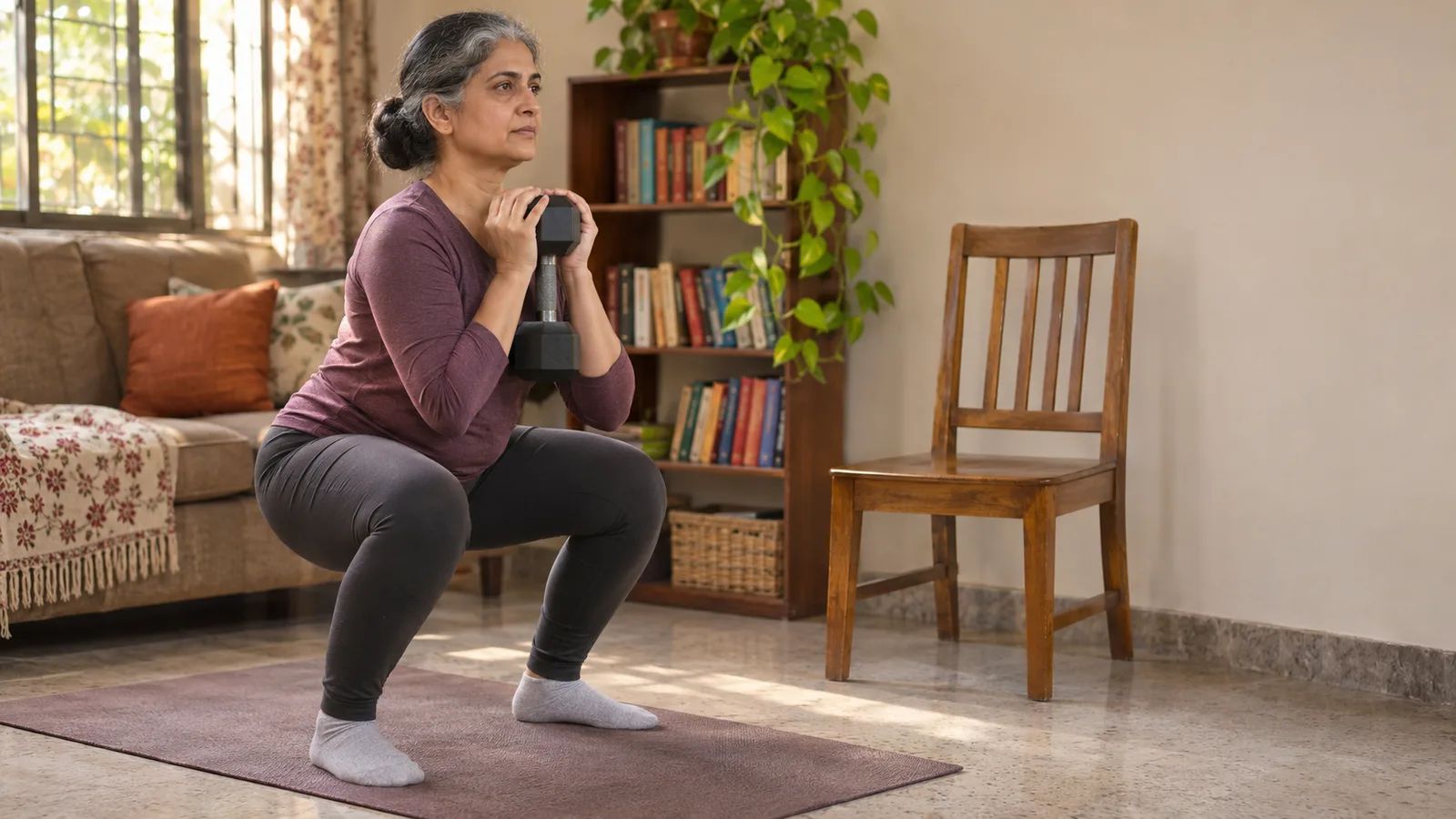
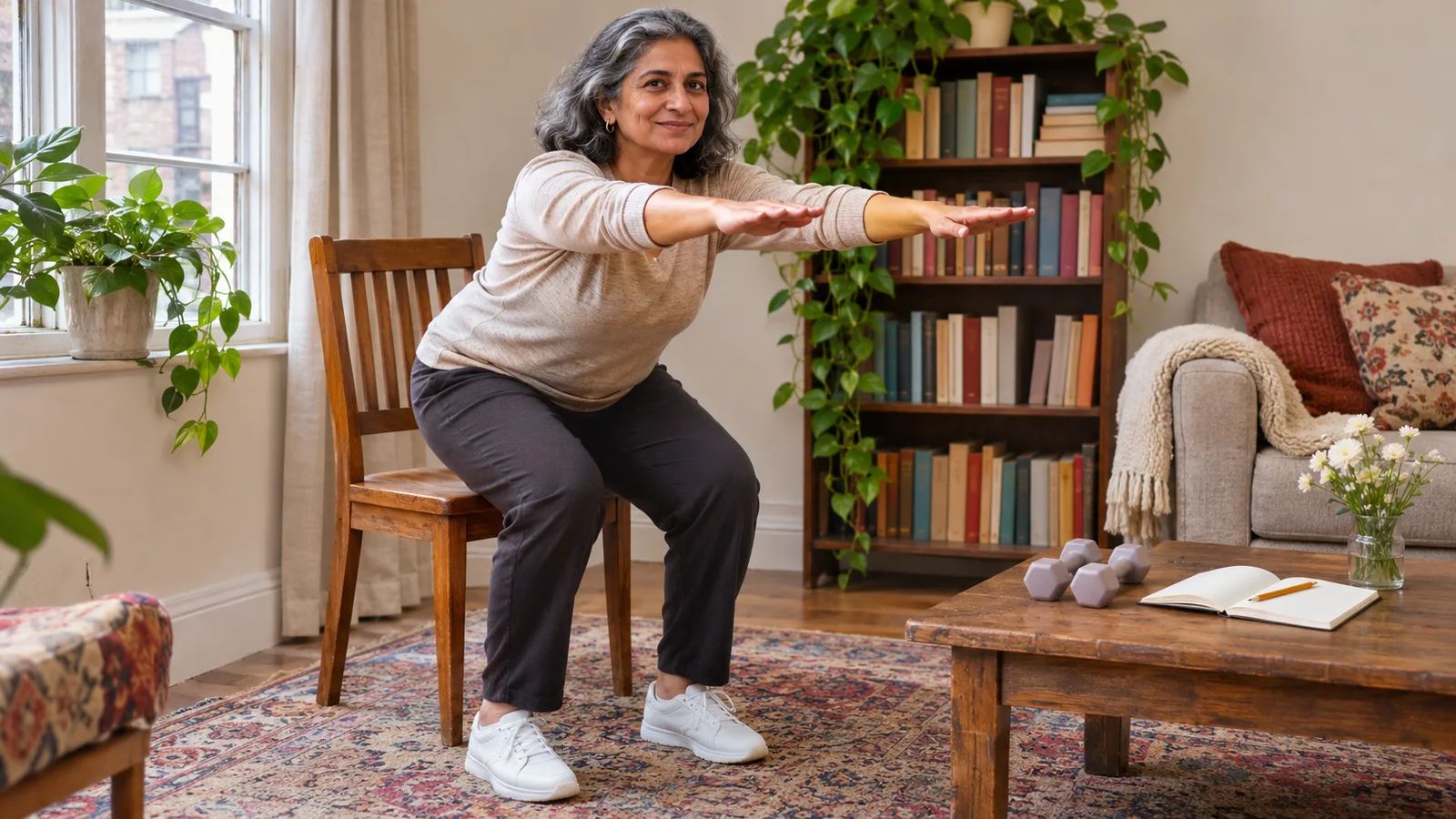
| 1. Squat | Sit down onto a chair and stand back up. Later, hold one dumbbell at your chest (a goblet squat) | Goblet squat, or the leg press machine |
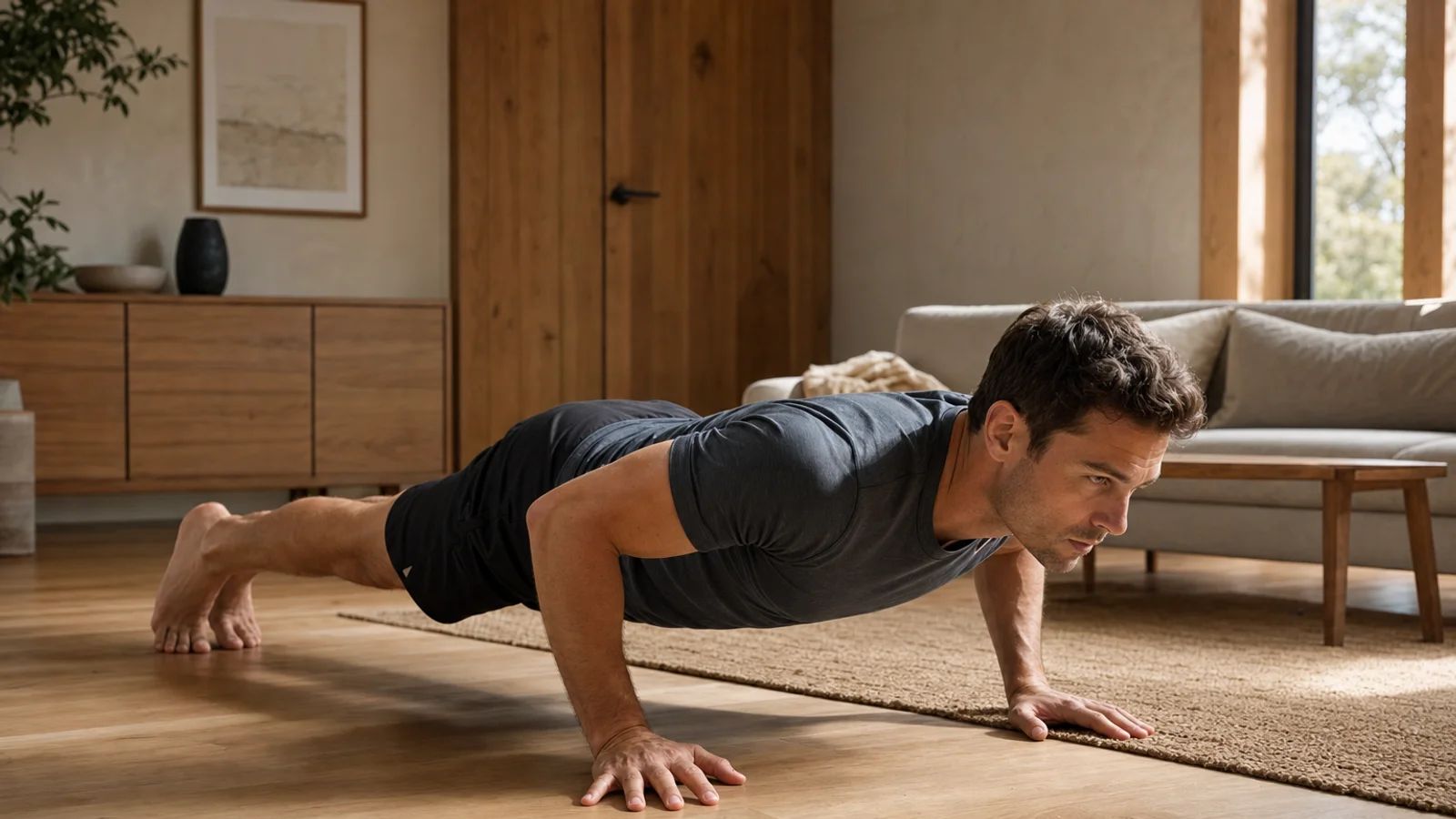
| 2. Push | Push-up with your hands on the kitchen counter | Chest press machine |
| 3. Pull | One-arm row, one hand on a chair seat, pulling a dumbbell or a loaded backpack | Seated cable row |
| 4. Hinge | Romanian deadlift, holding two dumbbells or the backpack | Romanian deadlift with two dumbbells |
| 5. Core | Dead bug, 6 to 10 slow reps each side | Dead bug, on a mat |
Workout B
Same sets, reps and rest as A. For moves done one side at a time, the reps are per side.
| Move | At home | In a gym |
|---|---|---|
| 1. Single leg | Step-up onto the bottom stair, a hand on the banister | Step-up onto a low box or step |
| 2. Overhead press | Seated, pressing two dumbbells or two full water bottles | Seated shoulder press machine, or dumbbells |
| 3. Pull | Two-arm bent-over row, holding the backpack by its top handle or two dumbbells. With a band: a pulldown from a door anchor | Lat pulldown machine |
| 4. Hips | Glute bridge on the floor. When 12 is easy, one leg at a time | Glute bridge with a dumbbell resting on your hips |
| 5. Carry | Suitcase carry: a heavy shopping bag or dumbbell in one hand, 30 to 40 steps, then switch hands | The same, with a dumbbell or kettlebell |
Machines, dumbbells or a backpack in the living room: the latest big review of the research found the type of equipment made no consistent difference to results.1 Use whichever column you've got.
The moves, in one line each
- Goblet squat. A squat holding one dumbbell upright against your chest, like a goblet. It counterbalances you, so sitting back feels less like falling.
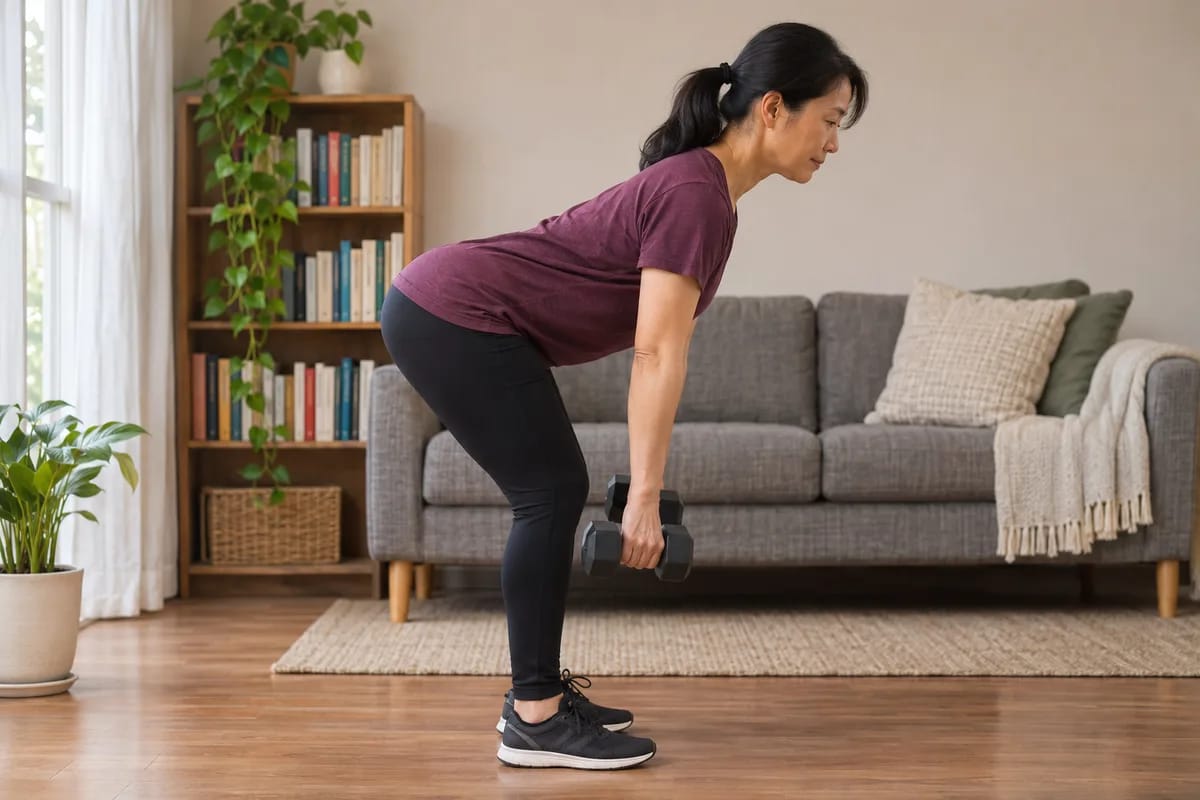
- Romanian deadlift. The bend you'd use to pick up a laundry basket with a flat back. Push your hips back, let the weights slide down the front of your thighs, and stop when you feel a stretch behind them, usually when the weights reach your knees. Then stand up.
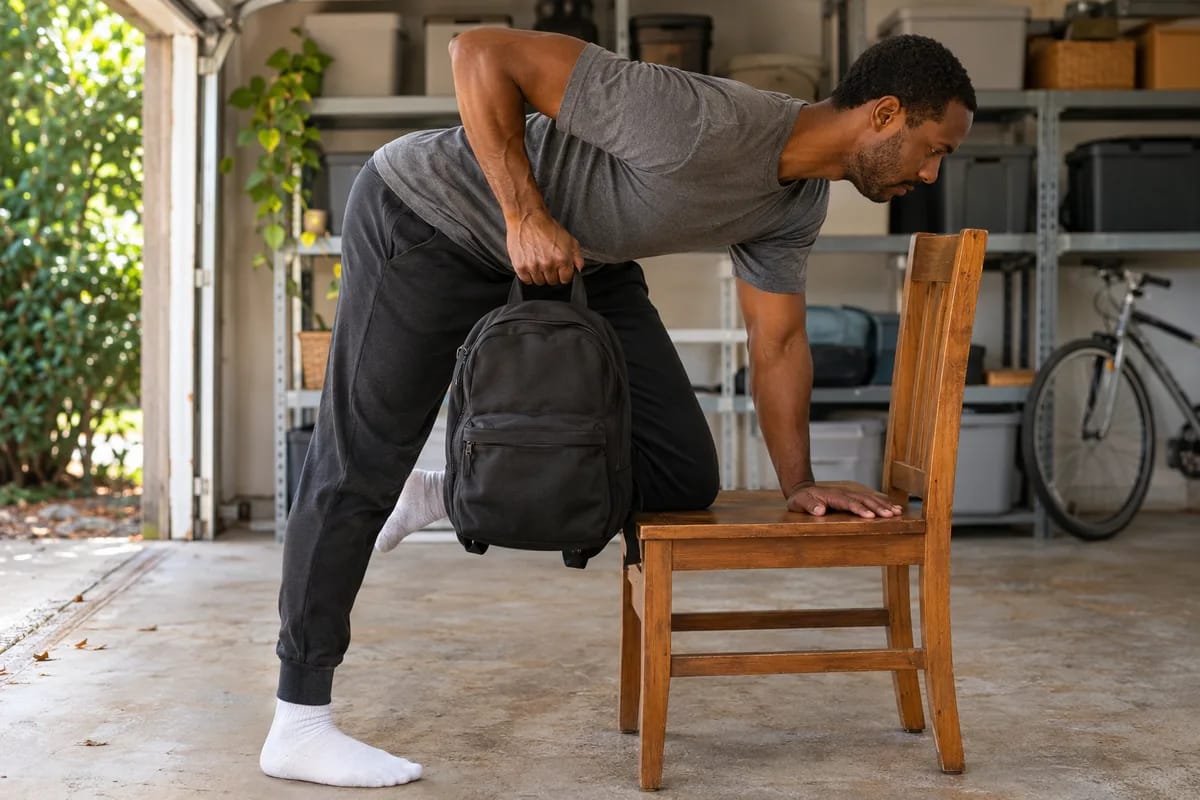
- One-arm row. One hand and one knee on a chair, the other hand pulls a weight from arm's length up to your hip, elbow brushing your side.
- Dead bug. Lie on your back, arms and knees pointing at the ceiling. Slowly lower one arm and the opposite leg toward the floor while your lower back stays pressed down. It feels like patting your head and rubbing your stomach at first.
- Glute bridge. Lie on your back, knees bent, feet flat, and lift your hips until your body makes a straight line from knees to shoulders.
- Suitcase carry. Walk tall with a weight in one hand, not leaning toward it. Your middle does the work of keeping you from tipping over.
- Band pulldown. A resistance band anchored at the top of a door, pulled down toward your chest while you kneel or sit facing it.
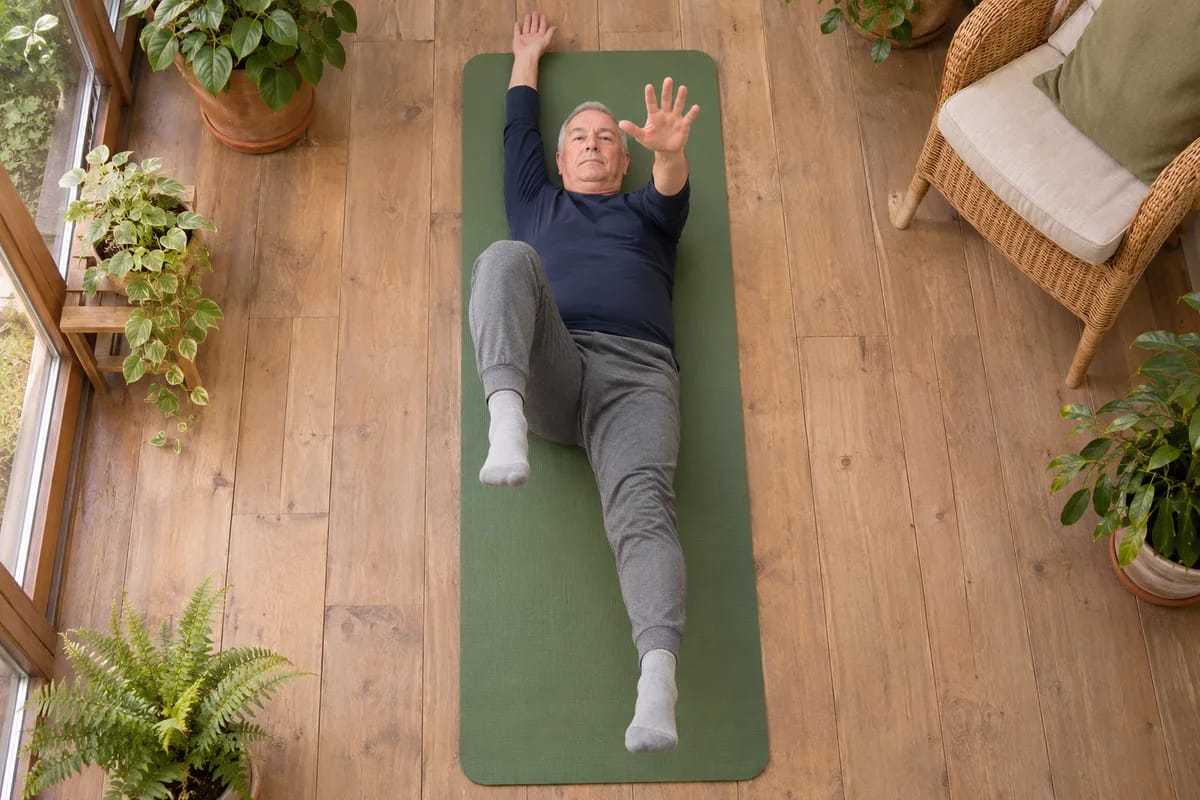
To check your form, prop your phone side on at hip height, film one set and compare it with the line above. On the deadlift, look at your back.
The one thing your body weight can't do: pull
Most no-equipment plans have the same hole. Squats, push-ups and bridges load themselves, but there's no good way to load a pull with nothing to hold. Your back matters as much as your chest, so don't let it get skipped. A backpack with a few heavy books does the job for rows. A band kit with a door anchor costs about $25 and gives you pulldowns as well. The first $300 of a home gym covers what to buy after that.
How hard, and when to go up
A good rep looks like your first one: same depth, same speed, no swinging or straining. Stop the set while two or three more of those are still in you. A Cleveland Clinic exercise specialist puts it as always having "two reps left in the tank".2 Going all the way to failure isn't needed; in the same review, it didn't consistently improve results.1 If "two or three left" feels like a wild guess, it is for everyone at first. Rating effort with reps in reserve shows how to get better at it.
Add reps before you add weight. When you get 12 on every set of a move, go up one weight and drop back to about 8, then build up again. That's close to the standard advice for beginners: add a little load once you can do a rep or two more than your target.3
At the light end of a dumbbell rack, "one weight up" can be a big jump: going from 5 lb to 8 lb (2 to 3.5 kg) is 60% heavier. The weights article has the fix for that. If you have no heavier weight to move to, make the same one harder: lower it over three seconds, pause at the bottom, or switch to the harder version of the move, like a lower surface for push-ups or one leg for bridges. Progressive overload at home has the full list.
Your week
Pick one column and keep the same days every week. Any days work, as long as there's a day off between strength sessions.
| Day | Two days a week | Three days a week |
|---|---|---|
| Mon | Workout A | Workout A |
| Tue | Walk, 30 min | Walk, 30 min |
| Wed | Walk, 30 min | Workout B |
| Thu | Workout B | Walk, 30 min |
| Fri | Walk, 30 min | Workout A |
| Sat | Walk, 30 min | Walk, 45 min |
| Sun | Walk, 30 min | Walk, 45 min |
On three days, start the next week with B, so it runs B, A, B. Two or three strength days a week is the standard advice for people new to lifting.3 Three gets you there a little faster. Two is plenty, and the one you'll still be doing in two months is the right one.
Make the walks brisk. Both columns add up to the 150 minutes a week of moderate activity that the US guidelines ask for.4
Before your first session
Check your health first. Exercise is safe for most people, and when heart trouble does happen during exercise, there are often warning signs first.5 Talk to your doctor or physio before you start if you have a heart, lung, kidney or metabolic condition, including diabetes; if you get chest pain, dizziness or unusual breathlessness when you exert yourself; if you've had surgery recently or you're pregnant; or if a joint hurts when you put weight through it. The PAR-Q+ is a short questionnaire you can download that walks you through those questions and tells you whether to check first.6
Before session one
- Clear a space about the size of a yoga mat, with an arm's length around it
- At home, find a sturdy chair without wheels, and a stair or a low step
- At a gym, ask a staff member to show you the seat settings on each machine you'll use, and note them down
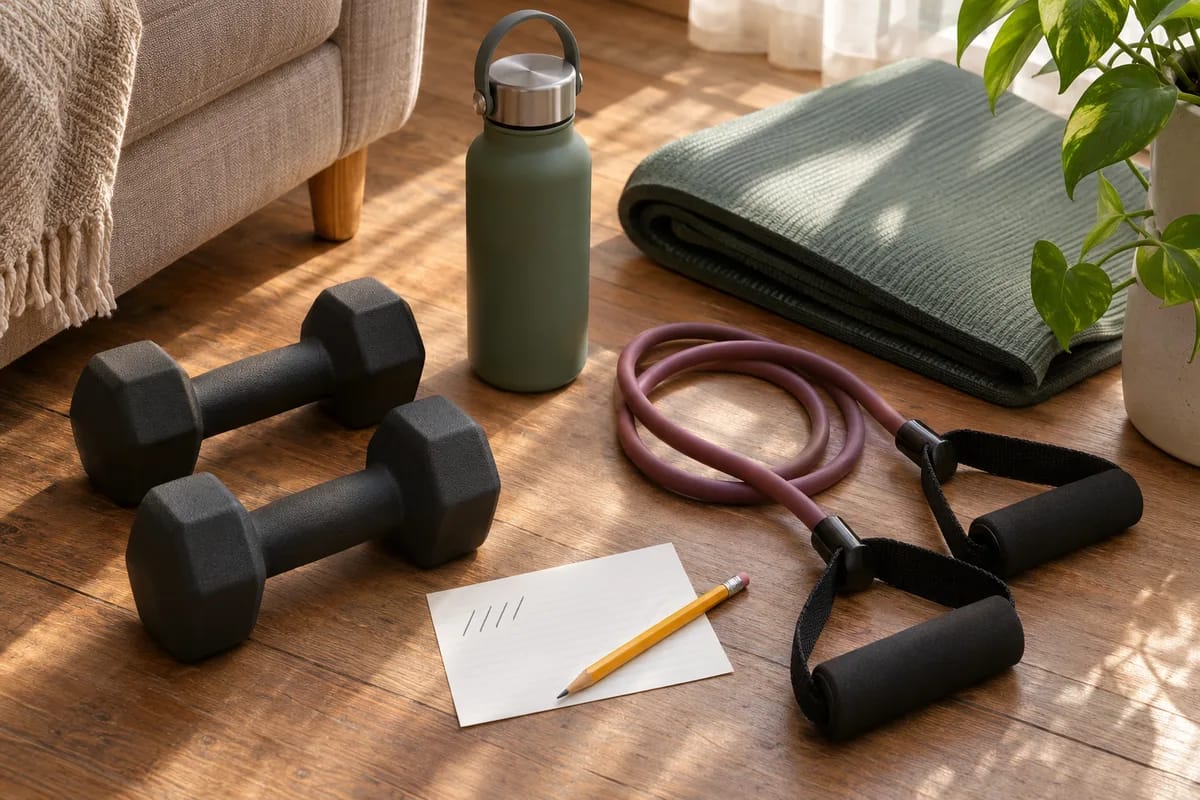
- Start a log: a note on your phone or a page in a notebook
- Put this week's sessions in your calendar, on the days you picked
What weight to pick up. These are our own coaching starting points for people who've never lifted, per hand unless it says otherwise:
- Goblet squat: body weight first, then 8 to 12 lb (3.5 to 5.5 kg), one dumbbell
- One-arm row and Romanian deadlift: 8 to 12 lb (3.5 to 5.5 kg)
- Shoulder press: 5 to 8 lb (2 to 3.5 kg)
A full 2-litre bottle weighs about 4.4 lb (2 kg), so water bottles are a fine first shoulder press. On a machine, start with the pin near the top of the stack, where the plates are lightest, and use week 2 to find your weight. The full table, and a three-set test that turns these guesses into your own numbers, are in how much weight to start lifting with. Buying dumbbells? Two pairs beat one: a light pair for shoulders and arms and a heavier pair for legs and back.
Warm up for five minutes. Three minutes of anything easy, like marching on the spot or a few trips up the stairs, then one light set of your first move. That's a short version of a 10-minute warm-up, which is worth doing on days you have the time.
Your first four weeks
Each week has one job. That's the whole trick of a first month: your body gets to adapt to each change before the next one arrives.
Week 1
Learn the moves
Two sets of 8 of each move (dead bugs and carries as listed), using body weight or the lightest of the starting weights. Every set should feel easy, with five or more reps left in you. It'll feel awkward: wobbly step-ups, a dead bug that makes no sense, a deadlift that feels like a stiff bow. That's what learning feels like. Some stiffness a day or two later is normal. About 25 to 30 minutes.
Week 2
Find your weights
Two sets of 10. The first time you do each move this week, find a weight where reps 8 to 10 slow down but still look like rep 1. Write down every weight and every rep count. About 30 minutes.
Week 3
Add reps, not weight
Same weights as week 2. Try for one or two more reps in each set, up to 12. You'll probably feel noticeably stronger by now. That's mostly your nervous system getting better at the moves, not new muscle yet, and it's real progress. About 30 minutes.
Week 4
Add a third set
Three sets of every move, at the same weights. About 40 minutes.
If you're still out of breath after 90 seconds, rest longer. On squats and deadlifts, two or three minutes is better still when you have it. There's more on why week 3 feels like a jump in your first strength gains are neural, not muscle.
Here's what a week 2 log for Workout A might look like. Keep one like it for every session, and after week 4 it tells you which moves go up.
| Move | Weight | Reps |
|---|---|---|
| Goblet squat | 12 lb (5.5 kg) | 10, 10 |
| Counter push-up | Body weight | 10, 9 |
| One-arm row | 10 lb (4.5 kg) | 10, 10 |
| Romanian deadlift | 10 lb (4.5 kg) each hand | 10, 10 |
| Dead bug | Body weight | 8, 8 each side |
When it goes wrong
It will, at some point, for everyone.
- You missed a session. Do the next workout in line at your next slot. Don't double up and don't restart the month. If you miss a whole week, repeat the last week you finished.
- Your legs are sore for days. If you can barely get down the stairs, do one fewer set next time, or use a lighter weight. Soreness isn't proof a workout worked, and it fades as you get used to training (what soreness does and doesn't mean).
- A joint pinches. A muscle working hard is fine; a pinch or ache in a joint isn't. Stop that move for today and use its easier version next time: a higher chair, a higher counter, a shorter range. If the same joint keeps complaining, see a physio. Chest pain, unusual breathlessness or dizziness mean stop and see a doctor. There's more in joint-friendly programming that still builds strength.
- A number stops moving. One or two moves usually stall somewhere in the first couple of months. Repeat that week, check the next weight up isn't simply too big a jump, and look at your sleep. How plateaus work goes deeper.
- You're bored. Swap a move for a close cousin and keep the shape of the plan: a one-arm row for a two-arm row, a split squat holding a wall for a step-up.
- It's week five and you've stopped wanting to. You're in good company: in gym attendance data, the biggest drop comes in weeks 5 to 8 (why most people quit the gym by week six). Keep the slot even when the session shrinks. One set of each move on a bad day still counts. If this is where every plan you've started has ended, a coach on the call is built for exactly this week.
After week four
Keep going with the same plan for another four to eight weeks. Start week 5 by moving up one weight on any move where you got 12 on every set, then keep adding reps, then weight, then reps again. It rarely feels boring while the numbers in your log keep climbing.
Most people get stronger on a plan like this, at very different speeds, and in the research neither age nor sex predicted who gained more.7
When 40 minutes starts to feel short and you'd like more, these are the next steps:
- How to make progress training three hours a week: three one-hour sessions, built around one main lift each.
- Starting to lift at 50 with zero gym background: a gentler 12-week ramp, if you'd rather go slower.
- How long until you see results from lifting weights, for an honest timeline of what changes when.
Doing this plan with a coach on the call
Everything above works on your own, and it's free. It gets hard in three places, and a coach on a live call takes all three off your hands.
Week one: is my form right? Here's what that looks like on a live 1‑on‑1 video call. Your phone is propped on a shelf, side on. On rep six of your first Romanian deadlift set, your back starts to round. Your coach says "push your hips back, let the weights slide down your thighs" while you're still in the rep, not a day and a half later from a clip you filmed and sent off for review. Your next set is clean, and you know what clean feels like.
If being watched while you wobble sounds worse than wobbling alone: an awkward first week is what a coach expects to see, and spotting the awkward bits is the job. You're at home, in whatever you'd wear to walk the dog, and there's nothing to buy first, because your coach writes the program around what you have, even if that's a chair, a stair and a backpack.
"I was skeptical about doing training over video at my age, but it has been much easier than I expected. My trainer is patient and adjusts everything to what my body can handle."
Wanda, 70, a Bespoke Fit member
Weeks two to four: what weight, and when to go up? Deciding stops being your job. Your coach writes your program onto your training calendar, and you open today's workout in the app and log each set as you go. If you wear an Apple Watch or a Bluetooth heart rate strap, your coach sees your heart rate live and uses it to decide how hard to push and when you need longer than 90 seconds to recover. After every session a recap shows what you lifted, your sets and any records.
Week five onward: turning up. Each session is booked with your coach and lands in your calendar, with reminders. At that time, a person is on the call waiting for you, which is a different evening from one where nobody would notice. One member put it like this:
"2 months in and I haven't skipped a single workout, which has literally never happened before. I don't have to plan anything. I just put on my clothes and fill my water bottle, and my coach does the rest."
Deqa, 27, a Bespoke Fit member
That only works if your coach knows you. Each coach has 12 members at most, and we hold to that when we assign coaches. App coaching that reviews logged workouts can spread one coach across hundreds of people; a coach who is live on every session can't, and with 12, yours remembers last week. You don't pick from a list: a 30-minute call with a head coach matches you with one of our coaches.
Sessions run 45 to 90 minutes at the same price, and most people settle at about an hour: this plan's 30 minutes plus a proper warm-up, more sets and time to learn each move.
It's 14 days free, then $299/mo, one flat price for as many sessions as you and your coach book. At two hour-long sessions a week, that's about $35 a coached hour; at three, about $23.
You add a card to start, and the 14 days begin at your first session, not at signup. A reminder goes out 3 days before the first charge, and you can cancel anytime, including during the 14 days. Those two weeks line up with weeks 1 and 2 of the plan, when someone watching helps most. Judge the trial on one question: did your coach catch something you'd have missed on your own?
If you've started plans like this before and kept them going on your own, keep doing that. This one costs nothing.
If you've started three and each faded around week five, that's the part we fix.
We're the wrong pick if $299 a month is a stretch, if you want someone beside you spotting a heavy barbell, or if you want meal plans, because we don't do nutrition coaching. If it's the price, Ladder is $29.99 a month, or $14.99 a month billed yearly, for a plan one coach writes for a whole team, which you follow on your own with no live sessions.8 Is online personal training good for beginners has more on what a first month with a coach looks like.
Common questions
Can I work out every day as a beginner? You can walk every day, and it helps. Keep the strength workouts to every other day at most for now, with a day off between them, because both workouts in this plan use the whole body. Two or three a week is plenty to get stronger.
What is the 3-3-3 rule for working out? Its useful idea is a mix of strength, cardio and rest, which this plan already gives you. It isn't a standard rule. Anytime Fitness's blog describes it as three strength days, three cardio days and three active recovery days. That's nine days, so it doesn't fit in a single week.9
Sources
-
Currier BS, D'Souza AC, Phillips SM and colleagues, 2026. Resistance training prescription for muscle function, hypertrophy, and physical performance in healthy adults: an overview of reviews. Medicine and Science in Sports and Exercise (an ACSM position stand). 137 systematic reviews; training to momentary muscle fatigue and equipment type did not consistently change outcomes. ↩ ↩2
-
Cleveland Clinic, 10 March 2025. New to exercise? Start with this sample workout routine. ↩
-
American College of Sports Medicine, 2009. Progression models in resistance training for healthy adults. Medicine and Science in Sports and Exercise. For novices: loads of an 8 to 12 repetition maximum, 2 to 3 days a week, a 2 to 10% increase once the current load can be lifted for one or two reps over the target, and larger multi-joint exercises first. ↩ ↩2
-
Centers for Disease Control and Prevention. Adult activity: an overview. At least 150 minutes a week of moderate-intensity activity, and muscle-strengthening activity on at least 2 days a week that works all major muscle groups (legs, hips, back, abdomen, chest, shoulders and arms). ↩
-
Riebe D, Franklin BA, Thompson PD and colleagues, 2015. Updating ACSM's recommendations for exercise preparticipation health screening. Medicine and Science in Sports and Exercise. ↩
-
PAR-Q+ Collaboration. The Physical Activity Readiness Questionnaire for Everyone (PAR-Q+), a self-screening questionnaire with a downloadable fillable form. ↩
-
Ahtiainen JP, Walker S, Peltonen H and colleagues, 2016. Heterogeneity in resistance training-induced muscle strength and mass responses in men and women of different ages. Age. Pooled data from 215 previously untrained men and women who did strength training, plus 72 controls who didn't. Strength rose 21% on average, ranging from a small loss to 60%. ↩
-
Ladder, pricing and homepage, checked 11 Nov 2026: PRO Monthly $29.99 a month, or PRO Annual $179.99 for the year ($14.99 a month); a coach writes each week's plan for a whole team, and members follow it on their own. ↩
-
Anytime Fitness, 19 March 2026. Your step-by-step beginner workout routine, which describes its 3-3-3 rule as three strength, three cardio and three recovery days. ↩