Progressive overload at home without adding weight
When you can't buy more plates, weight is only one way to overload a muscle. Here are the levers that work at home, and the mechanism behind each.

In this article10
Your muscles don't know what a kilogram is. They only feel two things: how much tension a fiber is under, and how close a set pushes it to giving out. That's the whole reason home training works even when your equipment doesn't grow. Weight is one way to raise tension. It's not the only one.
I've covered the rule itself and why it doesn't need a spreadsheet elsewhere. This post is the specific problem underneath it: two dumbbells and a mat is a real ceiling on load, but not on stimulus. Five things still make a set harder each week without another plate: more reps at the same weight, a slower rep, a longer range of motion, one limb instead of two, and how you use your rest. Here's how each one works, and where its limit is.
Tension is the trigger, not the number on the dumbbell
Growth starts inside the fiber, not on the dumbbell's label. Muscle responds to mechanical tension, the force a fiber makes as it contracts and resists. Your body only calls up its biggest, strongest fibers once a set gets genuinely hard. An easy set never wakes them up, no matter what the plate says.
Heavy weight is the obvious way to create that tension, but it's not the only route in. In a 2016 trial in the Journal of Applied Physiology, 49 resistance-trained men trained for twelve weeks, one group at 30 to 50 percent of their max for 20 to 25 reps, the other at 75 to 90 percent for 8 to 12, both pushed to failure. They built nearly the same amount of muscle.1 A follow-up pooling 21 more studies agreed: hypertrophy holds steady across a wide span of loads, and heavy weight only keeps its edge when the goal is maximum strength, not size.2
A muscle can't count the number on a dumbbell. It counts tension and fatigue, and a light set that gets hard enough sends the same signal as a heavy one. Every lever below is a way to make a load feel heavier without adding weight to it.
Do more work at the same weight
The simplest lever is just doing more. Press a pair of dumbbells for 8 reps this week and 11 next week, and the muscle did more total work at the same load. Add a fourth set to three, same story. Neither move touches the dumbbell.
There's a real condition on this: reps only count once the last few are genuinely hard. Stop a set five easy reps short and it barely registers, no matter how many you rack up. How close is close enough covers the research in full, but the short version holds here too: one to three hard reps left in the tank captures almost all of the benefit. More honest reps at a weight you already own is a heavier demand on the muscle than fewer easy ones ever were.

Slow the rep down
Take a weight you can normally lift 15 times. Lower it over four slow seconds, pause a beat at the bottom of every rep, and you'll be done well before 15. Nothing about the weight changed, only time under tension. Slowing down removes the bounce that was quietly doing some of the work for you.
This lever has real evidence, and a real limit. A pooled review of eight tempo studies found reps anywhere from about half a second to eight seconds build muscle about equally well.3 What didn't hold up was grinding reps out past ten seconds, which forces the weight so light that tension drops out from under it. The lowering phase carries most of that stimulus, and why the lowering phase builds the most muscle gets into why.
Slow the weight down and add a pause, and a set you used to breeze through gets hard with no extra load. Just stop short of slow motion. Past ten seconds a rep stops paying off.
Go deeper
Half-squatting a weight is easier than squatting it to the floor. A longer range means the muscle produces force across more of its length, often including the stretched position where it works hardest. Going deeper is more work per rep at the same load, no extra plate required.
A systematic review comparing full and partial range of motion found full-range training built more lower-body muscle than partial-range work.4 The upper-body picture was less clear, and the effect may depend on the muscle, so treat this as a strong lead rather than a rule for every lift. The lever itself costs nothing: a deeper lunge, a full stretch at the bottom of a row, a push-up where your chest actually reaches the floor, all ask more than the shortened version you drift into once a set gets tiring.
Another inch of clean depth is a real way to progress a lift you can't load any heavier.
Load one limb instead of two
This is the lever people forget, and the strongest one for training with just your bodyweight. Move from two limbs to one and you roughly double the load on the working muscle, because the same bodyweight or dumbbell is now held up by half the machinery.
A two-leg squat becomes a split squat, then a rear-foot-elevated split squat, then eventually a pistol squat. A push-up becomes feet-elevated, then an archer push-up leaning most of your weight onto one arm, then a true one-arm push-up. Each rung on that ladder is a real jump in tension per limb, the kind you'd otherwise only get from adding plates. It's how the load keeps climbing long after a pair of light dumbbells has maxed out.
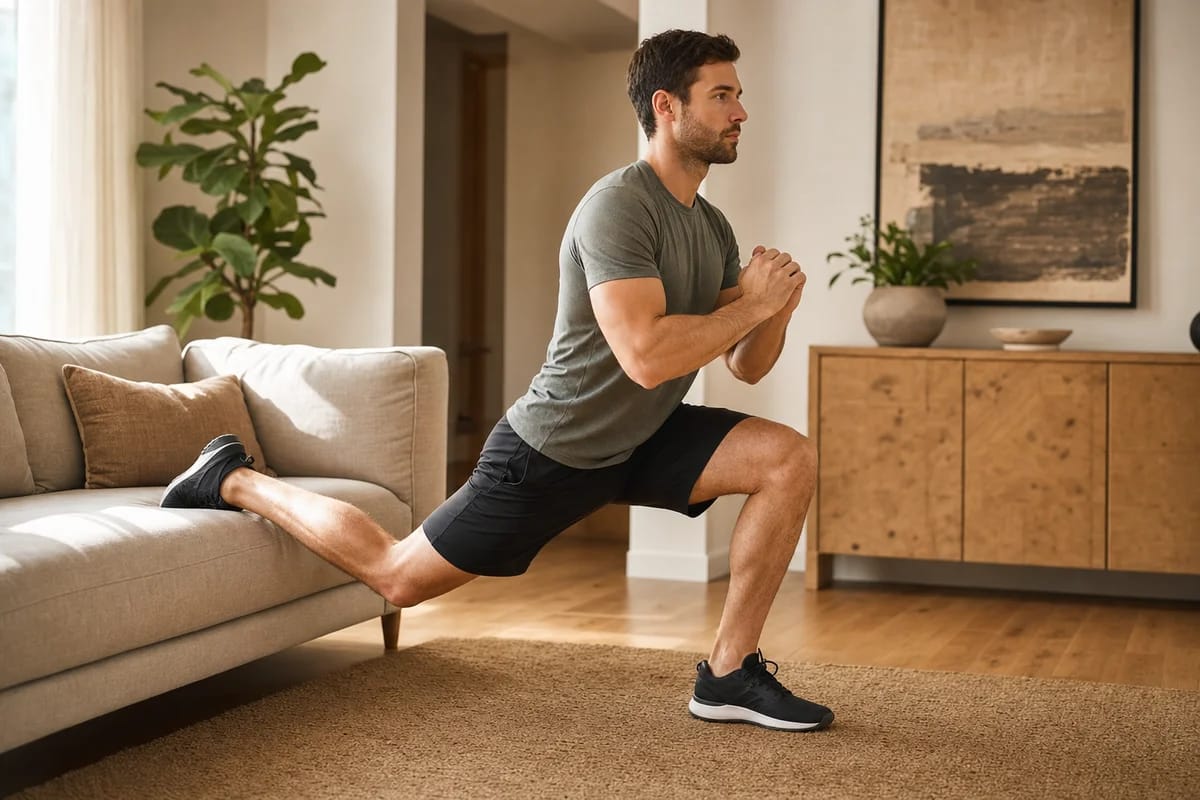
Fewer limbs sharing the same load means more load on each one. Harder single-limb variations are your heavy weights.
Rest less for a harder workout, rest more for a bigger one
Cutting rest from three minutes to one makes a session harder and much shorter, because each set starts before you've recovered and more reps happen fatigued. That's genuinely useful, for conditioning and for fitting real training into a short window.
But harder in the moment doesn't always mean more muscle. Researchers who put 21 trained men on either one-minute or three-minute rest between sets found the longer-rest group built more strength and slightly more size, most likely because full recovery let them log more quality reps.5 Short rest is a density and time tool. It isn't a shortcut to growth.
Use it on purpose. Cut rest when you're pressed for time, and give yourself two to three minutes when muscle is the actual goal.
Run one lever at a time
The mistake is changing everything in the same week. Pick one lever and push it until it stalls, the same way you'd add weight until you couldn't. Add reps at a fixed weight until every set hits the top of your range, then switch to a slower tempo or a harder single-limb variation and start climbing again. Range of motion isn't part of the rotation, keep it full throughout. It's a standard, not a variable.
Running one lever at a time is double progression with more dials on it. It also tells you exactly what caused the progress, and exactly what to change once it stops.
Where the evidence gets thin
None of this replaces the basics. Adaptation happens between sessions, not during them, so bad sleep, low protein, or erratic weekly volume will flatten any of these levers before they get a chance to work.
The research has real edges too. Most of the load and tempo studies ran on younger trainees over a few months, the range-of-motion evidence is strongest for the lower body, and individual response varies more than any of these numbers suggest. Treat them as directions, not promises.
These levers also run out the same way added weight does. A beginner can add reps for months. Someone well-trained might grind through a whole ladder of single-limb variations for the result a small plate used to give in a week. That's arithmetic, not failure, and it's the normal shape of a plateau.
Common questions
Can you build muscle at home with just light dumbbells? Yes, if the sets get genuinely hard. Light-to-failure and heavy-to-failure build similar amounts of muscle, so the real limit at home is effort and reps close to failure, not how much your dumbbells weigh. You'll cap out on maximal strength sooner than a barbell lifter, but for size, light weights go a long way.
How do I make push-ups harder without weight? Move along the leverage ladder. Elevate your feet, shift toward archer push-ups that load one arm at a time, then work toward one-arm progressions. You can also slow the lowering phase, pause at the bottom, and get your chest to the floor on every rep.
Should I lift to failure at home? Close to it most of the time, but you rarely need absolute failure. Growth rises the closer you get, and most of the benefit sits in the last few hard reps, so leaving one to three reps in reserve captures nearly all of it while keeping your form and joints safer.
Run it yourself, or run it with a coach
Here's the solo version in five moves: push every set to one to three hard reps in reserve, add reps until you top out your rep range, slow the tempo down once reps stop working, own the full range of motion every time, and rotate to single-limb variations once light dumbbells stop cutting it. Plenty of people run exactly this for years with two dumbbells and real attention.
What a coach changes is the judgment calls in between. Whether that "hard" set had two reps left or five. Whether your range quietly shortened as you got tired. Which lever to reach for this week instead of next. At Bespoke Fit, every session is 1‑on‑1 over HD video with a real coach, live, every rep, and rotating these levers as you plateau is the core of the job when you can't add weight. Your coach watches the effort and range live and builds next week's plan from what they actually saw, not from what you wrote down after the fact.
Your first 14 days are free, then it's $299 a month. See how the sessions actually run on the how it works page.
Sources
-
Morton RW, et al., 2016. Neither load nor systemic hormones determine resistance training-mediated hypertrophy or strength gains in resistance-trained young men. Journal of Applied Physiology. ↩
-
Schoenfeld BJ, Grgic J, Ogborn D, Krieger JW, 2017. Strength and Hypertrophy Adaptations Between Low- vs. High-Load Resistance Training: A Systematic Review and Meta-analysis. Journal of Strength and Conditioning Research. ↩
-
Schoenfeld BJ, Ogborn DI, Krieger JW, 2015. Effect of repetition duration during resistance training on muscle hypertrophy: a systematic review and meta-analysis. Sports Medicine. ↩
-
Schoenfeld BJ, Grgic J, 2020. Effects of range of motion on muscle development during resistance training interventions: A systematic review. SAGE Open Medicine. ↩
-
Schoenfeld BJ, Pope ZK, Benik FM, et al., 2016. Longer Interset Rest Periods Enhance Muscle Strength and Hypertrophy in Resistance-Trained Men. Journal of Strength and Conditioning Research. ↩
More on