Progressive overload without the spreadsheet
Progressive overload is one biological rule, not a logging habit. Here's the mechanism, the levers besides weight, and how to apply it simply.
Updated

Progressive overload is one sentence long. Give a muscle a bit more than it's used to and it has a reason to change. Give it the same thing every week and it doesn't.
Everything on top of that sentence is bookkeeping. The apps, the templates, the columns of weights logged to the pound. Some people like the bookkeeping, and it does keep them honest. It isn't what makes them stronger.
What you do need is a sense of what "a bit more" can mean, because it hardly ever means weight alone, and a way to add it that doesn't depend on remembering what you did five weeks ago. Both fit on an index card.
Why your body bothers to change at all
You don't get stronger during a workout. You get stronger over the next day or two, while your body repairs the specific thing you made hard.
"Specific" is doing a lot of work in that sentence. Exercise physiologists have an ugly acronym for it, SAID: specific adaptation to imposed demands. Your body answers the question you asked and not much else. Ask for heavier lifts and it builds what heavier lifts need. Ask for the same five sets you were doing in March and the reply comes back "already handled," so you stay where you are.
The idea came out of a rehab ward rather than a gym. A 1948 paper on rebuilding strength in injured soldiers set out a method its authors called progressive resistance exercise: raise the resistance a little at a time, as fast as the limb can take it.1 Almost everything since has been a refinement of that.
Six ways to make a set harder without touching the weight
This is where the spreadsheet anxiety usually starts. People hear "progressive overload" and picture the number on the bar going up every session, so the week it stalls, they think they've stopped progressing. Load is one lever. Here are the others.
- Reps. Ten push-ups this week, twelve next week. That's overload, and you didn't buy anything.
- Sets. Three hard sets becoming four is more total work your body has to answer for.
- Tempo. Lower the weight over three slow seconds and the muscle is under tension far longer at the same load.
- Range of motion. A deeper squat, or a fuller stretch at the bottom of a row, is more work than a half rep. It also tends to be the first thing that quietly shrinks when a weight gets heavy.
- Density. Same work in less rest, or more work in the same time.
- Technique. Better control means the muscle you're targeting does more of the job instead of handing it to momentum.
Adding reps isn't a lesser version of adding weight. In a 2016 trial in the Journal of Applied Physiology, 49 trained men lifted for twelve weeks, one group at 30 to 50 percent of their max for 20 to 25 reps, the other at 75 to 90 percent for 8 to 12 reps, with every set taken to failure. Both groups built nearly the same muscle.2
So the light-and-long sets weren't the consolation prize. When the set was genuinely hard, how much weight was on the bar didn't decide how much muscle grew.

Earn the reps, then buy the weight
Here's the method I'd put almost anyone on. It uses two levers in a fixed order, reps first and load second, which is why it needs no columns: you're always doing one of two things, and the workout tells you which.
Pick a rep range for an exercise, say 8 to 12. Pick a weight you can lift for 8 clean reps on every set. Then your only job, week to week, is to add reps at that same weight until you hit 12 on all of them. The session you clear 12 across the board, you add a small amount of weight, drop back to 8, and start climbing again.
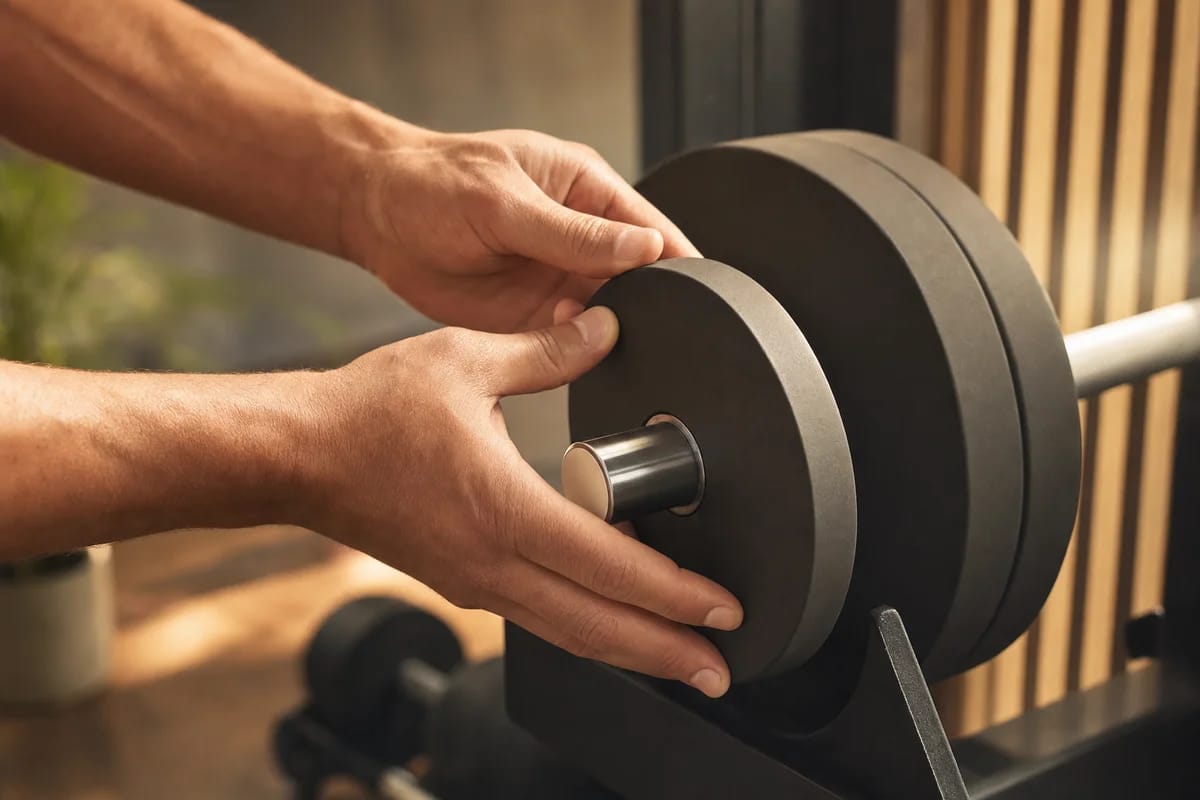
That "small amount" has a number behind it. The American College of Sports Medicine's guidance on progression puts the jump at 2 to 10 percent, taken once you can beat your target by a rep or two.3 On most upper-body lifts that's the smallest plates you own. Small is the point. Big jumps mean you fail the next block outright and spend two weeks getting back to where you already were.
So what do you actually write down?
Two or three lifts. One big push, one big pull, one for the legs. Note the weight and the reps for those, run everything else by feel on the same double-progression rule, and stop there.
Then read them by the month, not by the day. Sleep, stress, a rough week at work and a late dinner all move the numbers around, so one flat session means nothing at all. Compare this month against last month. If the weight or the reps on your tracked lifts have crept up, you're overloading, and the rest is noise.
A flat month is different. That's real information, and it usually points at recovery or the program rather than your effort. Grinding harder is the wrong response to it, and the most common one.
Why did the first two months move so much faster?
If you added weight nearly every session for eight weeks and then watched that pace fall off a cliff, nothing went wrong. The early gains and the later gains come from two different places.
A small 1979 study tracked strength and muscle size side by side across eight weeks of training and found the two ran on different clocks. For the first three to five weeks, most of the strength came from the nervous system getting better at recruiting and coordinating the muscle already there. Only after that did actual muscle growth become the main driver.4
So at the start you're learning the lift, and learning is fast. Once the movement is grooved, more strength has to come from the slower job of building tissue. The weight stops flying up because the cheap gains are spent, which is also the beginning of how plateaus actually work.
Plenty of people quit right at this point, convinced they've done something wrong. They've mostly just become intermediates.
Where the rule stops being tidy
It can't stay linear, and that's arithmetic rather than failure. Adding weight every week works for a beginner and becomes impossible for anyone trained, so progress arrives in smaller increments over longer cycles. That's the normal shape of a plateau, not a wall.
More is not automatically better either. Overload is a stress, and a stress you don't recover from stops helping and starts costing you. The adaptation happens during recovery, so sleep, food and a sane weekly volume are what let the overload land in the first place. Piling on sets while under-recovered is a reliable way to stall while feeling like you're trying hard. It's also why balancing the hard lifting with easy aerobic work beats making every session brutal, roughly along the lines of a simple zone 2 and strength week.
And the research has edges. The twelve-week lifting trial used young trained men, the neural-versus-muscle work was small and decades old, and individual response varies a lot. The principles hold broadly. Your exact numbers are still yours to find.
Common questions
Do I have to add weight every session to make progress? No, and past your first few months it isn't possible anyway. Progress can be one more rep, one more set, a slower lowering phase or a fuller range of motion. If one of those is trending up over a month, you're overloading.
Is lifting lighter for more reps a waste of time? Not for building muscle. In that twelve-week trial, light-and-high-reps and heavy-and-low-reps built nearly identical muscle when both were taken close to failure. Heavy loads still have an edge for maximal strength, so keep some heavy work if strength is the goal.
How much weight should I add when I do go up? Small. The ACSM's guidance is roughly 2 to 10 percent, once you can do one or two reps past your target, which usually means the smallest plate available. Small jumps keep you from stalling the moment you go up.
Why did my fast beginner progress stop? The early gains were mostly your nervous system learning the lifts, which happens quickly and runs its course inside the first several weeks. After that, strength has to come from added muscle, and that's slower. The slowdown is the expected shape of it.
The one thing you can't watch yourself do
Most stalls I see aren't a broken program. They're small: a range of motion that quietly got shorter, a "heavy" set that stops three reps short of honest, a weight jump too big to hold, overload added in a week that needed rest instead. All of them are hard to catch from inside the set, because you can't see yourself lift.
That's the part a live coach covers. Every session at Bespoke Fit is 1-on-1 over HD video with a real coach who sets the load, watches your range and your effort while it's happening, and builds next week's small progression out of what they actually saw instead of a template. Your first month is $49, founding members pay $299 a month locked for life, and there are 25 spots. The how it works page shows how a session runs.
What that mostly buys you is honesty about your effort and your range, plus somebody catching the small errors before they cost you a month, though double progression, two tracked lifts and the patience to add slowly will carry you a long way by yourself. The rule doesn't care which route you take. It only asks that the work is real, and a little harder than last time.
Sources
-
DeLorme TL, Watkins AL, 1948. Technics of progressive resistance exercise. Archives of Physical Medicine and Rehabilitation. ↩
-
Morton RW, et al., 2016. Neither load nor systemic hormones determine resistance training-mediated hypertrophy or strength gains in resistance-trained young men. Journal of Applied Physiology. ↩
-
American College of Sports Medicine, 2009. Progression models in resistance training for healthy adults. Medicine and Science in Sports and Exercise. ↩
-
Moritani T, deVries HA, 1979. Neural factors versus hypertrophy in the time course of muscle strength gain. American Journal of Physical Medicine. ↩