Starting to lift at 50 with zero gym background
A true beginner at 50 gets fast newbie gains and hits anabolic resistance at the same time, so the fix is a real coached stimulus, not a timid one.
Fifty-year-old beginners run into two facts that seem to pull in opposite directions. You'll make some of the fastest strength gains of your life over the next few months, the kind that make early progress feel almost too easy. And your muscle has gotten a little harder to talk into growing than it was at 25. Both are true. The second one is not a reason to go easy.
If the signal your muscle listens for is quieter now, the fix is a louder signal, not a smaller workout. Starting at 50 with no gym background is not too late, and gentle is not the same as safe. What works is a real, well-coached stimulus and the patience to learn the lifts before you load them.
Is 50 too late to start lifting?
No, and the research here is about as settled as exercise science gets. The strongest evidence is a 2010 meta-analysis pooling 47 studies and 1,079 adults aged 50 and up, published in Ageing Research Reviews, which found average strength gains of roughly 24 to 33 percent across the major lifts after a training program.1 Most of these people weren't athletes. They were ordinary older adults, plenty of them lifting for the first time in their lives.
The starkest version of this comes from a trial that put ten frail adults, averaging 90 years old, through eight weeks of high-intensity strength training. Their strength gains averaged 174 percent.2 If people in their nineties respond like that, a 50-year-old has an enormous amount of room to work with.
Part of that comes down to something that has nothing to do with age: early strength gains are mostly your nervous system learning to use muscle you already have, not new muscle showing up. That wiring upgrade doesn't expire. We go deeper on it in your first strength gains are neural, not muscle, but the short version is that a real chunk of your first weeks of progress is a skill you're learning, and skill doesn't care how old you are.
Why older muscle needs a louder signal
Older muscle responds less to the signals that trigger growth. Researchers call this anabolic resistance. The same training stimulus that would spark real growth in a 25-year-old produces a smaller response once you're past 50.
You can see it in the protein research. Researchers measuring how much protein it takes to fully switch on muscle-building in a single meal found older men needed close to 0.40 grams per kilogram of body weight, about 0.2 grams per pound, while younger men needed only about 0.24 grams per kilogram to get the same response.3 Same target, almost double the dose.
It shows up in training too. Pooled data from 49 studies and 1,328 older adults found resistance training added about 1.1 kilograms of lean mass on average, just over 2 lb, with higher-volume programs working better and the oldest participants gaining the least.4 The response is real. It's just blunted, and more work is what drives more of it.
The volume knob on the signal is turned down a notch, so the training needs to turn the input up, not down.
Gentle feels safer. It isn't.
Most first-time lifters at 50 assume light and slow is the careful choice. It usually isn't. Under-load your muscles and you pay the cost of training, the time, the soreness, the effort, without much of the adaptation you showed up for. Anabolic resistance makes this worse for an older beginner specifically: a weak signal barely registers on muscle that's already less responsive.
That same meta-analysis found higher-intensity training produced bigger strength gains in older adults, not smaller ones. Effort, applied with control, is what moves the needle. Backing off the weight to feel safe usually just means backing off the results.
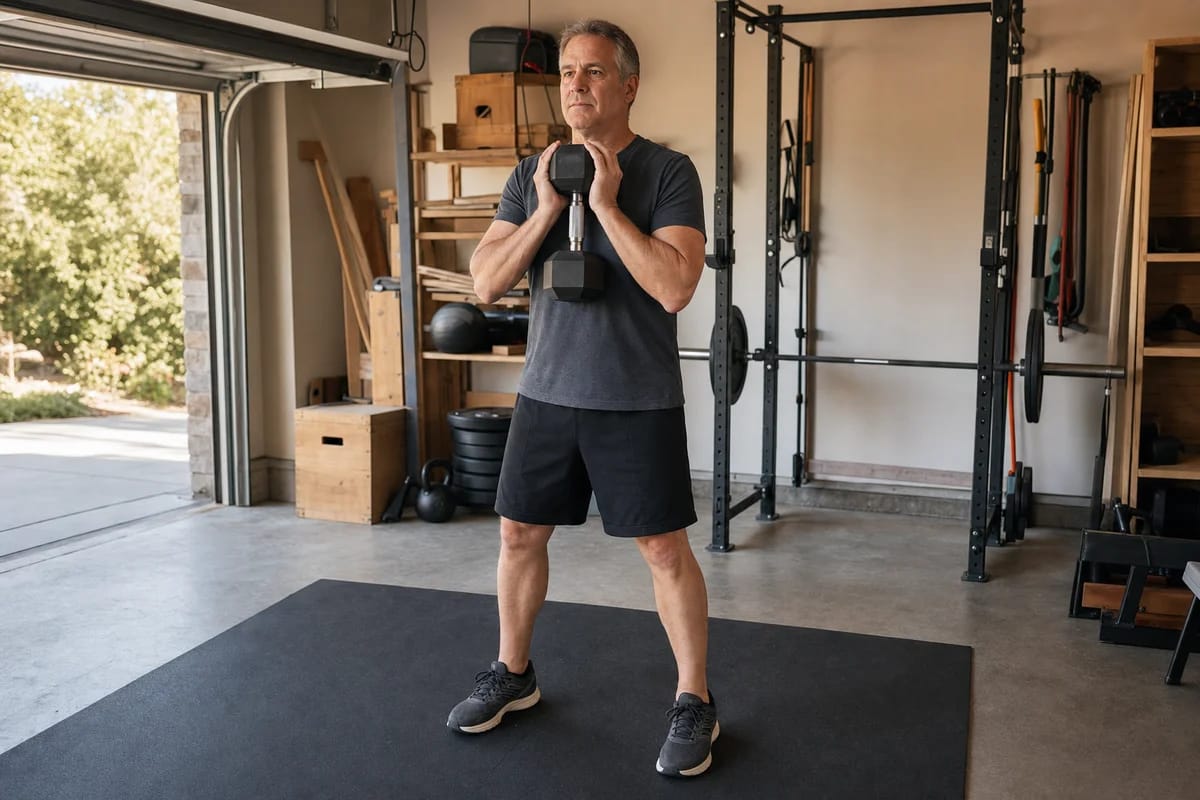
Real safety comes from somewhere else: a movement pattern you can control through its full range, a load you've earned week by week, and knowing the difference between a set that's hard and a set that's risky. Lightness alone doesn't protect a rounding back.
The first twelve weeks, week by week
Keep the exercise list short and repeat it. Five movement patterns cover most of your body: a squat, a hinge, an upper-body push, an upper-body pull, and a loaded carry. You don't need a machine circuit or a rotating menu of exercises to get strong.
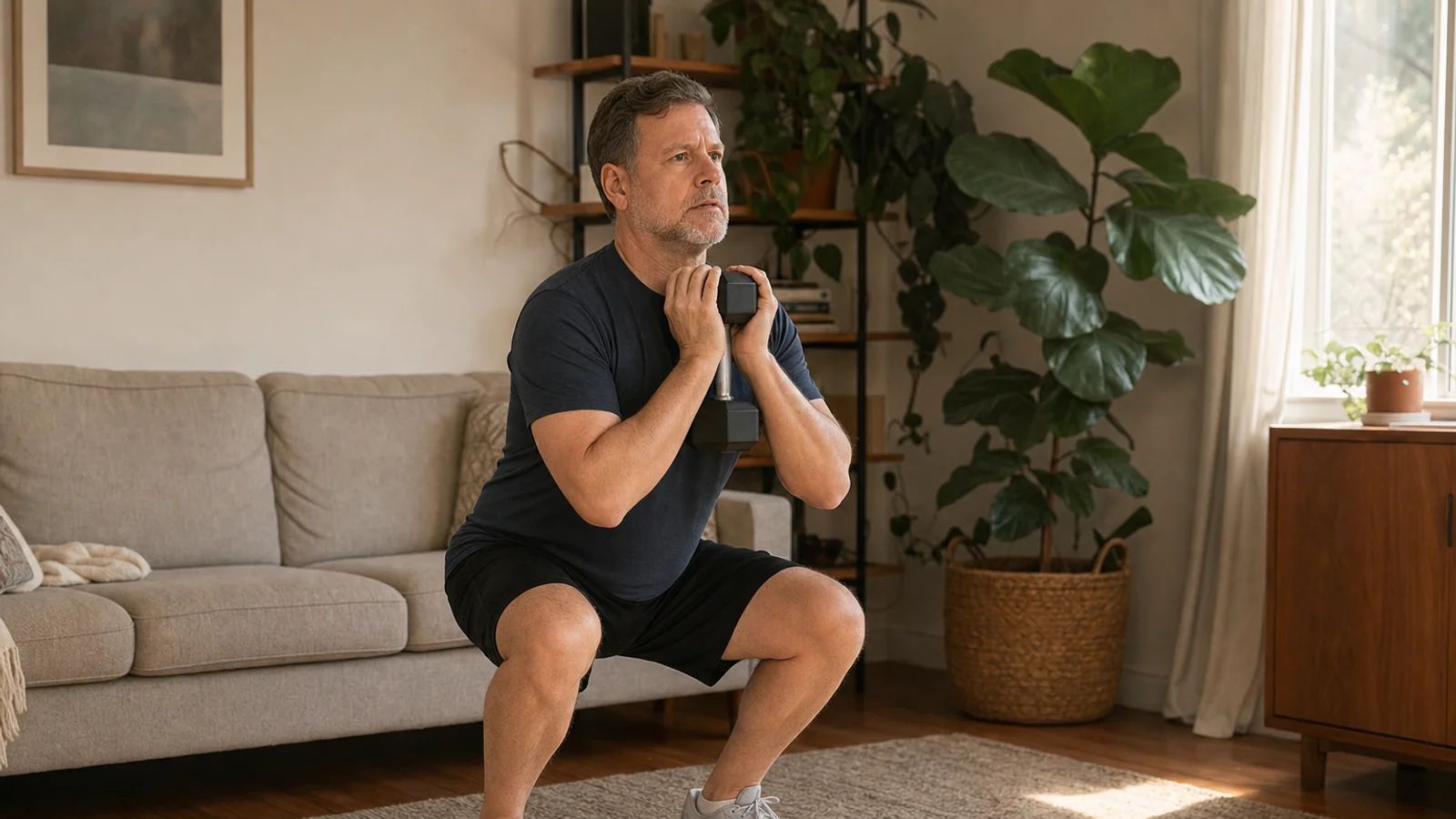
Weeks one and two are for learning, not loading. Pick a version of each pattern you can do well: a box squat to a chair, a dumbbell Romanian deadlift, a push-up or dumbbell press, a row, a suitcase carry. Two to three sessions a week, well short of your limit, just grooving the movement.
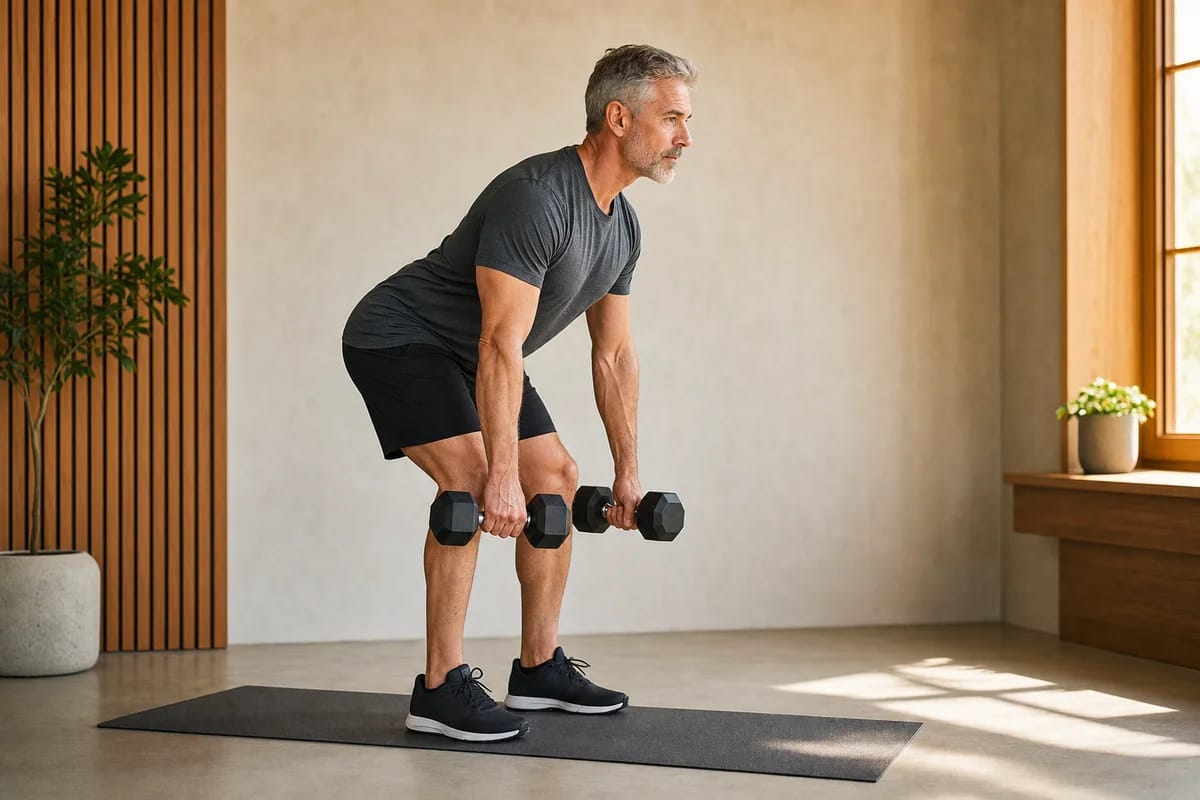
Weeks three through eight are where load creeps in. Work in sets of roughly 8 to 12 reps, stopping two or three reps before you'd fail, and add a little weight whenever the last rep still looks clean. That's progressive overload, and it doesn't need a spreadsheet, just a steady nudge upward.
By weeks nine through twelve, you're consolidating. The weights are meaningfully heavier than week one, the patterns feel automatic, and you can start pushing closer to genuinely hard effort on your main lifts. You're not really a novice anymore.
Four mistakes that quietly stall beginners
A handful of errors show up again and again, and each one either blunts your results or nudges up your risk.
Chasing weight before the pattern is solid. Load magnifies whatever you're already doing, so a slightly off squat becomes a badly off squat the moment you add real weight to it. Earn the load first.
Cutting the range short. Half a squat, or a hinge that barely bends, trains half the muscle. Full range, under control, beats a bigger number moved a shorter distance.
Letting the lowering phase collapse. Dropping the weight down wastes the part of the rep that builds the most, and it's usually where control fails first. Lower it like you mean it.
Holding your breath and bracing wrong, which matters most on hinges and squats, where a rounded, unbraced spine is the real risk.
If you're returning to lifting rather than starting from scratch, the relearning curve moves faster; coming back to lifting after 20 years away covers that separately. And because recovery becomes the real ceiling this decade, it's worth reading training in your 50s: recovery is the new limiter alongside this one.
What the averages don't promise you
The meta-analyses report averages across groups. Individuals vary a lot in how fast they respond, so your curve won't track a study's mean exactly. The protein numbers come from tightly controlled lab measurements of a single meal's effect on muscle protein synthesis, an early signal, not a direct readout of how much muscle you'll build over a year. And the oldest-adult studies involved supervised training and medical screening, which matters if you've got joint issues, a heart condition, or you've been sedentary for years. Talk to a doctor first if any of that's you.
None of that changes the direction of the evidence. It just means the numbers are a solid map, not your exact route.
Common questions
How often should you lift, starting out? Two to three full-body sessions a week is plenty, with a rest day between them. That's often enough to practice each pattern while still recovering, and recovery matters more this decade than it used to.
How much weight should I start with? Lighter than you think for the first week or two: a load you could do several more reps with, so your whole focus can go to the pattern. Once a movement is clean, add weight steadily. You want genuinely challenging sets within a few weeks, not on day one.
Is lifting risky at this age? Poorly controlled lifting carries some risk at any age, but well-run resistance training is one of the safer things you can do, and it cuts your risk of the falls and frailty that come from doing nothing at all. Control, full range, and sensible progression protect you far more than picking a light weight does.
Isn't walking enough? Walking is great for your heart. It does very little for muscle and strength, and those are exactly what fade with age. Because older muscle responds less to begin with, it needs the clear mechanical signal that lifting provides. Walking and lifting work together, neither replaces the other.
Can you tell if your own form is good?
Everything above assumes one thing: that the reps you're practicing are genuinely good ones. That's the hardest thing to judge alone. You can't see your own back round or your own knee cave, and as a beginner you don't yet know what a clean rep feels like from the inside.
On a Bespoke Fit session, a real coach, never AI, watches every rep live over HD video and corrects your form while the weight is still in your hands, not a week later. The programming gets written session by session and adjusted as you learn, and it works with whatever equipment you've got at home. Having someone watching also removes the intimidation that keeps a lot of first-timers out of a gym in the first place. Your first month is $49, founding members lock in $299 a month for life, 25 spots, $499 standard after that, and there's a 30-day money-back guarantee. How it works walks through what a session looks like.
Filming yourself from the side and comparing each set to a clean demo costs nothing, and it works fine if you're disciplined enough to review the footage every time and fix what you see.
Sources
-
Peterson MD, Rhea MR, Sen A, Gordon PM, 2010. Resistance exercise for muscular strength in older adults: a meta-analysis. Ageing Research Reviews. ↩
-
Fiatarone MA, Marks EC, Ryan ND, Meredith CN, Lipsitz LA, Evans WJ, 1990. High-intensity strength training in nonagenarians. JAMA. ↩
-
Moore DR, Churchward-Venne TA, Witard O, Breen L, Burd NA, Tipton KD, Phillips SM, 2015. Protein ingestion to stimulate myofibrillar protein synthesis requires greater relative protein intakes in healthy older versus younger men. Journals of Gerontology: Series A. ↩
-
Peterson MD, Sen A, Gordon PM, 2011. Influence of resistance exercise on lean body mass in aging adults: a meta-analysis. Medicine and Science in Sports and Exercise. ↩