Why the lowering phase builds the most muscle
The eccentric half of every rep produces the most force, yet most people rush it. Here's what lowering under control does for muscle and tendons.
Updated

You can lower a weight you can't lift. Load a curl bar past what someone can curl, hand it to them at the top, and they'll still get it down under control. That's just how muscle works. A muscle makes more force while it's being stretched than while it's shortening, so the lowering half of every rep, the part physiologists call the eccentric, puts the most tension through the tissue. Tension is the main signal that tells a muscle to grow.
Most people hand that half to gravity. They fight the weight up, then let it fall, and the boring bit turns out to be the bit doing the most work.
The popular version of this does get oversold, though. Both halves of a rep build muscle, and once you match the weight, the difference between them gets small.
A muscle is stronger on the way down
When a muscle shortens to move something, the motors inside it, actin and myosin, are actively pulling, and there's a ceiling on how hard they can pull. When that same muscle is stretched under load, those connections are being pulled apart rather than made, and the springy parts of the fiber take up the slack. The main one is titin, a huge protein that runs the length of each contractile unit and behaves like a stiff bungee. So the muscle can hold back more than it can move.
The nervous system runs the two halves differently too. Enoka's 1996 review of the research concluded that eccentric contractions "require unique activation strategies by the nervous system."1 Your brain uses a different, more economical pattern to hold a weight than to move one.
Put those together and each working fiber sits under more tension coming down than going up. That's the whole case for caring about the lowering, and it's a good one.
So does lowering build more muscle?
Partly, and for a duller reason than you'd hope. A 2009 review in the British Journal of Sports Medicine pooled 20 randomized trials and found eccentric training produced bigger gains in strength and size than concentric training.2 The reviewers also named the thing the headline version leaves out: the advantage mostly showed up when the eccentric work was done at a higher intensity.
That matters, because you can handle more weight on the way down. Eccentric-emphasis programs load the muscle harder almost by definition. So a lot of the edge is about load, not direction.
When trials match load and effort, the gap narrows a long way. Both halves grow muscle. The bigger levers are how hard you train and how much you do across a week, which we went through in how many sets per week your muscles actually need.
Which gives the title an honest answer. The lowering phase is where a muscle makes the most force and where you can load it hardest. It doesn't have a private growth switch that the lifting half is missing.
Controlled beats slow
Somewhere this turned into "slower is better." It isn't. Eight tempo trials pooled in 2015 found growth was much the same whether a rep took half a second or eight seconds, and that very slow reps, over 10 seconds each, are inferior for growth.3
The reason is boring and convincing. Crawl through a rep and you have to use a lighter weight, which cuts the exact tension you were trying to add.
Two to four seconds down is a good default. Long enough that you're genuinely resisting the weight, short enough to keep the load honest. Count it out loud if that helps.

Tendons are the strongest case for eccentrics
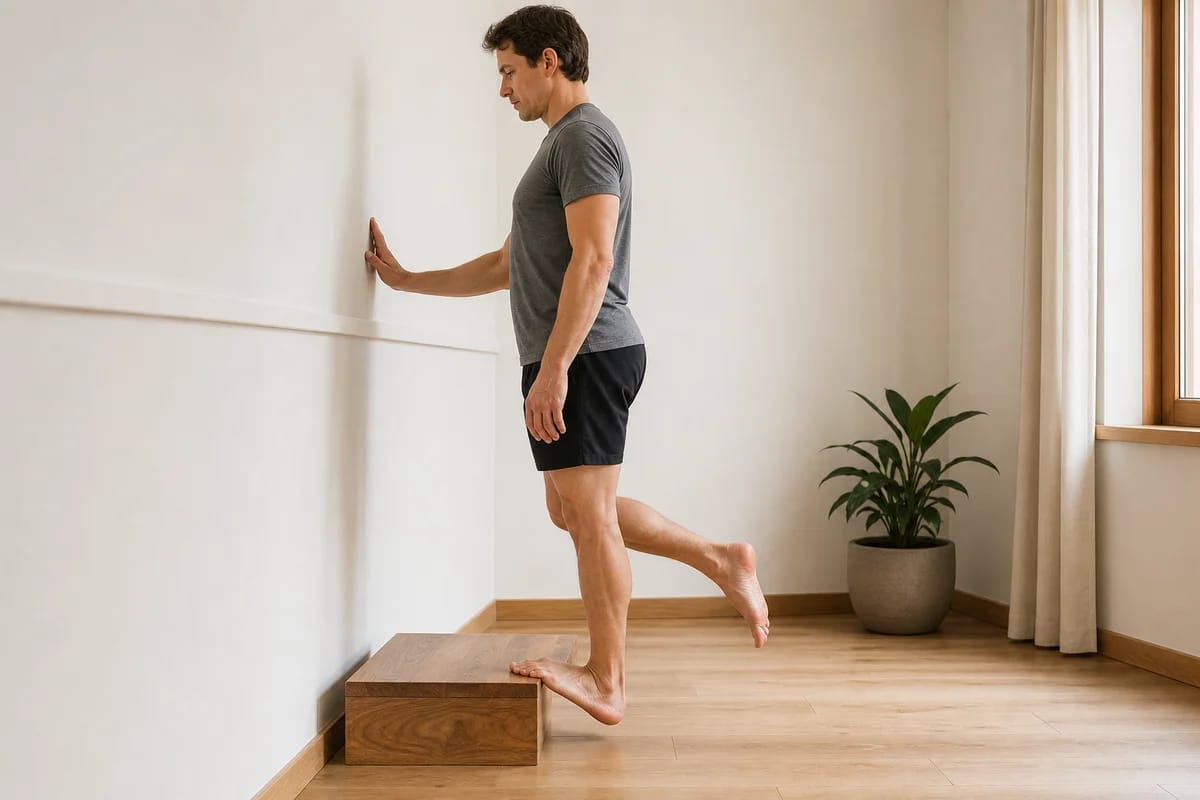
Tendons adapt to load the way muscle does, only slower, and controlled lowering has been the standard tool for cranky ones since the late nineties. Alfredson's Achilles study is why. In 1998, 15 recreational athletes, average age about 44, with pain bad enough that they'd stopped running, did heavy eccentric heel drops twice a day for 12 weeks.4 All 15 got back to their pre-injury running. A comparison group treated the usual way, rest and anti-inflammatories, ended up in surgery. Physios still call it the Alfredson protocol.
Why the lowering specifically? A slow lengthening under real load gives the tendon a strong, steady signal to rebuild its collagen. Researchers still argue about whether the eccentric part is the active ingredient, since heavy slow loading in both directions helps too. What nobody argues about is the stuff underneath: heavy, controlled, patient loading, week after week.
If a sore tendon is why you're reading this, get it assessed and programmed by someone qualified, and plan for 8 to 12 weeks rather than a couple.
Why it wrecks you two days later
Add slow lowering to a routine that isn't used to it and the stairs will let you know on day two. Proske and Morgan's 2001 review laid out the mechanism: unaccustomed eccentric exercise pulls sarcomeres, the tiny contractile units inside the fiber, out of shape, and untrained people "become stiff and sore the day afterwards."5 Labs use eccentric exercise to produce soreness on purpose, because it works every time.
The good news is how fast your body protects itself. The same review describes the repeated bout effect: "a second period of exercise, a week after the first, produces much less damage."5 The muscle adds sarcomeres and adjusts to the new demand. The session that flattens you the first time barely registers by the third.
That leads to the part people get backwards. Soreness isn't a scorecard. It tells you the work was new and did a bit of damage. It doesn't tell you the muscle grew. Once you've adapted, you'll keep building with almost no soreness at all.
Where the research runs out
Most of the tendon evidence comes from two specific spots, the Achilles and the patellar tendon, so it travels less well than people assume. Individual response varies a lot, and loading something that already hurts is genuinely a job for a professional's eyes. A fair amount of the eccentric hype also rests on lab measures like peak force and muscle activation, and those don't convert one for one into muscle you can see in the mirror. What survives all of that is small and useful: control the lowering, load it properly, be patient with tendons.
What to change in your next set
- Lower every working rep in 2 to 4 seconds. Don't let it fall.
- Don't crawl. Past roughly 10 seconds a rep you're just holding a lighter weight.
- Treat eccentric emphasis as a tool, not a rule. On a stuck lift, a 4-second lower or eccentric-only reps add stimulus without adding weight.
- Sort out weekly sets and effort first. Tempo is a refinement on top of that, not a substitute for it.
- Judge a session on load and reps over weeks, not on how sore you are the next day.
If you change one thing about your training this month, I'd make it the first bullet.
The three-second lower that turns into one
Tempo is easy to describe and easy to lose. A 3-second lower quietly becomes a 1-second drop by the last hard set, and you almost never catch yourself doing it.
You can police that on your own. Prop your phone against a water bottle and film one working set from the side. Count the lower out loud, one thousand one, one thousand two. Play it back and compare your last two reps against your first two. Do that once a month and you'll catch most of the drift before it costs you anything.
A coach changes when the fix arrives. On a Bespoke Fit session a real coach sees the tempo slipping while the set is still running, calls it before the reps fall apart, and takes a notch off the load rather than letting you grind out four sloppy ones. That's the gap between spotting it on Saturday's playback and fixing it on rep six, which we get into in why a coach watches every rep. The how it works page shows how a session runs. Your first month is $49, then $299 a month as a founding member, locked for life, one of 25 spots. After those go it's $499 a month, with a 30-day money-back guarantee.
Sources
-
Enoka, 1996. Eccentric contractions require unique activation strategies by the nervous system. Journal of Applied Physiology. ↩
-
Roig et al., 2009. The effects of eccentric versus concentric resistance training on muscle strength and mass in healthy adults: a systematic review with meta-analysis. British Journal of Sports Medicine. ↩
-
Schoenfeld, Ogborn & Krieger, 2015. Effect of repetition duration during resistance training on muscle hypertrophy: a systematic review and meta-analysis. Sports Medicine. ↩
-
Alfredson, Pietilä, Jonsson & Lorentzon, 1998. Heavy-load eccentric calf muscle training for the treatment of chronic Achilles tendinosis. American Journal of Sports Medicine. ↩
-
Proske & Morgan, 2001. Muscle damage from eccentric exercise: mechanism, mechanical signs, adaptation and clinical applications. The Journal of Physiology. ↩ ↩2
More on