Warm-ups that work: what actually prepares you to lift
A good warm-up raises muscle temperature and primes your nervous system. Long static stretching first can cost you force. Here's what to do instead.
Updated

Ten to fifteen minutes gets you ready to lift heavy. Five of those are easy cardio, two or three are moving the joints you're about to load, and the rest is climbing toward your working weight in a few steps. That's the whole thing.
The useful part is knowing what to leave out. Sitting on the floor and holding a stretch for thirty seconds a side, the routine most of us learned in school, is close to the worst use of the ten minutes before a heavy set. Held long enough, it leaves you measurably weaker for the lift you came to do.
A warm-up isn't a ritual you perform to feel prepared. It's a short list of changes you're making in your muscles and your nervous system before you load them. Once you know which changes, what stays and what goes gets obvious.
Three parts, ten to fifteen minutes
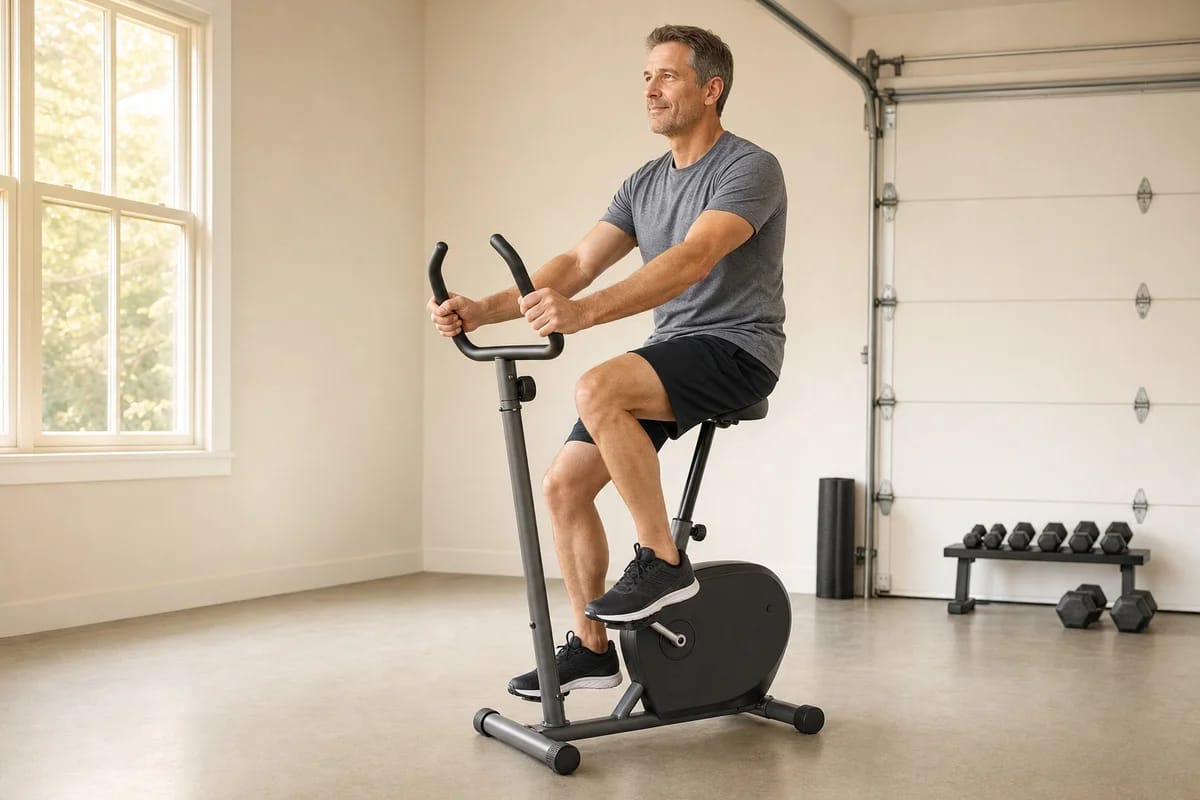
Five minutes of a general raise. Easy cardio that warms your whole body and lifts your heart rate: a bike, a rower, a brisk walk, a few minutes of anything that keeps moving. You want a light sweat and warmer tissue. You do not want to arrive at the bar tired.
Two or three minutes of dynamic mobility. Take the joints you're about to load through their full range, actively, without stopping in a position. Before squats that's bodyweight squats, leg swings, hip circles. Before pressing it's arm swings and band pull-aparts. You're moving each joint through the shapes the lift will demand, which prepares the tissue and rehearses the pattern in the same couple of minutes.

Two to four ramp-up sets. Start well under your working weight and climb to it in steps, dropping reps as the load rises. For a working set of five, that might be the empty bar, then roughly 50%, 70% and 85% of your target, a few reps each. These sets warm the muscles you're about to use, prime them, and let you feel the groove while the weight is still light enough to forgive a sloppy setup.
That's it. If you're breathing hard or your legs feel heavy before the first working set, you've done too much.
Why each piece is in there
Four things change while you warm up, and every part of that list is aimed at one of them.
The first is heat. Muscle is a chemical engine, and warm chemistry runs faster. As the tissue heats, the enzymes that release energy speed up, blood flow rises, and the muscle gets more pliable. A warm muscle also contracts and relaxes faster, which is what you want the moment a heavy bar starts moving.
The second is your nervous system. Lifting isn't only muscle, it's the signal that fires the muscle. Warming up speeds up nerve conduction and lets you recruit more fibers, sooner, once the weight gets real.
The third has a heavy name and a simple mechanism: post-activation potentiation. Contract a muscle hard and it fires better for a short window afterward. Part of the reason is that a hard contraction sticks phosphate groups onto proteins inside the muscle, which makes them more sensitive to the calcium signal that tells them to fire. A few progressively harder efforts leave the muscle briefly primed to do more.
The fourth is rehearsal. A squat is a motor skill, and your nervous system runs a skill better after a couple of practice reps. Ramp sets let you find the balance point while the weight is still forgiving.
None of that would count for much if it didn't show up in performance. It does. Pooled across 32 studies, an adequate warm-up improved performance in 79% of the measures researchers tested, with little sign of it hurting anything.1 That's a wide net across a lot of different tests. It doesn't mean any warm-up works, since one that leaves you tired or eats half an hour has its own cost, but the direction is settled.
Does stretching first really make you weaker?
There's a real difference between moving a joint through its range and parking in a stretch and holding it. Only the second one costs you.
A 2013 review in the Scandinavian Journal of Medicine and Science in Sports pooled 104 studies on stretching before exercise, and held stretches cut maximal strength by about 5.4% on average, with smaller drops in power and explosive work.2 Two things seem to be behind it. The muscle briefly can't contract as forcefully, and the muscle-tendon unit changes how it stores and gives back energy, so you get less of the spring.
The size of the hold is where the practical advice lives. That same review found the losses were minimal when each stretch stayed under about 45 seconds.2 A quick stretch before you lift won't wreck anything. It's the long, still, thirty-seconds-a-side routine right before a heavy set that costs you.
So keep your long holds. Move them to after your session, or to a day of their own, where they take nothing away from the lifting.
The effects are smaller than they sound
A 5% strength drop sounds alarming until you notice it's an average, and that it fades within minutes. It matters if you're chasing a near-maximal single or a peak power effort. If you're doing sets of eight at a moderate weight and you like a gentle stretch first, the cost to your actual training is close to nothing.
The injury case is softer than the performance case, and it's fair to say so. One review of the randomized trials found five of them: three showed warming up reduced injury risk, two showed no effect.3 The reasonable read is that the evidence leans toward fewer injuries without being strong enough to promise them. Warm up because it makes you lift better and probably keeps you healthier, not because it's insurance against getting hurt.
When you need more than ten minutes
Three things push the number up. Older muscle and connective tissue take longer to warm through, so past 50, give yourself more time on the general raise. Early-morning sessions need a longer ramp than afternoon ones, when you've already been moving for hours. And a heavy triple needs more preparation than a light set of fifteen.
Treat the template as a floor and add to it. The rule that doesn't move: a warm-up that leaves you tired has failed at its job. It's competing with the session it's supposed to set up. If you want to see where those sessions sit across a week, here's what a longevity week of zone 2 and strength looks like.
Common questions
Do I actually need to warm up before lifting? For anything moderately heavy, yes. Across 32 pooled studies, performance improved in 79% of the measures tested after a proper warm-up, and warming up probably lowers injury risk on top of that. The closer the weight is to your max, the more those ten minutes earn their place.
Is stretching before a workout bad? Long static holds right before you lift can knock about 5% off your maximal strength for a few minutes, so they're a poor fit ahead of a heavy set. Anything under about 45 seconds per position barely registers. Move the long holds to after training or a separate day, and use dynamic movement before you lift.
How long should a warm-up take? Usually ten to fifteen minutes: about five minutes of easy cardio, a couple of minutes of dynamic mobility, then two to four ramp-up sets. Older lifters, early mornings and heavy days push it toward the long end. If you're gassed before your first working set, you've overdone it.
What are ramp-up sets and why do they help? They're lighter versions of the set you're about to do, climbing toward it in steps while the reps drop. They warm the specific muscles you're about to use, leave your nervous system briefly primed to fire harder, and let you rehearse the movement while the weight is still forgiving.
Ten minutes you'll be tempted to skip
Warm-ups get cut when you're rushed, and the cost is invisible on the day: a slightly worse first set, a slightly shakier setup, nothing that looks like a problem. The other awkward bit is that the adjustments worth making are small and specific. Adding a ramp set because your third rep drifted forward, or dropping mobility work that isn't doing anything for you, is easy to spot from outside and hard to judge from inside your own body.
That's the part our coaches do live. At Bespoke Fit every session is 1-on-1 HD video with a real coach who builds the warm-up around what you're lifting that day, watches your ramp sets, and changes the plan from what they see. Your first month is $49, founding members pay $299 a month locked for life, and there are 25 founding spots. You can see how a session runs on the how it works page, and we've written about why a coach watches every rep instead of reviewing a clip the next day.
The cheaper version is the template above, run on your own with a notebook, and that's the right call while your lifts are moderate and your setup already feels stable.
Sources
-
Fradkin AJ, Zazryn TR, Smoliga JM, 2010. Effects of warming-up on physical performance: a systematic review with meta-analysis. Journal of Strength and Conditioning Research. ↩
-
Simic L, Sarabon N, Markovic G, 2013. Does pre-exercise static stretching inhibit maximal muscular performance? A meta-analytical review. Scandinavian Journal of Medicine & Science in Sports. ↩ ↩2
-
Fradkin AJ, Gabbe BJ, Cameron PA, 2006. Does warming up prevent injury in sport? The evidence from randomised controlled trials? Journal of Science and Medicine in Sport. ↩
More on