Deadlift form: 6 cues and 7 fixes for barbell or kettlebell
Six cues for a clean deadlift with a barbell, kettlebell or dumbbells, the seven faults that show up most from the side, and the fix for each.
In this article9
The lift in one line
Stand with the weight over the middle of your feet. Hinge down, grip it, flatten your back, then push the floor away with the weight brushing your legs until you're standing tall. Lower it the same way, hips first.
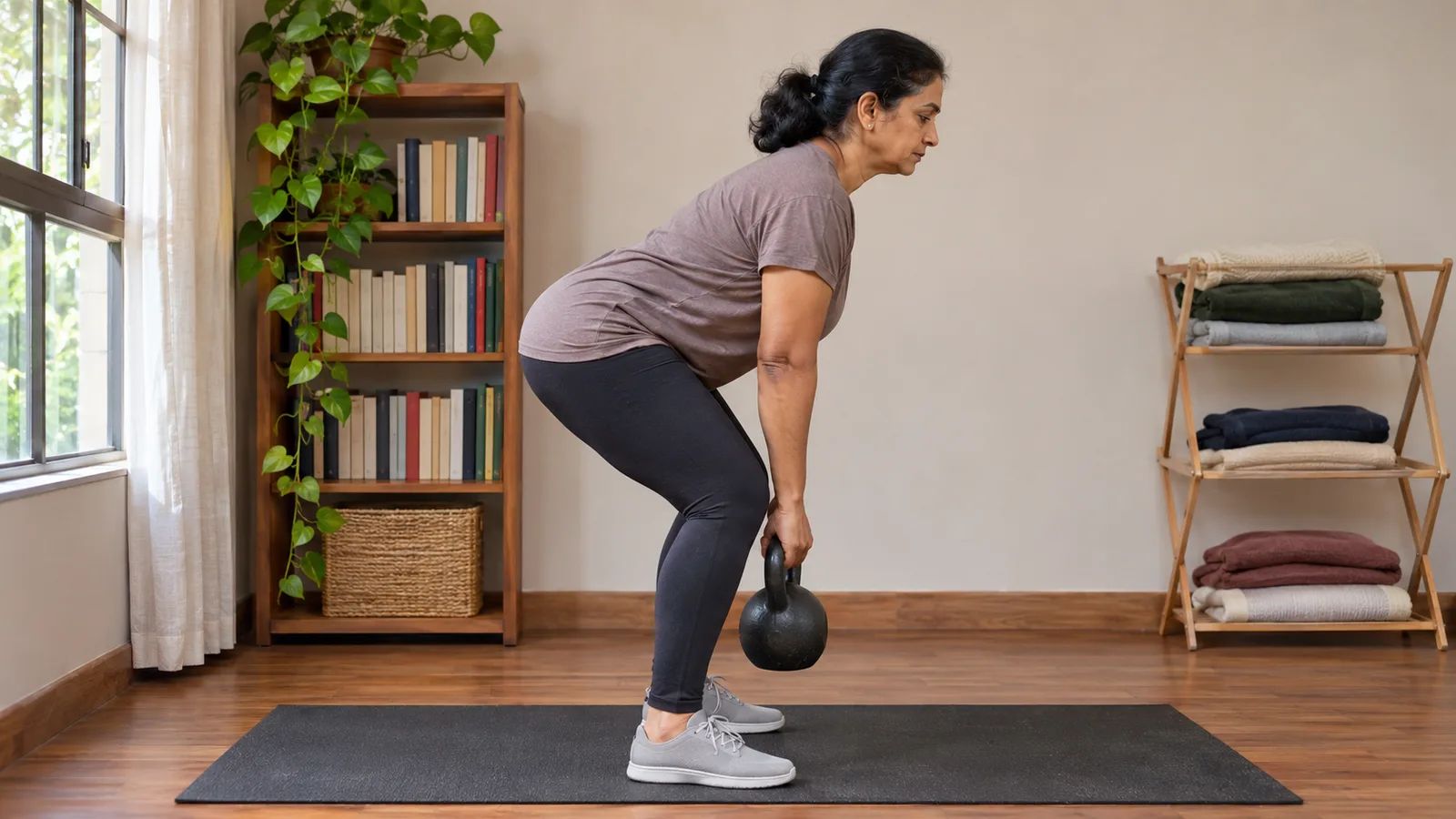
That's the whole lift, whether it's your first time near a barbell, you've got one kettlebell in a spare room, or your back was sore after your last session and you want to know why. The drawing is the position to check before every rep, because most problems later in the lift start here.
The checkpoints are the same with a kettlebell or dumbbells. Only where the weight sits changes, and cue 1 covers that.
The six cues, in order
Stand with the weight over the middle of your feet
Feet about hip width, the stance you'd jump from, toes forward or turned out a little. Barbell: about an inch (2 to 3 cm) from your shins, roughly over your laces. Kettlebell: on the floor between your feet, handle in line with the middle of your foot. Two dumbbells: beside your feet, handles in line with the middle of your foot.
Hinge down to it
Push your hips back and bend your knees until your hands reach the weight. On a barbell, your shins come forward to touch it, or nearly. Grip a barbell just outside your legs, palms facing you. A kettlebell takes both hands on the handle. Feels like: a stretch down the backs of your thighs, not a deep squat. If your hips are down near your heels, they've gone too low.
Flatten your back and set your shoulders
Lift your chest a little, keeping your shoulders slightly in front of the weight. Think "shoulder blades into your back pockets": the muscles under your armpits tighten, and that tension is what keeps the weight close later. Eyes on the floor about 6 feet (2 m) ahead, neck in line with your back. Feels like: tight under your armpits, long through your spine.
Breathe in, brace, take the slack out
Take a big breath into your belly and tighten your stomach as if someone's about to poke it. Then pull gently until the weight is just about to leave the floor. On a barbell you'll often hear it click up against the plates. Feels like: your whole body tightens before anything moves.
Push the floor away
Squeeze the weight off the floor rather than yanking it. Press through your whole foot, not your toes or heels, and let your hips and shoulders rise together, so your back keeps the same angle until the weight passes your knees. Keep it brushing your shins, then your thighs. Feels like: your legs doing the work, not your back.
Stand tall, then reverse it
Finish standing straight with your hips pushed through and your glutes squeezed. Shoulders end over your hips, not behind them. To lower it, send your hips back first and keep the weight close; your knees bend once it's past them. Let it settle on the floor, take a fresh breath, and set up the next rep from cue 3.
If your grip gives out before your legs do, that's normal. Lifting straps, or a mixed grip (one palm facing you, one facing away), both fix it. Lift in flat shoes or socks rather than soft running shoes, which squash under the weight. A belt can wait; you don't need one to learn the lift.
Will deadlifts hurt your back?
Done at a weight you can control, a deadlift is an ordinary strength exercise. Even in competitive lifting sports, injury rates are low compared with common team sports.1
Sore hamstrings and glutes a day or two later are normal, especially in your first few weeks. If it's mainly your lower back that aches, the usual culprits are your hips shooting up first or the weight drifting away from your legs. Both are in the table below, and both are fixable.
A little rounding isn't the cliff edge it's often made out to be, either. When researchers pooled the studies, bending the lower back more while lifting wasn't found to make back pain more likely to start or to stick around.2 That evidence is thin and mostly from lab lifting tasks, not heavy barbell training. So learn the lift with a flat back anyway: it's a shape you can repeat rep after rep, and it keeps the work on the muscles you meant to train.
If you have back pain right now, a past back injury, or pain, numbness or tingling that runs down a leg, see a doctor or physical therapist before you load this lift.
Seven faults and the fix for each
These are what you'd see on a clip filmed from the side. Most start in the setup, so the fix is often slowing down before the weight moves. The first is easiest to see in a picture.
| Fault | What you'd see side-on | The fix |
|---|---|---|
| Hips shoot up first | Your hips rise while your chest stays down, so the weight is still on the floor and you're now in a stiff-legged position | Take the slack out before you pull (cue 4). Start with your hips a touch higher. Go lighter and slower |
| Back rounds as the set goes on | Flat on rep 1, curved by rep 5 | Drop the weight, brace before every rep, and end the set when the shape changes |
| Weight drifts away from your legs | A gap opens between the weight and your shins or thighs | Shoulder blades into back pockets (cue 3), and think of dragging it up your legs |
| Squatting it | Hips start low, knees push forward, and the bar has to travel around your knees | Raise your hips, bring your shins closer to upright, check the weight is over mid-foot. The wall drill below teaches the hinge |
| Yanking it off the floor | The weight jumps, your arms snap straight, your back moves before your legs | Take the slack out and squeeze it off, slower than feels necessary |
| Leaning back at the top | Shoulders end behind your hips, lower back arched | Squeeze your glutes and stand straight. Upright is the finish; there's no extra credit for leaning |
| Knees bend first on the way down | The bar bumps into your knees as you lower it | Hips back first, and bend your knees only once the weight has passed them |
Fault two is the one that creeps up on you. Why form breaks under fatigue covers when to stop a set and a slow-lowering drill that helps.
Which deadlift for the equipment you own
All of these are real deadlifts. Pick the one you have.
| Equipment | Why it's good | Watch for |
|---|---|---|
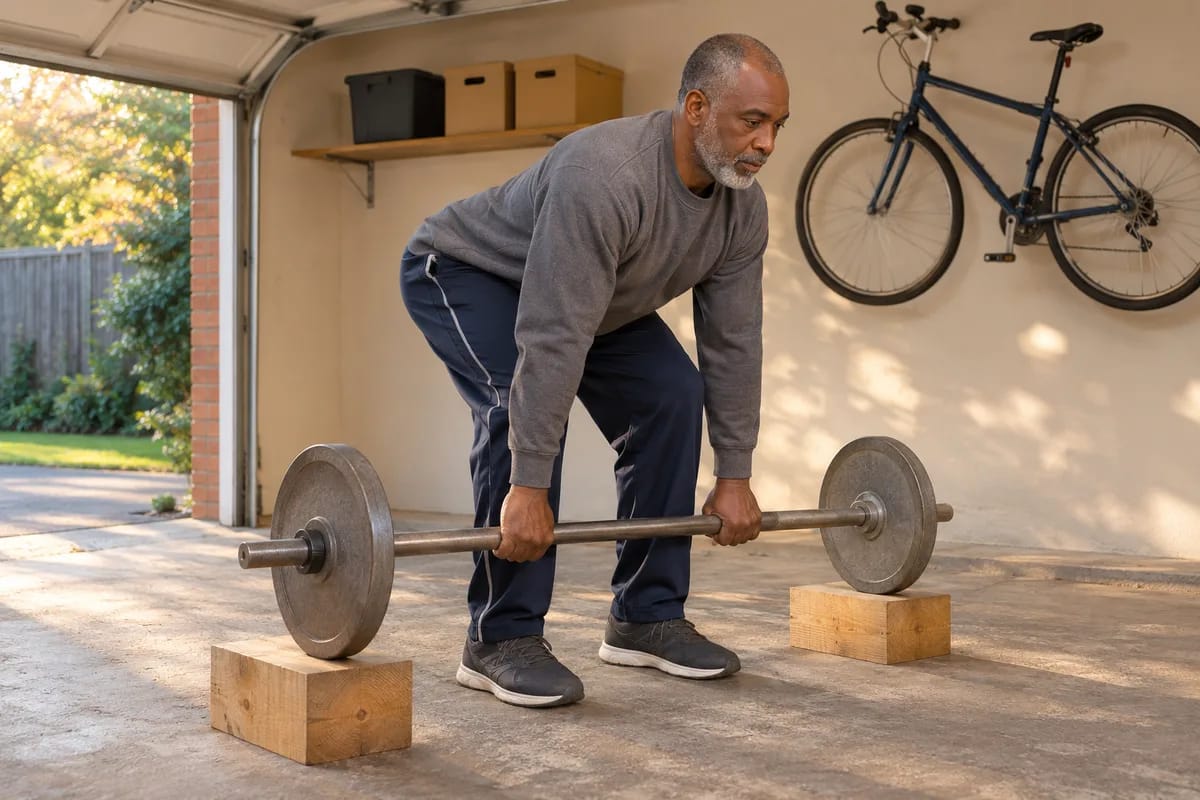
| Barbell | Loads up in small steps. The empty bar is usually 45 lb (20 kg); many gyms also have a lighter 33 lb (15 kg) bar | Full-size plates put the bar about 9 inches (23 cm) off the floor, the height the lift is built around. Smaller plates sit lower, so raise the bar on blocks or stacked plates |
| Trap (hex) bar | You stand inside the frame with a handle at each side, so the weight stays in line with you | Your knees do more of the work, so it feels a bit closer to a squat. That's fine |
| One kettlebell | The weight sits right under you, so it's easy to keep close. One of the friendliest ways to learn | A light bell is easy to "squat" up. Keep the hinge, and move up a size once it's easy |
| Two dumbbells | Most home setups already have a pair | Light dumbbells sit low, so the bottom asks for more bend than a barbell. Set them on a sturdy low step, or do the Romanian version |
| One weight at one side (suitcase deadlift) | Your trunk has to stop you leaning toward the weight, which is the point | Keep your shoulders level, and do both sides |
A trap bar is a good place to start, not a lesser lift. In a small lab study of experienced male powerlifters, they lifted more with a trap bar than a straight bar, with less load on the lower back and hips.3 That's a reason to try one, not proof it's safer for beginners, but if your gym has one, use it.
You'll also see sumo deadlifts: feet wide, toes turned out, hands inside your knees. It's a legitimate style, not a cheat, and most of the cues carry over. Try both and keep the one that feels strongest.
Deadlift or Romanian deadlift?
Plenty of "deadlift" videos and home plans actually teach a Romanian deadlift. Neither is wrong; they're different lifts.
Deadlift
- Starts on the floor
- The weight comes to a dead stop every rep
- Knees bend as much as it takes to reach the weight, hips above knees
- The heavier of the two for most people
Romanian deadlift
- Starts standing, weight in front of your hips
- Goes down only as far as your back stays flat, often to just below the knee
- Knees softly bent, and they stay that way
- The weight never touches the floor between reps
If a tutorial taught you to stop at the knee with a slight knee bend, you've been doing a Romanian-style lift, and you can keep doing it. Most dumbbell plans, including our dumbbell leg workout, use it because it works with weights that sit low on the floor. The flat back, the brace and the finish (cues 3, 4 and 6) apply to both.
If pushing your hips back without squatting feels strange, try this: stand with your back to a wall, heels about a foot (30 cm) from it, knees soft. Push your hips back until your bottom touches the wall, then stand up. Shuffle a few inches further away and repeat.
Check your own lift
Prop your phone sideways at hip height, side-on, and film your last set. Where the phone goes has the details. Pause the clip at the start of a rep and hold it against the drawing at the top, then watch the whole set for the faults in the table.
When a clip isn't enough
A clip shows you the fault once the set is over, and it can't tell you what to change next week. With Bespoke Fit you train on a live video call, at home or wherever you lift, and a real coach is on it for every session, watching through your camera. They see your hips start to rise on rep 3 and tell you before rep 4 leaves the floor. Each coach has 12 members at most, so yours remembers how last week's deadlifts moved. They also write your program, so when to add weight is their call, not a guess.
It's 14 days free, then $299/mo for unlimited sessions. If you already film your sets and enjoy fixing them yourself, you may not need it. Here's how live 1‑on‑1 video training works.
How heavy, how many, how often
Start lighter than you think you need. Pick a weight you could lift about 10 times with clean form and do 2 or 3 sets of 5 with it. On a barbell, people usually start around 65 lb (30 kg) all in, about what it takes to bring the bar up to height with plates. That leaves plenty in the tank, which is the point while you're learning. When every rep of every set looks like your first, add a little: 5 to 10 lb (2 to 5 kg) on a barbell, or the next size up of kettlebell or dumbbell. Keep adding until a set of 5 leaves you only 2 or 3 good reps to spare (rating reps in reserve explains how to judge that). For starting weights by lift, see how much weight to start lifting with.
Once or twice a week is plenty, because the deadlift works a lot of muscle in one go. Warm up with a set or two of the same lift at a lighter weight first.
Common questions
How much should you bend your knees in a deadlift?
As much as it takes to reach the weight with your hips above your knees and your shins close to it. That's more bend than a Romanian deadlift, where your knees stay softly bent and don't change. If you've seen "about 20 degrees", that advice is for a version that stops at the knee, not one that starts on the floor.
What are good deadlift alternatives?
A Romanian deadlift, a trap bar deadlift, a kettlebell deadlift and a single-leg Romanian deadlift all train the same hip hinge. A glute bridge or hip thrust works your glutes and hamstrings without the weight in your hands, which makes it a useful swap while you're still learning the hinge.
Is deadlifting good for weight loss?
It helps, but not by burning the fat off directly. No single exercise does that, and what you eat decides most of what the scale does. Lifting earns its place by helping more of what you lose come from fat rather than muscle, so you end up stronger as well as lighter.
Sources
-
Keogh and Winwood, 2017. The epidemiology of injuries across the weight-training sports. Sports Medicine. ↩
-
Saraceni and colleagues, 2020. To flex or not to flex? Is there a relationship between lumbar spine flexion during lifting and low back pain? A systematic review with meta-analysis. Journal of Orthopaedic and Sports Physical Therapy. ↩
-
Swinton and colleagues, 2011. A biomechanical analysis of straight and hexagonal barbell deadlifts using submaximal loads. Journal of Strength and Conditioning Research. ↩