How to do a proper push-up, even if you can't do one yet
Hands just wider than your shoulders, one straight line, elbows angled back, chest to a fist from the floor. The faults to fix, and the ladder to your first.
In this article7
A proper push-up
Hands a bit wider than your shoulders, body straight from head to heels, elbows angled back like an arrow, not out like a T. Lower until your chest is a fist from the floor, then push the floor away until your arms are straight.
That's the standard, and it's the same whether your hands are on the floor, on a kitchen counter or you're on your knees. Can't do one on the floor yet? That's very common, and the ladder further down shows exactly where to start. Already doing them but something feels off? Jump to what goes wrong.
One good rep, start to finish
Set your hands
Lie face down with your palms flat on the floor beside your armpits. Slide each hand out by one hand's width, fingers spread and pointing forward. Now your hands are a little wider than your shoulders and roughly under them. Don't go wide for "more chest": in a Mayo Clinic study, wide hands made the chest work less, not more, than a narrow grip.1 Narrower than this is fine too, if your wrists and elbows like it.
Press up into a straight line
Straighten your arms, feet together or hip-width apart. If someone laid a broomstick along your back, it would touch the back of your head, the spot between your shoulder blades and your tailbone.
Brace
Squeeze your glutes and tighten your stomach as if someone's about to poke you in the ribs. That's what holds the line once your arms get tired.
Lower with your elbows angled back
Bend your elbows so they point back toward your hips, about 45 degrees from your sides. Your shoulder blades slide together as you go down. Breathe in and take about 2 seconds.
Touch a target, not the floor
Roll up a bath towel until it's about as tall as your fist and put it under your breastbone. Touch it lightly with your chest on every rep, chest first, not your chin or your hips. Lower is fine if your shoulders like it; the point is a target you can still feel on rep 12.
Push the floor away
Rise in one piece, hips and shoulders together, breathing out. At the top, straighten your arms without slamming into them, then push a touch further so your shoulder blades spread apart. That last push works the muscle that keeps them steady.2
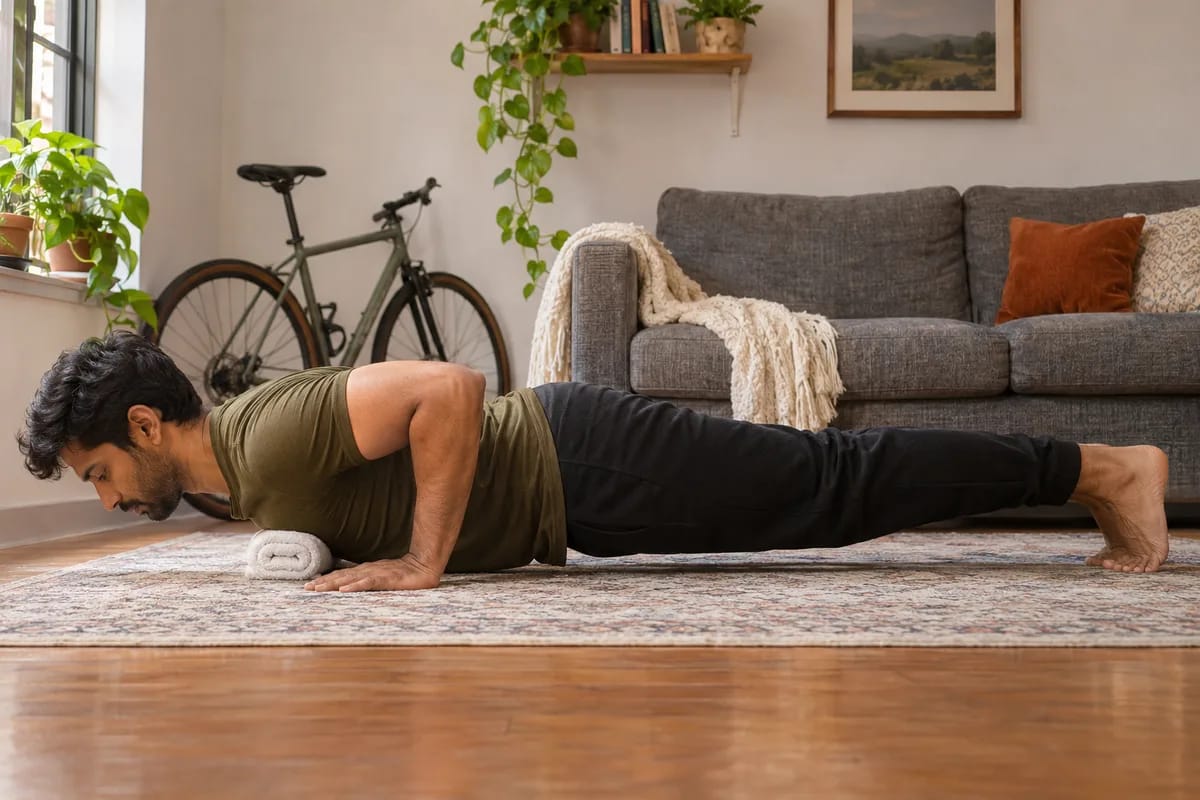
Should your elbows be tucked? Somewhat. We couldn't find a study that pins down one best angle, so "45 degrees" is a coaching habit, not a lab number, and we're happy with anything between the arrow and arms close to your sides. The T is the one to drop; if your elbows keep drifting out to it, bring your hands in a little.
What goes wrong, and the fix
| What you see | Why it happens | The fix |
|---|---|---|
| Hips sag, belly reaches the floor first | Your trunk tires before your arms do | Squeeze your glutes before each rep. Still sagging by the last few? Raise your hands one rung |
| Hips up high, like a tent | Shifting weight to your feet makes it easier | Lower your hips until the broomstick line comes back. Can't hold it? Raise your hands instead |
| Chin reaches for the floor | Your head is chasing depth | Look at the floor a few inches ahead of your hands. Chest touches the towel, not your nose |
| Reps get shorter as the set goes on | Your hands carry the most weight at the bottom,3 so the last inches go first | Count only reps that touch the towel. When they stop touching, the set's done |
| Hands creep out ahead of your shoulders | They drift between reps | At the bottom, your forearms should be close to vertical. Hands up toward your head load the inside of your elbow more4 |
| Shoulders shrug up to your ears | A tired upper back | Keep a long neck and your shoulders away from your ears |
Most of these show up only near the end of a set, which is why form breaks under fatigue and not on rep one. To catch them, prop your phone on the floor side-on for one set, then film a second set from in front of your head to check your elbows. Filming your lifts has the other camera setups.
Can't do one yet? Start higher
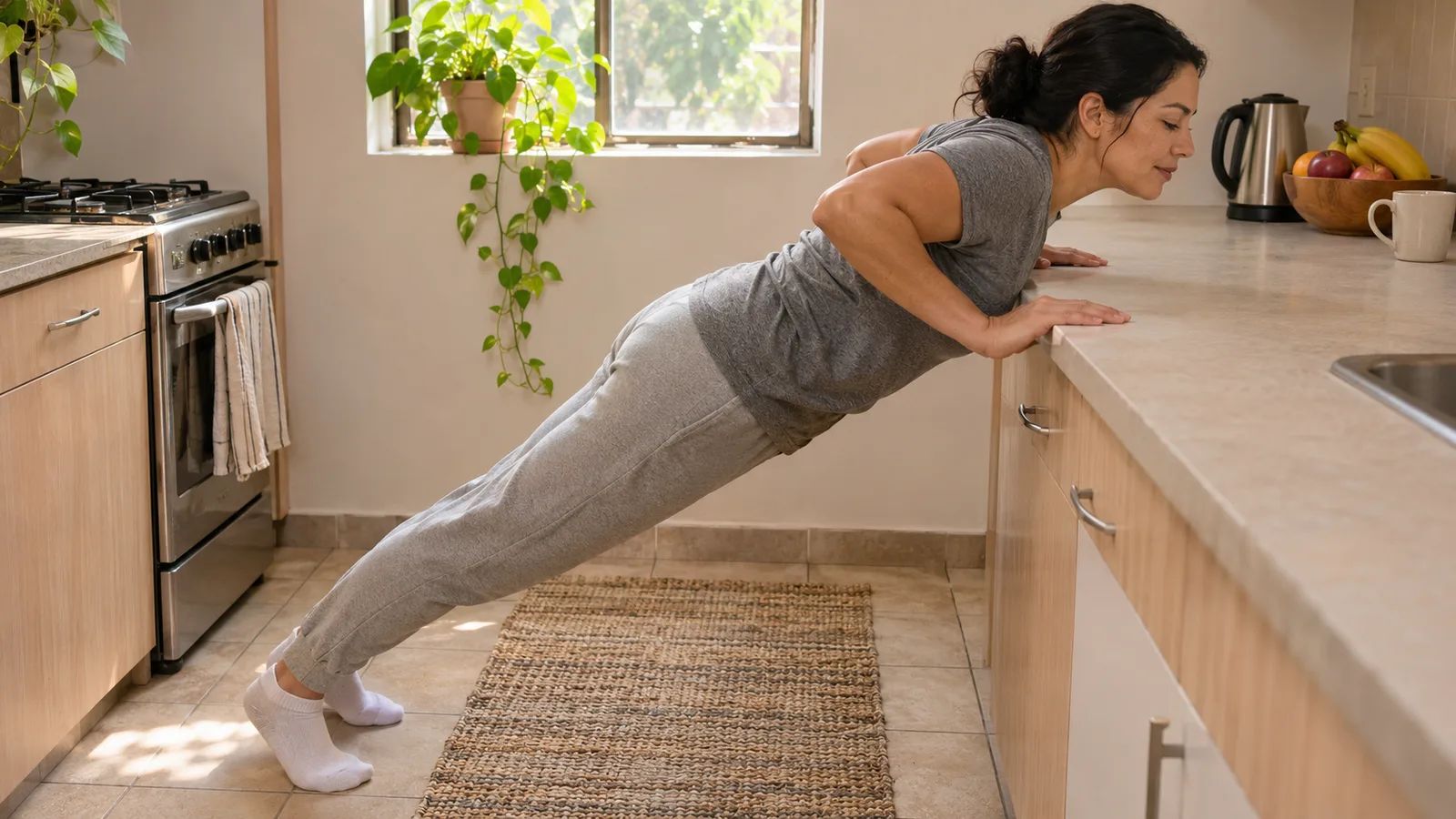
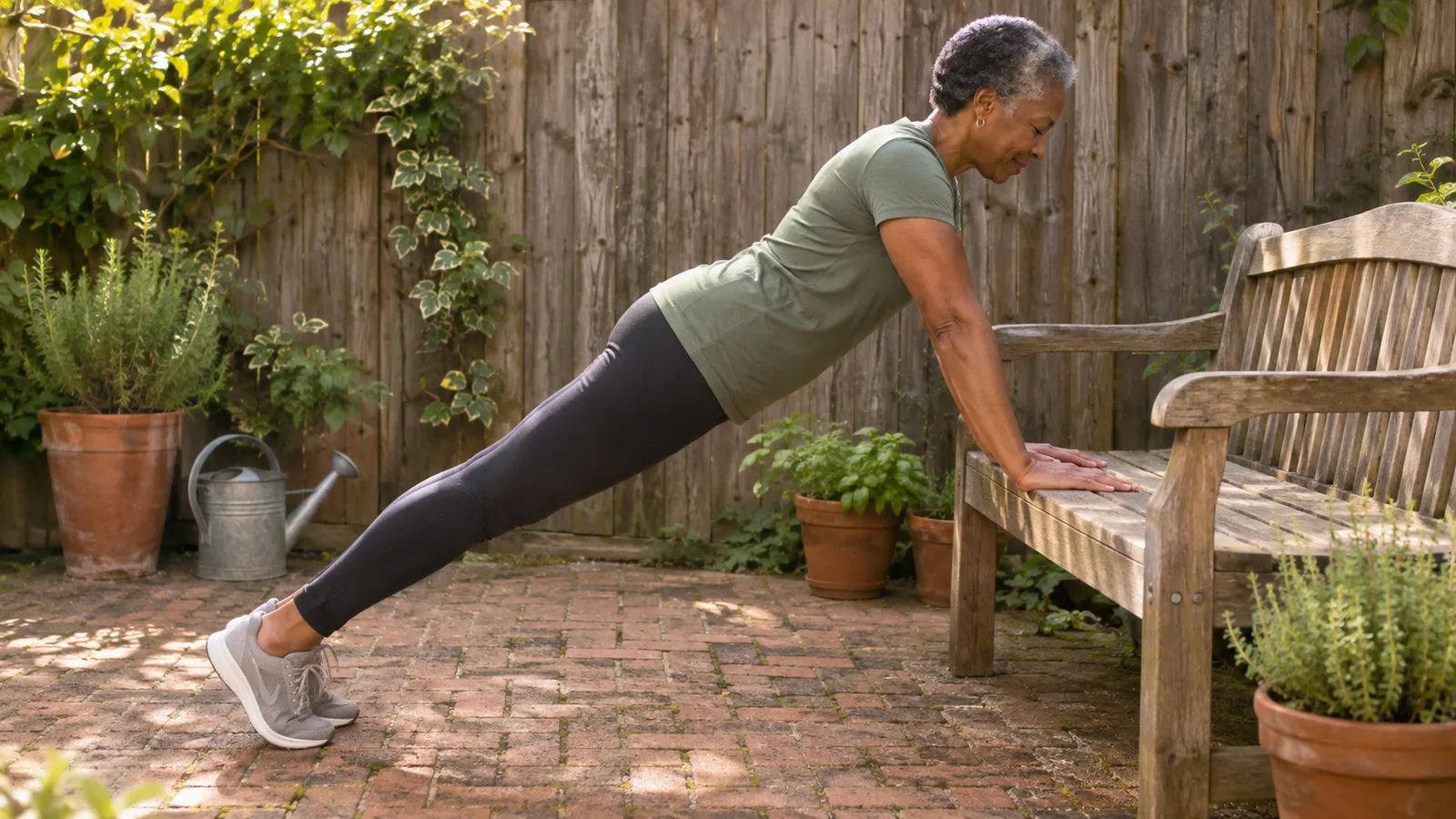
Not being able to do a floor push-up isn't a verdict on you. It's a load problem, and load is easy to change: raise your hands and less of your body weight lands on them. Researchers measured how much with a force plate under people's hands.5
| Rung, lightest first | Share of your weight on your hands | For a 160 lb (73 kg) person |
|---|---|---|
| Wall, then kitchen counter, about 36 in (91 cm), then table, about 30 in (76 cm) | under 41% | under 66 lb (30 kg) |
| Hands on a 24-inch (61 cm) box | 41% | about 66 lb (30 kg) |
| Dining chair seat, about 17 to 19 in (43 to 48 cm), back against a wall | about 48%, our estimate | about 77 lb (35 kg) |
| Knees on the floor | 49% | about 78 lb (36 kg) |
| Hands on a 12-inch (30 cm) box | 55% | about 88 lb (40 kg) |
| Bottom stair, about 7 in (18 cm) | about 59%, our estimate | about 94 lb (43 kg) |
| Floor push-up | 64% | about 102 lb (47 kg) |
| Feet on a 12-inch (30 cm) box, then a 24-inch (61 cm) box | 70%, then 74% | about 112 lb (51 kg), then 118 lb (54 kg) |
Bold rows were measured in recreationally fit adults; the rest are our estimates from their height. Trust the order more than the exact numbers. At home, feet on a stair and then a chair seat do the job of the last row.
Knees aren't the easiest step: they land just past a chair seat, between the two boxes. And knees to floor is a big jump, from about 78 to 102 lb (36 to 47 kg) for that 160 lb person, which may be one reason people stall on their knees. The bottom stair sits inside that gap. Use it.
Start on the rung where your last two or three reps are slow and hard but still clean. When your first set reaches about 25 clean reps, lower your hands one rung. That sounds like a lot, but each measured step down adds 10 to 14 lb (about 5 to 6 kg) to your hands, and it pays to arrive with reps to spare.
How long it takes depends on where you start and how often you train. The full method has a worked example: kitchen counter to first floor push-ups in about 15 weeks, at twice a week.
The bridge from knees to floor is slow lowering. Start at the top of a floor push-up, lower yourself to the towel over 3 to 5 seconds, then drop your knees and push back up from there. Do 2 sets of 3 to 5 at the end of a session, on top of your normal rung. When the whole way down feels controlled, try a full floor rep.
How many, and how often
Two or three days a week, two or three sets, with a day off between. End each set with one to three good reps still in you; that's reps in reserve, and it keeps the sag and the short reps out of your practice.
Balance the pushing with pulling, like a row, so your upper back gets as much work as your chest. A dumbbell back workout has rows you can do at home without a bench. Wondering if your number is any good? How many push-ups you should be able to do has the norms by age.
Sore wrists, cranky shoulders
A push-up bends your wrist back under a lot of weight. If that's what aches, keep the wrist straight instead: grip a pair of hex dumbbells (they won't roll), push-up handles, or make fists on a folded mat. Raising your hands a rung also takes weight off both the wrists and the shoulders, so stepping up for a few weeks is a fair trade. Some shoulders like the hands a little narrower or turned slightly out. Try a few positions on easy reps.
If a push-up causes sharp pain, pain inside the joint itself, or pain that's still there the next day, or you have a known shoulder, elbow or wrist problem or a recent operation, ask a physical therapist which version suits you before you push through it.
When a coach is watching the set
A towel and a phone on the floor will get you a good push-up. If you're working down the ladder on your own and it's going well, keep going. What's hard alone is catching a fault while it's happening, and keeping a 15-week climb going when nobody would notice if you stopped.
Bespoke Fit sessions are live 1‑on‑1 video calls with your own coach, in our app on iPhone, Android or a browser. Each one is booked for a set time with your coach waiting on the call, so stopping means telling a person who's expecting you, not quietly drifting off.
Picture a set of counter push-ups with your phone propped side-on. Around rep 6 your hips start to drop. Your coach says "glutes, hips up" while you're still in the set, and the last reps are clean. They count only the reps that reach the towel, and if the sag comes back, they move your hands up a rung on the spot. Coaching that reviews your workout afterwards can't do that mid-set: when our founder tried it, the feedback came about a day and a half later.
The push-ups are a few minutes of a whole-body session your coach writes for you, so next week's rung is already on your calendar, set from what they saw. A coach who's live on every session can only hold so many people, so ours have 12 members each at most. Yours remembers which rung you finished on, and if your wrist flares up midweek, you can message them before the next session and they'll plan around it.
- As many sessions as you like, one price. Sessions run 45 to 90 minutes, and most people settle at around an hour.
- 14 days free, then $299 a month, cancel anytime. At two sessions a week that's about $35 a coached session, at three about $23; what personal trainers cost has the comparison. You start with a 30-minute call with a head coach, who matches you to your coach.
It isn't in-person training, and there's no nutrition coaching. Whether a trainer can really check your form over video covers what the camera catches and what it doesn't.
Common questions
Are push-ups better than the bench press?
Neither is better on its own. In a small eight-week trial with 18 young men, push-ups matched to the load of a light bench press built similar chest and triceps muscle and bench strength.6 The bench is easier to load heavy as you get stronger. Push-ups need no equipment.
Is 20 push-ups in a minute good?
Most push-up charts count reps done without stopping, not in a minute. On the chart most sites copy, which credits the American College of Sports Medicine, 20 in a row from your toes is average for men in their 30s or 40s and women in their 30s. It's above average or better for women from 40 and men from 50.7
Sources
-
Cogley RM, Archambault TA, Fibeger JF, Koverman MM, Youdas JW, Hollman JH, 2005. Comparison of muscle activation using various hand positions during the push-up exercise. Journal of Strength and Conditioning Research. 40 adults, one rep in each hand position, muscle activity measured with surface electrodes. ↩
-
Kowalski KL, Connelly DM, Jakobi JM, Sadi J, 2022. Shoulder electromyography activity during push-up variations: a scoping review. Shoulder and Elbow. Serratus anterior, the muscle along your ribs that steadies the shoulder blades, was most active in the "push-up plus" (that extra push at the top) and in incline push-ups. ↩
-
Suprak DN, Dawes J, Stephenson MD, 2011. The effect of position on the percentage of body mass supported during traditional and modified push-up variants. Journal of Strength and Conditioning Research. 28 strength-trained men, held positions. ↩
-
Donkers MJ, An KN, Chao EY, Morrey BF, 1993. Hand position affects elbow joint load during push-up exercise. Journal of Biomechanics. A small lab study of nine healthy men; the inner-elbow (valgus) torque rose when the hands were placed higher, toward the head ("superiorly"). ↩
-
Ebben WP, Wurm B, VanderZanden TL, Spadavecchia ML, Durocher JJ, Bickham CT, Petushek EJ, 2011. Kinetic analysis of several variations of push-ups. Journal of Strength and Conditioning Research. 23 recreationally fit adults; peak vertical force at a 2-second rep. The percentages are from Table 1 of the conference version (ISBS proceedings). The pounds, and the chair and stair estimates (straight-line between the measured heights), are our arithmetic. ↩
-
Kikuchi N, Nakazato K, 2017. Low-load bench press and push-up induce similar muscle hypertrophy and strength gain. Journal of Exercise Science and Fitness. 18 young men, twice a week for 8 weeks, both groups at about 40% of their bench press maximum; the authors call the two "comparably effective". ↩
-
Topend Sports, Push-up test, read November 12, 2026. Norms "based on ACSM (American College of Sports Medicine) research", untimed, reps done "until exhaustion"; the page says the norms are for standard push-ups "on toes". Men 30 to 39 average 20 to 24, 40 to 49 average 16 to 20, 50 to 59 above average 18 to 24, 60 and over above average 17 to 23. Women 30 to 39 average 14 to 21, 40 to 49 above average 17 to 23, 50 to 59 above average 14 to 20, 60 and over good 19 to 22. ↩