Low-impact workouts: 3 no-jump routines and a weekly plan
Low impact means nothing lands hard, not that it's easy. Jump-free swaps for every move, three home routines, a sample week, and what to add for your bones.
In this article8
A low-impact workout keeps at least one foot on the ground, or lets something else carry your weight: a bike seat, a rowing machine, the water. Nothing lands hard. That's the whole definition, and it says nothing about how hard you work. You can get as fit as you like without ever leaving the floor.
The usual options: walking (flat or uphill), an exercise bike, a rowing machine, an elliptical, swimming or water walking, strength training, and Pilates or yoga. They don't all work you equally hard, and the chart below shows which ones can stand in for a run.
There's one thing worth adding back, and it isn't jumping. Your bones want load, and the low-impact way to give them some is to lift things. The plan below includes it.
Whatever brought you here (a knee that didn't love the jump squats, a neighbor downstairs, or plain dislike of bootcamp videos), this page has the no-jump version of moves you already know, three workouts, a week that covers everything and what to do when a joint complains.
Low impact isn't low effort
Each walking step hits the ground with roughly 1 to 1.5 times your body weight; running takes it to about 2 to 2.9 times.1 Low impact cuts that. It does nothing to cap how hard your heart and lungs can work.
In the chart, sitting on the sofa scores 1. Anything from 6 up counts as vigorous, and running is there for comparison.23
Read that as a ceiling, not a promise: the hard bike and rower efforts are ones few people hold in week one, and nobody needs to. But a bike, a rower or an elliptical can work you as hard as a run, and a steep walk gets you into vigorous, without a single landing. At the other end, mat Pilates and gentle yoga sit under 3: good for mobility, control and your core, not a stand-in for cardio.
You don't need a watch to judge your own effort. Use the talk test.4
- Moderate: you can talk, but you couldn't sing.
- Vigorous: you can't say more than a few words without stopping for a breath.
If you're here to lose weight, a no-jump workout done hard can use as much energy as a jumping one. Past that, the workout you'll still be doing in March beats the one you dread, and for a lot of people the jumping was the dread.
The no-jump version of moves you already know
Follow-along videos are full of jumping. Here's the swap for each move, so you can keep using the videos you like.
| If the video says | Do this instead | How |
|---|---|---|
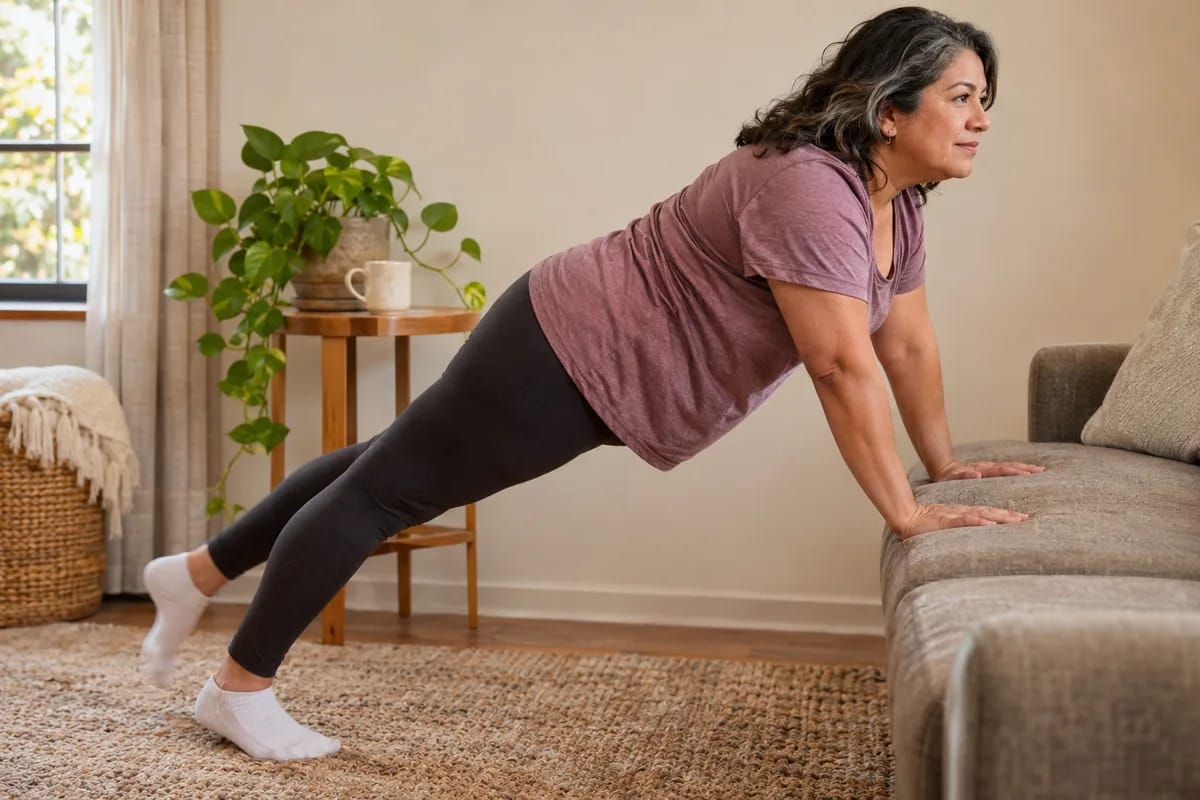
| Burpees | Step-back burpees | Hands on the floor, or on a sofa seat to make it easier. Step one foot back, then the other, into a plank. Step in, stand up tall. |
| Jumping jacks | Step jacks | Tap one foot out to the side as both arms go up, then the other. Speed up once you have the rhythm. |
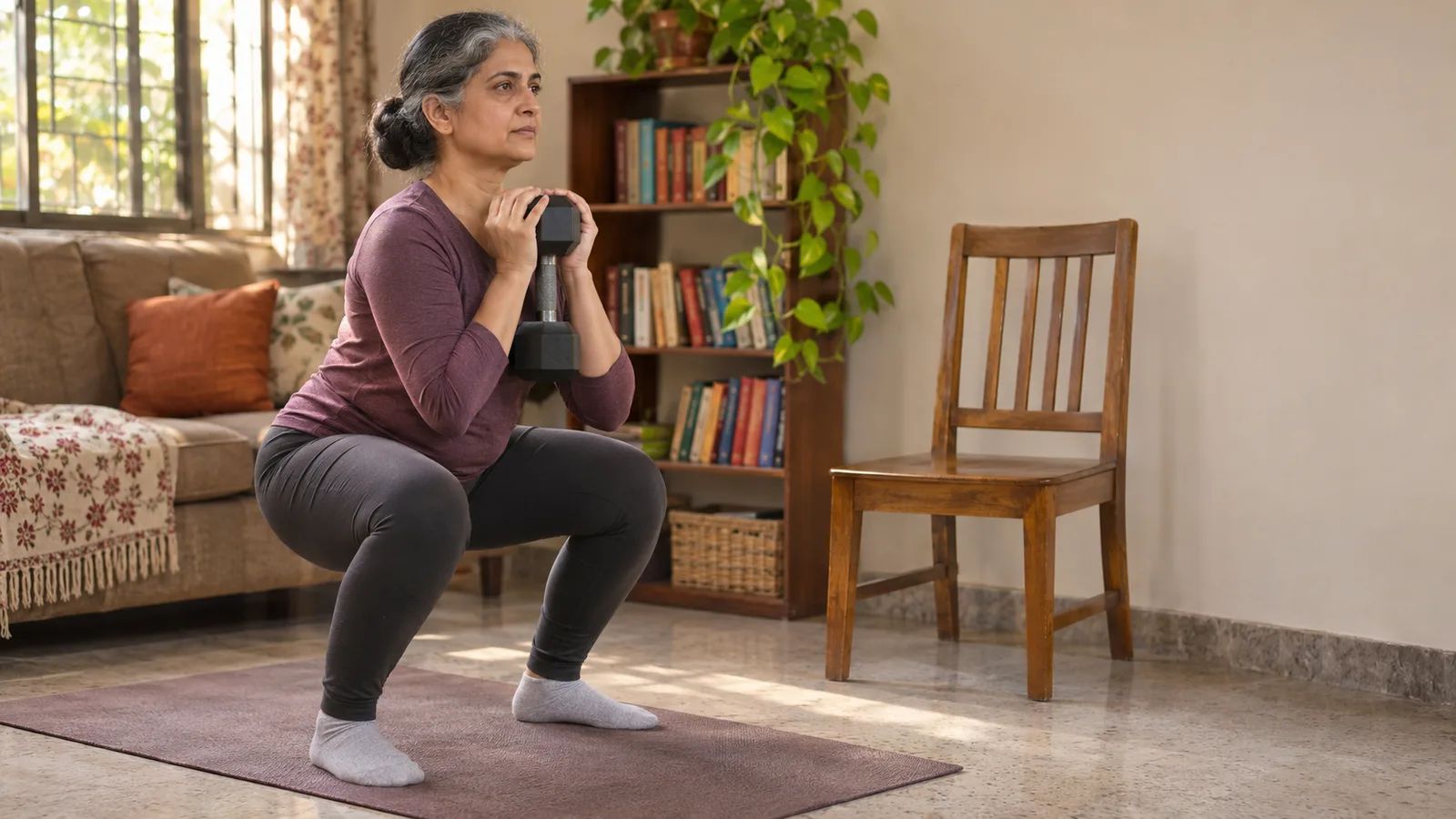
| Jump squats | Squat to calf raise | Squat, then drive up onto your toes at the top. All the push, none of the landing. |
| High knees | Fast march | Knees toward hip height, arms pumping, as quick as you can stay quiet. |
| Jump rope | Fast step-touch | Step side to side, quickly, turning your wrists as if you held the rope. |
| Mountain climbers | Slow knee drives | Plank with your hands on the sofa or a sturdy bench, then bring one knee in at a time, under control. |
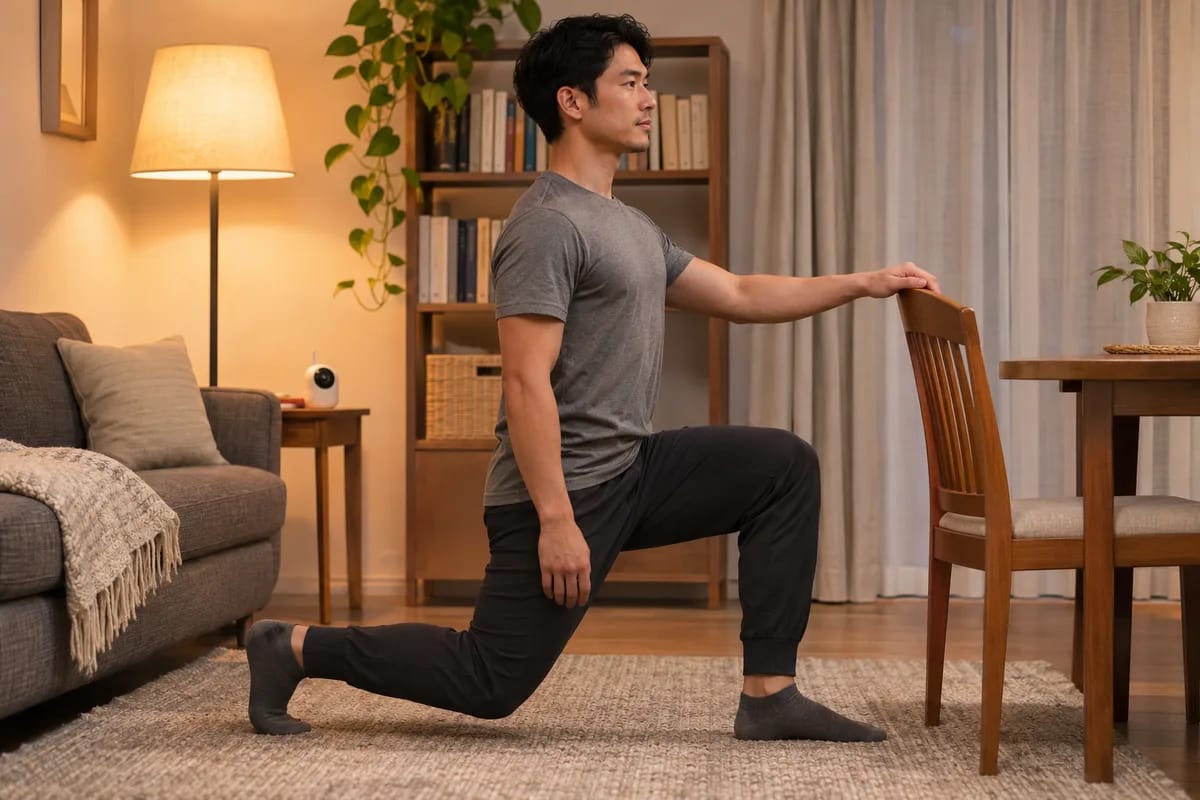
| Jump lunges | Reverse lunges | Step back, lower, push back up through the front foot. Hold a chair if your balance wobbles. |
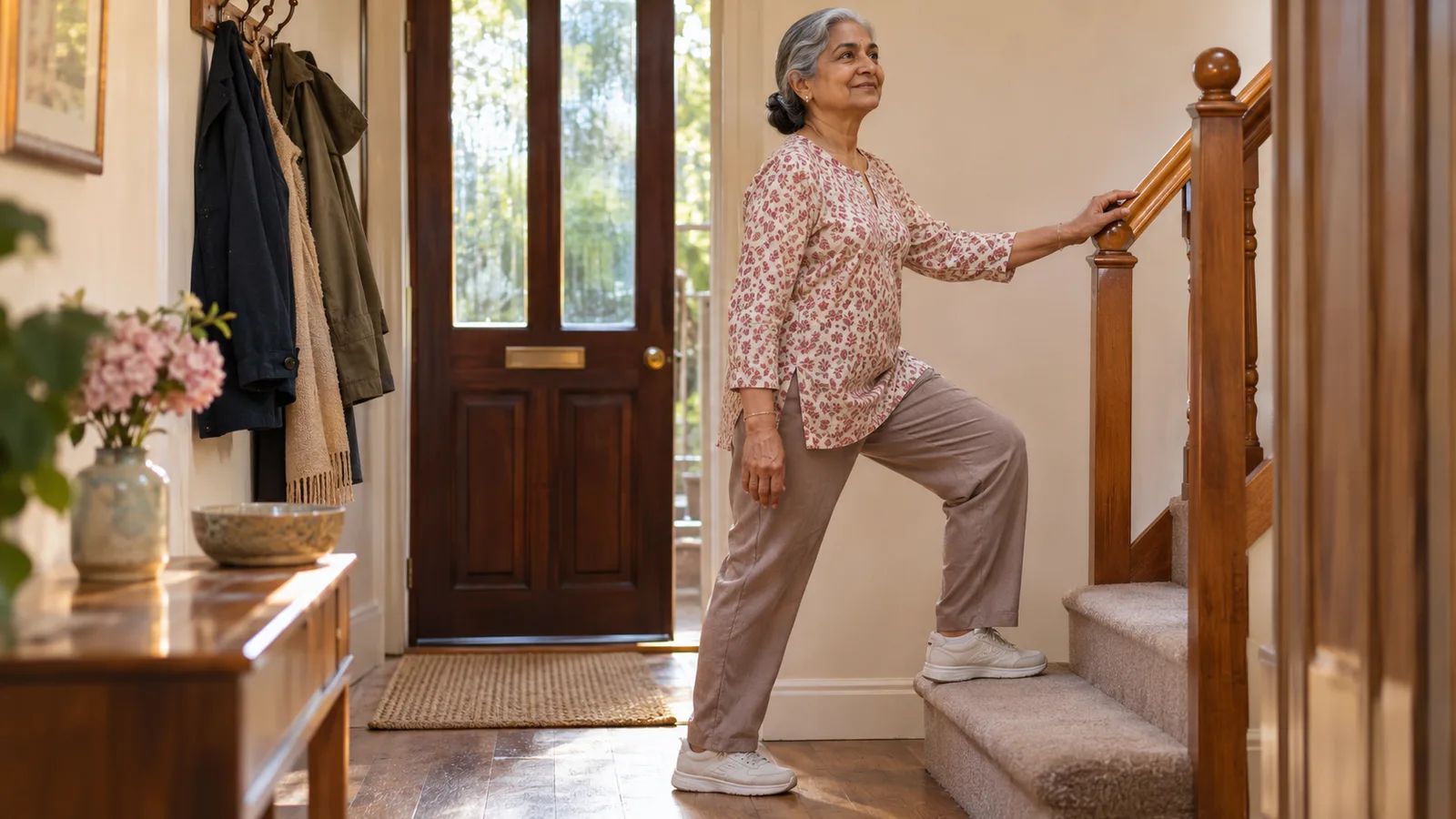
| Box jumps | Step-ups | The bottom stair or a sturdy step. Push through the whole front foot and step down softly. |
| Running | Brisk or uphill walk, bike, rower, elliptical | Workout 3 below works on any of them. |
No landing also means no thud for the people downstairs. Do these on a rug or a mat, in socks or soft shoes. Weights make a different kind of noise, and lifting in an apartment covers floors, mats and dropped dumbbells.
Three workouts for this week
Each one has a different job: the first is cardio for a small room, the second builds muscle, and the third is for days you have a machine or a hill.
1. A 20-minute standing circuit
No equipment, no jumping, and nothing on the floor: the burpees use a sofa seat.
Warm up for 3 minutes
March on the spot, then add big arm circles. For the last 30 seconds, stand on one leg, then the other, with a hand near a counter if you need it. That's your balance work for the day.
Set an interval timer: 40 seconds on, 20 seconds off
Work for the 40. Use the 20 to breathe and set up the next move.
Do one round of five moves from the table
Step jacks, squat to calf raise, step-back burpees with your hands on the sofa seat, fast march, reverse lunges (switch legs halfway).
Run the talk test at the end of the round
If you could sing, go faster or deeper next round. If you can't get three words out, ease off.
Do two more rounds
Three rounds is 15 minutes. Take up to a minute between rounds if you want it.
Cool down for 2 minutes
Walk around the room until your breathing settles.
2. Strength with a chair and two dumbbells
Lifting is about as low impact as exercise gets. Your feet hardly move and every weight is lowered under control. Warm up with the first three minutes of workout 1, one-leg stands included. Choose a pair you could deadlift and row about 15 times. For the squats and the press, hold one dumbbell, or none, if the pair is too much. No dumbbells yet? Water bottles or a backpack with a few books will do for the first weeks, and a resistance band works for the row and the press.
| Move | Sets × reps | How |
|---|---|---|
| Sit-to-stand | 3 × 8 to 12 | Sit back to a chair, touch it lightly, stand. Hold a dumbbell at your chest once it gets easy. |
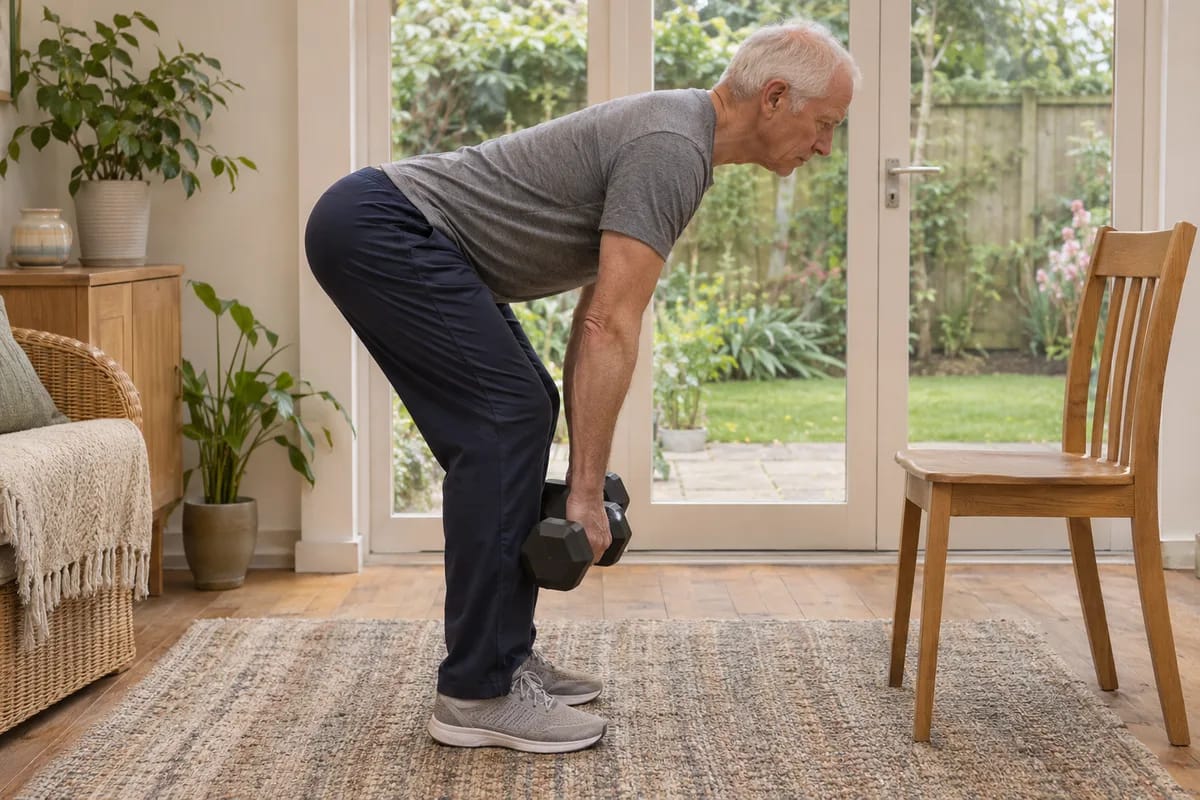
| Romanian deadlift | 3 × 8 to 12 | Dumbbells in front of your thighs. Push your hips back, knees soft, until you feel the backs of your legs, then stand tall. |
| One-arm row | 3 × 8 to 12 each side | One hand on the chair seat. Pull the dumbbell up toward your hip. |
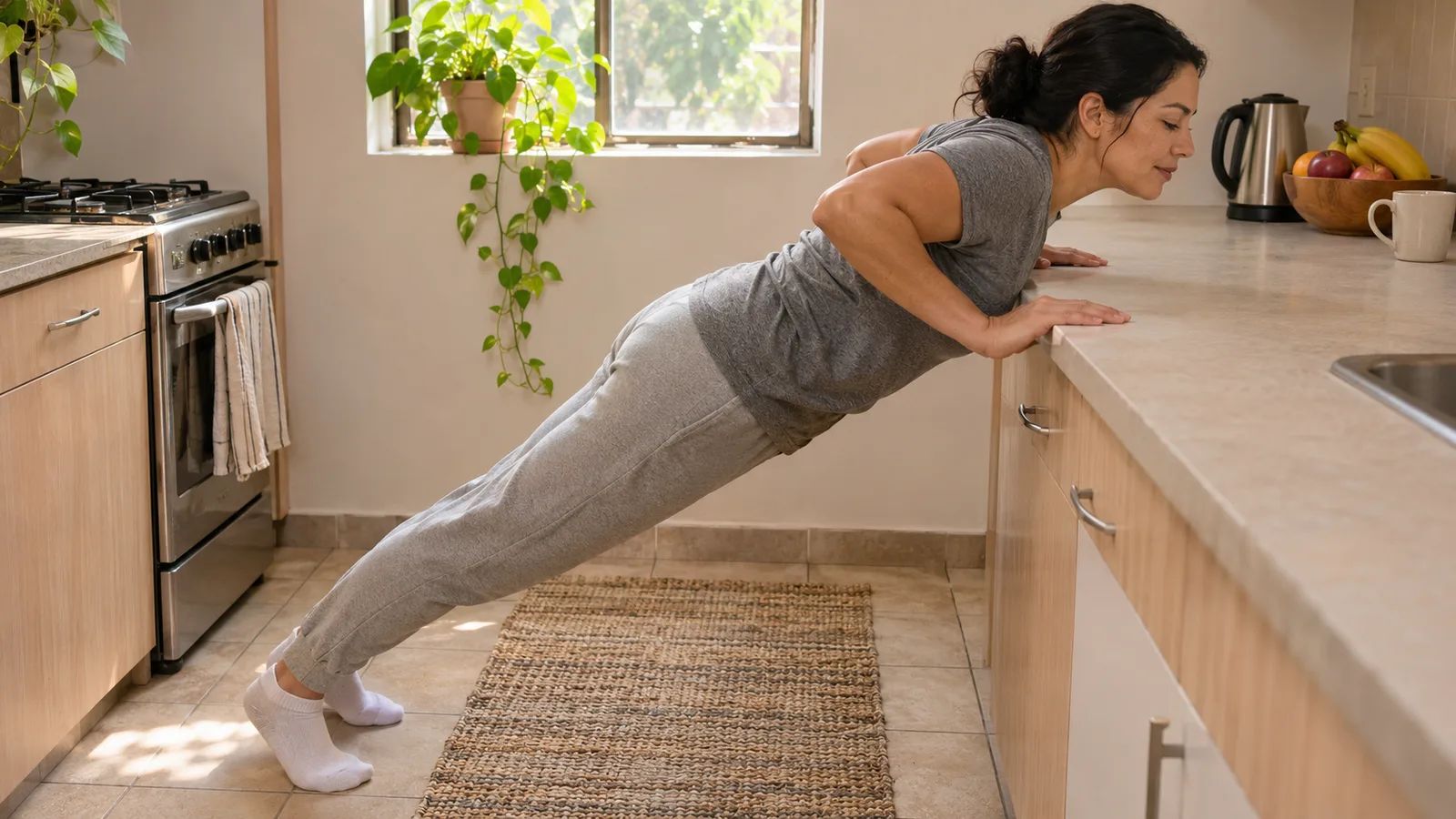
| Incline push-up | 3 × 6 to 12 | Hands on a kitchen counter or a table edge. The lower the surface, the harder it gets. |
| Overhead press | 3 × 8 to 12 | Sitting or standing, press the weight up, ribs down. |
| Split squat | 2 × 8 each side | One foot forward, one back, and lower straight down. Hand on the chair back. |
| Carry | 3 × 30 seconds | A dumbbell in each hand. Walk around the room, tall and slow. |
Rest about a minute between sets. End each set with two or three reps you could still have done; that's a coaching rule of thumb rather than a lab finding, and it keeps the work hard without wrecking you. The whole session takes 35 to 45 minutes.
3. A machine day, or a hill
A bike, a rower, an elliptical, a treadmill on an incline, or a long hill outside all take the same plan.
| Easier version | Harder version | |
|---|---|---|
| Warm-up | 5 minutes easy | 5 minutes easy |
| Main part | 5 rounds: 2 minutes where you can talk but not sing, then 2 minutes easy | 8 rounds: 1 minute where you can only get a few words out, then 1 minute easy |
| Cool-down | 5 minutes easy | 5 minutes easy |
| Total | 30 minutes | 26 minutes |
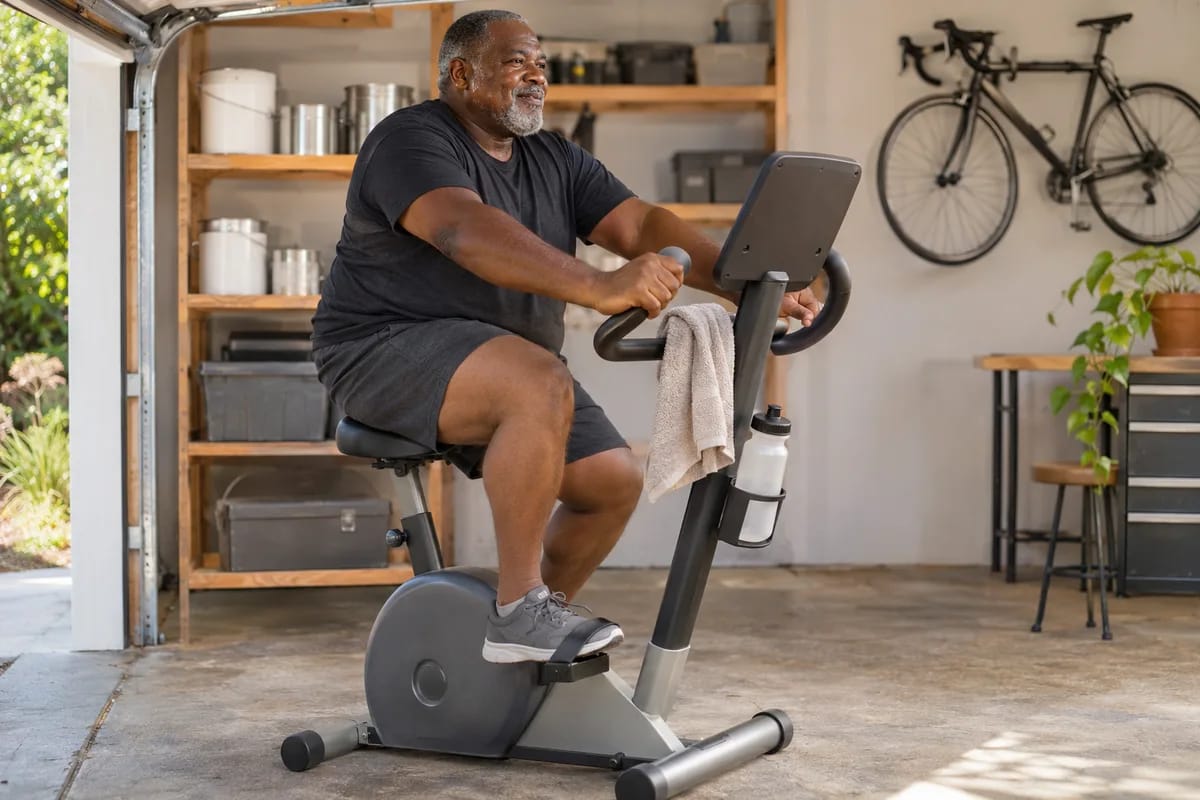
Use whatever you have and don't mind.
- Exercise bike: the easiest to start on, and you can watch something while you ride. Set the seat so your knee stays slightly bent at the bottom of each pedal stroke.
- Rower: legs, back and arms in one movement. Push with the legs first, then lean back, then pull with the arms.
- Elliptical: you stay upright with your feet on the pedals the whole time, and the moving handles let your arms share the work.
- Uphill walking: on a treadmill incline or a real hill. Walk tall and let go of the handrails, since hanging on takes weight off your legs.
- The pool: for people who love water, or who like being held up by it. Water walking is as easy or as brisk as you make it, and laps can be as hard as you want.
A week with no jumping that covers everything
The US guidelines ask adults for at least 150 minutes a week of moderate activity, or 75 of vigorous, plus strength work for all the major muscles on two or more days. Older adults are asked to add balance training.2 Only the brisk minutes count, the ones where you couldn't sing, so warm-ups, cool-downs and the easy stretches between intervals are left out of the tally below.
| Day | Session | Brisk minutes |
|---|---|---|
| Monday | Strength (workout 2), then a 15-minute brisk walk | 15 |
| Tuesday | Machine day or a hill (workout 3, easier version) | 10 |
| Wednesday | A brisk walk, 45 minutes | 45 |
| Thursday | Strength (workout 2), then a 15-minute brisk walk | 15 |
| Friday | Standing circuit (workout 1), counting the 40-second bursts | 10 |
| Saturday | An hour of something you enjoy, kept brisk: a walk, a bike ride, a swim | 60 |
| Sunday | Rest, or an easy stroll |
That's 155 brisk minutes, two strength days, and one-leg balance work in three warm-ups. Choose the harder machine day and Tuesday counts as 16, since a vigorous minute counts as two moderate ones.
Too much for now? Start with the two strength days and two walks, and add a day every week or two. Short bouts count too, so a 10-minute walk after lunch goes on the tally.2
When something aches
Sore muscles a day or two after a new workout are normal for the first couple of weeks. They aren't a sign you did it right or wrong, and moving gently usually helps. There's more in sore is not the signal.
A joint is different. The University of Melbourne team behind a free knee exercise program gives a simple rule.5 It's written for knees; using it for other joints is our suggestion, and a sensible one.
- Some ache during or just after a session is common. It doesn't mean you're doing harm.
- Check the next day. If the joint is still worse than usual more than a day later, you did a bit too much too soon. Next time, leave that move out or make it easier, rather than stopping altogether.
- A severe increase in pain means stop and talk to your doctor or a physiotherapist before you carry on.
Easier, in this plan, means a higher chair for sit-to-stands, a shallower squat, a lower step, split squats holding the chair in place of reverse lunges, or less resistance on the bike.
How to make it harder without adding impact
Change one thing at a time, in this order.
- Reps. Work up to the top of the rep range on every set, still with two reps to spare.
- Tempo. Take three seconds on the way down and pause for a second at the bottom.
- A harder version. A lower chair, a lower surface for push-ups, a higher step.
- More weight. Then drop back to the bottom of the rep range and climb again.
For cardio, add five minutes, or one more round, or a bit more resistance, but only one of those in a week.
Can you build muscle with bodyweight alone? Yes, especially at the start; tempo and harder versions take you a long way before you need something heavier to hold. Progressive overload at home has more ways.
Bone: the one thing low impact leaves out
Swimming and cycling are great for your heart, lungs and joints. For bone density, they don't do much. A systematic review of the research on both found neither had a positive effect on bone mineral density, and called them "not the most suitable exercises" for preventing osteoporosis.6 Nothing in it suggests the pool builds bone.
Bone responds to load. The UK's Royal Osteoporosis Society says the best way to help your bones is to do both impact and strength exercises, because "as your muscles work, they pull on your bones."7
- Strength is the low-impact half. Workout 2 covers it, and how lifting builds bone explains why it works.
- The impact half can be small. The same charity counts heel drops, walking and stair climbing as impact exercise. So walking is low impact for your joints and still a gentle dose of impact for your bones. Heel drops (rise onto your toes, then drop onto your heels) are the next small step up, and training in your 60s has a graded ladder for them.
If you have osteoporosis, have broken bones before (especially in your spine), are recovering from a fracture or surgery, or are pregnant, ask your doctor or a physiotherapist which moves suit you before adding impact or load.
When a coach picks the swap for you
Everything above works on your own, and it's free. What a page can't do is pick the right version of a move for you on the day, or notice when low-impact training has quietly slid from hard to pleasant. That's easy to miss when you're the one doing it.
At Bespoke Fit, every session is a live 1‑on‑1 video call with your own coach, in our app on iPhone, Android or a browser. You prop your phone up in whatever room you train in, and your coach watches every rep through the camera, close enough to see a knee cave inward that you can't feel. Wear an Apple Watch or a Bluetooth heart rate strap and they see your heart rate live too.
A morning when your knee is grumpy
Your knee felt stiff on the stairs this morning, so you say so as the call starts. Your coach shortens your lunge step and has you hold the chair back. On the second set the knee is still drifting, so they switch you to split squats before the set is over. Later, on the bike, your heart rate sits in easy territory through an interval meant to be hard. Your coach asks for a little more resistance and one more round. You finish tired, not hurting. Thursday's session, already on your calendar, has the split squats in it.
Each session is a set time with a person waiting on the call, so skipping means telling someone. That's what keeps the habit going. Your coach has 12 members at most, and we hold to it when we assign coaches: twelve people training two or three times a week for about an hour is already 24 to 36 hours of live calls a week. So yours remembers last week's split squats, and you can message them between sessions, photos included.
You start with a 30-minute call with a head coach, who matches you to one of our coaches, each of whom spent 90 days in onboarding with our founder, Carl, before taking a member. Mention the knee on that call.
"I was skeptical about doing training over video at my age, but it has been much easier than I expected. My trainer is patient and adjusts everything to what my body can handle. I have exercised more in the past two months than in the last ten years. My friends can see the difference."
Wanda, 70, a Bespoke Fit member
What it costs, and who should skip it
14 days free, then $299 a month, cancel anytime. Sessions run 45 to 90 minutes at the same price, as many as you book, and most people settle at around an hour. Twice a week, that's about $35 a session; three times, about $23. A trainer paid by the session costs more each time you add one. Here a third session in a week costs nothing extra, so your coach plans what you need, not what you can afford.
We're on video, so nobody is there to steady you by hand. If you're rehabbing an injury, we'd suggest seeing a physio first and coming to us once you're cleared to train.
If follow-along videos or the pool already keep you going, stay with them. If $299 a month would strain things, a local low-impact or water aerobics class is a good, cheaper way to have someone expecting you. And if you're here to lose weight and want meal plans, we don't do nutrition coaching.
If you do start, the 14 days begin at your first session, not at signup, and a reminder goes out 3 days before the first charge.
Sources
-
Nilsson, J. & Thorstensson, A., 1989. Ground reaction forces at different speeds of human walking and running. Acta Physiologica Scandinavica. Twelve healthy men on a force plate. These are forces at the ground, not inside the joints. ↩
-
Piercy, K.L., Troiano, R.P., Ballard, R.M. and colleagues, 2018. The Physical Activity Guidelines for Americans. JAMA. Moderate is 3 to 5.9 METs (multiples of resting energy use) and vigorous is 6 or more; 150 to 300 minutes a week of moderate activity or 75 to 150 of vigorous, or an equivalent mix; muscle strengthening on 2 or more days; balance training for older adults; bouts of any length count. ↩ ↩2 ↩3
-
Herrmann, S.D., Willis, E.A., Ainsworth, B.E. and colleagues, 2024. 2024 Adult Compendium of Physical Activities: a third update of the energy costs of human activities. Journal of Sport and Health Science. The bars are mat Pilates; brisk walking at 3.5 to 3.9 mph; climbing hills with no load at a 6 to 10% grade, moderate-to-brisk pace; elliptical at a vigorous effort; running at 6 mph; a stationary bike at 151 to 199 watts; and a rowing machine at 150 to 199 watts. Values from the Compendium's conditioning, walking, running and bicycling tables (codes 02103, 17200, 17035, 02049, 12050, 01232 and 02073; Hatha yoga, 02150, is 2.3), read November 12, 2026. They are averages for a reference adult, for comparing activities, not for counting your calories. ↩
-
Centers for Disease Control and Prevention. Measuring physical activity intensity. The talk test for moderate and vigorous activity. Read November 12, 2026. ↩
-
University of Melbourne. My Knee Education. My Knee Exercise. Written for knee pain: some pain during or straight after exercise is a normal response; knee pain worse for more than a day afterwards means a bit too much too soon, so leave out or ease the exercise that caused it; a severe increase in pain means stop and see your health care provider. Read November 12, 2026. ↩
-
Abrahin, O., Rodrigues, R.P., Marçal, A.C. and colleagues, 2016. Swimming and cycling do not cause positive effects on bone mineral density: a systematic review. Revista Brasileira de Reumatologia (doi). Ten cycling studies and 18 or 19 swimming studies (the abstract and the results give different counts). From the full text's limitations: "Most studies analyzed in this systematic review had cross-sectional design (specifically in athletes)", and benefits such as "improved aerobic fitness, mitochondrial density, and balance" "cannot be ruled out". Read November 12, 2026. ↩
-
Royal Osteoporosis Society. Exercise for bones. Read November 12, 2026. ↩