Training in your 60s: power, balance, and bone
After 60 the goal shifts from size to fast force. Why power, single-leg balance, and bone loading matter more than gentle workouts, and how to train them.
Ask someone what lifting is for and they'll picture muscle size. That's not the goal once you're past 60. What keeps you living on your own terms is power (how fast you can produce force), balance on one leg, and bone that can take a real load without breaking.
The gentle workout, light weights moved slowly, feels like the safe choice at this age. It's usually the riskier one. Speed and balance fade first, and you don't get them back by going slow and easy. You get them back by moving with intent, on one leg, against a load that actually means something.
Your 50s were about recovery becoming the limiter. Your 60s are about what you're training for changing entirely. Not softer. Sharper.
Power goes before strength does
Grinding out a heavy, slow lift holds up reasonably well with training, even into your 60s and beyond. What goes first is the fast stuff.
A large review of the aging research found that muscle power fades earlier and more steeply than muscle strength, and that power predicts everyday function, getting out of a chair, climbing stairs, walking speed, better than strength does.1 Power is force times speed. You can keep most of the force while the speed quietly leaks away, and speed is the half that saves you.
Think about what a near-fall asks of you. You catch a toe on a rug and you have a fraction of a second to throw a foot out and drive it into the ground hard. That's not a strength problem. It's a power problem, specifically how fast you can go from zero force to a lot of it.
Strength is how much you can push. Power is how fast you can push it. After 60, it's the fast half that's slipping, and it's the half that keeps you upright.
Does moving fast matter more than moving heavy?
Your nervous system trains for whatever you ask of it. Lift slowly and you get better at lifting slowly. Ask for speed and it gives you speed back.
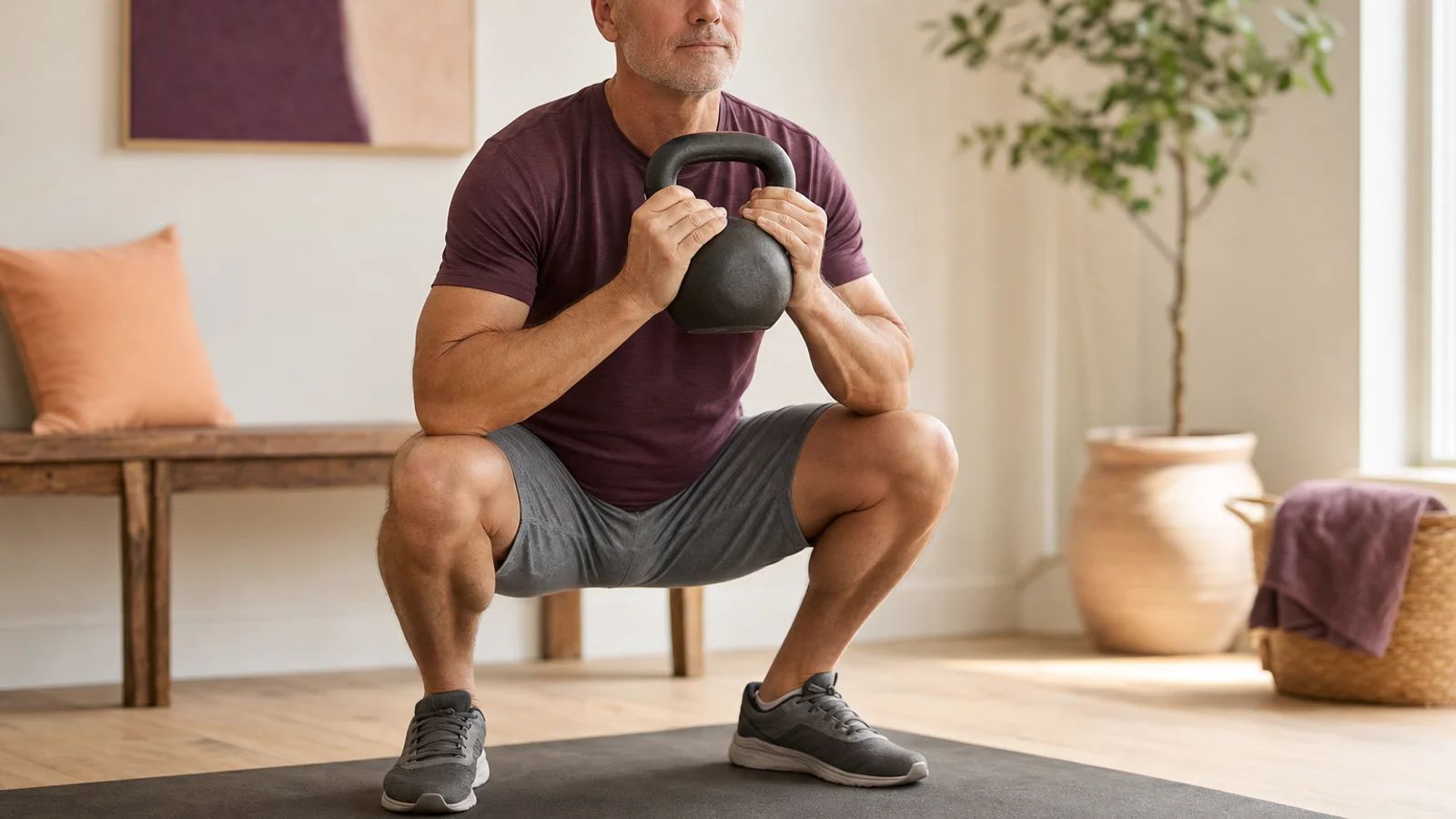
That's why the instruction changes in your 60s. You don't need a huge weight. You need to move whatever weight you're using with the intent to accelerate it, driving it up as fast as you can on the way out of the bottom of a squat or a press. The load can stay moderate. The intent has to be explosive.
A systematic review pooling 16 studies and roughly 800 adults over 60 found that training with the intent to move fast beat slower, submaximal lifting for functional performance, by a wide margin.2 The same review found the slower style built a bit more raw strength and size. The two goals pull in slightly different directions, and in your 60s, function is the one that matters more.
Moving the weight is no longer the whole job. Moving it fast on purpose is the other half, and that's the exact quality that fails with age.
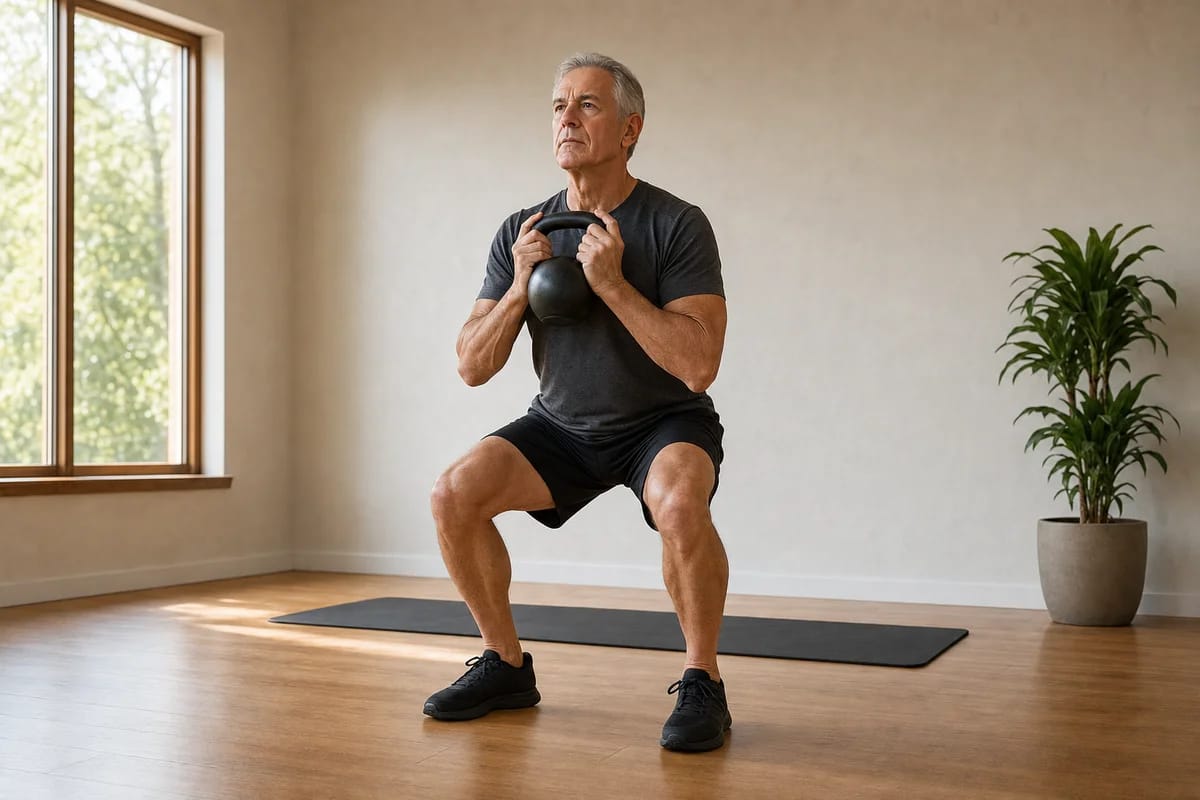
Nearly every fall happens on one leg
Almost nobody falls while standing on two feet. Falls happen mid-stride, on one foot, in the half-second your weight is committed to a single leg and something goes wrong.
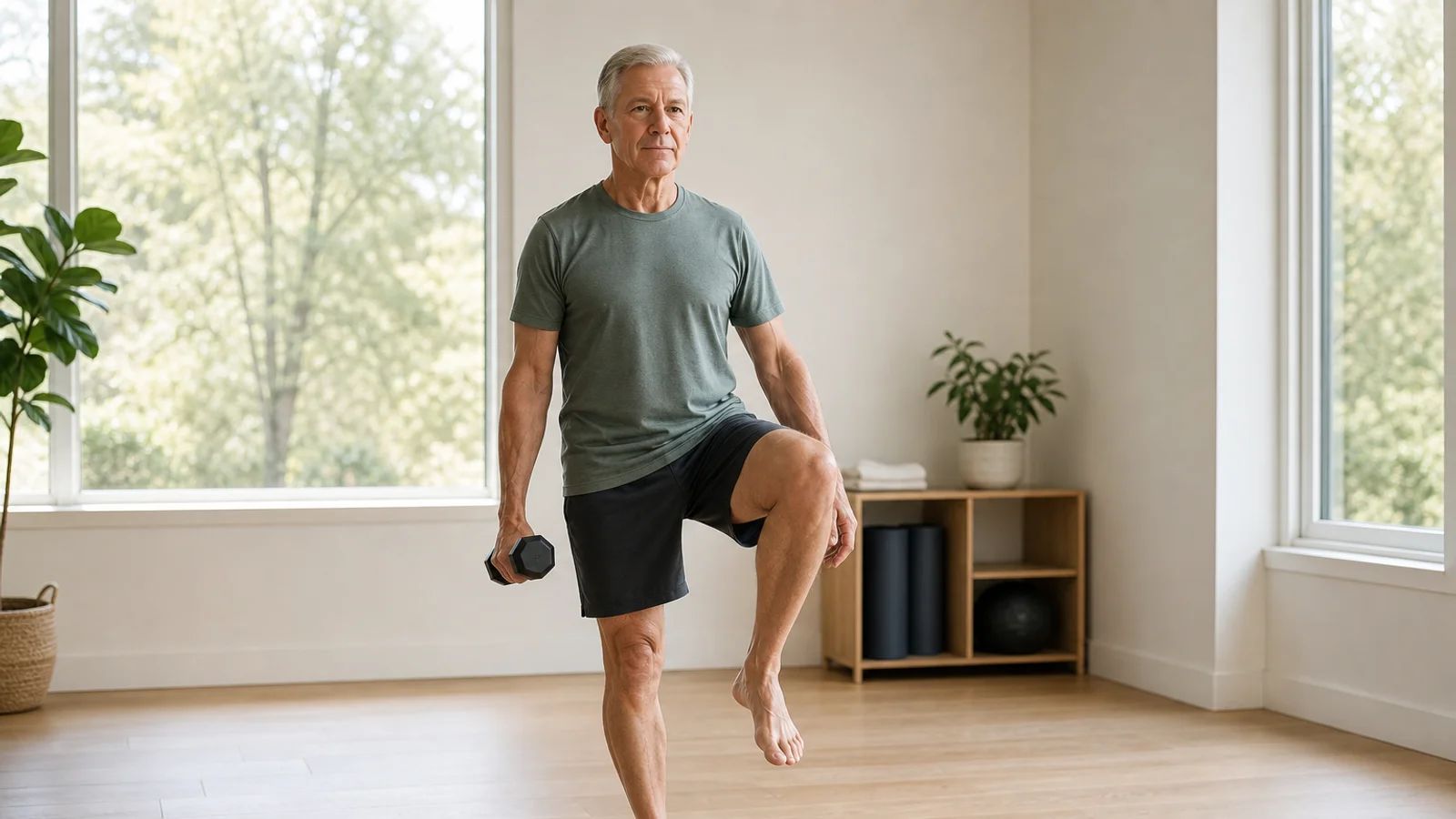
Two-legged exercises, however heavy, never put you in that position. The balance system that has to save you, the ankle, the hip, the reflex that fires a stabilizing muscle, never gets challenged where it counts. Single-leg work is how you train it: split squats, step-ups, single-leg stands, anything that forces one leg and your balance to hold the line together.
A 2019 Cochrane review of 108 trials and 23,407 community-dwelling older adults found that balance and functional exercise cut the rate of falls by about 24 percent.3 That's not a soft wellness effect. A quarter fewer falls, at this age, is the difference between staying independent and a hip fracture that changes everything.
You fall on one leg. So you train on one leg. Two-footed lifting alone leaves exactly the gap that trips you untrained.
Can lifting still build bone in your 60s?
Yes, and it's one of the few things that reliably does. Bone responds to being loaded hard. Gentle movement doesn't load it hard enough to register.
In the LIFTMOR-M trial, 93 men with low bone mass trained twice a week for eight months. The group doing heavy resistance work combined with impact raised their lumbar spine bone density by about 4.1 percent, while the control group barely moved, up 0.9 percent.4 Hip density climbed too. A companion trial in postmenopausal women found the same pattern; we cover that one in the 50s piece.
Bone is living tissue. It adds material where it's strained and sheds it where it isn't. A brisk walk barely strains the skeleton. A heavy load, or a controlled impact like a firm heel drop, tells the bone it needs to be stronger, and it responds. Light and easy sends no such message.
Bone rebuilds around the load you put through it. Load it and it holds. Baby it and it thins.
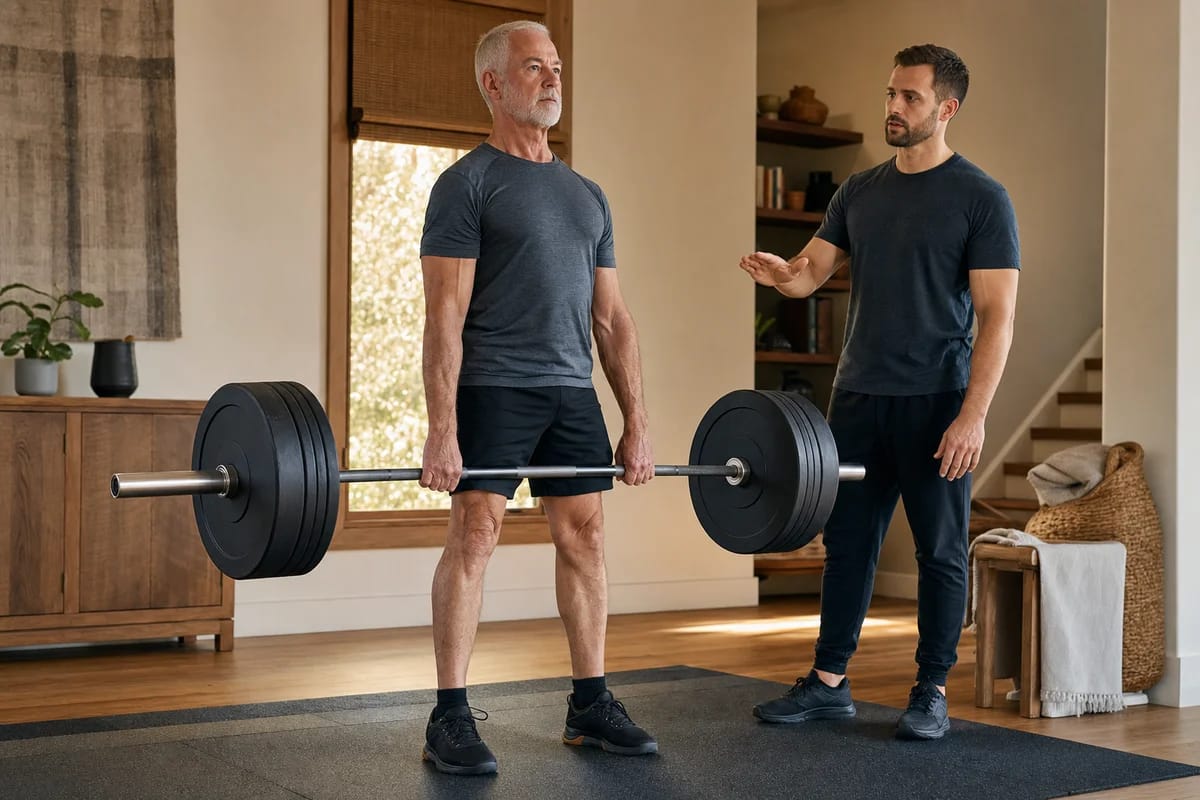
Gentle feels safer. It usually isn't.
This is the belief worth pushing back on, because it quietly does the most damage.
Going light and slow feels protective. But it under-trains the three things that fail: power, balance, and bone. You end up carefully preserving the one ability that was never at risk, moving slowly, while the abilities that keep you independent keep sliding. Avoiding the hard qualities isn't safety. It's slow-motion decline that feels responsible.
The real risk in a heavy or explosive session is bad technique, too much load too soon, or nobody watching, not the intensity itself. Those are solvable with coaching and sensible progression. Backing off entirely has its own cost, and it compounds fast: see how quickly strength fades once you stop lifting.
None of that erases real caution. People vary enormously at this age, more than the age effect itself, and your training history, joints, and health conditions matter more than your birth year. If you have osteoporosis, a heart condition, or any doubt at all, talk to your doctor first (the 70s piece goes into that properly). Bone also responds slowly and unevenly across the skeleton, so eight months of trial data is a real signal, not a guarantee for every person.
Gentle isn't the same as safe. Skill and supervision make hard training safe. Avoiding it just makes you weaker on a schedule.
Build this into your week
- Add one power move to most sessions. Pick a moderate load, about half of what you could lift once, and drive it up as fast as you can for 3 to 5 crisp reps. Slow going down, fast coming up.
- Train on one leg every week. Split squats, step-ups, or single-leg stands, working toward holding 30 seconds a side without wobbling or grabbing something.
- Keep one genuinely heavy lift per major movement, around 5 hard reps, for bone and top-end strength. Don't trade it for comfort.
- Add a little impact if your joints and doctor are fine with it. Firm heel drops or low step-downs load bone in a way slow lifting doesn't.
- Ramp load and speed gradually. Add the intent to move fast before you add weight, and let technique lead, not ego.
- New to this, or coming back from an injury? Get a coach or physio watching the first few weeks. That's where the real safety comes from.
Common questions
Is it too late to start strength training at 65? No. Older adults, including people well into their 80s, make real gains in strength, power, and bone with training, and the research here was done in exactly this age range. The adjustment isn't lower expectations. It's ramping load and speed patiently and getting your technique coached early.
How is power training different from regular lifting? Regular lifting is often slow and controlled. Power training means moving the weight with the intent to accelerate it, driving it up fast even when the load is moderate. Same exercises, different intent, and that intent trains the quality that fades fastest with age.
Do I need heavy weights, or is bodyweight enough? Bodyweight single-leg work and fast movement do a lot for balance and power. For bone and top-end strength, you eventually need real load, because your skeleton and nervous system only respond to a stimulus that's meaningfully hard. Start with bodyweight, add load as your technique holds.
Is explosive lifting dangerous for older joints? Done with moderate loads and good technique, moving with intent isn't reckless. The risk comes from too much weight too soon or sloppy form, not from speed itself. Start light, keep the reps clean, and progress slowly.
What a coach adds that a logbook can't
A patient training partner, a logbook, and the discipline to add load slowly can take a self-motivated lifter most of the way on their own, especially once the balance and power work is already part of the week. Where it gets hard to do alone is judgment, live: knowing when a load is ready to go up and when today calls for something lighter, catching the balance drill that looks fine but isn't, seeing the half-second of hesitation in a fast rep that says the pattern needs work before the weight does.
That's what our coaches do on live video: watch the actual sets and write the next session from what they saw, so intensity stays high and risk stays low. See how it runs on the how it works page. Founding membership is $49 your first month, then $299 a month locked in for life, with 25 of those spots. Every session is unlimited, real-time video with a real coach, never AI, and there's a 30-day money-back guarantee if it's not for you.
Sources
-
Reid and Fielding, 2012. Skeletal muscle power: a critical determinant of physical functioning in older adults. Exercise and Sport Sciences Reviews. ↩
-
Tao and colleagues, 2026. Effects of maximal versus submaximal intended velocity resistance training on muscular fitness adaptations in older adults: a systematic review and meta-analysis. Sports Medicine and Health Science. ↩
-
Sherrington and colleagues, 2019. Exercise for preventing falls in older people living in the community. Cochrane Database of Systematic Reviews. ↩
-
Harding and colleagues, 2020. A comparison of bone-targeted exercise strategies to reduce fracture risk in middle-aged and older men with osteopenia and osteoporosis: LIFTMOR-M semi-randomized controlled trial. Journal of Bone and Mineral Research. ↩