Training in your 70s: safety, dosing, and real gains
The 70s are not too late for strength training: what the research says about medical clearance, safe starting loads, sensible progression, and real gains.

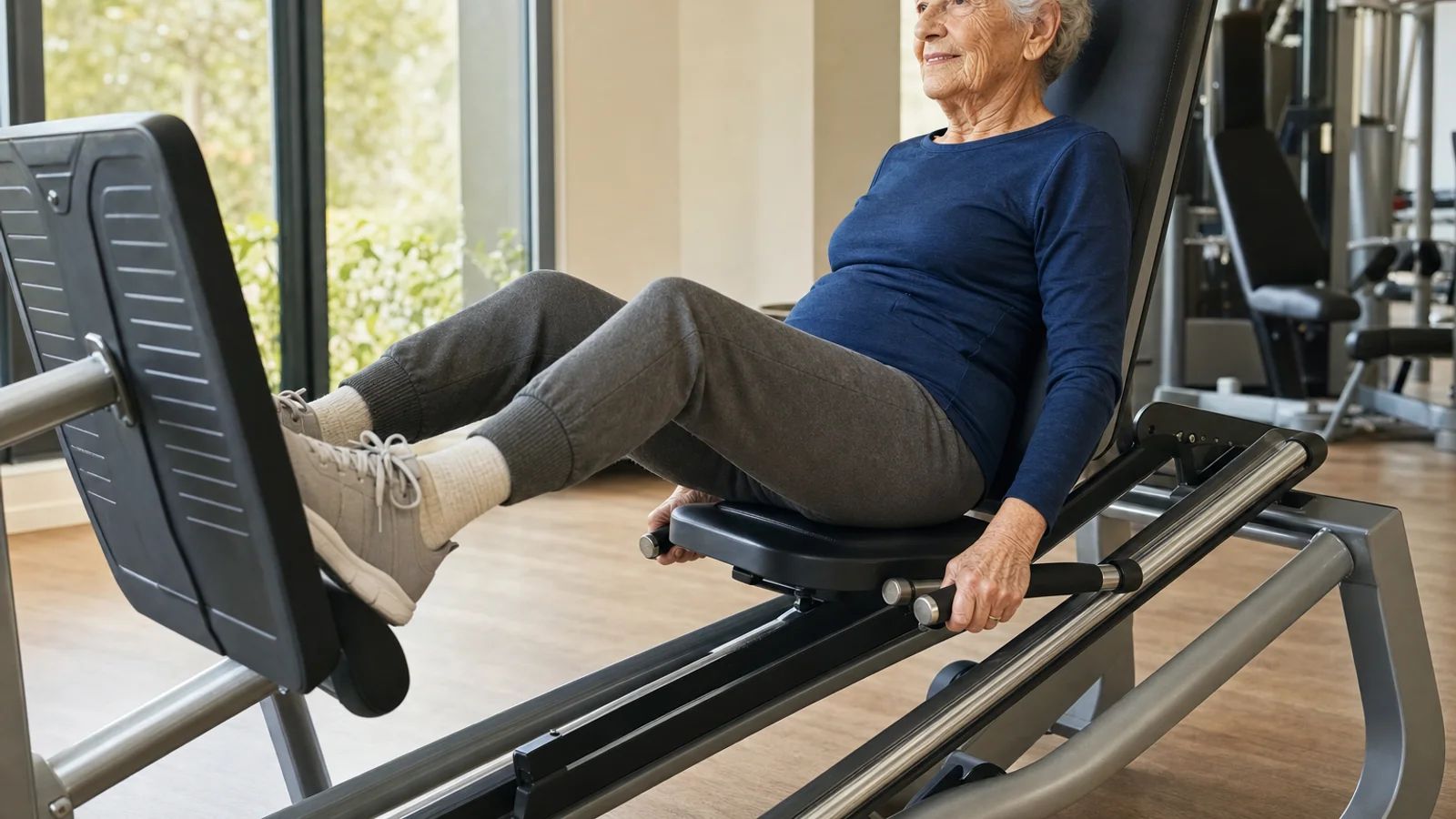
I want to open with the extreme case, because it settles the argument before it starts. In 1990, JAMA published a trial that put frail nursing-home residents, average age 90, through eight weeks of leg strength training. They came out about two and a half times stronger, and the muscle itself grew.1
If that's possible at 90, "too late" isn't the real problem at 70. What actually matters is getting the practical stuff right: whether you need a doctor's sign-off first, how heavy to start, how fast to add weight, and which risks are real instead of imagined. That's what this piece covers. For what changes one decade earlier, see training in your 60s, which covers power, balance, and bone.
Key takeaways
- Muscle stays trainable into your 70s and beyond. Real strength gains are the expected outcome of sensible training, not a long shot.
- The risk most people fear is injury. The bigger, measured risk is doing nothing: untrained leg strength drops a few percent every year.
- Most healthy older adults can start light-to-moderate training without special testing, though certain heart and blood-pressure symptoms are a real reason to check with a doctor first.
- Start at a weight you can lift for about 10 to 12 clean reps. Get technique solid before you get ambitious, then let the load rise.
- Add weight in small steps every couple of weeks, not every session. Tendons and connective tissue adapt slower than muscle does.
- Supervised strength training in older adults has a strong safety record. Serious adverse events are rare even at higher intensities.
Yes, your muscles still answer at 70
The biology doesn't check your ID. Load a muscle and its fibers still add contractile protein and get stronger. Your nervous system still learns to fire more of that muscle at once. It's slower than it was at 30 and it needs a real stimulus, not a light Tuesday walk, but it works.
The numbers back it up. The biggest pooled look at this, 47 trials and over a thousand older adults, found strength gains of 25 to 33 percent depending on the lift, bigger with harder training.2 That's not a handful of gym rats skewing the average. That's the typical aging adult, tested and measured.
And the nursing-home trial up top is the outer edge of what's possible, not the floor. If people in their 90s can nearly triple their leg strength in eight weeks, a 72-year-old has a lot of room to work with.
Your muscle can still hear the signal to grow. You just have to send one loud enough.
The real risk is sitting still, not lifting
Most people in their 70s worry about getting hurt in the gym. The bigger risk is the one that's quietly happening whether you notice it or not.
Here's the scale of it. A three-year tracking study followed adults in their 70s and watched leg strength slip by 3 to 4 percent a year, roughly triple the rate their muscle size actually shrank.3 Strength leaks out even in people who hold onto their muscle. Left alone, that's the road to a chair you can't get out of, or a stumble you can't catch.
Training pushes back hard against exactly that kind of stumble, and the reasons why are in training in your 60s: power and balance work do most of the job on fall risk, not raw strength alone.
The injury you're scared of is possible, but it's rare. The decline you're ignoring is close to certain if you sit still.
Do you need a doctor before you start?
For most healthy adults in their 70s, you can start light-to-moderate strength training without a stress test or special clearance. The guidance has shifted away from screening everyone, because a supervised program that ramps up slowly is low-risk, and staying sedentary is the riskier choice by far.
Some situations do call for a conversation with your doctor first, though. Check in if you have known heart disease, or symptoms like chest pain, unusual shortness of breath, or fainting spells. Check in if your blood pressure runs high and uncontrolled, if you've had a recent cardiac event or surgery, or if something in your health is currently unstable. And if you're living with joint replacements, real osteoporosis, or a bad back, ask specifically which movements to modify, not whether you're allowed to train at all.

The point of the check isn't permission. It's catching the small number of conditions where how you start needs to change.
Most people don't need a doctor's sign-off to lift. A short list of symptoms means you should ask first, and now you know what's on it.
Where to start: your first loads
Start lighter than feels productive. Not because you're fragile, because clean technique now is what keeps the whole thing safe once the weight gets real.
A good starting point is a weight you can lift for about 10 to 12 controlled reps, stopping with two or three reps still in the tank. Get the movement right first: full range, steady tempo, no straining or holding your breath. Only once that pattern is solid does it make sense to chase heavier, more productive loads.
And heavier work, done right, isn't the hazard it's made out to be. A safety comparison spanning 18 trials and more than 1,200 adults over 50 put high-intensity training up against low-to-moderate training and found no meaningful difference in falls or adverse events between them.4 Both were safe. Intensity itself wasn't what mattered.
Start where your form holds up, leave a couple of reps in reserve, and earn the heavier loads over time.
How fast to add weight
Slower than your muscles alone would let you. That's the mistake that turns a good program into a sore one.
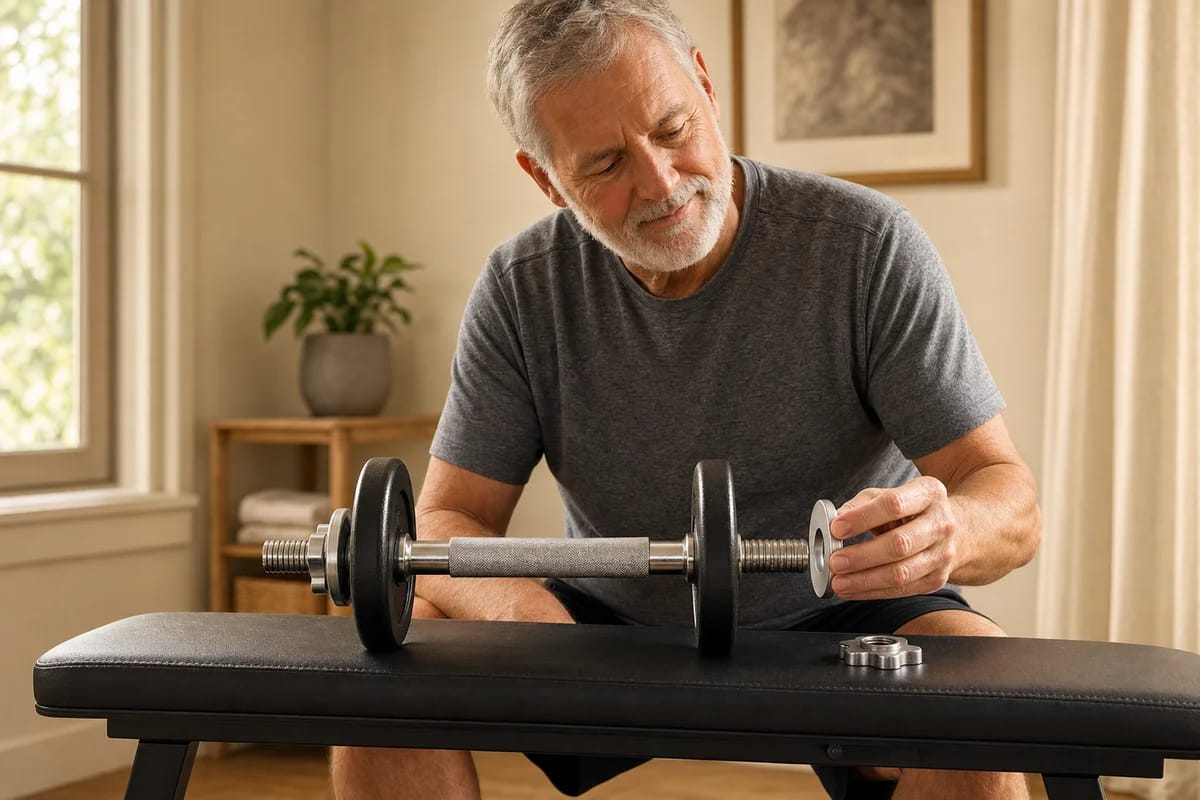
Muscle adapts in weeks. Tendons and connective tissue turn over much more slowly and trail behind. Your legs can feel ready for more before the tissue anchoring them is, and that gap explains a lot of the aches people get past 70. Training in your 50s goes deeper on the patience this takes.
In practice, add weight in small steps every week or two, not every session. Watch for the signal: when your top set starts feeling clearly easier, or you can do a rep or two more than planned, that's your green light to nudge the load up. The bigger gains mentioned earlier come from reaching real intensity eventually, not from rushing there.
Let your tendons set the pace, not your muscles. That's the whole rule for how fast to progress.
What the research can't promise you
The evidence here is strong, but it isn't a precise prescription for you specifically. I'd rather undersell this than oversell it. Some of the biggest gains, including the nursing-home trial, came from people starting at a very low base, so the raw percentages run higher than a fitter 72-year-old should expect. Most of the research was supervised too, which shapes both the results and the safety record. Your medications, joints, and health history will shape what "sensible" looks like more than your age does. Take all of this as a strong direction, not a fixed formula, and let your own body on your own equipment be the real starting point.
Common questions
Is it safe to lift weights in your 70s? For most people, yes, and it's one of the higher-value things you can do to stay independent. Supervised resistance training in older adults has a strong safety record, and serious problems are rare even at higher intensities. The real caution is about starting at the right load and progressing patiently, not about avoiding weights altogether.
How often should someone in their 70s strength train? Twice a week, covering the major movements, is a solid and sustainable target that drives real gains. A third day helps once the first two feel easy. Judge it by whether you're still adding a little weight over time and your joints feel good, not by chasing a bigger number.
Do I need to lift heavy, or is light fine to start? Light-to-moderate is the right on-ramp while you build technique. But the research is consistent: adding real load over time is what drives the bigger strength gains, so the goal is to graduate off light weights, not live there.
Can I still gain muscle at 75 if I've never trained before? Yes. Beginners often see the fastest early gains because they're starting from an untrained base, and that holds at 75 same as anywhere else. Much of that first progress is your nervous system learning to use muscle you already have, followed by the muscle itself growing.
Getting the calls right
The judgment calls in this, the right load for a cranky knee today, whether soreness means back off or push through, when a weight is actually ready to go up, are simple to describe and hard to run alone, consistently, for months.
That's what our coaches do live with members in their 70s: watch the actual reps over video, catch a technique fault before it turns into a strain, and write next week's session from what they saw rather than a plan set a month ago, though a patient logbook and honest weekly checks will carry most people a long way on their own too.
Founding membership runs $49 your first month, then $299 a month locked for life if you're one of the next 25 spots, $499 standard after that. Unlimited live 1-on-1 video sessions, a 30-day money-back guarantee, and it's equipment-agnostic, so a couple of dumbbells at home is enough to start. How it works covers the rest.
Sources
-
Fiatarone and colleagues, 1990. High-intensity strength training in nonagenarians. Effects on skeletal muscle. JAMA. ↩
-
Peterson and colleagues, 2010. Resistance exercise for muscular strength in older adults: a meta-analysis. Ageing Research Reviews. ↩
-
Goodpaster and colleagues, 2006. The loss of skeletal muscle strength, mass, and quality in older adults: the health, aging and body composition study. Journals of Gerontology Series A. ↩
-
Shen and colleagues, 2026. Effectiveness of high-intensity versus low-to-moderate-intensity resistance training in improving muscle strength and bone mineral density in older adults: a systematic review and meta-analysis of randomized controlled trials. Geriatrics & Gerontology International. ↩