What you train at 45 decides what you can do at 75
Midlife training sets the peak your age-related decline descends from. A higher reserve now buys more years above the line where daily life stays easy.

The lifting you do at 45 barely changes how you look at 45. It changes what you can still do at 75.
Every measure of physical capacity that keeps you independent, muscle, strength, aerobic fitness, bone, follows the same arc. It climbs through your 20s, peaks in early adulthood, then heads downhill for the rest of your life. You can't stop that slide. What you control is how high you were standing when it started.
Build a taller peak in your 40s and the same rate of decline leaves you further above the point where getting out of a chair, climbing stairs, or carrying your own bags turns hard. That's the argument, and the evidence behind each piece of it holds up.
Your capacity is a retirement account, and the withdrawals never stop
Think of muscle, strength, aerobic capacity, and bone as a balance in an account. You spend it down over decades whether you train or not. The two levers you actually control are how much you deposit before the spending speeds up, and how fast you let it drain.
The account has a floor you don't want to hit. For every daily task there's a level of capacity below which it stops being possible: rising from a low chair, climbing a flight of stairs, carrying a full bag, catching yourself when you trip. Above the floor, life feels normal. Below it, you need a hand, then a rail, then help.
Most people miss this part: the floor barely moves. Your balance does, and only downward once you're past your peak. So the question that decides your 70s isn't how fast you decline, which you barely control. It's how high your balance was when the withdrawals started.
You can't stop the spending. You can control the starting balance.
The withdrawal rates aren't equal
Aerobic capacity has the sharpest curve. A 2005 study in Circulation, the Baltimore Longitudinal Study of Aging, tracked 810 healthy adults and found peak VO2 max didn't fall at a steady pace. It dropped 3 to 6% per decade through people's 20s and 30s, then accelerated past 20% per decade once they hit their 70s.1 Staying active slowed the curve but didn't erase it. That acceleration is a big reason VO2 max tracks so closely with how long people live (why VO2 max predicts how long you will live).
Muscle size drains more gently. The biggest pooled look at it, 47 studies and just under 2,000 people, put the loss at roughly 27% of quad size between age 25 and 75, call it half a percent a year.2 Slow, but it compounds over five decades.
Strength is the twist. The Health, Aging and Body Composition study followed nearly 1,900 older adults for three years and found leg strength dropping 2.6 to 4.1% a year, about three times faster than muscle size shrank.3 Some of them were gaining muscle over that stretch and still losing strength. The tissue was getting weaker pound for pound, not just smaller.
Power drains fastest of all, the ability to produce force quickly rather than just hold it. That's why a stumble off a curb gets more dangerous with age faster than carrying a heavy bag does (why power fades faster than strength as you age).
Fitness, muscle, and strength all leak away as you age, and they leak faster the older you get.
Why a taller peak buys you years, not just a better birthday
This is where the account math earns its keep. Picture two people losing capacity at the same rate after 50. One spent their 40s lifting and built a tall peak. The other coasted. Thirty years later, running the identical slope, the one who started higher is still comfortably above the floor while the one who coasted already dropped below it.
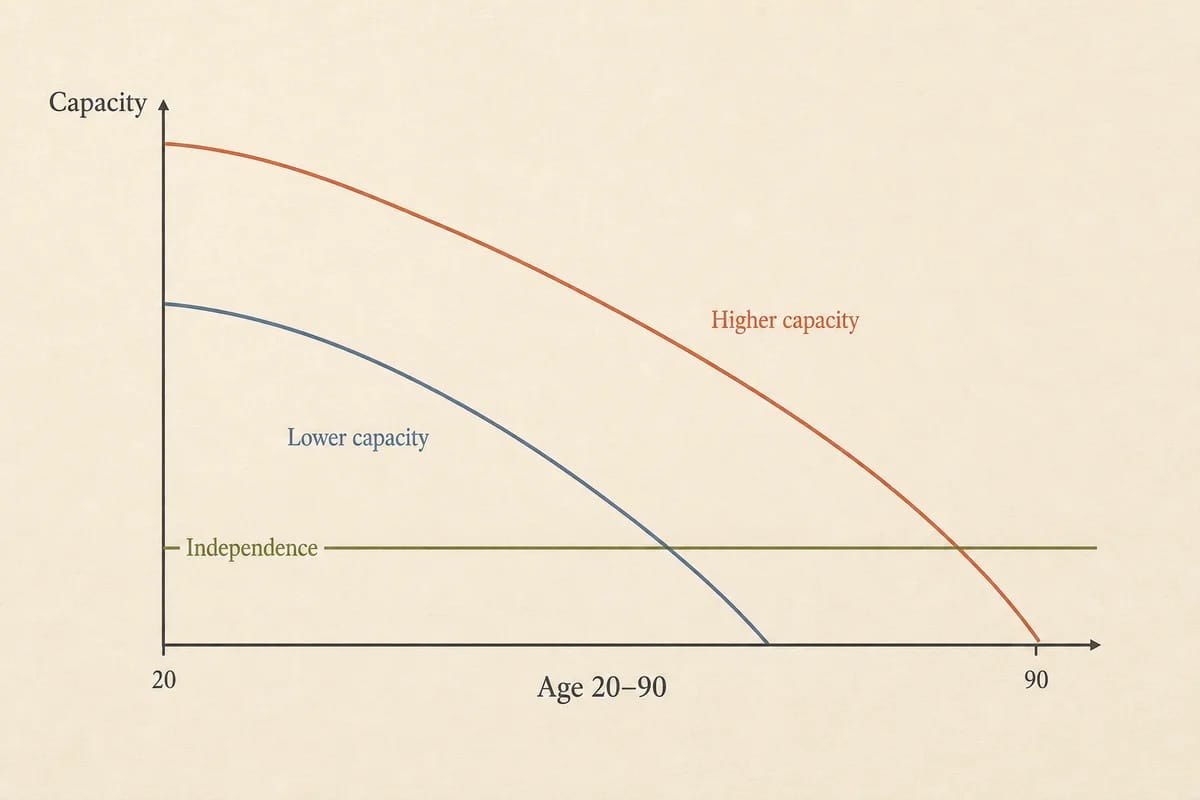
Nothing about the decline rate changed between them. The starting point did. And because the slope gets steeper with age, the gap between the two widens instead of closing. A higher peak pays twice: a taller launch point, and more years spent in the shallow, early part of the curve before the steep part hits.
Midlife deposits beat late ones for a second reason: the account takes them more easily at 45 than at 80. Building muscle and fitness slows with age, even though it never fully stops, so strength banked now is cheaper to earn and holds its value longer than the same pound of strength fought for at 78, when withdrawals are already fast. For the reverse version of this math, working backward from the tasks you actually want to keep at 90, see backcasting your training from age 90.
Is there really a floor, or is that just a tidy story?
The floor is more of a steep zone than a hard cliff, and the research is genuinely split on how sharp it is.
Some data backs a threshold: above a certain level of leg strength, extra strength stops adding to your walking speed, but below it, speed and function drop off fast. Other data pushes back. One study that tested this directly, the InCHIANTI project, found the link between leg strength and walking performance was curved but had no clean cutoff point, more of a steady slope than a switch.4
So don't picture one magic number on a chart. Picture a low region of the curve where losing a little more capacity costs a lot more function. What isn't in doubt is that strength itself tracks survival. The largest study on this, nearly 140,000 adults across 17 countries, found each 5 kg drop in grip strength linked to a 16% higher risk of death from any cause, and grip strength predicted it better than blood pressure did.5 Grip is only a rough stand-in for whole-body strength. That it carries this much signal says something (what grip strength really says about your health).
Two things temper all of this. Population averages have a huge spread around them: some 80-year-olds test stronger than sedentary 40-year-olds, and your genes, training history, and plain luck all bend your personal curve. And most of the strongest numbers here come from observational studies. They show a strong link, not proof that building reserve at 45 causes independence at 75. It's a well-supported bet, not a guarantee.
Why 45 is the target age, not a wall
Forty-five isn't magic. It's roughly the last decade where your body is still close to peak trainability and you've still got thirty-plus years of runway to protect.

What shifts inside those decades matters, because your training has to shift with it. In your 40s, most of your building capacity is still intact and the changes are subtle (training in your 40s, what changes and what doesn't). By your 50s, recovery runs short before intensity does, and the week has to be built around that instead (training in your 50s, recovery is the new limiter).
If you're reading this at 60 or 70, the account still takes deposits. Older adults reliably gain strength and power from training, which raises the floor under you and slows the drain. It just can't buy back the peak you'd have banked at 40. That's exactly why now is always the cheapest deposit you'll ever make.
Key takeaways
- Lift at least twice a week through your 40s and 50s. This is the reserve that later drains 2.6 to 4.1% a year and is hardest to rebuild once it's gone.
- Train for real strength, not just size. Strength fades roughly three times faster than muscle mass and matters more for staying independent.
- Keep a real aerobic base. Build VO2 max now, ahead of the 20%-plus-per-decade drop after 70, with mostly easy volume plus a little hard effort each week.
- Add fast, explosive movement: jumps, quick step-ups, medicine ball throws. Power fades fastest of all and is what actually saves you from a fall.
- Test yourself once a year against your own numbers, not an age chart: a five-time chair rise, a loaded carry up a flight of stairs, getting off the floor unaided.
Common questions
Is cardio or lifting more important for this reserve? Both, and they protect different parts of the account. Lifting builds the muscle, strength, and bone reserve. Aerobic training builds the VO2 max reserve that falls off a cliff after 70. Skip either one and you hit a floor sooner. A week that covers both is the idea behind a longevity training week.
How do I know if my reserve is high enough? There's no single lab number that settles it, but simple field tests track it well: a five-time sit-to-stand, a loaded carry up a flight of stairs, getting off the floor with no hands, and how this year compares to last year's result on the same tests. A falling trend is the early warning that your balance is dropping faster than you'd like.
I'm already 60. Does any of this still apply to me? Yes. You can't rebuild the peak you'd have banked at 40, but consistent training still raises your balance and slows the drain at any age, which pushes the day you'd cross the floor further out. Starting now beats every option except starting sooner.
Building the reserve, on your own or with someone watching
The training itself isn't a secret. Lift heavy enough to matter through your 40s and 50s, keep the aerobic base up, train power on purpose, and test yourself honestly once a year. A disciplined lifter who tracks their own numbers and adjusts the plan without being told can run every part of that alone. The account grows whether anyone's watching or not.
Where it usually breaks down is the long middle: the boring, adjust-as-you-go stretch of years where the plan slides the moment life gets busy and nobody's expecting you on a call. At Bespoke Fit your coach programs that progression around your own test results and watches every rep live over HD video, one on one, a real coach and never AI, so the heavy and fast work stays safe as the loads climb. Your first month is $49, then $299 a month locked for life as a founding member, with unlimited live sessions, 25 spots, and a 30-day money-back guarantee, and the how it works page walks through what an actual session looks like.
Sources
-
Fleg and colleagues, 2005. Accelerated longitudinal decline of aerobic capacity in healthy older adults. Circulation. ↩
-
Naruse, Trappe, and Trappe, 2023. Human skeletal muscle-specific atrophy with aging: a comprehensive review. Journal of Applied Physiology. ↩
-
Goodpaster and colleagues, 2006. The loss of skeletal muscle strength, mass, and quality in older adults: the health, aging and body composition study. Journals of Gerontology Series A. ↩
-
Marsh and colleagues, 2006. Lower extremity strength and power are associated with 400-meter walk time in older adults: the InCHIANTI study. Journals of Gerontology Series A. ↩
-
Leong DP, Teo KK, Rangarajan S, et al., 2015. Prognostic value of grip strength: findings from the Prospective Urban Rural Epidemiology (PURE) study. The Lancet. ↩