Why muscle is your protein reserve when you get sick
Serious illness and surgery make your body break down muscle to supply your organs. Why starting with more seems to help, what doesn't, and how to build it.

In this article8
The short answer
Your body breaks down muscle in a serious illness to keep your organs supplied with protein. A week in intensive care with several organs failing can cost about a sixth of a thigh muscle; a short flu costs little. Muscle built beforehand is your reserve.
Your body keeps fat for energy and a small store of sugar in your liver and muscles. It has no spare tank of protein. Nearly all of it is busy being something: an enzyme, an antibody, a heart cell, a muscle. So when a serious illness suddenly needs a lot of amino acids, the building blocks of protein, the body goes to the biggest pile it has. That's your muscle.
Someone you love just came home from hospital much weaker? Go to getting strength back. Surgery on the calendar? Go to before a planned operation.
Why your body spends muscle when you're ill
Skeletal muscle holds somewhere between half and three-quarters of all the protein in your body.1 Nutrition researcher Robert Wolfe calls it "the principal reservoir" of amino acids for the times when nothing is coming in from the gut, which describes most serious illnesses: you barely eat, and your organs still need supplies.2
The switch is hormonal. In a serious illness, stress hormones like cortisol and inflammation both rise, and the steady daily trade inside your muscles (a little built, a little broken down) tips toward losing. In one experiment, six healthy young men spent four weeks in bed while taking cortisol at the levels seen after trauma or serious illness. They lost about three times as much lean tissue from their legs as the same lab had seen with bed rest alone, mostly because their muscles rebuilt much more slowly.3
There's even a hint that the loss is a defense. In mice with a parasitic infection, researchers at the Salk Institute found that the later muscle wasting helped the animals cope with the infection, while losing fat made no difference to whether they survived.4 That's mice and one infection, so hold it lightly. It fits the idea that this is a body drawing on its savings, not a body failing.
Supplying protein is only one of muscle's jobs. The others, from handling blood sugar to supporting your bones, are in is muscle an organ?
How fast muscle goes when you're ill
Here's what the first days cost the thigh muscles in five situations. The first three are healthy young men in lab studies. The last two are patients in intensive care.
Healthy young men: brace, whole-thigh muscle by MRI (Kilroe 2020); cast and bed rest, quadriceps cross-section (Wall 2014, Dirks 2016). Intensive care patients, average age 55: one thigh muscle by ultrasound (Puthucheary 2013). The methods differ, so treat the comparison as rough.
Look at the last two bars. A week in intensive care with one failing organ cost about what a week of bed rest costs a healthy young man. With several organs failing, the loss was about five times bigger, and it started early: nearly 9% was already gone by day three.5 Over the same week, the sicker patients lost far more.
A couple of days in bed with flu? Some loss starts that fast. Two days with one leg in a brace cost young men 1.7% of their thigh muscle.6 You wouldn't notice that. For a healthy adult, a short illness at home is a blip for your muscles. While you're ill, eat what you can manage without forcing it, keep drinking, and as your appetite returns, put some protein in each meal. When you feel better, go a bit lighter for your first session or two back; a week or two off costs less than most people fear.
Age makes it worse. Ten days of bed rest, with no illness at all, cost healthy older volunteers about 1 kg (2 lb) of lean tissue from their legs.7 When researchers put men aged 55 to 65 to bed for two weeks alongside men under 30, the older men lost more thigh muscle (about 8% against 6%), and only the older men got measurably weaker.8 Put an older body together with a real illness and you can see how a week in hospital does so much.
Why the amount you start with matters
Losing the same amount sounds like the same blow for everyone. It isn't, because what matters is where it leaves you.
Think about getting out of a low chair. Your thighs have to lift your whole body. Below a certain level of leg strength for your weight, that gets hard, and so do stairs, curbs and the walk to the bus stop. Researchers who followed nearly 2,800 people in their 70s for about six years found roughly where that line sits: those whose knee strength started below it were the most likely to develop serious trouble walking a quarter mile or climbing ten steps.9 After their ten days in bed, the healthy older volunteers had come down toward it, though on average they were still above it.7 Someone who started a little weaker and lost the same share would have landed below it.
An illustration of the idea, not data
Hospital data line up with this: people who go into major surgery or intensive care with low muscle do worse.1011 One of those studies also answers a question people often ask: isn't carrying a few extra pounds protective when you're ill? In ventilated intensive care patients, once the researchers counted muscle, body weight (BMI) no longer predicted who died. The muscle seemed to be what mattered.
These studies observe rather than prove, since people who are already frailer tend to have less muscle. One exception to keep separate: cancer can cause its own wasting, called cachexia, which eating more can't fully reverse.12 That one is for the cancer team, not a gym plan.
Grip strength is another quick read on the same reserve, and it predicts a surprising amount. More in what grip strength really says about your health.
Before a planned operation
If you or someone close to you is ill or has surgery coming, the care team decides what activity and food are right. What follows is general information to help you ask good questions.
Getting fitter in the weeks before an operation is called prehabilitation, or prehab. Its most consistent benefit is that people walk better after the operation. Fewer complications is a maybe. Some trials in older or higher-risk patients saw far fewer, one in frail people in their late 70s saw none, and the pooled results are mixed.13
So if an operation is four or more weeks away, it's worth asking your surgeon or anesthesiologist two things: is there a prehab program here, and what am I cleared to do at home? The programs in these trials were built from ordinary parts: regular exercise hard enough to get you breathing heavily, advice on eating, help with nerves, and help stopping smoking.
During a hospital stay
This is where people hope for a trick, and for the sickest patients there isn't one. In a large trial in ventilated patients, giving much more protein didn't get people home sooner, and it may have made things worse for those with kidney problems or more failing organs.14 In another, more intensive early exercise didn't improve recovery and came with more problems linked to the exercise.15 You can't eat or train your way through a crisis. The intensive care team balances this every day, and following them is the right call.
An ordinary ward is different, especially for older people. About a third of patients over 70 leave hospital less able to manage everyday tasks, like dressing or getting to the bathroom, than before they came in, and it can happen even when the illness itself was treated well.16 Part of that comes from the stay: days in bed in a hospital gown, waiting. If you're visiting someone older, it's reasonable to ask the nurses or the physical therapist whether they can sit in a chair for meals, walk to the bathroom, and get dressed in their own clothes. A hospital campaign called #EndPJparalysis exists for exactly this.
Food is the other thing a visitor can help with. Appetite often vanishes in hospital, and older people who are ill usually need more protein than usual, not less.17 Small, easy things get eaten: yogurt, milk, a boiled egg, cheese, soup with chicken or lentils, a milky drink. Check with the nurses before you bring anything, since some patients are on special diets (kidney disease is one reason), and if your person is barely eating, ask for a dietitian to see them.
Getting strength back after a hospital stay
If your parent came home and can't get out of their chair, it's frightening, and it often feels like something went wrong. Weakness after a hospital stay is common, and often it's the reserve doing its job. The good part is that it can be refilled.
Expect it to take longer than it took to lose. In one small study, young men whose leg had been immobilized for two weeks were fully back after four weeks of training. Older men's muscle fibers still hadn't caught up by then.18 So for an older person after a week or two on a ward, think in months, and in steady small gains. After the hardest cases, such as weeks on a ventilator with severe lung failure, people kept improving through the first year, though on average they were still below normal five years on.19 Most hospital stays are nothing like that.
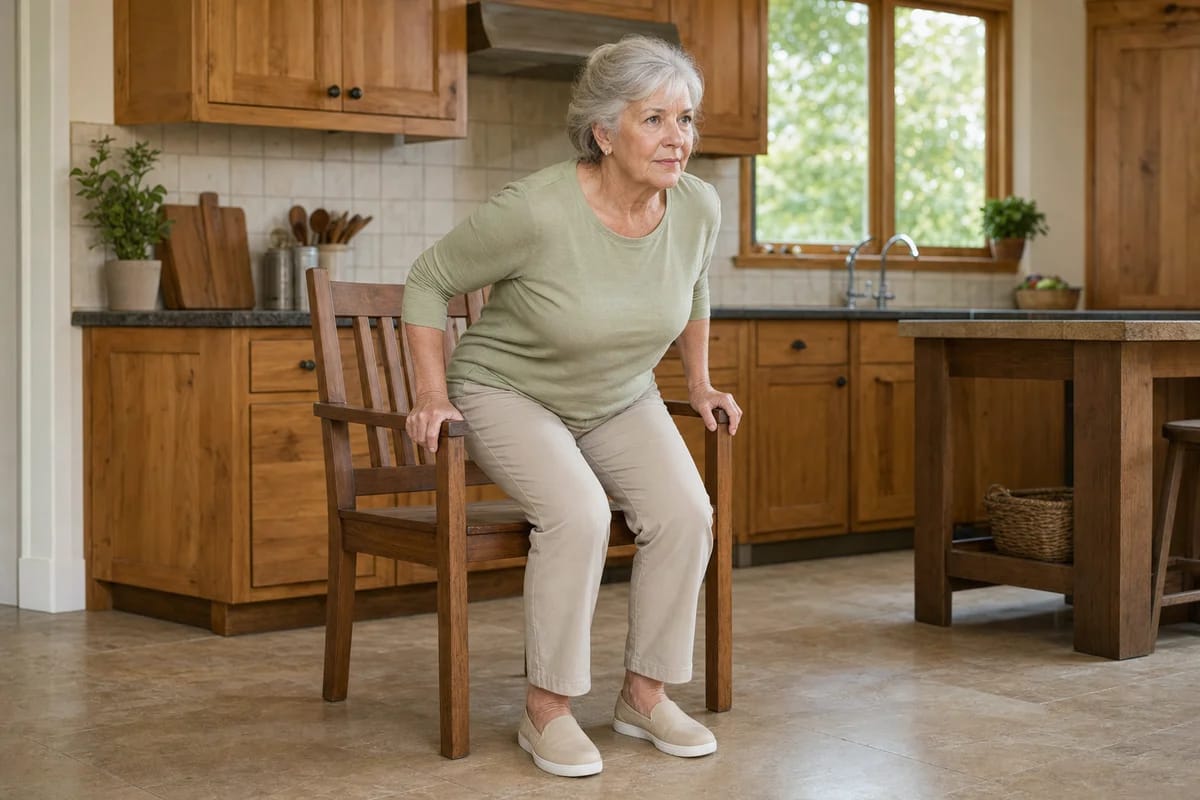
For the first couple of weeks home, a few things do most of the work:
- Move little and often. A short walk to the kitchen or the front door every hour or two while awake beats one big effort a day.
- Practice standing up. A few sit-to-stands from a higher seat, a cushion on the chair or the edge of the bed, several times a day. Pushing on the armrests is fine at first.
- Keep protein in every meal and snack, using the same easy foods as in hospital.
- Ask for help. Before discharge if you can, or from their doctor afterwards: is physical therapy or home health set up, and which exercises are safe at home?
Call the doctor if the weakness is getting worse rather than slowly better, after a fall, or if there's new confusion. Weakness or numbness on one side, or a drooping face, is an emergency: call 911.
Once the first weeks are behind you, the path is whatever rehab the hospital arranges, then ordinary strength training two or three times a week. Muscle keeps responding to training into the 80s and 90s, as the frailty studies show, and strength training in your 70s covers how often and how heavy. The chair test below gives you a number to watch go up, which helps on the weeks it feels like nothing is changing.
Check your reserve in 30 seconds
There's no home test for how much muscle you have. This one tells you how well your legs lift you, which is what the reserve is for. It's the CDC's 30-second chair stand, used to check fall risk in people over 60.20
Set up a sturdy chair without armrests
About 17 inches (43 cm) high, pushed back against a wall. Have someone stand nearby.
Sit in the middle, feet flat, arms crossed at the wrists on your chest
Stand all the way up, then sit all the way down, for 30 seconds
Count each full stand. If you're more than halfway up when time runs out, count that one too.
If you need your arms to get up, stop
That's a score of zero, and it's useful to know.
A score below these numbers is linked to a higher risk of falls:
| Age | Men, below average if under | Women, below average if under |
|---|---|---|
| 60 to 64 | 14 | 12 |
| 65 to 69 | 12 | 11 |
| 70 to 74 | 12 | 10 |
| 75 to 79 | 11 | 10 |
| 80 to 84 | 10 | 9 |
| 85 to 89 | 8 | 8 |
| 90 to 94 | 7 | 4 |
The CDC sheet has no numbers for people under 60. If you're younger, use it as your own baseline: write the number down and test again after eight weeks of training. More on reading your score in the sit-to-stand test.
Building the reserve now
It's built the ordinary way, and slowly, which is the whole reason to start before you need it.
- Strength training on two or more days a week, working your legs, hips, back, belly, chest, shoulders and arms.21 Sit-to-stands, a loaded backpack, a pair of dumbbells and push-ups against a kitchen counter all count. If you've never lifted, starting to lift weights at 50 walks you through the first 12 weeks. If two days sounds like a lot, start with one and add the second once the first feels routine.
- Give it time. In trials of adults over 50, strength training added about 1.1 kg (2.4 lb) of lean mass on average.22 That deposit is made one session at a time, while the losses above happen in days.
- Protein spread across the day. For people over 65, experts recommend about 0.45 to 0.55 g per pound of body weight a day (1.0 to 1.2 g per kilo), and at least 0.55 g per pound (1.2 g per kilo) if you're active.17 Researchers who study older muscle suggest about 25 to 30 g at each meal.7 People with serious kidney disease are the exception and should ask their doctor first. The details, and what changes after 40, are in how much protein you need after 40.
If you'd rather not plan it alone, a Bespoke Fit coach writes your program and is with you on live 1‑on‑1 video for every session, watching your form and your heart rate and adding weight as you get stronger. The first 14 days are free.
The muscle you build this year is the reserve you'll have if the day comes.
Sources
-
Frontera and Ochala, 2015. Skeletal muscle: a brief review of structure and function. Calcified Tissue International. ↩
-
Wolfe, 2006. The underappreciated role of muscle in health and disease. American Journal of Clinical Nutrition. ↩
-
Paddon-Jones et al., 2006. Atrophy and impaired muscle protein synthesis during prolonged inactivity and stress. Journal of Clinical Endocrinology and Metabolism. The comparison is with the lab's earlier bed-rest-only study, not a control group in the same trial. ↩
-
Redford et al., 2023. CD4+ T cells regulate sickness-induced anorexia and fat wasting during a chronic parasitic infection. Cell Reports. ↩
-
Puthucheary et al., 2013. Acute skeletal muscle wasting in critical illness. JAMA. Bars data also from Dirks et al., 2016, One week of bed rest leads to substantial muscle atrophy and induces whole-body insulin resistance in the absence of skeletal muscle lipid accumulation, Diabetes; and Wall et al., 2014, Substantial skeletal muscle loss occurs during only 5 days of disuse, Acta Physiologica. ↩
-
Kilroe et al., 2020. Temporal muscle-specific disuse atrophy during one week of leg immobilization. Medicine and Science in Sports and Exercise. ↩
-
English and Paddon-Jones, 2010. Protecting muscle mass and function in older adults during bed rest. Current Opinion in Clinical Nutrition and Metabolic Care. Reviews the ten-day bed rest study by Kortebein and colleagues (about 0.95 kg of lean leg tissue lost; knee strength fell from 1.42 to 1.20 Nm/kg, men and women together) and sets it beside the Manini cut-offs (1.13 Nm/kg for men, 1.01 for women). The studies measured strength separately, so read the comparison as rough. ↩ ↩2 ↩3
-
Pišot et al., 2016. Greater loss in muscle mass and function but smaller metabolic alterations in older compared with younger men following 2 wk of bed rest and recovery. Journal of Applied Physiology. Sixteen men aged 55 to 65 and seven aged 18 to 30; quadriceps volume fell 8.3% and 5.7%. ↩
-
Manini et al., 2007. Knee extension strength cutpoints for maintaining mobility. Journal of the American Geriatrics Society. 2,784 well-functioning adults averaging 74, followed for a median of 5.9 years. The high-risk group was below 1.13 Nm/kg of knee strength per kilo of body weight for men and 1.01 for women. ↩
-
Simonsen et al., 2018. Sarcopenia and postoperative complication risk in gastrointestinal surgical oncology: a meta-analysis. Annals of Surgery. About a 40% higher risk of major complications after surgery for digestive cancers. ↩
-
Weijs et al., 2014. Low skeletal muscle area is a risk factor for mortality in mechanically ventilated critically ill patients. Critical Care. A look back at 240 patients: low muscle on the admission scan went with about four times the odds of dying in hospital. ↩
-
Fearon et al., 2011. Definition and classification of cancer cachexia: an international consensus. The Lancet Oncology. ↩
-
Prehab evidence. Fewer complications: Barberan-Garcia et al., 2018, Personalised prehabilitation in high-risk patients undergoing elective major abdominal surgery, Annals of Surgery (about half as many patients with complications); Molenaar et al., 2023, Effect of multimodal prehabilitation on reducing postoperative complications and enhancing functional capacity following colorectal cancer surgery: the PREHAB randomized clinical trial, JAMA Surgery (severe complications 17% against 30%). No difference: Carli et al., 2020, Effect of multimodal prehabilitation vs postoperative rehabilitation on 30-day postoperative complications for frail patients undergoing resection of colorectal cancer, JAMA Surgery (frail patients, average age 78). Pooled: Xiang et al., 2026, Comparative effectiveness of preoperative prehabilitation modalities for postoperative recovery in colorectal cancer: a systematic review and network meta-analysis, Journal of Gastrointestinal Surgery (22 randomized trials: better walking, no consistent effect on complications or hospital stay); Skořepa et al., 2024, The impact of prehabilitation on outcomes in frail and high-risk patients undergoing major abdominal surgery: a systematic review and meta-analysis, Clinical Nutrition (16 studies, mostly observational: fewer severe complications and about a day less in hospital). ↩
-
Heyland et al., 2023. The effect of higher protein dosing in critically ill patients with high nutritional risk (EFFORT Protein). The Lancet. ↩
-
TEAM Study Investigators (Hodgson et al.), 2022. Early active mobilization during mechanical ventilation in the ICU. New England Journal of Medicine. ↩
-
Covinsky, Pierluissi and Johnston, 2011. Hospitalization-associated disability. JAMA. ↩
-
Bauer et al., 2013. Evidence-based recommendations for optimal dietary protein intake in older people: a position paper from the PROT-AGE Study Group. Journal of the American Medical Directors Association. ↩ ↩2
-
Hvid et al., 2010. Effects of aging on muscle mechanical function and muscle fiber morphology during short-term immobilization and subsequent retraining. Journal of Applied Physiology. ↩
-
Herridge et al., 2003. One-year outcomes in survivors of the acute respiratory distress syndrome. New England Journal of Medicine. And Herridge et al., 2011. Functional disability 5 years after acute respiratory distress syndrome. New England Journal of Medicine. ↩
-
CDC STEADI, 2017. 30-Second Chair Stand assessment. Centers for Disease Control and Prevention. ↩
-
CDC. Physical activity guidelines for adults. Centers for Disease Control and Prevention. ↩
-
Peterson et al., 2011. Influence of resistance exercise on lean body mass in aging adults: a meta-analysis. Medicine and Science in Sports and Exercise. ↩