Sit-to-stand test scores by age and what yours means
Do the chair and floor tests in five minutes, see where your score sits for your age and sex, and learn what to train based on where you lost points.

In this article9
Your score in context
Chair test: below your age range in the table is a falls-risk flag (at 70 to 74: under 10 for women, under 12 for men).
Five stands: slower than the reference time for your age (11.4 seconds at 60 to 69) is below average. Separately, 12 seconds or more is a cue to have your falls risk checked.
Floor test: 8 out of 10 is the most common score; below 8, the study saw a clearly higher risk of dying, even allowing for age and health.
Several tests go by this name, and news stories often mix them up. So first, which one did you do?
| Test | What you do | Score |
|---|---|---|
| 30-second chair stand, the usual one at a doctor's or physio's | Stand up and sit down, arms crossed, as often as you can in 30 seconds | Stands |
| Five-times sit-to-stand | Five stands, as fast as you can | Seconds |
| One-minute sit-to-stand | The chair stand for a full minute | Stands |
| Sitting-rising test, the floor test in the "how long you'll live" headlines | Sit on the floor and get back up, with as little help as you can | Out of 10 |
Below you'll find what your number means for your age, how to do each test the standard way, and the most useful part: what to work on, depending on exactly where you struggled.
30-second chair stand scores by age
These ranges are the middle half of scores from 7,183 Americans aged 60 to 94.1 A quarter of people your age and sex did fewer stands, and a quarter did more.
| Age | Women | Men |
|---|---|---|
| 60 to 64 | 12 to 17 | 14 to 19 |
| 65 to 69 | 11 to 16 | 12 to 18 |
| 70 to 74 | 10 to 15 | 12 to 17 |
| 75 to 79 | 10 to 15 | 11 to 17 |
| 80 to 84 | 9 to 14 | 10 to 15 |
| 85 to 89 | 8 to 13 | 8 to 14 |
| 90 to 94 | 4 to 11 | 7 to 12 |
Below your range puts you in the bottom quarter for your age. The CDC's falls screening, which many US doctors use, counts that as a sign of raised falls risk.2 It's not a diagnosis. It means your legs would like some attention, and legs usually respond to training at any age. If you score below your range and have also fallen, felt unsteady or had a scare on stairs, tell your doctor or physio before you start the ladders below.
Inside your range is ordinary for your age. Above it is the top quarter, and worth keeping.
Under 60? There's no large table for your age, so use the 60 to 64 row as a floor. If you're in your 40s or 50s and below it (under 12 for women, under 14 for men), your legs are behind most people in their early 60s, and that's worth training. Inside or above it, your leg power, near the end, gives you a sharper number.
How to do the chair test properly
A dining chair is usually close to the right height. The whole thing takes two minutes, including setup.
Use a sturdy chair with no armrests
The standard seat is 17 in (43 cm) high. Push the chair against a wall, or have someone hold the back, so it can't slide.
Sit in the middle of the seat, feet flat, hands on opposite shoulders
Cross your arms at the wrists, so your hands can't help.
Have someone stand beside you and say “go”
They time 30 seconds and count. A phone timer works if you're on your own, but a second person is safer.
Stand all the way up, sit all the way down, and repeat
Go as fast as you safely can for the whole 30 seconds.
Count the full stands
If you're more than halfway up when time runs out, that one counts. If you need your hands to stand, the official score is 0. Rest, then do another 30 seconds using your hands and write that number down: it's your real starting point.

Five stands or one minute: the other chair tests
Five stands
Some clinics time five stands instead of counting for 30 seconds. The clock starts on "go" and stops when you sit down after the fifth stand. Slower than these times is below average for your age:3
| Age | Below average if slower than |
|---|---|
| 60 to 69 | 11.4 seconds |
| 70 to 79 | 12.6 seconds |
| 80 to 89 | 14.8 seconds |
Under 60, the yardstick is rougher: in one small study, people aged 19 to 49 averaged about 6 seconds and people in their 50s about 7.4 That study's own 60-somethings averaged about 8, quicker than the table above, so the two aren't on the same scale: treat the under-60 numbers as a rough guide.
The 12-second line in the answer above asks a different question. It comes from a falls study of people aged 74 to 98, and it marks the point where a clinician would look more closely at your falls risk.4 The reference time for people in their 80s (14.8 seconds) is already past it, so plenty of people who are ordinary for their age cross it. Treat it as a cue to train and to mention it at your next check-up, not as an alarm.
One minute
A minute's count has its own norms, so don't compare it with the 30-second table. In almost 7,000 Swiss adults, the typical count was about 47 for women and 50 for men at 20 to 24, and about 27 and 30 at 75 to 79.5 At 75 to 79, fewer than 22 for women or 25 for men put you in the bottom quarter.
How to do the floor test and score it
Stand barefoot on a rug or mat, with a friend watching and a sturdy chair or the sofa within reach in case you wobble. Sit down on the floor without worrying about speed. You can cross your legs if that helps. Then stand back up, using as little help as you can each way. Score each half out of 5 and add them. Have another go if you like: your best score counts.
Scoring rules from Araújo and colleagues, 2025
What your floor score says, and what it doesn't
The study behind the headlines tested 4,282 people aged 46 to 75 at a clinic in Rio de Janeiro and followed them for a median of 12 years.6 Here's how scores spread, and how many people in each group died of natural causes during it. One warning before you look: those death rates are raw. Low scorers were often older or already less healthy, and the paragraph under the table shows what's left once that's allowed for.
| Score | Share of people | Died during the study |
|---|---|---|
| 10 | 10% | 4% |
| 8.5 to 9.5 | 22% | 7% |
| 8 | 28% | 11% |
| 4.5 to 7.5 | 29% | 20% |
| 0 to 4 | 11% | 42% |
Once the researchers allowed for age, sex, weight and conditions like heart disease and diabetes, scores of 8 and up were no longer clearly worse than a perfect 10. Below 8, the gap held: about twice the risk of dying of natural causes at 4.5 to 7.5, and nearly four times at 4 or under.
Notice too that 8 was the most common score, for men and women alike. A perfect 10 is much rarer than the headlines make it sound. In the same team's age chart of over 6,000 adults, fewer than 8% of people over 55 scored 10.7 Their own target is a score at or above the median (the middle score) for your age and sex, and the chart in that paper shows where it sits.
A few more things to know before that lands too hard:
- The study couldn't account for how much people exercised, which could explain some of the link.
- The volunteers were patients at one private clinic, two thirds of them men, mostly well-off.
- We found no trial of whether raising your score adds years. The authors list it as an open question.
So read a low score as information about your body today, not a verdict on your lifespan. Simple checks like grip strength and walking speed work the same way.
There's a more immediate reason to care. Getting up from the floor is the skill that matters after a fall. In a study of people over 90, 80% of those who fell couldn't get up on their own after at least one of their falls, and 30% lay on the floor for an hour or more, which went with serious injury and hospital stays.8 The authors' conclusion was plain: people need training in how to get up from the floor. That's something you can practise, starting from wherever you are today.
Where you lost points tells you what to train
Your score is a total, but how you lost the points is more useful. This is coaching logic, not a research finding: each kind of slip tends to point at a different weak link, and each has a different place to start.
| What happened | Points to | Start here |
|---|---|---|
| Needed hands to stand from the chair | Leg strength | Chair ladder, step 1 |
| Hand or knee on the way up from the floor | Leg strength and speed | Chair ladder, steps 2 and 4 |
| Hand or knee on the way down | Control while lowering | Chair ladder, step 3 |
| A wobble | Balance | One-leg stands at the kitchen counter |
| Couldn't fold down that far | Hip and ankle mobility | Floor ladder, steps 1 and 2, and sitting on the floor to watch TV |
| Couldn't get up without furniture | The whole skill | Floor ladder, step 1 |
Wobbles get their own article, which also has how long people of each age can stand on one leg: balance declines quietly, and here's how to train it back.
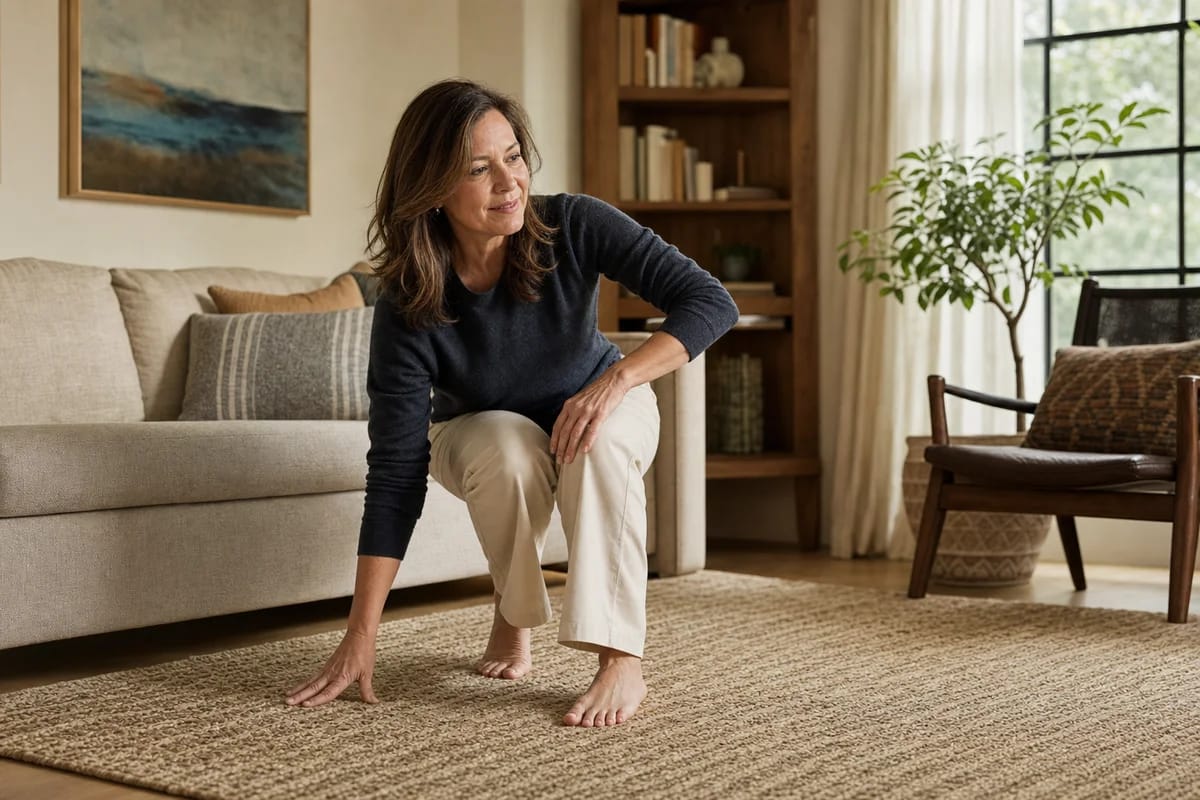
Two ladders: one for the chair, one for the floor
Two or three short sessions a week is plenty, and each takes about ten minutes. Move up a step when the one you're on feels easy two sessions in a row. For the chair, easy means 2 sets of 10 smooth reps. For the floor, it means 3 calm trips down and up.
This kind of practice works: progressive strength training makes getting out of a chair noticeably easier for older adults.9
The chair ladder
Stand from a higher seat
Add a firm cushion, or use the edge of a bed. No hands.
Stand from a standard chair, no hands
Take three seconds on the way down
Lower slowly until you touch the seat, then stand at a normal pace.
Stand up fast
Lower slowly, then stand as quickly as you can while staying in control. This is the speed that the 30-second count rewards, and it's why power matters for falls.
Hold a weight at your chest
A dumbbell, a kettlebell or a full bag of shopping. Once that's easy, use a slightly lower seat.
The floor ladder
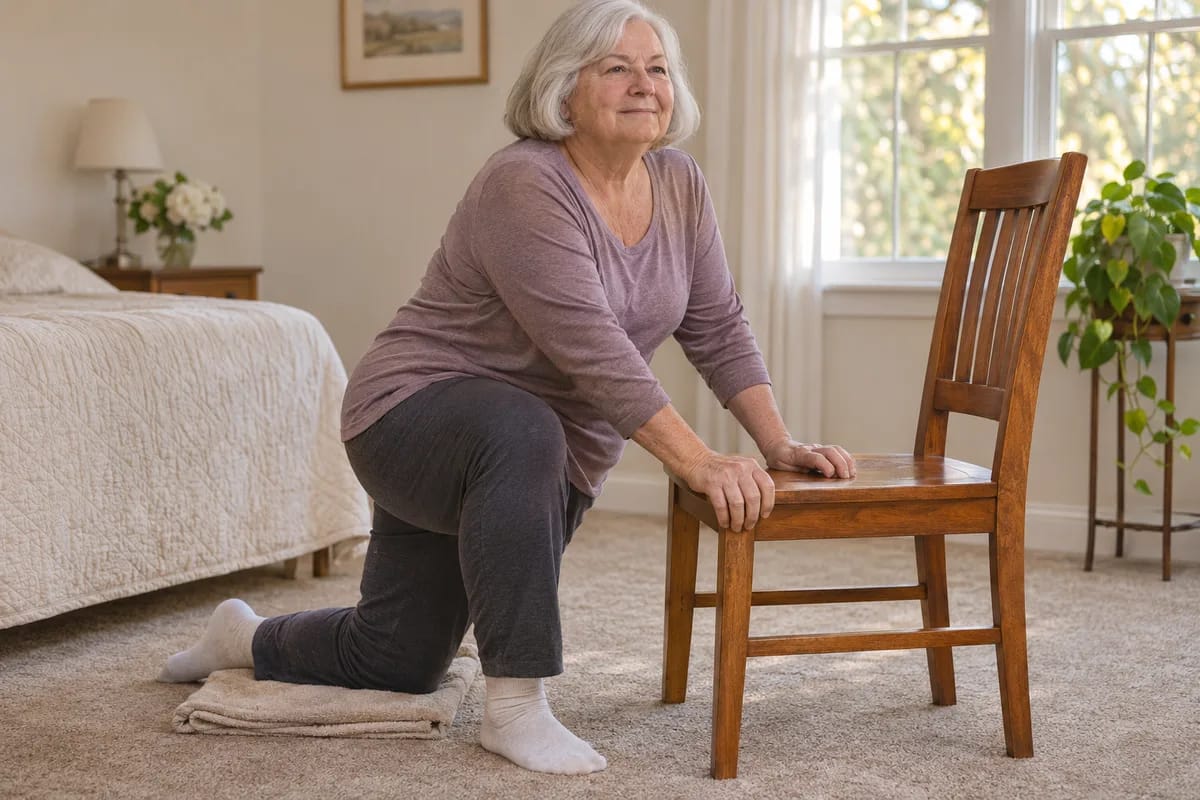
Kneel down and stand up, holding a chair
Put both hands on the seat of a sturdy chair, kneel onto a cushion, then step one foot forward and push up to stand.
Go from kneeling to sitting, still holding the chair
From kneeling, sit down to one side on the floor. Come back to kneeling, then stand the same way.
The same trip with one hand on the chair
Your other hand can push on your thigh.
The same trip with no chair
Use your hands on the floor as much as you need. Most people come up through hands and knees, then one foot forward.
Sit down cross-legged and rise with one hand, then none
This is the test itself. Every support you drop is a point back.
These two ladders slot into any routine. Training in your 60s shows how they fit a full week, and starting to lift at 50 with zero gym background walks you through a first month.
Retest without fooling yourself
Every 8 to 12 weeks is a good rhythm. Keep everything else the same: the same chair in the same spot, the same time of day, the same shoes or bare feet. Otherwise you're measuring the chair, not your legs.
On the chair test, a rough rule of thumb is about 2 more stands. That was the smallest change that counted as real improvement in a study of people with hip arthritis, and a large European study uses the same line.10 One more can just be a good day. On the floor test, look for a whole point, which means one less hand, knee or forearm on the floor.
It's hard to spot your own wobble, or the hand that drifts to your knee on the way up. A Bespoke Fit coach can run both tests with you on live video, see exactly where the points went, and build the right ladder steps into your sessions. Here's how a session works.
Either way, write today's numbers down. In three months you'll want to know what they were.
Under 60, or curious: your score as leg power
For a sense of the younger end, a small group of healthy adults aged 19 to 35 averaged 33 stands.11 In a few hundred Danish adults, leg power measured with this test showed no clear change between 30 and 50, and European data show a steady fall after that.12
A raw count also leaves out your height and your speed. The chair test was built as a leg-strength test,13 but you're racing the clock, and a tall person on a standard chair travels further on every stand. The same European researchers folded all of that into one number, leg power per kilo of body weight.12 Simplified for a 17 in (43 cm) seat:
Leg power = stands × (half your height in inches − 17) × 0.015
In metric, that's stands × (half your height in metres − 0.43) × 0.59.
Take a woman who's 5 ft 4 in, which is 64 inches, and did 13 stands: 13 × (32 − 17) × 0.015 = about 2.9 watts per kilo. That's level with the typical woman over 60 without mobility problems in the study, who scored about 2.85 (the typical man scored about 3.55). Below 2.1 for women or 2.6 for men counted as low, and people under those lines were far more likely to have trouble getting around.
Those lines come from people aged 60 and over, so there's no official cut-off for a 45-year-old. Before 60, though, this is the number we'd track, and it's worth working out again each time you retest.
Sources
-
Rikli and Jones, 1999. Functional fitness normative scores for community-residing older adults, ages 60-94. Journal of Aging and Physical Activity. The ranges are the 25th to 75th percentiles; the lower limits match the CDC's chart. ↩
-
Centers for Disease Control and Prevention, 2017. Assessment: 30-Second Chair Stand. STEADI. ↩
-
Bohannon, 2006. Reference values for the five-repetition sit-to-stand test: a descriptive meta-analysis of data from elders. Perceptual and Motor Skills. ↩
-
Shirley Ryan AbilityLab. Five Times Sit to Stand Test. Rehabilitation Measures Database, citing Bohannon, 2007 (the under-60 averages, from 54 people) and Tiedemann and colleagues, 2008 (the 12-second cut-off, from 362 people aged 74 to 98). ↩ ↩2
-
Strassmann and colleagues, 2013. Population-based reference values for the 1-min sit-to-stand test. International Journal of Public Health. ↩
-
Araújo and colleagues, 2025. Sitting-rising test scores predict natural and cardiovascular causes of deaths in middle-aged and older men and women. European Journal of Preventive Cardiology. The percentages in the table are our rounding of the paper's counts. ↩
-
Araújo and colleagues, 2020 (online 2019). Sitting-rising test: sex- and age-reference scores derived from 6141 adults. European Journal of Preventive Cardiology. The chart gives quartile bands by sex for 15 five-year age groups from 16 to over 85. Free copy (PDF). ↩
-
Fleming and Brayne, 2008. Inability to get up after falling, subsequent time on floor, and summoning help: prospective cohort study in people over 90. BMJ. ↩
-
Liu and Latham, 2009. Progressive resistance strength training for improving physical function in older adults. Cochrane Database of Systematic Reviews. ↩
-
Wright and colleagues, 2011. A comparison of 3 methodological approaches to defining major clinically important improvement of 4 performance measures in patients with hip osteoarthritis. Journal of Orthopaedic and Sports Physical Therapy. Alcazar and colleagues (note 4) use the same 2-stand threshold. ↩
-
Lein and colleagues, 2022. Normative reference values and validity for the 30-second chair-stand test in healthy young adults. International Journal of Sports Physical Therapy. ↩
-
Alcazar and colleagues, 2021. Relative sit-to-stand power: aging trajectories, functionally relevant cut-off points, and normative data in a large European cohort. Journal of Cachexia, Sarcopenia and Muscle. The formula above is our simplification of the authors' equation for a 30-second test with a 43 cm seat. ↩ ↩2
-
Jones and colleagues, 1999. A 30-s chair-stand test as a measure of lower body strength in community-residing older adults. Research Quarterly for Exercise and Sport. ↩