Balance declines quietly: how to train it back
The 10-second one-leg test predicts survival, and balance fades from disuse as much as age. Here's how to train it back at any age.
Step off a curb wrong, catch your foot on a rug, or stand up too fast, and you brace for the stumble before you've even registered what happened. That reflex used to be instant. If it isn't anymore, age is rarely the real reason. Balance is a trained skill, and skills fade fast once you stop practicing them. Most of what feels like getting older here is really a system going unused for months or years, which is also the good news: it comes back fast, often within weeks, because the first gains are your brain relearning a movement it stopped rehearsing, not new muscle.
Three systems, one balancing act
Balance feels like one sense, but it's really your brain merging three separate feeds of information, many times a second.
Vision tells you where level is and how the room is moving around you. The vestibular system, fluid-filled canals in your inner ear, senses head tilt, rotation, and acceleration. Proprioception is the position sense coming from receptors packed into your muscles, tendons, and joints, especially around your ankles and feet. It tells your brain where your body is without you having to look down and check.
Your brain checks these three streams against each other and fires corrections to your muscles continuously. When they agree, you feel steady. When one sends a bad or missing signal, you wobble while your brain sorts out which of the other two to trust more. That's the whole system: eyes, inner ear, and feet, arguing it out, with your brain as referee.
Why it goes quiet: age wears at it, disuse does more
All three inputs decline with age, and none of them announce it. Vision loses contrast sensitivity and depth cues. The inner ear steadily loses hair cells from around midlife on. Proprioception dulls as nerve signals slow and the small stabilizing muscles around your ankles and hips weaken. None of that comes with a symptom. You just start reaching for the handrail a little more than you used to.
The bigger factor is disuse. Flat floors, supportive shoes, and a desk job mean most adults never challenge their balance at all. The nervous system runs on a use-it-or-lose-it rule: circuits you don't rehearse get slower and less precise, no matter your age. Age sets the backdrop. Training loss usually does the rest, wearing a disguise that looks a lot like getting older.
What a 10-second stance tells you, and what it doesn't
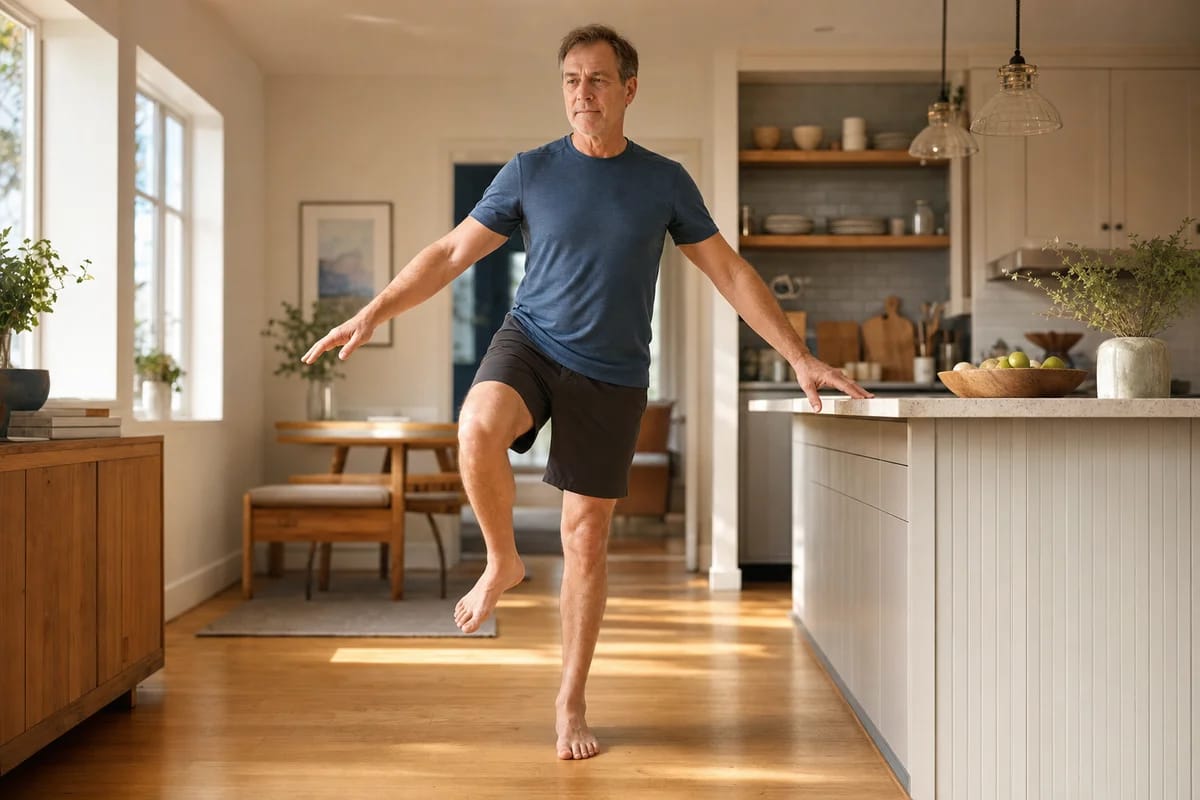
There's a simple field test that turns out to carry a surprising amount of information: stand on one leg for 10 seconds, no support, and see if you make it.
A 2022 study in the British Journal of Sports Medicine followed 1,702 people aged 51 to 75 for a median of seven years. About one in five couldn't hold the stance at the start. Over the follow-up, 17.5 percent of the people who failed the test died, compared with 4.6 percent of those who passed. After adjusting for age, sex, body mass, and other clinical factors, failing was linked to roughly 84 percent higher risk of death from any cause.1
That doesn't mean a wobble kills you. It means the test is a fast readout of how several body systems, not just balance, are holding up together, and those systems track your overall health closely enough that ten seconds on one leg says something real. It's a proxy, not a diagnosis: it can't tell you what's wrong, and one bad attempt on a tired day means little. The mortality link is also observational. People who fail the test tend to die sooner, but that's not the same as proving that training your balance adds years, and no one has run a 30-year balance-training trial to settle it. The connection is strong and consistent, which is why doctors use the test, but it's a marker, not a lever you can prove you're pulling.
For a sense of what's normal, a look at 549 healthy adults across six age groups, from the late teens to over 80, found hold times drop steadily with every decade, and the drop is far steeper once you close your eyes.2 Without vision, your inner ear and feet have to carry the whole job.
How to actually get it back
The reason balance training works fast is that the early gains are neural, not muscular. Practice a balance task and your nervous system quickly gets better at reading the position signals and firing the right stabilizing muscle at the right instant, before you've built any new strength at all. A review pulling together the neuroscience on this backs it up: balance skill improves quickly with practice in both younger and older adults, even though researchers are still mapping exactly what's changing in the brain to produce that improvement.3 The practical version: the skill comes back with reps.
The payoff shows up where it matters most, in falls. The largest pooled analysis of fall-prevention trials to date combined 108 randomized trials and 23,407 community-dwelling older adults. Exercise cut the rate of falls by about 23 percent overall (a rate ratio of 0.77), and programs built specifically around balance and functional movement did the most work on their own, cutting falls by around 24 percent.4 Programs that combined balance, functional, and resistance training reached about a 34 percent reduction, the strongest result in the analysis, though the review rates that specific combined-program figure as moderate-certainty evidence (the 23 and 24 percent figures above are the high-certainty ones). Balance is also only half of catching yourself: the power to react fast enough matters just as much. I get into that in why power matters more than strength for fall-proofing.
That trial evidence skews older, though. Most of it comes from adults over 65, many already at some fall risk. A fit 50-year-old will get real balance gains from training, but the exact 23 percent figure describes an older, less healthy group than that. Balance also varies a lot person to person, so track your own numbers over time instead of comparing yourself to a chart.
Here's a progression that works from a standing start, each stage building on the one before it:
- Narrow your base. Feet together, then heel-to-toe (one foot directly in front of the other), 30 seconds each. Stay near a counter so you can touch down if you need to.
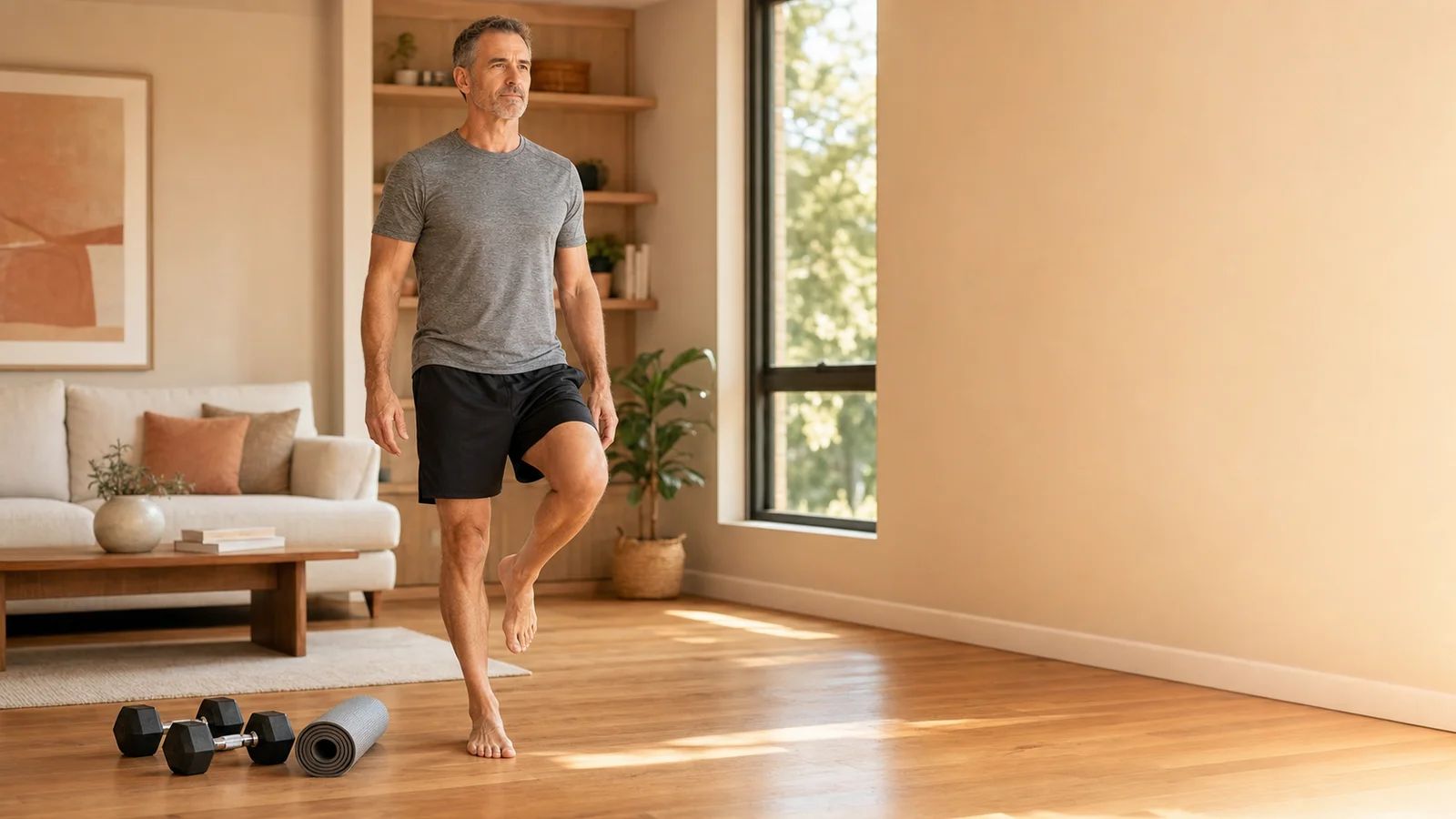
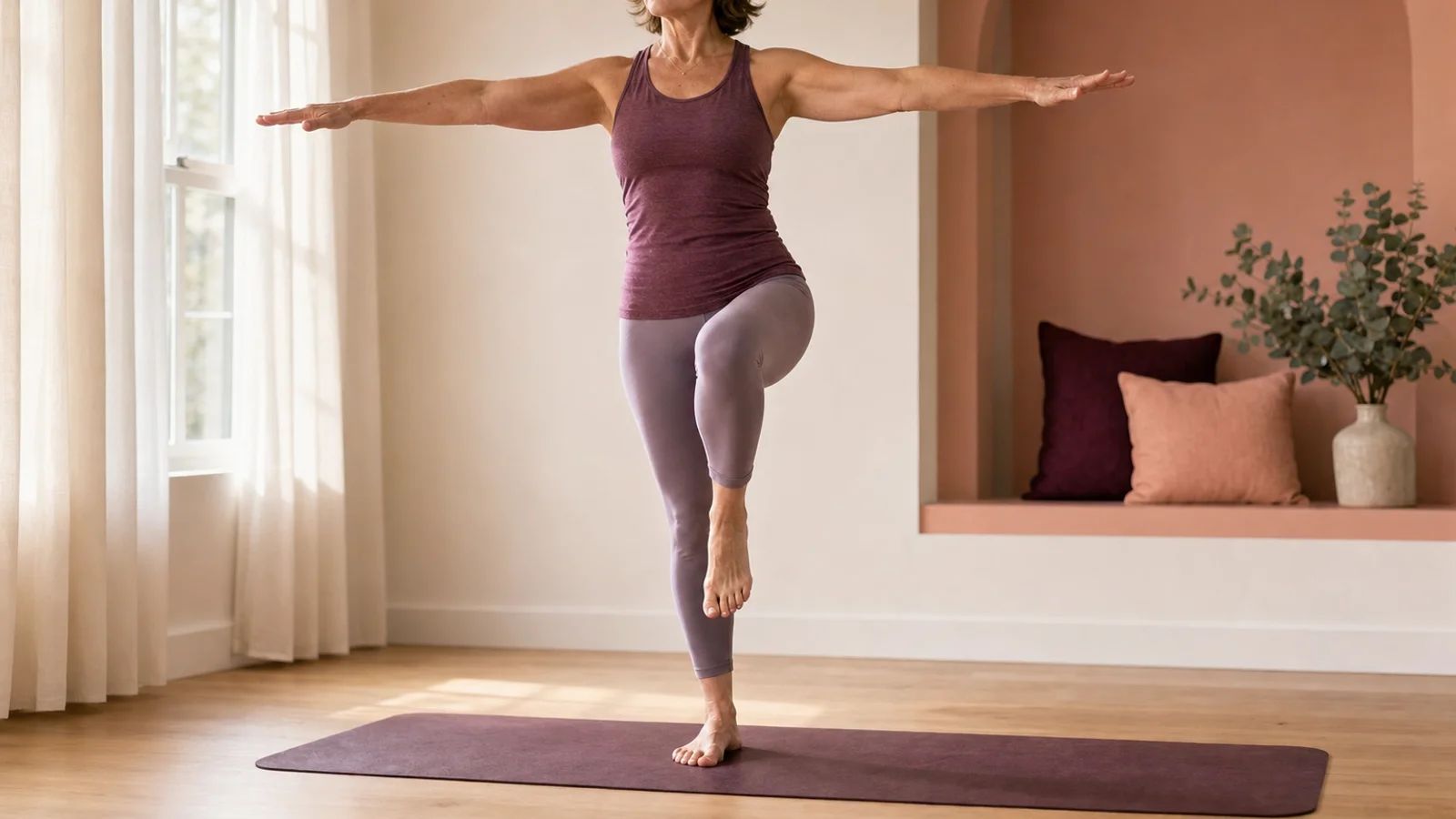
- Go single-leg. Stand on one leg, eyes open, and build toward 30 seconds a side. Once that feels easy, move on.
- Close your eyes. This is the big jump: it removes vision and forces your inner ear and feet to do the whole job. Your time will drop hard at first. Stay within arm's reach of a wall.
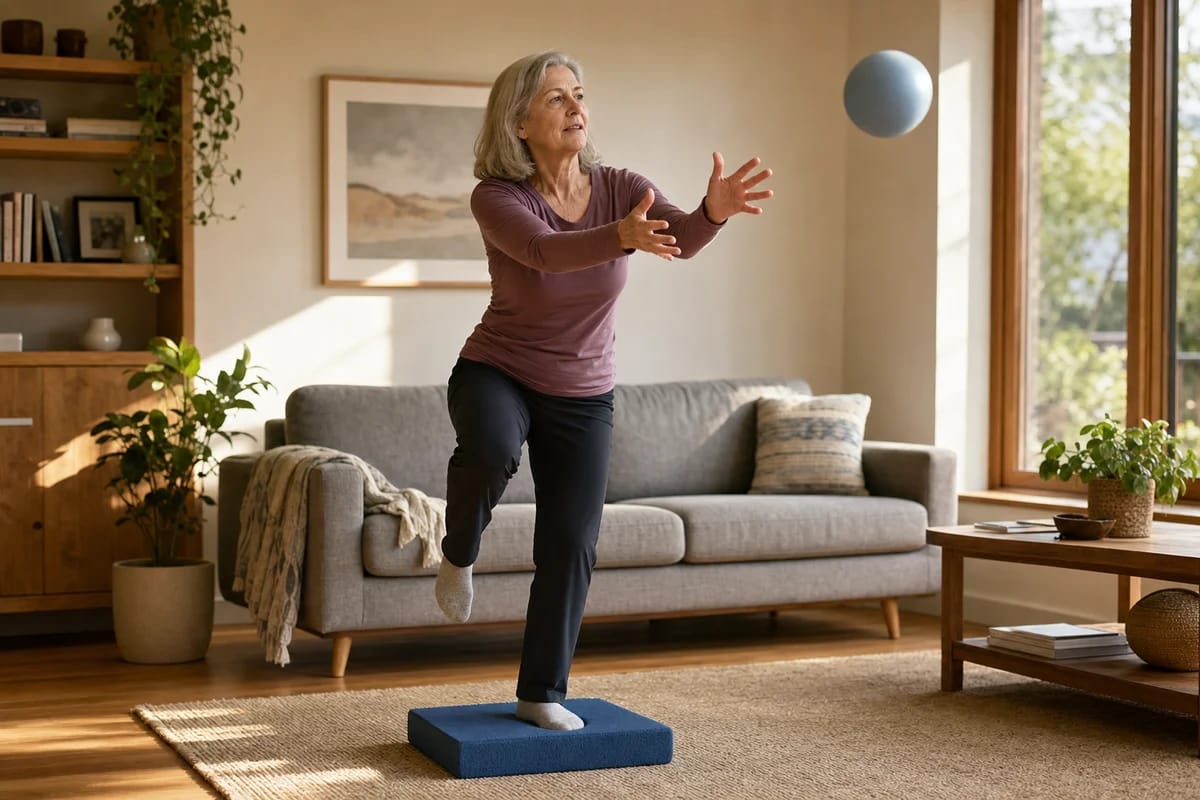
- Add instability and distraction. Stand on a cushion or folded towel, turn your head side to side, reach for something, or toss a ball hand to hand. These force the same kind of real-time correction a curb or a wet floor demands.
A few minutes most days beats one long session a week, because you're building a skill, not exhausting a muscle. Brush your teeth on one leg. Stand heel-to-toe while the kettle boils. The reps add up faster than a scheduled workout ever could.
Common questions
How long should I be able to stand on one leg? Thirty seconds a side, eyes open, is a solid home target. Ten seconds is the floor that shows up in the mortality research, so clearing it comfortably is goal one. Thirty seconds gives you real margin above that.
How fast will balance improve if I actually train it? Faster than strength training does. Because the early gains are your nervous system relearning the task rather than muscle growth, most people notice steadier single-leg holds within two to four weeks of near-daily practice. The stabilizing muscles keep catching up after that, so the gains don't stop at week four, they just slow down.
Is a wobble board or foam pad better than practicing on the floor? It's a later stage, not a starting point. Unstable surfaces only make sense once you can hold a single-leg stance on solid ground with your eyes closed. Start there instead and you'll spend the whole session grabbing the wall, which trains almost nothing.
Can I train balance after I've already had a fall? Yes, and it's especially worth doing. Start conservative and supported, though. If you have a known issue with your inner ear, vision, or nerves, or you've fallen more than once, check with your doctor or a physiotherapist first so the progression fits your situation.
What you can't catch in a mirror
The progression above is a complete program on its own: a wall, a timer, and a few minutes most days is genuinely enough to move a 10-second hold toward 30. Plenty of people run exactly this plan alone and get there. If you're someone who'll actually stand heel-to-toe while the kettle boils without anyone reminding you, you're the kind of person coaching is optional for.
What's harder to do alone is catching the cheats. Balance drills are full of quiet compensations: gripping the floor with your toes, hiking one hip, locking a knee, drifting a hand toward the wall before you've even noticed you're falling. Every one of those makes the hold look successful while training the wrong pattern. A coach watching in real time calls the wobble and fixes it before it sets, the same reason a coach watches every rep on your strength work. At Bespoke Fit your coach builds the balance progression into your strength and power programming, retests your single-leg holds on video, and moves you to the next stage the moment the current one gets easy. See how it works, or claim a founding spot: your first month is $49, then $299 a month locked for life, one of 25 founding spots, with unlimited live 1-on-1 sessions and a 30-day money-back guarantee.
Steady feet are trainable at any age. The only thing that builds them is the practice you actually keep doing.
Sources
-
Araujo and colleagues, 2022. Successful 10-second one-legged stance performance predicts survival in middle-aged and older individuals. British Journal of Sports Medicine. ↩
-
Springer and colleagues, 2007. Normative values for the unipedal stance test with eyes open and closed. Journal of Geriatric Physical Therapy. ↩
-
Bakker and colleagues, 2024. Neural correlates of balance skill learning in young and older individuals: a systematic review and meta-analysis. Sports Medicine - Open. ↩
-
Sherrington and colleagues, 2019. Exercise for preventing falls in older people living in the community. Cochrane Database of Systematic Reviews. ↩