Why a coach watches every rep
Async form checks arrive a day late. Live coaching fixes the rep while the bar's still in your hands, and that timing changes what you learn.
Updated

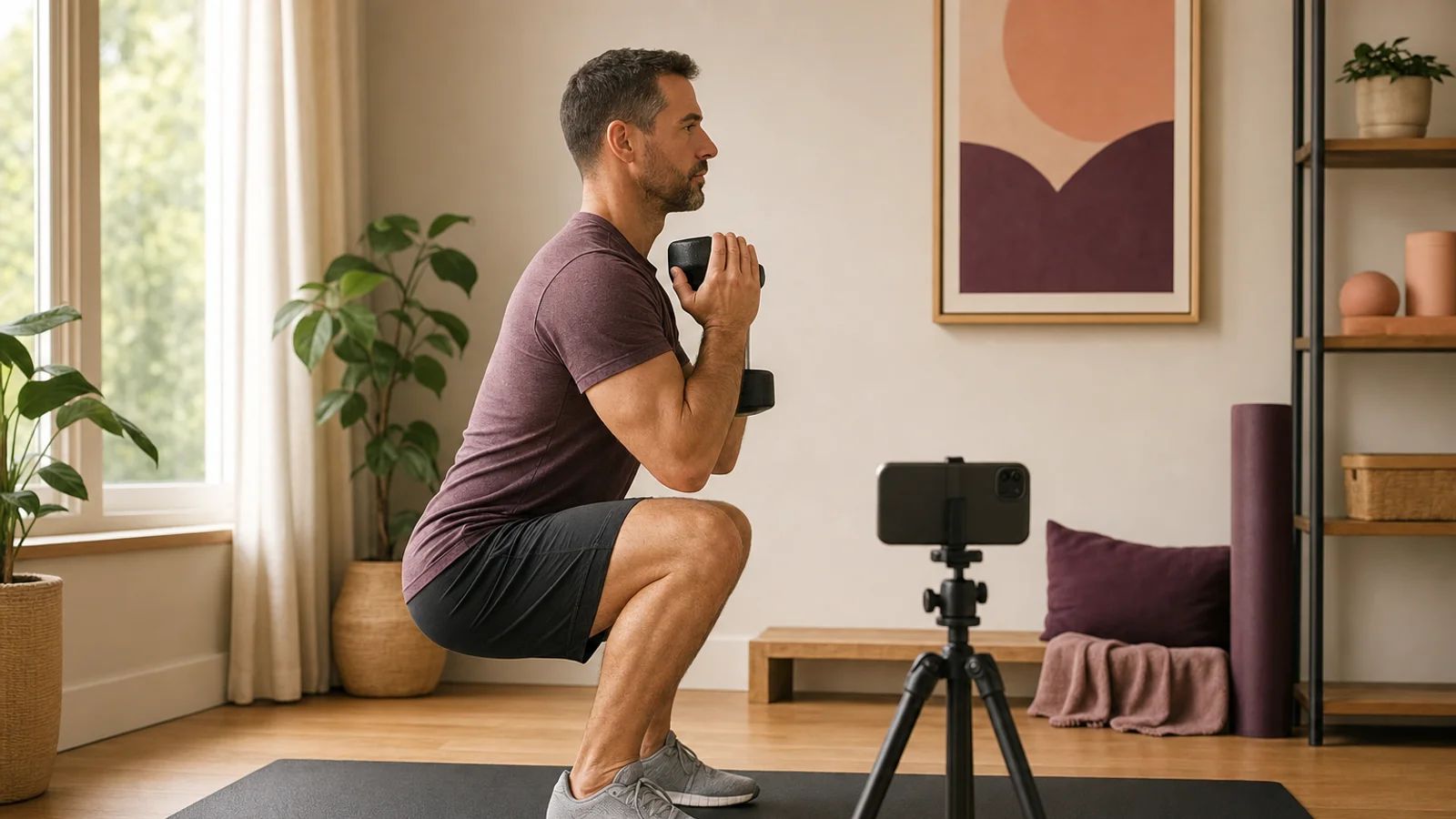
Rep four of a heavy set of squats. The bar creeps forward over your toes, your chest dips a few degrees, and you finish the set anyway, because from the inside it didn't feel that bad.
What happens next decides whether anything gets fixed.
If a coach is watching live, you hear "sit back, weight in your heels" before rep five, and rep five feels different. If you're filming the set for an async form check, you'll read a note about it tomorrow, after four more sets and maybe another whole workout done the old way.
Same observation, same coach, same skill. What separates those two outcomes is timing, and timing turns out to be most of what live coaching sells.
Most online coaching is the second version. A coach writes your program, you train alone, you upload a clip, feedback lands hours or a day later. Future, trainwell, and Caliber all work roughly like that. It's a reasonable model with a hole in the middle of it, and that hole is why we built Bespoke Fit around a real coach on live HD video for every session.
A correction has a shelf life
Learning a lift is mostly a matching problem. You do a rep, it produces a particular feeling in your hips and back and feet, and something has to tell you whether that feeling was the right one. Do that enough times and your body starts picking the good version on its own, without you talking yourself through it.
The feeling is the part that expires.
A clip keeps the picture. It doesn't keep the feeling. By the time you read "you're drifting forward," you can't call up how rep four felt, so the note turns into an instruction you have to remember next Tuesday rather than a sensation you can go find again. Those are very different things to carry into a workout.
Live, the comparison sits right next to itself. Wrong rep, cue, right rep, seconds apart. You feel the difference in your own body while the bad version is still fresh, and that comparison is where the learning happens.
Then there's the cost most people underrate. Between filming the set and reading the note, you kept training. Four more sets, possibly a second session. Practice doesn't check whether a pattern is a good one before it grooves it in. So tomorrow's correction shows up with more work to undo than it would have had at rep four.
The feedback isn't wrong. It's late, and late feedback is weak feedback. A camera is still worth owning, and I've written separately about what a tripod catches and what it can't.
What only happens while someone's watching

The fix lands inside the set
Your coach cues you between reps, sometimes during one. You don't finish a session wondering whether your form held up, because somebody told you while it was happening.
The weight stops being a guess
How fast the bar moves says a lot about what you have left, and it's only readable while the set is happening. A coach who can see it adds weight when the bar is flying and ends the set when rep five turns into a grind. Training alone off a spreadsheet, you either leave easy reps on the table or push through ugly ones. I've done both. Neither feels great a week later.
Next week gets built from what your coach saw
Logs are fuzzy. "Felt heavy" covers a hundred different problems. Your coach watched the session, so they know which exercise stalled, on which rep, and what your hips did right before it stalled. That's the raw material for next week's plan. You can see how a session actually runs on our how it works page.
Questions that come up in between go to your coach by message, so those don't wait for the next call either.
An app never notices that you didn't show
There's a quieter benefit here with nothing to do with technique.
The hard part of training usually isn't the training. It's showing up on the days you'd rather not. A notification is easy to swipe away. Nobody knows, nobody minds, and the app will cheerfully reschedule you forever.
A booked session with a person behaves differently. Your coach is on the call at the time you picked, whether you join or not. They know your name and what you're working toward, and they'll see the empty screen. We're good at breaking promises to software. We're much worse at breaking them to somebody who's already sitting there waiting. That's the appointment effect doing the work.
Our coaches will tell you this is half the job. Programming matters. So does being the reason you didn't skip Tuesday.
When a form check tomorrow is genuinely fine
Most companies in our position would leave this part out.
If your technique on the main lifts is already solid, your motivation is reliable, and what you really want is smart programming, async coaching will probably do the job. You get a well-built plan, occasional form checks, and a coach in your pocket for questions, at a lower price than live coaching. Future is good at exactly that, and we've written an honest comparison with Future if you want the details.
Live coaching earns its money when things are messier. You're still learning the main lifts. Your form holds at light weights and falls apart when it gets heavy. You've quit programs before, not because the programs were bad, but because nobody noticed when you stopped. Or you tried async coaching and quietly stopped filming your sets, because uploading them felt like homework.
If that sounds familiar, a note arriving tomorrow won't fix it. Someone in the room, even a virtual one, might.
What that costs next to a local trainer
A good in-person trainer runs around $90 a session in most cities. Train three times a week and that's roughly $1,080 a month, which is why most people who'd benefit from a trainer don't have one.
Bespoke Fit is $299 a month at the founding member rate, locked for life, with unlimited live 1-on-1 video sessions. There are 25 founding spots, and once they're gone the standard rate is $499 a month. Your first month is $49, and there's a 30-day money-back guarantee, so you can find out whether being watched changes anything for you before it costs much of anything.
The full numbers are on our pricing page. The short version: for roughly what three sessions with a local trainer cost, you get a coach who watches every rep, every session. That's the whole idea.
More on