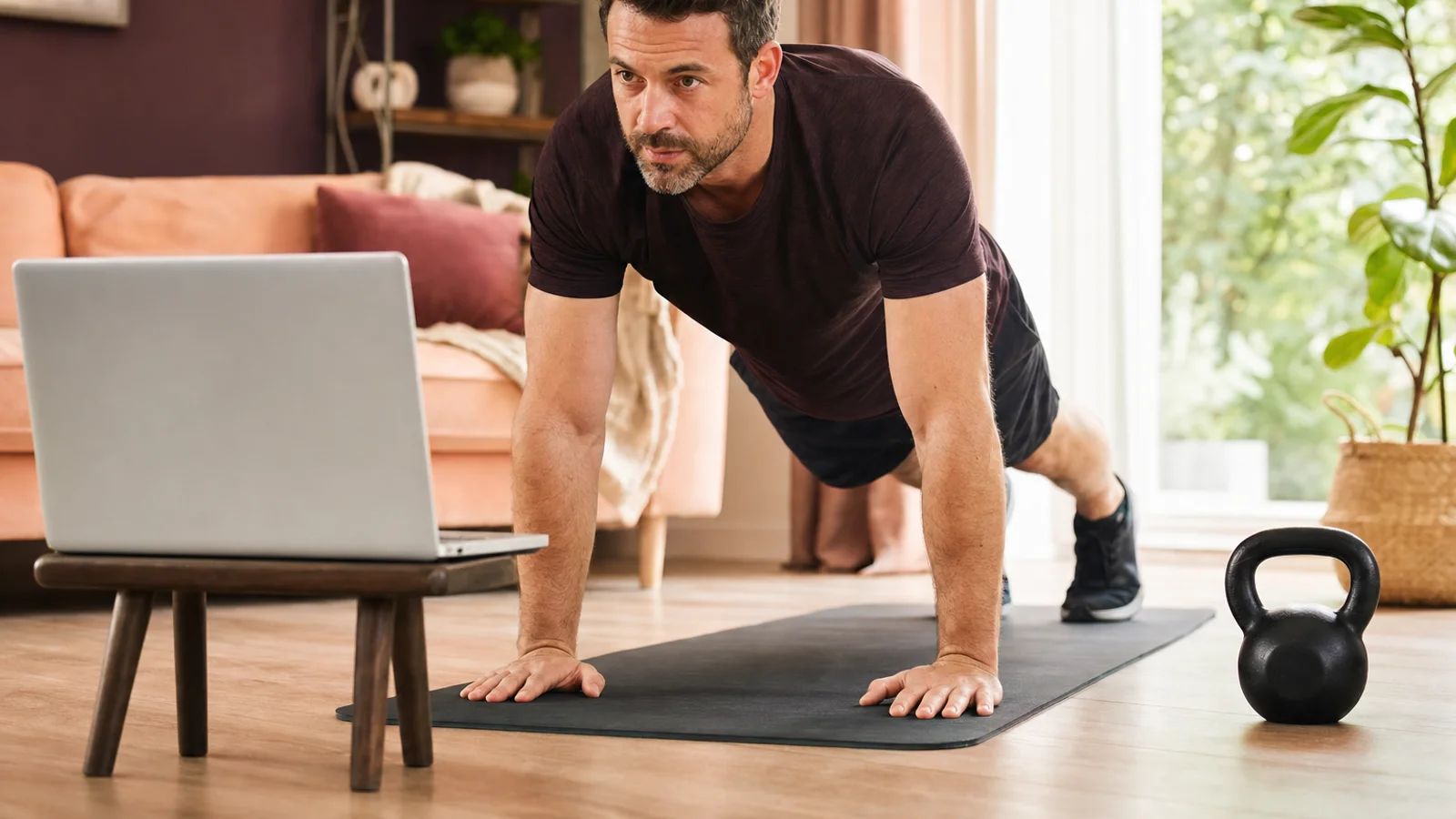
Can a trainer really check your form over video?
What a coach can and can't see over video, what physio research says about remote movement assessment, and why camera angle decides most of it.
Updated
Most of it, yes.
A coach on a screen can see your squat depth, your bar path, how fast rep six moves compared to rep one, and the moment your hip slides out to one side at the bottom. What they can't do is put a hand on your lower back, feel where your shoulder really stops, or catch a bench press that's about to pin you.
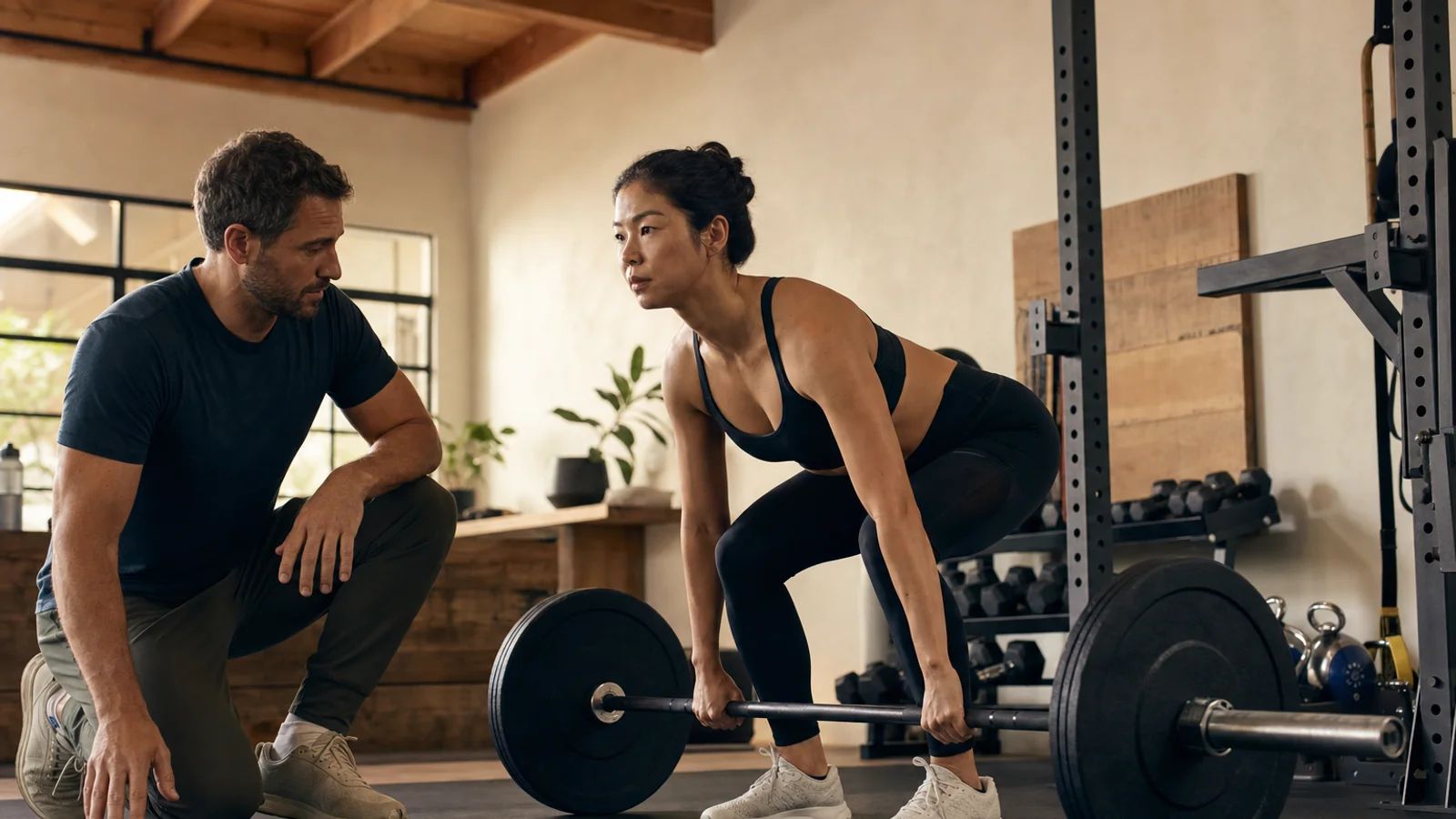
That's a real loss, and the skeptics are right to name it. What they usually miss is how little of coaching ever ran on touch. Watch a good trainer on a gym floor and count. How often do they physically move somebody, and how often do they stand back and say a sentence? It's mostly the sentence.
So the thing worth testing is whether a camera lets a coach watch well enough. Physical therapists had to answer that when their field went remote, and they measured it.
What a coach is actually watching
"Checking your form" stays vague until you break it into what a pair of eyes is doing.
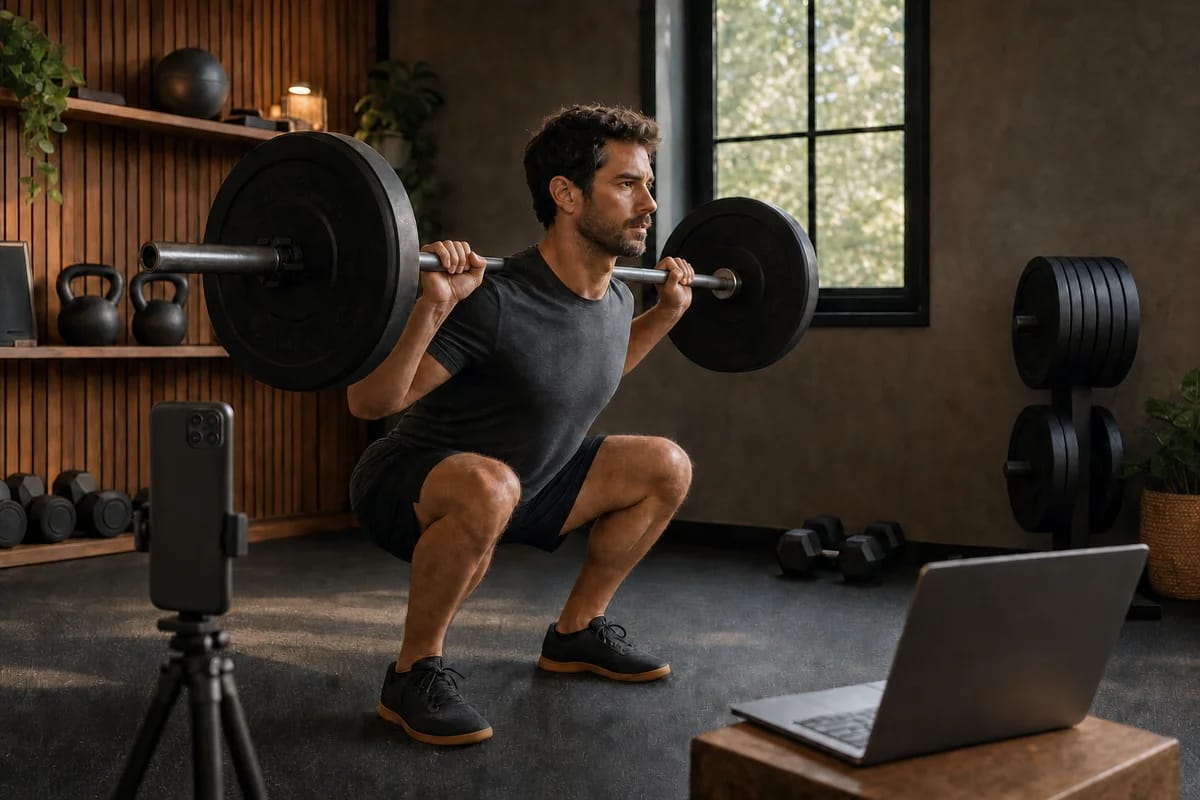
Joint angles come first. At the bottom of a squat: where's your hip crease compared to your knee, how far forward has your shin traveled, has your pelvis tucked under. Those are positions in space, and recording positions in space is the one thing a camera is built for.
Then bar path. A good squat or deadlift keeps the weight stacked over the middle of your foot. Let the bar drift forward and your lower back picks up the difference. From the side, that drift is one of the easiest things in lifting to spot on video, because the coach sees your whole outline at once.
Then tempo. How fast the weight moves, where it slows down, whether rep six is grinding while rep one was crisp. Bar speed is the best live read anyone has on how close you are to failure, and it comes through a camera perfectly.
Last, symmetry. A hip shifting out to one side. One arm locking out late. Heels peeling up, knees caving in, a back that rounds the second your hamstrings run out of range. These patterns tell a coach where trouble is going to come from, and every one of them is visible.
None of that needs hands. It needs a clear view, and a clear view is a solvable problem.
Physios already ran this experiment
Physical therapy spent 15 years checking whether an assessment done over video matches one done in the room. The results split cleanly, and the split is the useful part.
A 2023 review in PLOS One pulled together 10 studies that ran both assessments on the same patients. Joint range of motion agreed almost perfectly between video and face to face, and so did the clinician's decision about what to do next. Spinal posture didn't agree at all, and the curve of the lower back was the worst of the lot.1
A bigger sweep of 39 studies agreed about the parts that work. Over live video, range of motion, strength testing and pain on movement all held up well.2
So "how is this body moving" is a question video answers. "What exactly is this spine doing" is a question it answers badly. Both halves matter for lifting, and a coach who says the second half out loud is worth more to you on the first.
Which lifts does a camera read well?
Squats and hinges filmed from the side are the easy case. Nearly everything that matters in them happens in the plane you'd see in a profile photo: hip and knee angles, shin travel, bar path, the shape of your back. When researchers checked plain 2D video against laboratory motion capture for knee bend during a single-leg landing, the two matched closely.3 Measuring knee cave off ordinary video is reliable too, which is why physios use exactly that method to screen athletes.4
Presses, rows, lunges and carries all read fine given a decent angle.
The hard case is small amounts of spinal movement under heavy loads. The gap between a braced neutral back and a few degrees of lumbar flexion on a near-max deadlift is genuinely hard to see on a screen. It's hard in the room too, which is why coaches in the flesh put a hand on your back, and it's the exact thing the video-versus-in-room comparison flagged as weak. A good side angle and a snug shirt narrow that gap. Nothing closes it.
Camera placement decides most of it
Almost every bad remote form check you've seen traces back to a camera squashing three dimensions into two. A joint angle only lands truthfully on that flat image when the movement happens in a plane facing the lens square on. Turn the camera 30 degrees off axis and the same squat depth measures differently. Motion-analysis people call it perspective error. Height and distance do the same damage: a phone lying on the floor a few feet away blows up whatever is nearest the lens, which is why floor-level squat clips make everybody's knees look broken.
The camera turns you into a drawing, and the drawing is only accurate when you're standing square to the page.
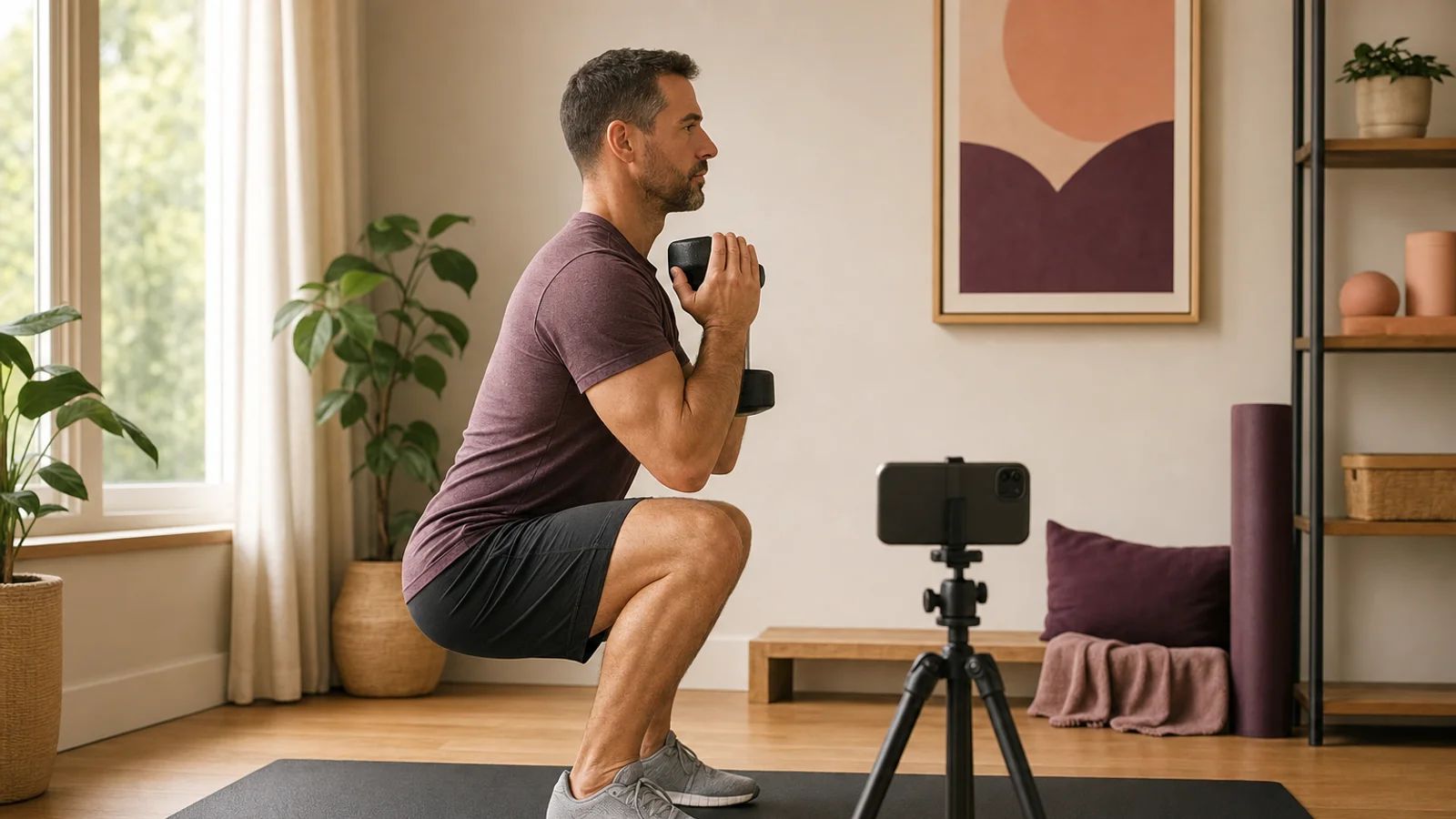
The fixes are boring and they work. Side-on at hip height for squats, deadlifts and hinges, far enough back that your whole body stays in frame. Front-on or 45 degrees when knees or elbows are the question. Behind you for rows. The right angle changes per exercise, which is why a fixed camera in the corner would be useless and a phone you can pick up and move is not. The full setup, tripods and earbuds and all, is in the logistics of live video training.
Three things a camera can't do
Any remote coach who won't say these out loud is selling you something.
No palpation. Nobody can feel muscle tone through a screen, find the tender spot, or work out whether a restriction comes from the joint or from the tissue around it. If something hurts and the reason isn't obvious, video runs out of road, and the right move is to go see someone in person.
No feel for true end range. In the room, a coach can move your shoulder or hip for you and feel where it stops and how it stops. On video they can only watch you move yourself, which shows the range you can use but not what's limiting it.
No spot. Nobody is grabbing the bar if a heavy bench goes wrong. A good remote coach builds around that instead of pretending: dumbbells or a rack with safeties for pressing near failure, a rep left in the tank on the big barbell lifts, and loads picked off your bar speed rather than your mood.
Live video beats a clip you send later
Recorded form checks beat nothing. They come with two problems built in, and neither one is about camera quality.
The first is timing. A correction changes your next rep most when it lands seconds after the last one, while the feel of the mistake is still in your body. Advice that arrives tomorrow has to fight every rep you did in between. That gap is the whole subject of why a coach watches every rep.
The second is selection. When you film a set to send your coach, you send the good one. Everybody does. It's an audition, not a sample, and your form actually falls apart on rep nine of set four, which is the rep worth watching. On a live call there's no editing. The coach sees the warm-ups, the grinders and the moment your brace quits, and can say "turn the phone a quarter turn" while it still helps. A clip shot from a useless angle is simply gone, and you find out a day later.
What the research can't tell you about your squat
All of the validity work above comes out of physiotherapy and telehealth: clinical patients, small samples, nobody holding a barbell. Treat it as strong circumstantial evidence, not proof about your squat. Agreement also depends on what's being measured, so gross movement holds up and fine spinal detail doesn't. And I can't find a study that compares live video strength coaching against in-person training on actual outcomes. Everything here assumes a steady camera and enough light to see by, too. One fixed angle with half your body out of frame deserves every bit of the skepticism it gets.
How to film yourself so it's worth watching
- Squats and hinges: side-on, camera at hip height, about 10 feet back, whole body in frame for the whole set.
- Add a head-on angle when the question is knees caving in or an uneven lockout.
- Film your last working set, not your first. The tired reps carry the information.
- Check three things on the clip: bar over midfoot, depth the same on every rep, and how the final rep moves compared to the first.
- Wear something snug enough that your back and hips are visible. Baggy hoodies hide exactly the things worth seeing.
- If a lift hurts in a way you can't explain, book an in-person assessment. That's where any camera, and any honest remote coach, hands you off.
Common questions
Can an online trainer see if I'm lifting with bad form? Yes, for most of what matters. Depth, bar path, tempo, symmetry and compensation patterns all show up on ordinary video at a decent angle. The blind spot is fine spinal position under heavy loads, which is hard remotely and hard in person too.
What camera angle is best for checking squat form? Side-on, at hip height, far enough back that your whole body and the bar stay in frame through the full rep. That one view gives depth, shin angle, back position and bar path together. Add a front view if knee position is the question.
Is video form checking safe for beginners? It works well for beginners, because mistakes get caught before they set into habits. Spotting is the caveat. Nobody can physically catch a failed lift, so a sensible remote coach keeps beginners away from grinding maximal barbell reps and picks setups that fail safely.
Do I need special equipment for video form checks? A phone, something to prop it at the right height, and decent lighting. That's the kit.
The gap between filming and fixing
A tripod, the checklist above, and the nerve to film the ugly sets will catch the big stuff on their own. Plenty of experienced lifters have self-coached that way for years.
What that setup can't do is close the distance between seeing a problem and fixing it. Knowing which of five visible faults actually matters. Catching it on the rep where it shows up. Changing next week's plan because of it. That's the job Bespoke Fit is built around. Every session runs on live HD video, your coach tells you where to put the phone for each exercise, your first session starts with a movement screen, and next session's programming comes from what the coach just watched. Sessions are unlimited, the first month is $49, and the founding rate is $299 a month, locked for life, for the first 25 members. If you've been filming yourself for months and fixing nothing, that's the gap we're for.
Sources
-
Bernhardsson S, Larsson A, Bergenheim A, et al., 2023. Digital physiotherapy assessment vs conventional face-to-face physiotherapy assessment of patients with musculoskeletal disorders: A systematic review. PLOS One. ↩
-
Zischke C, Simas V, Hing W, Milne N, Spittle A, Pope R, 2021. The utility of physiotherapy assessments delivered by telehealth: A systematic review. Journal of Global Health. ↩
-
Cleary CJ, Rogers K, Dombrowski N, Vopat LM, Vopat BG, Herda AA, 2024. High agreement between 3D motion capture and 2D video analysis systems and raters for knee flexion range of motion during a single-leg drop landing task. JOSPT Open. ↩
-
Munro A, Herrington L, Carolan M, 2012. Reliability of 2-dimensional video assessment of frontal-plane dynamic knee valgus during common athletic screening tasks. Journal of Sport Rehabilitation. ↩
More on