AI personal trainer vs human coach: an honest case
I use AI every day for real work. An AI personal trainer wins the information job. A human coach wins the in-the-moment one. Here is where each falls over.
An AI personal trainer beats a human coach at the information job: writing a sane program, remembering every set you've logged, answering a question at 11pm for nothing. A human beats it at the in-the-moment job: catching a rep that's going wrong before the next one, telling a hard set from an unsafe one, picking today's weight after watching your warm-up, and noticing when you quietly stop showing up. Two different jobs, and most of the AI-versus-human argument compares them as if they were one. The closest controlled test of that second job measured human supervision rather than AI: 88% of sessions attended with a coach in the room against 81% following an app, and about 59 lb added to the squat one-rep max against about 42 lb.1
I write software with an AI assistant open all day. It drafts code, catches my mistakes, and answers things that used to cost me an hour of searching. I'd fight you for it. I also run a live-video coaching service, so I'm the last person you should take on faith here. Check the logic instead.
The people I know who lean on AI hardest are usually the most specific about where it falls over. They've hit the walls themselves.
Who's better at what
| The job | Better done by | Why |
|---|---|---|
| Writing a starter program | AI | the basics of strength training are settled and well documented |
| Tracking sets and spotting trends | AI | it's arithmetic you'll skip and a computer won't |
| Answering a training question at 11pm | AI | instant, free, and it won't make you feel stupid for asking |
| Picking today's weight | A person | they saw your first warm-up set move |
| Fixing a rep in progress | A person | the correction has to land before the next rep, not after the set |
| Telling a hard set from an unsafe one | A person | that shows in your face and your breathing, not in the numbers |
| Noticing you've stopped | A person | somebody has to be waiting for you |
| Training around a hip replacement | A person | you're not the average case, and the average answer can hurt you |
What I'd hand to AI without arguing
Logging. Typing sets in, watching the numbers trend, noticing your bench hasn't moved in a month, catching that your squat stalls the week after a bad night's sleep. Computers beat you at that, and they don't get bored of it.
Starter programs. Ask a model for a beginner routine and you'll get a decent one. Progressive overload isn't a secret, and the good answers are all over the training data. Paying a person for a generic plan is a waste of money.
Questions, at any hour, with no judgment. What's a rep in reserve, how much protein do I need, is it normal to still be sore on day three. That used to cost money and now it doesn't.
If that covers what you need, use the app.
Form feedback that arrives one rep late
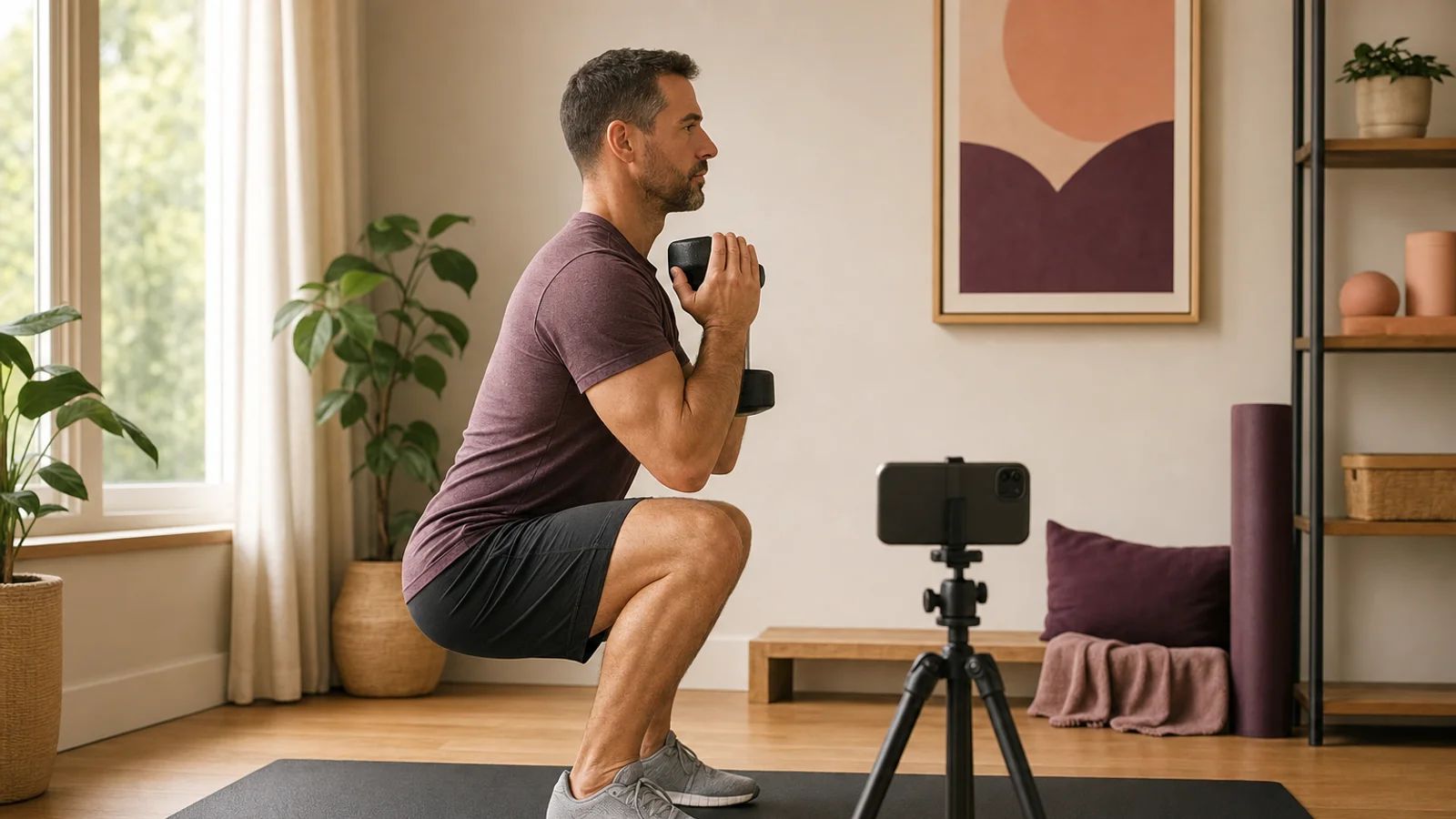
An AI form checker works off video. You film a set, the model runs pose estimation, and the feedback lands a few seconds later or once the set is done. Either way the note is about a rep you already finished. Your knee caved on rep four and you hear about it on rep seven, with the bar back on the rack.
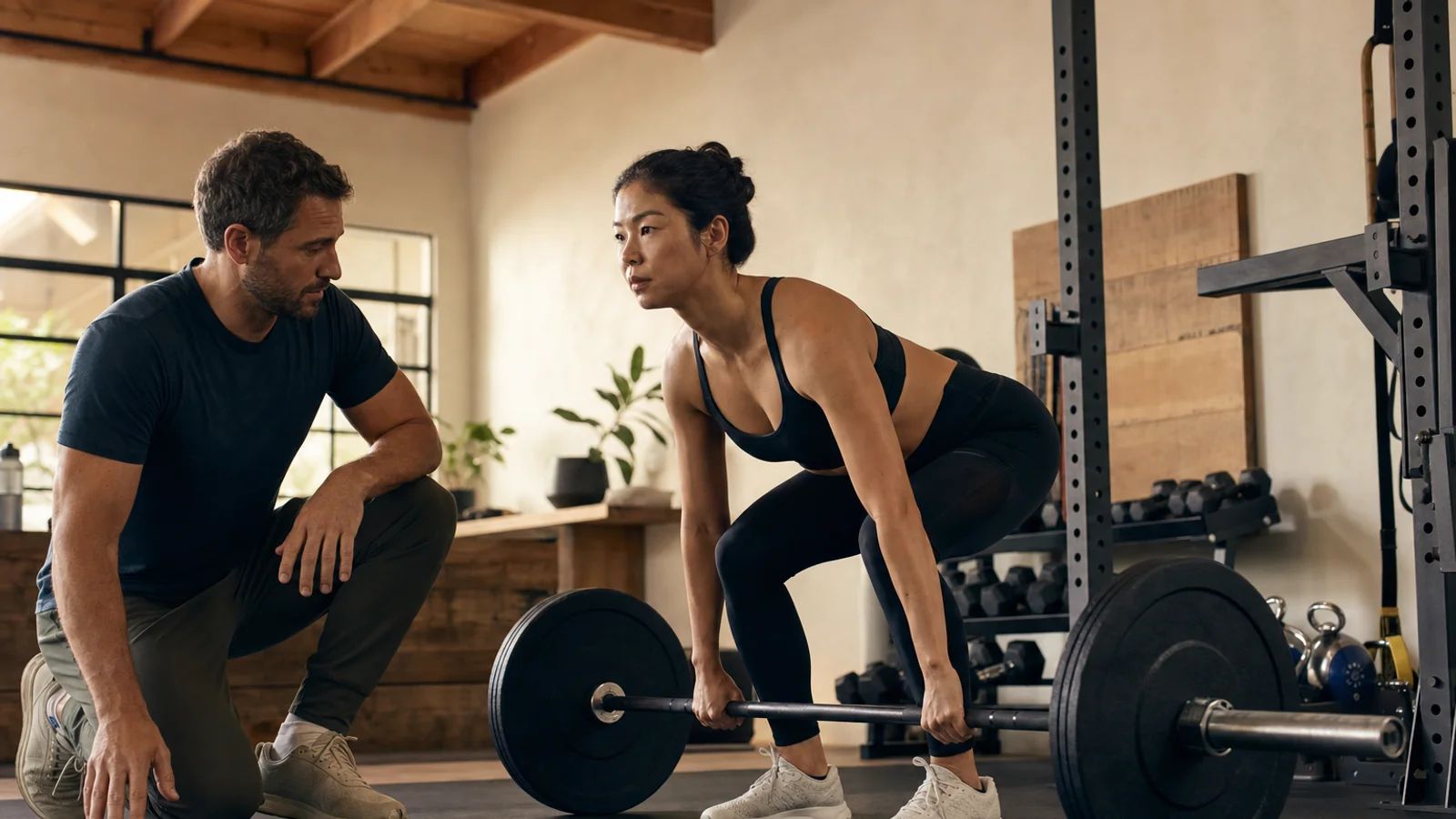
A coach watching live doesn't wait for the clip. They see the knee start to drift on rep four and say "push them out" before rep five, so rep five is the fix while the bad version is still fresh. It's the whole subject of why a coach watches every rep.
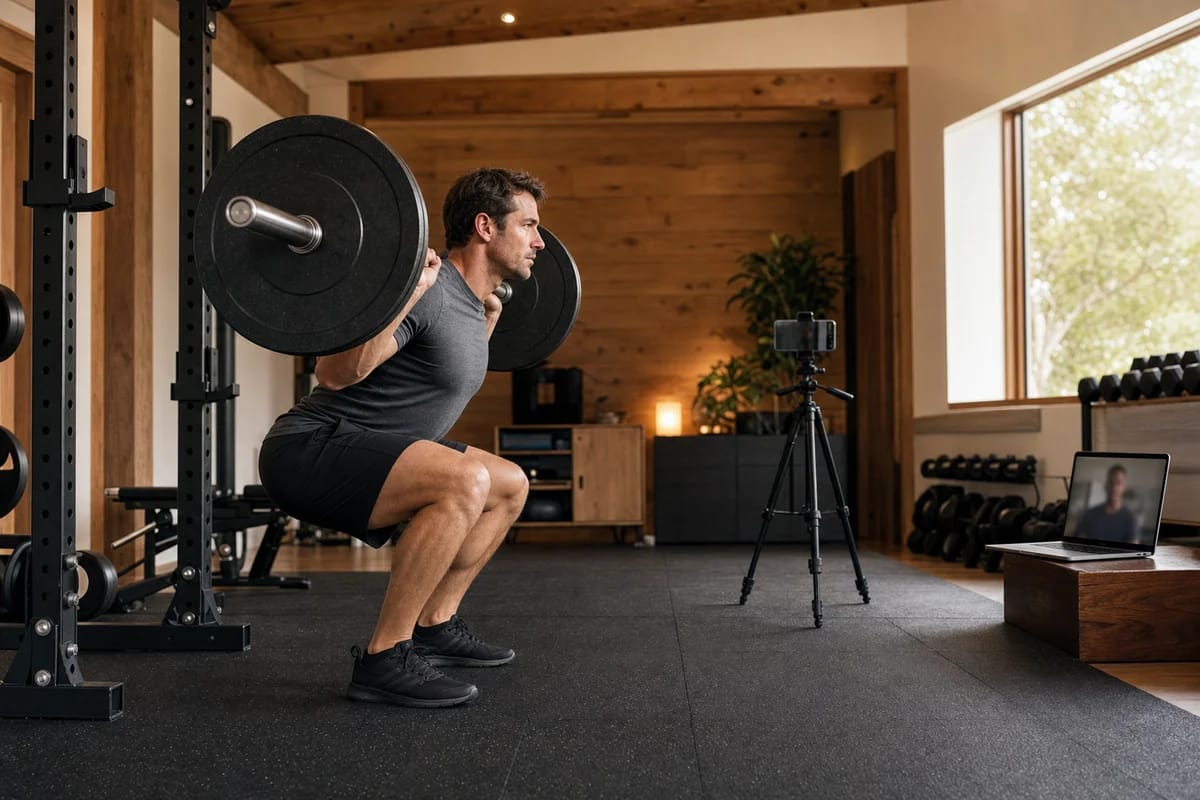
The analysis is shakier than the confident overlay makes it look, too. Pose estimation turns your body into joint dots and measures the angles between them. On a clean, side-on rep in good light it does fine. On a heavy rep filmed at an angle, in a dim room, in a loose shirt, the dots wander and the model fills in the gaps, and it rarely tells you which of the two it just did. Filming your lifts versus being watched live covers what each one picks up.
Worth knowing if you're shopping, because both get sold as 1-on-1 coaching. Ask which one you'd be buying: is a coach on the call while you train, or do they watch your video afterwards.
The same problem shows up one level higher. Your program was written before today happened. You slept badly, your shoulder's cranky, and the plan still says 5 sets of 5 at a weight that made sense last Tuesday. A person watching your warm-up rewrites it on the spot: less on top, a different pressing movement for the shoulder. An AI program adapts too, on a weekly clock, from what you logged. It can't watch set one and rewrite set three.
What never shows up in the data
A model measures what it can see: joint angles, bar path, rep speed. Useful proxies, all of them. A coach reads things that don't reduce to numbers cleanly. The hitch in your breathing that means you're closer to failure than bar speed suggests. The wince you covered. The difference between a good grind, hard but safe, and a bad one where your lower back is about to take over from your legs. Those two look nearly identical on a stick figure.
Part of that is memory of you. A coach carries a picture of your normal, so an off day registers as an off day. A form checker starts fresh on every clip and compares you to a general template.
Effort is also something you say out loud. A coach asks how that felt, then weighs your answer against what they just saw. A model usually gets one channel, the video.
Nobody is waiting for you at six o'clock
Every fitness app promises accountability, and a better notification won't deliver it. Accountability means someone notices you didn't show up, and that noticing costs you something. An app fails both halves: nobody's on the other end, and it will reschedule you forever without minding.
AI makes that slightly worse, because it's endlessly patient. It never minds that you skipped. That's a good quality in a tool and a bad one in the thing meant to get you off the couch on a Tuesday you're not feeling it.
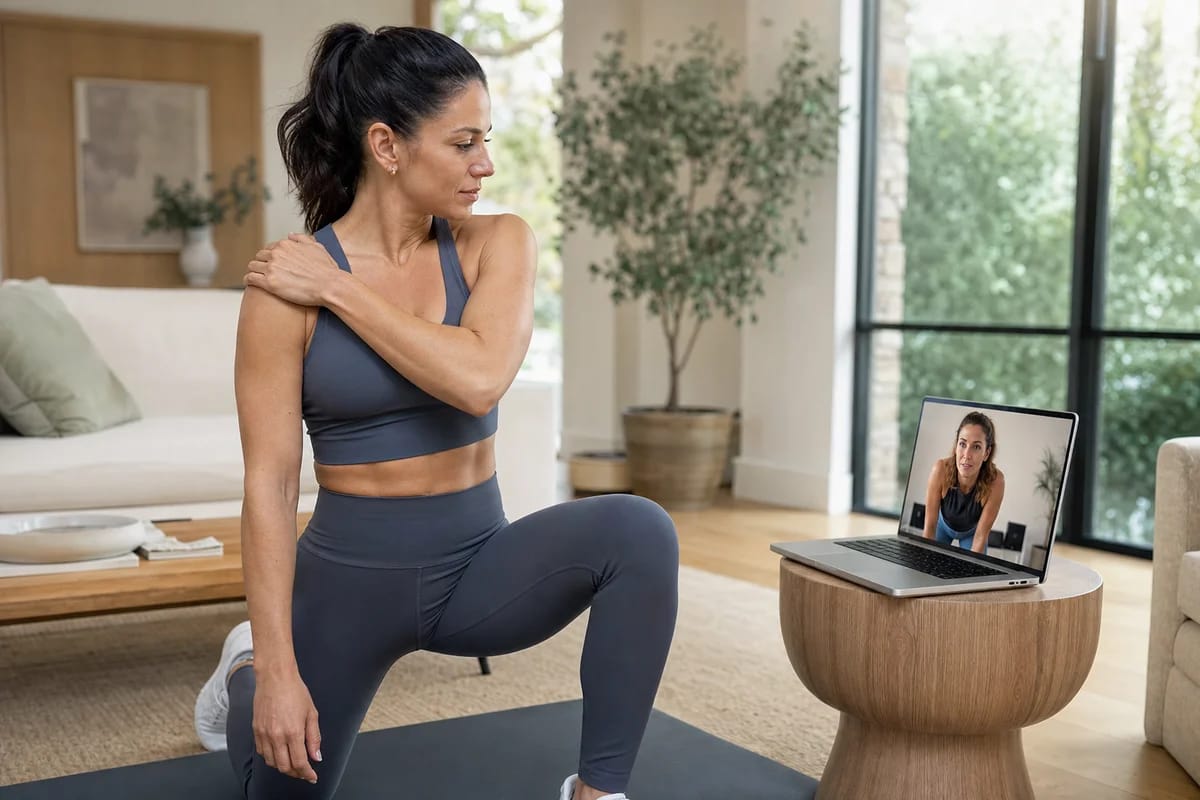
A booked session works differently. At six o'clock your coach is on the call whether you join or not. They know your name and what you're working toward, and they'll see the empty screen. Most of us break a promise to software more easily than a promise to a person who's already waiting. That's the subject of why scheduled sessions with a person stick.
When you're not the average case
A language model returns the most likely answer. That's the design, and usually a strength, because most questions have a common correct answer. It gets thin fast when you're not common.
You had a hip replaced two years ago. Your shoulder slips at certain angles. You're on a medication that flattens your heart rate, so the usual zone math is wrong for you. Here the average answer can be unsafe rather than unhelpful, and these are the cases a model handles worst, because little of your situation is in the data. It answers in the same confident tone anyway.
A good coach gets uncertain in the right places. They'll tell you that one's above their pay grade and to clear it with your surgeon, or quietly program around a limitation you mentioned once in week one.
What the research covers, and what it doesn't
People aren't asking for this, for whatever that's worth on its own. Les Mills surveyed more than 10,000 consumers across five continents for its 2026 Global Fitness Report and found 10% preferred an AI-created workout to a human-led one. Another 52% preferred a human trainer and 37% hadn't decided.2 Preference tells you nothing about outcomes, and that undecided share is the number worth watching, but it does say the market hasn't moved.
The trial I opened with is narrower than those numbers make it sound. Researchers in Germany put 79 trained adults through the same 10-week program three ways: coached in person, through an app, or handed over as a PDF. The PDF group attended 52% of sessions, so the app's 81% is close to in-person attendance, and that's a point for apps, not against them. Squat gains complicate it further: the PDF group added about 43 lb against the app group's 42 lb, on half the attendance. Bench press showed no clear difference between the three groups. And supervision there meant a coach in the room, not on a screen, while the app arm was a workout app rather than an AI coach.
Nobody has run the study you'd actually want: AI coaching against human coaching, measured on strength and adherence, over a year. Anyone quoting you a clean number on that is selling something.
So this is a case built on how the tools work, not on a scoreboard. AI is moving quickly, and some of what I've called a wall will get lower, real-time form feedback most of all.
Common questions
Can an AI personal trainer correct my form? Up to a point. It can review a video and flag obvious problems on a clean, well-filmed rep. It can't correct the rep while it's happening, and it's least reliable on heavy, tired reps, which is exactly when form breaks down.
Is an AI fitness coach better than nothing? Easily. A decent AI-built program you follow beats a perfect one you never start. If AI logging and a template get you training three times a week, that's a real win and you should take it.
Why can't AI replace a human coach yet? Because coaching a live set is a judgment job about a body, not an information job. Reading effort and pain, fixing a rep in real time, changing the session halfway through, and knowing the edge of its own competence are the parts AI does worst.
Do human coaches use AI? Good ones do, for the boring parts: drafting programs, crunching logs, answering routine questions. It frees up the session for the thing only a person can do, which is watching you move.
So which do you need?
If your form holds up when the weight gets heavy, you train without anyone chasing you, and what you want is a smart plan and somewhere to log it, an AI setup will carry you a long way. Use it without guilt.
The case for a person is narrower. Does your form hold light and fall apart heavy? Have you quit before, not because the plan was wrong but because nobody noticed when you stopped? Do you have a body with some history that a generic answer doesn't fit? A yes to any of those points at someone watching, not at a better model.
That's the job we built Bespoke Fit around. Every session runs on live HD video with a real coach, never AI, watching every rep and changing the load to suit how you move that day. Sessions are unlimited, your first month is $49, and the founding rate is $299 a month locked for life for the first 25 members, then $499 after, with a 30-day money-back guarantee.
Two reasons to skip us. Our sessions are booked appointments, so if you want to train whenever the mood takes you, an app is the better product and I'd rather you bought that. And we cost several times what an AI app costs, which only pays off if a person watching is the part you're missing. Use AI for everything it's good at. When you need someone watching you lift, that's our part.
Sources
-
Gavanda, S., et al., 2025. Optimizing resistance training outcomes: comparing in-person supervision, online coaching, and self-guided approaches: a randomized controlled trial. Journal of Strength and Conditioning Research 39(11): 1129-1137. ↩
-
Les Mills, 2026. We want humans, not algorithms, on the 2026 Global Fitness Report. Human-preference and undecided splits from the report press release. Read September 8, 2026. ↩
More on