Walking speed after 60: the vital sign you can test at home
Time a 4-meter walk at your usual pace, then see what your seconds mean after 60, what's normal for your age, and the training that speeds you up.

In this article8
The short answer
Your pace sums up how your heart, lungs, nerves, muscles and joints are working together. Walk 4 meters (about 13 feet) at your usual pace: after 65, 4 seconds or less is a good sign, and slower than 5 seconds is worth raising with your doctor.
A nurse checks your pulse, blood pressure, temperature and breathing, and often asks about pain. Since 2009, physical therapists have argued for adding one more number to that list: how fast you walk across a room. They call it the sixth vital sign.1 When any part of you starts to struggle, your pace tends to drop, sometimes before you've noticed anything else.
The good news comes in two parts. You can measure it in a couple of minutes with a tape measure and a phone. And it's a number you can move.
Test yours in the hallway
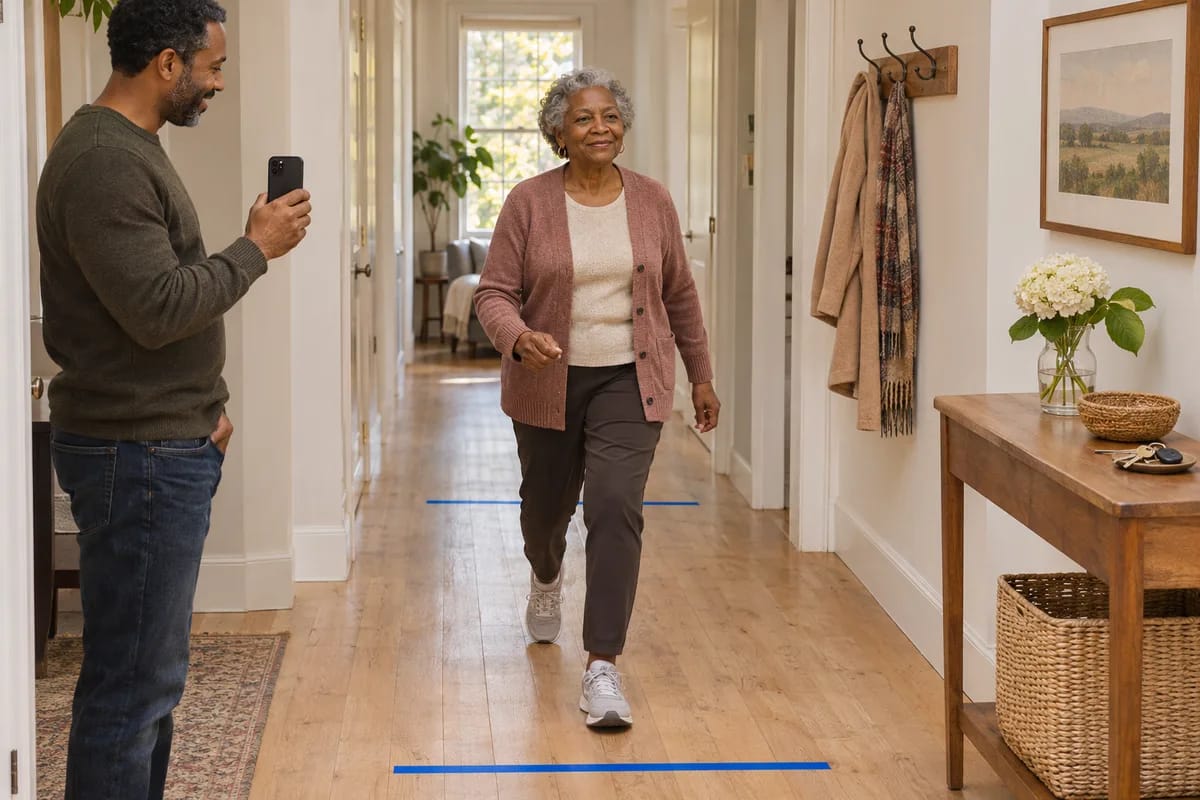
You need a tape measure, some masking tape, a phone stopwatch and, ideally, a helper. Wear your normal shoes. If you usually walk with a cane or a walker, use it.
Mark 4 meters of flat floor
Put a strip of tape down for the start and another 4 meters (13 feet 1.5 inches) further on for the finish. Leave a few steps of clear floor past the finish line.
Stand still with your toes at the start line
Walk at your everyday pace
On “go”, walk the way you'd walk down the street to the shops. Don't hurry: the bands below are for your normal pace, so a rushed time flatters you and tells you less. Keep walking past the finish line instead of slowing down for it.
Stop the clock as your first foot crosses the finish
Your helper starts the stopwatch on “go” and stops it when your leading foot passes the line. On your own, press start as you set off and stop as you cross. That's a little less precise, but fine for tracking yourself.
Do it three times and take the average
Rest for a minute between tries. Add up the three times and divide by three. That average is your number.
Skip the test on a day you feel dizzy or unwell, and keep a wall or counter within reach if your balance is shaky.
No 4 meters of clear floor? Use a garden path, a quiet stretch of pavement or a corridor at the library.
What your time means
| Your 4-meter time | Speed | What it's linked with after 65 |
|---|---|---|
| Under 3.3 seconds | Over 1.2 m/s (2.7 mph) | Well above average. May point to an unusually long life, though that isn't proven |
| 3.3 to 4 seconds | 1.0 to 1.2 m/s (2.2 to 2.7 mph) | A good sign. People at this pace lived longer than their age and sex alone would predict |
| 4 to 5 seconds | 0.8 to 1.0 m/s (1.8 to 2.2 mph) | Around average for over-65s |
| 5 to 6.7 seconds | 0.6 to 0.8 m/s (1.3 to 1.8 mph) | Below average. At this pace people tended to live less long than is typical for their age. Mention it at your next check-up, and start working on it |
| 6.7 seconds or more | 0.6 m/s or less (1.3 mph or less) | Linked with poorer health and function. Raise it with your doctor soon rather than waiting for a routine visit |
These bands come from a study that pooled survival data on 34,485 people over 65, all timed at their usual pace from a standing start, as you were, over short walks of about 2.5 to 6 meters (8 to 20 feet).2 Many home tests online add a few steps of run-up before the timed stretch, which skips the speeding-up part and gives quicker times, so compare like with like. If you're in your early 60s, use them as a rough guide and expect to land on the quicker side. Younger than that, the most useful thing about your number is how it changes from one year to the next.
Say your three tries were 4.6, 4.4 and 4.5 seconds. The average is 4.5. Divide 4 meters by 4.5 seconds and you get 0.89 meters per second, about 2 mph: right in the middle of the average band.
One yardstick from everyday life: the US federal traffic manual times a crossing's flashing countdown for someone walking 3.5 feet per second, about 1.07 meters per second.3 That's roughly 3.7 seconds on your hallway test. Walk slower than that, step off just as the countdown starts, and on a wide road it may hit zero before you reach the far curb.
When slow is a question for your doctor
A slow walk is often about strength and balance you can rebuild. Sometimes it's something else. The researchers behind those bands say a slow pace is a reason to check the heart and lungs, nerves, muscles and joints, and that a drop over time may be a sign of a new health problem.2
Book an appointment rather than a workout if you notice:
- a sudden or steep slowdown over weeks or a few months
- a new shuffle or limp, or a foot that catches or drags
- falls or near-falls
- breathlessness, chest discomfort or dizziness when you walk
- new numbness or weakness in a leg
Ask first, too, before starting the plan further down if you have a heart condition or have been told to limit activity.
If you're reading this about a parent who has slowed down, the same list applies. "Just getting older" usually looks gradual. A change you can date to the last few months deserves a proper look.
What usually slows people down
Gradual slowing usually has ordinary causes, often more than one at a time. Each is worth fixing on its own.
| What's going on | How it tends to show | Who helps |
|---|---|---|
| Sore hips, knees or feet | Shorter steps to dodge the twinge | Your doctor or a physical therapist, or a podiatrist for feet |
| Weaker legs | Stairs and low chairs feel harder than they used to | The strength work below, or a physical therapist if you're unsure where to start |
| Shaky balance, or worry about falling | Watching your feet, reaching for walls and furniture | The balance practice below, or a physical therapist |
| Eyesight | Slowing on steps, curbs and in dim light | An eye test, and brighter bulbs in halls and on stairs |
| Shoes | Slippers, loose backs or worn-smooth soles | Flat, firm shoes that hold your heel |
| Medicines | Drowsy, dizzy or unsteady since a new prescription or dose | Your doctor or pharmacist, for a medication review |
Why a walk says so much
Walking feels easy because you've done it a few million times. But every step is a small one-legged landing. Your nervous system steers it, your muscles catch it and push off again, and your heart and lungs pay for it. In the researchers' words, walking "places demands on multiple organ systems, including the heart, lungs, circulatory, nervous, and musculoskeletal systems."2
So one number sums up a lot. Knowing someone's age, sex and walking speed predicted how long they'd live as well as knowing their age, sex and a doctor's list of their conditions, smoking, blood pressure, weight and past hospital stays.2 Here's what that looks like for one group of people the same age.
Same age, same sex, and the share still alive ten years on more than doubles from the slowest group to the quickest. Men the same age show the same climb, from 15% in the slowest group to 53% at 3.3 to 4 seconds. These are group averages, not anyone's personal forecast. In long-term studies, slow walkers were also more likely to go on to disability, falls, memory and thinking problems, and a move into a care home.4
None of this proves that walking fast is what keeps people alive. A slow pace is often the sign of something already going on, like a heart that's struggling or a painful hip, and that's part of why it predicts so well. Whether speeding up adds years is less certain, though there's an encouraging clue further down.
What's normal for your age
You'll see two kinds of "average walking speed" quoted, and they answer different questions.
On the hallway test, the average over-65 takes about 4.3 seconds (0.92 meters per second). That's everyone behind the bands above, healthy or not, tested the way you were.2 It's the fair comparison for your own time.
Healthy volunteers in walking studies are quicker, and slow down with each decade:5
| Age | Women | Men |
|---|---|---|
| 50s | 1.31 m/s (2.9 mph) | 1.43 m/s (3.2 mph) |
| 60s | 1.24 m/s (2.8 mph) | 1.34 m/s (3.0 mph) |
| 70s | 1.13 m/s (2.5 mph) | 1.26 m/s (2.8 mph) |
| 80 and over | 0.94 m/s (2.1 mph) | 0.97 m/s (2.2 mph) |
Pace slips gently through the 60s and 70s, then drops more steeply after 80. The authors warn these figures may not suit a short walk from a standstill like yours, so use this table to see how pace changes with age, and the seconds table to read your own time.
Under 60? The bands were built for older adults, but in a New Zealand group timed at 45, the slower walkers were already aging faster on biological measures,6 so it's worth learning your number now.
How to tell if a change is real
Researchers count a change of about 0.05 meters per second as small but real, and 0.1 as substantial.7 In seconds, it depends on where you start, because the same gain in speed takes more time off a slow walk:
| Your 4-meter time now | A small real change | A substantial change |
|---|---|---|
| 4 seconds | About 0.2 seconds quicker | About 0.4 seconds quicker |
| 5 seconds | About 0.3 seconds quicker | About 0.6 seconds quicker |
| 6.7 seconds | About 0.5 seconds quicker | About 1 second quicker |
| 10 seconds | About 1 second quicker | About 2 seconds quicker |
One test can't show you that reliably, because the ordinary wobble between tests on a short course can be bigger than the substantial change.8 So keep everything else the same: the same hallway, the same shoes or walking aid, the same time of day and the same way of timing, with three tries each time. Retesting every month or two is plenty, and a trend over several tests tells you far more than any one result.
A page in a notebook or your phone's notes does the job. Copy these columns:
| Date and time | Your three times | Average | Shoes, cane or walker | How you felt |
|---|---|---|---|---|
| March 3, 10 a.m. | 4.6, 4.4, 4.5 s | 4.5 s | Sneakers, no cane | Fine, a bit stiff |
| April 14, 10 a.m. | 4.4, 4.2, 4.3 s | 4.3 s | Sneakers, no cane | Easier on the turn |
Now the encouraging clue. In one group of over-65s timed every three months for a year, people whose usual pace rose by 0.1 meters per second and held there were much more likely to be alive eight years later. About a third of them had died by then, against about half of those who never improved.9 That's an observational finding, not proof that the speed itself made the difference. But it's a good reason to treat your number as something to work on, not a verdict.
What makes you faster
You don't need anything fancy. In trials with healthy people over 65, strength training, balance and coordination work, and mixed programs each raised walking speed by about 0.1 meters per second, the substantial change above, and none clearly beat the others. The programs ran for three to four months on average, two or three sessions a week.10
The week below is built loosely on the biggest trial of its kind, which used walking, ankle-weight leg work and balance practice to help inactive 70-to-89-year-olds keep walking.11 Start wherever you are, even if that means five minutes of walking and standing up from a high chair a few times.
| What | How often | What it looks like |
|---|---|---|
| Walking | Most days, building to about 30 minutes | Somewhat hard: you can talk in sentences, but you wouldn't want to sing. It also builds your aerobic fitness |
| Leg strength | 2 or 3 days a week | Sit-to-stand from a chair, step-ups onto the bottom stair, heel raises. 2 sets of 10 of each |
| Balance | About 10 minutes, most days | Standing on one leg beside a counter, heel-to-toe walking along the hallway, turning on the spot |
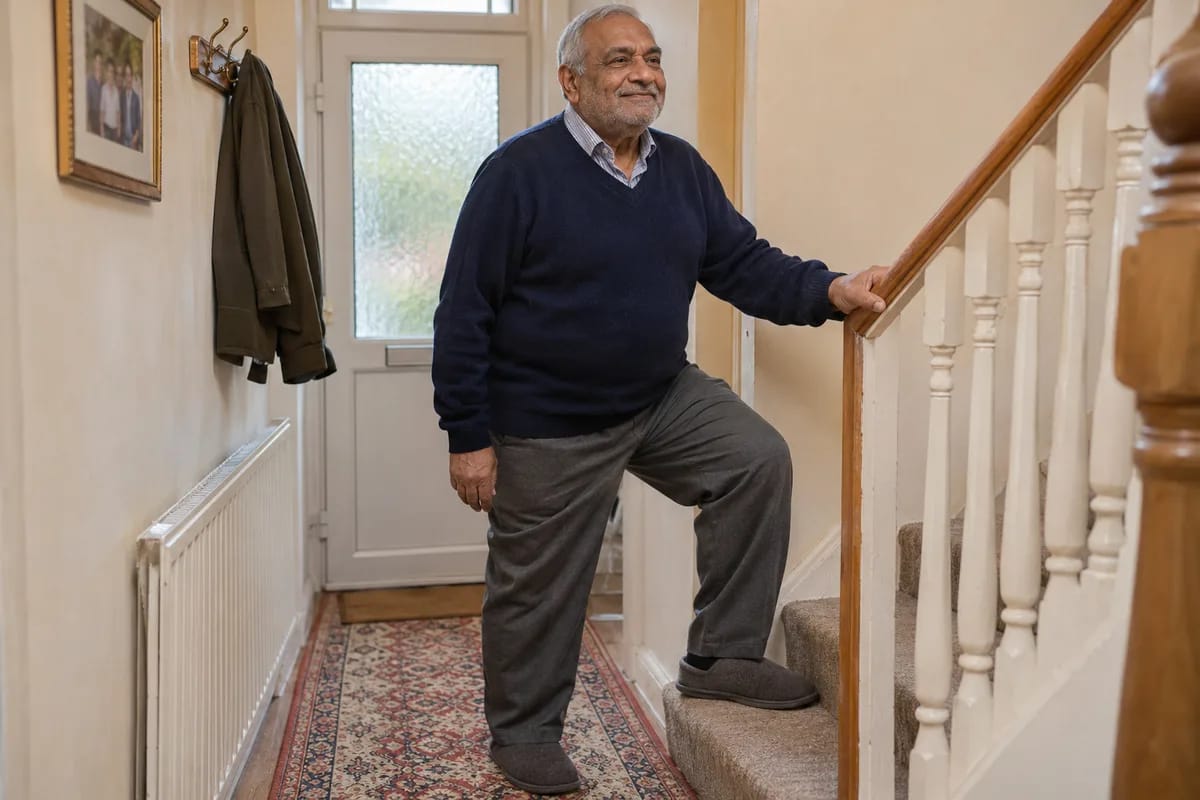
For the strength moves, stand up briskly and lower yourself slowly. Moving quickly trains power, the speed side of strength, which fades faster than strength with age, and it may help everyday function a little more than slow lifting.12
Keep your log going, and give it about three months before you judge the plan. If your average improves by the substantial amount in the change table and holds across a few tests, or moves you up a band, the training is doing its job.
If balance is where you feel least sure, this guide to training it back has a progression from holding the counter to letting go. For more on how much and how hard by decade, see strength training in your 60s and in your 70s. If you'd rather have someone with you, a Bespoke Fit coach runs every session with you over live video: they watch each step-up and balance hold as it happens, see your heart rate from an Apple Watch or a strap to judge how hard to push and when to rest, and move the plan on as your times change. Sessions run 45 to 90 minutes, most people settle at around an hour, and it's 14 days free, then $299/mo for as many sessions as you book.
Common questions
Should I time my fastest pace too? You can. Physical therapists often time both, and your fast pace shows how much you have in hand for things like a short crossing. But every band in this article is for your usual pace, so that's the one to track first. Hurrying only makes the usual-pace number look better than it is.
Is walking speed better than grip strength or the sit-to-stand test? Not better, just different. Walking speed sums up your whole moving body at once. Grip strength is a quick read on overall muscle strength, though it needs a hand dynamometer that most people don't own. The sit-to-stand test zooms in on your legs and needs only a chair, so it's an easy one to track alongside your walk.
My iPhone shows a walking speed. Is that the same thing? Not quite. The Health app records a walking speed by itself when you carry the phone in a pocket or at your hip and walk steadily on flat ground. That's everyday walking, already on the move, so don't read it against the bands here. It's handy for spotting a trend over months, but use the hallway test for your number.
Sources
-
Fritz & Lusardi, 2009. White paper: walking speed: the sixth vital sign. Journal of Geriatric Physical Therapy. ↩
-
Studenski et al., 2011. Gait speed and survival in older adults. JAMA. ↩ ↩2 ↩3 ↩4 ↩5
-
Federal Highway Administration, 2025. Manual on Uniform Traffic Control Devices, 11th edition with Revision 1, Section 4I.06, pedestrian intervals. US Department of Transportation. ↩
-
Abellan van Kan et al., 2009. Gait speed at usual pace as a predictor of adverse outcomes in community-dwelling older people: an International Academy on Nutrition and Aging (IANA) Task Force. The Journal of Nutrition, Health and Aging. ↩
-
Bohannon & Andrews, 2011. Normal walking speed: a descriptive meta-analysis. Physiotherapy. ↩
-
Rasmussen et al., 2019. Association of neurocognitive and physical function with gait speed in midlife. JAMA Network Open. ↩
-
Perera et al., 2006. Meaningful change and responsiveness in common physical performance measures in older adults. Journal of the American Geriatrics Society. ↩
-
Middleton, Fritz & Lusardi, 2015. Walking speed: the functional vital sign. Journal of Aging and Physical Activity. ↩
-
Hardy et al., 2007. Improvement in usual gait speed predicts better survival in older adults. Journal of the American Geriatrics Society. ↩
-
Hortobágyi et al., 2015. Effects of three types of exercise interventions on healthy old adults' gait speed: a systematic review and meta-analysis. Sports Medicine. ↩
-
Pahor et al., 2014. Effect of structured physical activity on prevention of major mobility disability in older adults: the LIFE study randomized clinical trial. JAMA. ↩
-
Balachandran et al., 2022. Comparison of power training vs traditional strength training on physical function in older adults: a systematic review and meta-analysis. JAMA Network Open. ↩