VO2 max and longevity: why it predicts how long you live
Why one fitness number tracks lifespan so closely, what the big studies really found, where your VO2 max sits for your age, and how far to trust your watch.
In this article8
The short version
VO2 max, the most oxygen your body can use, grades heart, blood, vessels and muscles at once, sums up years of habits and shows the reserve you'll grow old with. In one large clinic study, the least fit had about five times the death risk of the fittest 2 to 3 percent.
That's an association, not a guarantee, though it has held up across millions of people. Part of the link may be that fitness mirrors other things, like body fat and how active you are. That turns out not to change what you should do. And unlike your age or your genes, the number moves when you train.
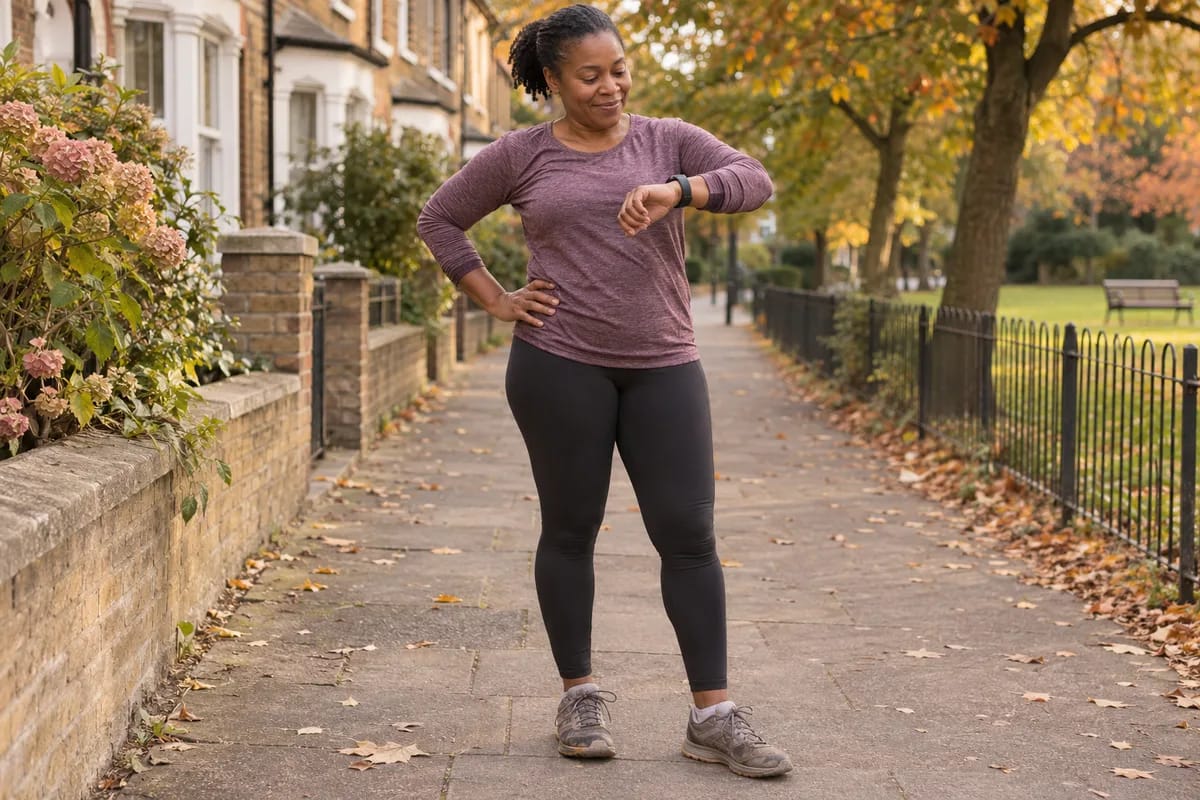
Maybe your watch just called your cardio fitness "below average". Here's how it compares with people your age.
Where your number sits
These are the US reference values from the FRIEND registry, built from thousands of adults without heart disease who did a full lab test on a treadmill.1 Find your age, then see which column your number lands nearest. Each column is a percentile: under the 25th puts you in the bottom quarter for your age and sex, over the 90th in the top tenth. Everything is in mL/kg/min, the same unit your watch shows.
Women
| Age | 25th | Median | 75th | 90th |
|---|---|---|---|---|
| 20s | 30.5 | 37.6 | 44.7 | 51.3 |
| 30s | 25.3 | 30.2 | 36.1 | 41.4 |
| 40s | 22.1 | 26.7 | 32.4 | 38.4 |
| 50s | 19.9 | 23.4 | 27.6 | 32.0 |
| 60s | 17.2 | 20.0 | 23.8 | 27.0 |
| 70s | 15.6 | 18.3 | 20.8 | 23.1 |
Men
| Age | 25th | Median | 75th | 90th |
|---|---|---|---|---|
| 20s | 40.1 | 48.0 | 55.2 | 61.8 |
| 30s | 35.9 | 42.4 | 49.2 | 56.5 |
| 40s | 31.9 | 37.8 | 45.0 | 52.1 |
| 50s | 27.1 | 32.6 | 39.7 | 45.6 |
| 60s | 23.7 | 28.2 | 34.5 | 40.3 |
| 70s | 20.4 | 24.4 | 30.4 | 36.6 |
Three things to know before you judge your number:
- It's a little strict. This is the most recent full table we could find free to read. A 2022 update, built from about twice as many treadmill tests, came out 1.5 to 4.6 points lower.2 If you're a point or two under a line, you may well be on it.
- Bikes read lower. A lab test on a bike usually comes out a few points under a treadmill test, about 3 to 7 at the median.3 Treadmills use more of your muscles.
- A watch number is an estimate. It can be off by more than the gap between two columns. More on that below.
The table also has good news in it. A woman in her 60s at the 90th percentile (27.0) outscores the median woman in her 40s (26.7), and the same holds for men (40.3 against 37.8). Age sets the trend. It doesn't set your row.
Why one number knows so much
VO2 max is the most oxygen your body can take in and use per minute at full effort, divided by your weight. On its way from the air to a working muscle, that oxygen passes through five links, and the test grades all of them at once.
A weak link anywhere pulls the number down. In healthy people the weak link is usually the heart: what caps VO2 max is how much blood it can pump each minute, not how much oxygen the muscles can pull out.4
So why would a measure of capacity predict who dies? Researchers point to three things.
It shows how your heart is holding up. In the biggest review of the evidence, people with high fitness had about a third of the risk of heart failure of people with low fitness.5
It keeps score of how you live. Your number rises with activity and muscle and falls with body fat, and you can't cram for it the night before. One reading sums up years of habits. It also predicts more than heart trouble: in a study that measured oxygen directly rather than estimating it, the least fit had about twice the risk of dying of cancer as the fittest.6
It's your reserve. Climbing stairs or carrying shopping takes about the same oxygen whatever your VO2 max is, so a bigger engine does those jobs with more to spare. The engine shrinks with age, slowly at first, 3 to 6 percent a decade in your 20s and 30s, then faster, over 20 percent a decade by your 70s.7 A widely cited estimate puts the line for living on your own at about 18 for men and 15 for women, a level the average person reaches somewhere between 80 and 85.8 That's why fitness you build at 50 may well pay off at 80. You start the steep part of the slide from higher up, so you'd stay above that line for longer.
What the big studies found
The study behind most headlines comes from the Cleveland Clinic, where researchers looked back at more than 120,000 people sent by their doctors for a treadmill test that kept getting harder, and checked who died over the next eight or so years.9 Each person was ranked against others of the same age and sex, with smoking, diabetes, blood pressure and the other usual risk factors allowed for.
Mandsager and colleagues, 2018. Adjusted for age, sex and health, Figure 2C.
Look at where the biggest drop is. People in the second quarter had about half the risk of people in the bottom quarter, a bigger gap than between any other two neighbouring groups. These were clinic patients, not the people in the table above, but as a rough guide: if the table put you in the bottom quarter, you're on the steepest part of the curve, where a step up counts most.
That holds at any weight. When researchers pooled the studies that measured both fitness and weight, unfit people had about twice the risk of dying whatever they weighed, and fit people who were overweight or obese did about as well as fit people of normal weight.10 So if you're carrying more weight than you'd like, getting fitter is worth doing now, not after the scales move.
You'll often read that being unfit is "worse than smoking". The paper's actual comparison is narrower. Being in the second quarter of the fitness table instead of the third went with about 40 percent higher risk, the same as smoking or diabetes in the same patients. So one step down the ladder counted about as much as being a smoker.
There's no ceiling either. The top 2 to 3 percent still did better than the very fit group just below them, and that held in people over 70 too. In a larger study of US veterans, risk was lowest at around 49 on your watch's scale and didn't rise again above that.11 In these studies, risk didn't turn back up at the top.
The most human version of the result comes from Copenhagen. In 1970 and 1971, middle-aged working men had their fitness estimated on an exercise bike, and researchers followed them for 46 years, by which time 92 percent had died.12 That's almost whole lives, so the gap can be counted in years.
Clausen and colleagues, 2018. Danish men followed for 46 years.
That's one group of Danish men, each measured once, half a century ago. But it turns a risk ratio into something you can picture.
Cause or sign? What the studies can't settle
Everything above is observational: researchers measured people and then waited. That leaves real doubts, and some of the best evidence comes from people who set out to test them.
Maybe illness causes low fitness, not the other way round. Someone with an undiagnosed heart problem scores low, dies early, and fitness gets the blame. In the treadmill study, the least fit already had far more diabetes and took more heart medicines than the fittest.9 Studies adjust for that, but they can only adjust for what they measured. The Danish team tried a cleaner check: they dropped everyone who died in the first 10 years, when hidden illness would show itself, and the results barely changed.12
Getting fitter seems to count, not only being fit. Men who were tested twice, about five years apart, and went from unfit to fit had 44 percent lower risk of dying over the next five years than men who stayed unfit.13 Still observational, but it's the pattern you'd expect if fitness itself matters.
The one big trial couldn't settle it. In Norway's Generation 100 study, people in their early 70s were randomly assigned to two sessions a week of hard intervals, moderate exercise, or simply following the national activity advice, for five years. Death rates didn't differ overall.14 The trouble was that the comparison group was very active too, and actually did more hard exercise than the moderate group. The interval group had fewer deaths, but not clearly enough to rule out chance. Five years in healthy, active people is a short time to see a difference in deaths.
Genes hint that fitness might be partly a gauge. A genetics study published in 2024 looked at people born with gene variants that nudge VO2 max up. Those variants didn't predict a longer life. Variants for more body fat lowered VO2 max and shortened life, and being more active raised VO2 max. The authors' reading: fitness and long life share causes, mainly body fat and how active you are, rather than fitness adding years all by itself.15 It estimated fitness from an easy bike test rather than a maximal one and looked only at people of European descent, so it isn't the last word.
Put it together and VO2 max might be the engine, or it might be the fuel gauge. For you, it makes surprisingly little difference. The way you raise the number is by moving more and carrying more muscle and less fat, and those are exactly the things the skeptical studies point to as the real causes. Either way, it's the same plan.
What a few points are worth
Studies usually count fitness in METs. One MET is the oxygen you use sitting still, 3.5 points on your watch's scale.16 In running terms, it's roughly the difference between jogging at a given pace and jogging about 0.6 mph (1 km/h) faster.17
Take a woman in her 50s whose watch reads 20. That puts her right at the 25th percentile for her age. A few months of steady training that lifts her by one MET, to 23.5, puts her at the median. In the reviews that pooled death risk across studies, each MET like that went with roughly 11 to 17 percent lower risk.5 In the Danish study, each point was worth about 45 days of life, so her 3.5 points would come to about five months.12
Those are averages across thousands of people, not a forecast for her. They're also only as good as the number she starts from, which brings us to her watch.
How far to trust your watch
| Way to get a number | What it involves | How close it gets |
|---|---|---|
| Lab test | A mask and a treadmill or bike that ramps up to your limit. Sports-medicine clinics, university exercise labs and some performance or longevity clinics offer it | The real measurement. Every table above is built on it |
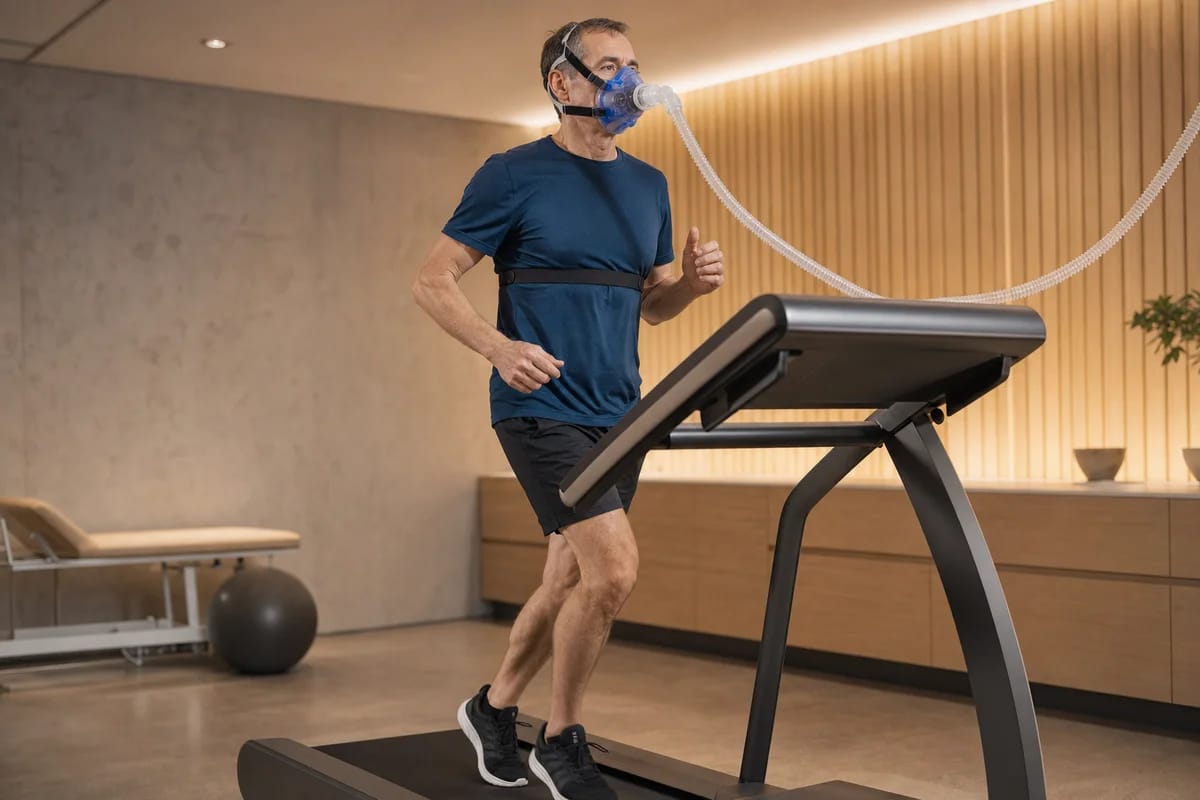
| Watch, from workouts | Estimated from your heart rate and pace on outdoor walks, runs or hikes | Close on average, but one reading can be about 10 points off either way |
| Rockport walk test | Walk a flat mile as fast as you can, time it and take your pulse the moment you finish. A free Rockport calculator online turns that, your age, sex and weight into a number | A fair estimate for healthy adults aged 30 to 69, the group it was built on |
| NTNU fitness calculator | Free online. Asks your age, waist, resting heart rate and how you exercise | A rough estimate with no workout at all |
The watch row is the one that trips people up. When researchers pooled the studies that checked wearables against lab tests, estimates made during exercise were about right on average, but a single person's reading could land roughly 10 points too high or too low. Estimates made from resting data alone did worse and tended to read high.18 Ten points is nearly the whole gap between the bottom quarter and the top tenth for a woman in her 50s.
So don't panic about one low reading, and don't celebrate one high one either. What a watch does well is the trend: the same watch, the same kind of workout, over months. If your number climbs from 31 to 34 across a spring, that's real, even if neither figure is exact. That goes for any brand, watch or ring.
No watch? The walk test is the one to try tonight. In the study that built it, estimates from the timed mile and the finishing heart rate tracked lab results closely.19 Repeat it on the same route every couple of months and you have your own trend line.
Read the small print for your device, because each brand has its own rules about what counts. Apple's estimate only comes from Outdoor Walk, Outdoor Run and Hiking workouts, so a year of treadmill sessions won't count. Apple also warns that conditions or medicines that limit your heart rate can make it read too high.20 Beta blockers are a common example.
What moves the number
Where you start depends on where you are now. If the table put you near the bottom, a brisk walk up a hill is a hard session, and incline walking is a gentle way in. Most of the week can be easy: walking, cycling, swimming or jogging at a pace where you can still talk.
Once that feels routine, one or two harder sessions a week do the most for the number. The best-known version comes from Norwegian researchers: four 4-minute efforts at 85 to 95 percent of your maximum heart rate, with 3 easy minutes between, finishing as if you could manage one more.21 In their early trial, moderately trained men who did it three times a week raised VO2 max by about 7 percent in eight weeks, more than steady running of the same total work did.22
Some people respond faster than others, partly because of their genes.23 But "I don't respond" often means "not enough yet": in one study, everyone who hadn't improved after six weeks did once they added two more sessions a week.24 Age isn't a bar either. We cover what changes after 50 in can you raise VO2 max at 50.
For the mix of easy and hard, see zone 2 vs HIIT, and for a whole week that fits cardio around strength, zone 2 and strength in one week. If you use heart-rate targets, 220 minus age is often off, so read that first. If you have a heart condition, take medicine that affects your heart rate, or get chest pain, dizziness or unusual breathlessness when you exert yourself, talk to your doctor before you add hard intervals.
Holding 85 to 95 percent of your maximum is hard to judge alone, and it's where a coach on the call earns their keep. In a live session, your Bespoke Fit coach sees your heart rate as you go, from an Apple Watch or a Bluetooth heart rate strap, and tells you when to push and when to rest. They also write the intervals and your strength work into the same week. It's 14 days free, then $299 a month.
Common questions
Is VO2 max more important than strength for living longer? You don't have to pick one, and it's better not to. VO2 max is the size of your engine. Strength is what gets you up off the floor, up the stairs with the shopping and back on your feet after a stumble. A good week trains both, and the same session can often do a bit of each.
Does losing weight raise your VO2 max? On paper, yes, because the number is per kilo of body weight. Someone whose body uses 2.4 litres of oxygen a minute at full effort scores 30 at 176 lb (80 kg) and 32 at 165 lb (75 kg), with exactly the same heart. That's not a cheat. Carrying less fat makes every walk and climb cheaper. Training does more, though, because it raises the litres too.
Sources
-
Kaminsky LA, et al., 2015. Reference standards for cardiorespiratory fitness measured with cardiopulmonary exercise testing: data from the Fitness Registry and the Importance of Exercise National Database. Mayo Clinic Proceedings. ↩
-
Kaminsky LA, et al., 2022. Updated reference standards for cardiorespiratory fitness measured with cardiopulmonary exercise testing: data from the Fitness Registry and the Importance of Exercise National Database (FRIEND). Mayo Clinic Proceedings. ↩
-
Kaminsky LA, et al., 2017. Reference standards for cardiorespiratory fitness measured with cardiopulmonary exercise testing using cycle ergometry: data from the Fitness Registry and the Importance of Exercise National Database (FRIEND) Registry. Mayo Clinic Proceedings. ↩
-
Bassett DR, Howley ET, 2000. Limiting factors for maximum oxygen uptake and determinants of endurance performance. Medicine and Science in Sports and Exercise. ↩
-
Lang JJ, et al., 2024. Cardiorespiratory fitness is a strong and consistent predictor of morbidity and mortality among adults: an overview of meta-analyses representing over 20.9 million observations from 199 unique cohort studies. British Journal of Sports Medicine. ↩ ↩2
-
Imboden MT, et al., 2018. Cardiorespiratory fitness and mortality in healthy men and women. Journal of the American College of Cardiology. ↩
-
Fleg JL, et al., 2005. Accelerated longitudinal decline of aerobic capacity in healthy older adults. Circulation. ↩
-
Shephard RJ, 2009. Maximal oxygen intake and independence in old age. British Journal of Sports Medicine. ↩
-
Mandsager K, et al., 2018. Association of cardiorespiratory fitness with long-term mortality among adults undergoing exercise treadmill testing. JAMA Network Open. ↩ ↩2
-
Barry VW, et al., 2014. Fitness vs. fatness on all-cause mortality: a meta-analysis. Progress in Cardiovascular Diseases. ↩
-
Kokkinos P, et al., 2022. Cardiorespiratory fitness and mortality risk across the spectra of age, race, and sex. Journal of the American College of Cardiology. ↩
-
Clausen JSR, et al., 2018. Midlife cardiorespiratory fitness and the long-term risk of mortality: 46 years of follow-up. Journal of the American College of Cardiology. ↩ ↩2 ↩3
-
Blair SN, et al., 1995. Changes in physical fitness and all-cause mortality: a prospective study of healthy and unhealthy men. JAMA. ↩
-
Stensvold D, et al., 2020. Effect of exercise training for five years on all cause mortality in older adults, the Generation 100 study: randomised controlled trial. BMJ. ↩
-
Kjaergaard AD, et al., 2024. Cardiorespiratory fitness, body composition, diabetes, and longevity: a 2-sample Mendelian randomization study. Journal of Clinical Endocrinology and Metabolism. ↩
-
Jetté M, et al., 1990. Metabolic equivalents (METS) in exercise testing, exercise prescription, and evaluation of functional capacity. Clinical Cardiology. ↩
-
Kodama S, et al., 2009. Cardiorespiratory fitness as a quantitative predictor of all-cause mortality and cardiovascular events in healthy men and women: a meta-analysis. JAMA. ↩
-
Molina-Garcia P, et al., 2022. Validity of estimating the maximal oxygen consumption by consumer wearables: a systematic review with meta-analysis and expert statement of the INTERLIVE network. Sports Medicine. ↩
-
Kline GM, et al., 1987. Estimation of VO2max from a one-mile track walk, gender, age, and body weight. Medicine and Science in Sports and Exercise. ↩
-
Apple, 2026. Track your cardio fitness levels. Apple Support. ↩
-
NTNU Cardiac Exercise Research Group. Training advice. Norwegian University of Science and Technology. ↩
-
Helgerud J, et al., 2007. Aerobic high-intensity intervals improve VO2max more than moderate training. Medicine and Science in Sports and Exercise. ↩
-
Bouchard C, et al., 1999. Familial aggregation of VO2max response to exercise training: results from the HERITAGE Family Study. Journal of Applied Physiology. ↩
-
Montero D, Lundby C, 2017. Refuting the myth of non-response to exercise training: 'non-responders' do respond to higher dose of training. Journal of Physiology. ↩