Incline treadmill walking: 8% at 3 mph is zone 2
An 8 percent grade at 3 mph costs about twice the oxygen of flat walking, so you reach a jog-level effort with no landing impact. The settings and the caveats.
Updated
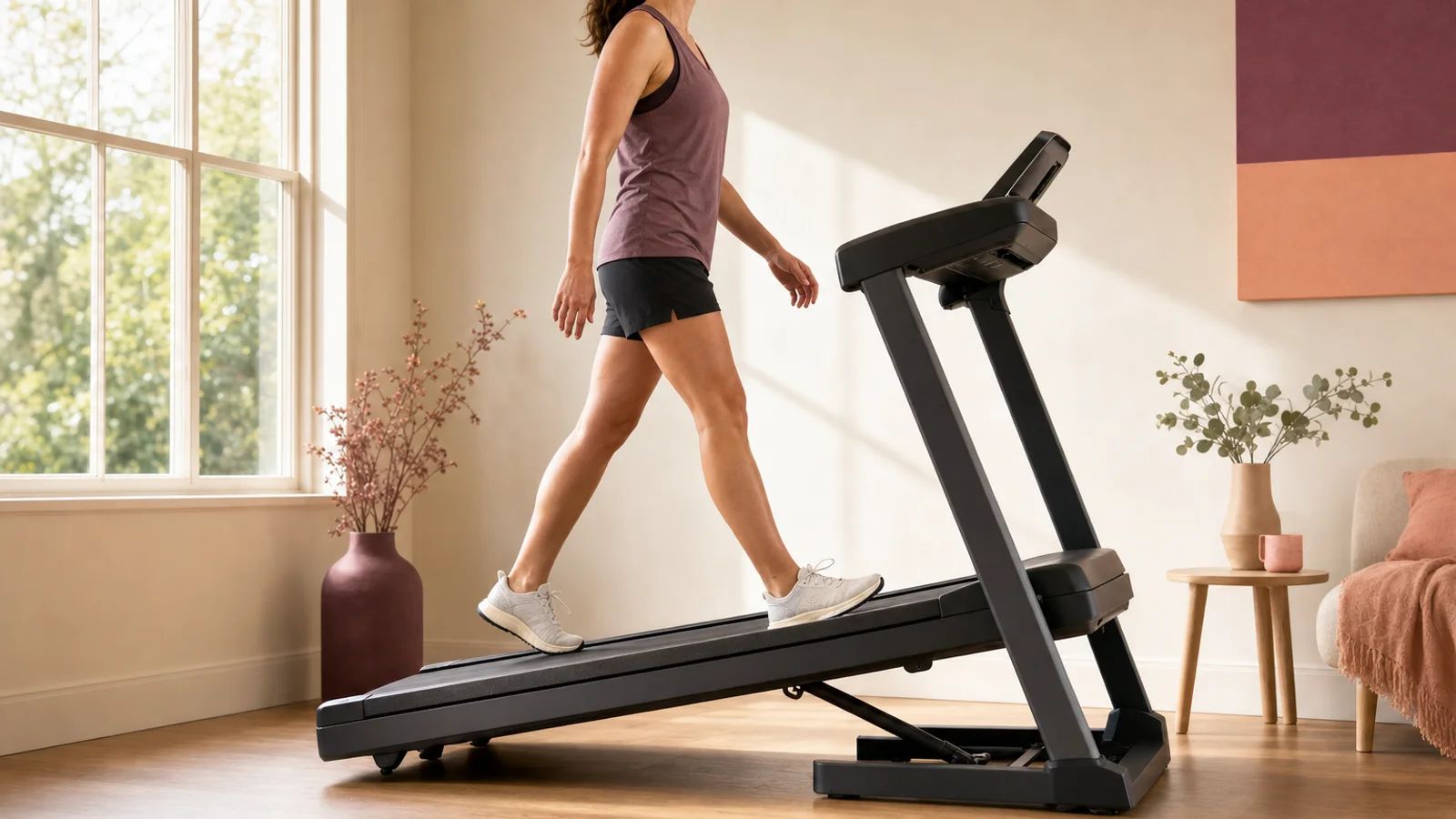
Tilt a treadmill to an 8 percent grade and a 3 mph walk suddenly costs about twice the oxygen of the same speed on the flat. That's the whole mechanism behind incline walking: grade adds effort without adding speed, so you can reach the same aerobic zone as a slow jog while one foot stays on the ground the entire time. No landing, no pounding, no moment where your full body weight comes crashing back down through one leg.
That's why incline walking has become one of the more popular ways into zone 2, the easy aerobic effort that does most of the metabolic work in a longevity plan. If you haven't read the basics yet, start with zone 2 training explained. This post covers the part that's specific to the treadmill: why tilting the belt works, how hard it actually is, and where people get the settings wrong.
Key takeaways
- Grade adds oxygen cost without adding speed, so a walking pace can reach jog-level effort.
- At matched calorie burn, incline walking hits your joints with a lot less force than jogging, because you never leave the ground.
- Walking uphill also pulls more work into your glutes, calves, and lower back than flat walking does.
- A 5 to 8 percent grade at 2.8 to 3.3 mph lands many people in zone 2, but the talk test is what actually confirms it.
- 12-3-30 is a real workout, just not usually an easy one. At a 12 percent grade it's closer to zone 3 for most beginners.
- Gripping the handrails quietly cancels a lot of the benefit.
Why grade raises the effort so fast
Walking costs your body oxygen two ways: moving forward, and lifting your weight against gravity. Flat ground only charges you for the first one. Add grade, and every step also charges you for the second, which is why a gentle incline can feel so much harder than flat ground at the exact same speed.
There's a real equation behind this, from the American College of Sports Medicine. Oxygen use in milliliters per kilogram per minute works out to 0.1 times your speed, plus 1.8 times your speed times the grade, plus a resting 3.5.1 Speed goes in as meters per minute, grade as a decimal. That middle term is the grade tax, and it grows fast: a flat 3 mph walk sits around 3.3 METs, an easy stroll, but tilt that same 3 mph walk to an 8 percent grade and you're at roughly 6.6 METs, solidly into jogging territory, without moving your feet any faster. A lab study that had 51 adults walk across a wide range of speeds and grades confirmed the energy cost climbs steeply as the incline rises, exactly what the equation predicts.2
The extra work has to come from somewhere, and it's mostly your backside. Flat walking is a quad-and-shin job. Point the belt uphill and your glutes have to extend your hip harder on every step, and your calves have to push you off the ground with more force. Researchers who measured muscle activity with skin sensors found more electrical activity in the glutes, the calves, and the erector spinae along the lower back during high-incline walking than during a near-flat jog. It's not a substitute for a real strength program, but your cardio session ends up doing a little posterior-chain work on the side.
Why it's easier on your joints than running
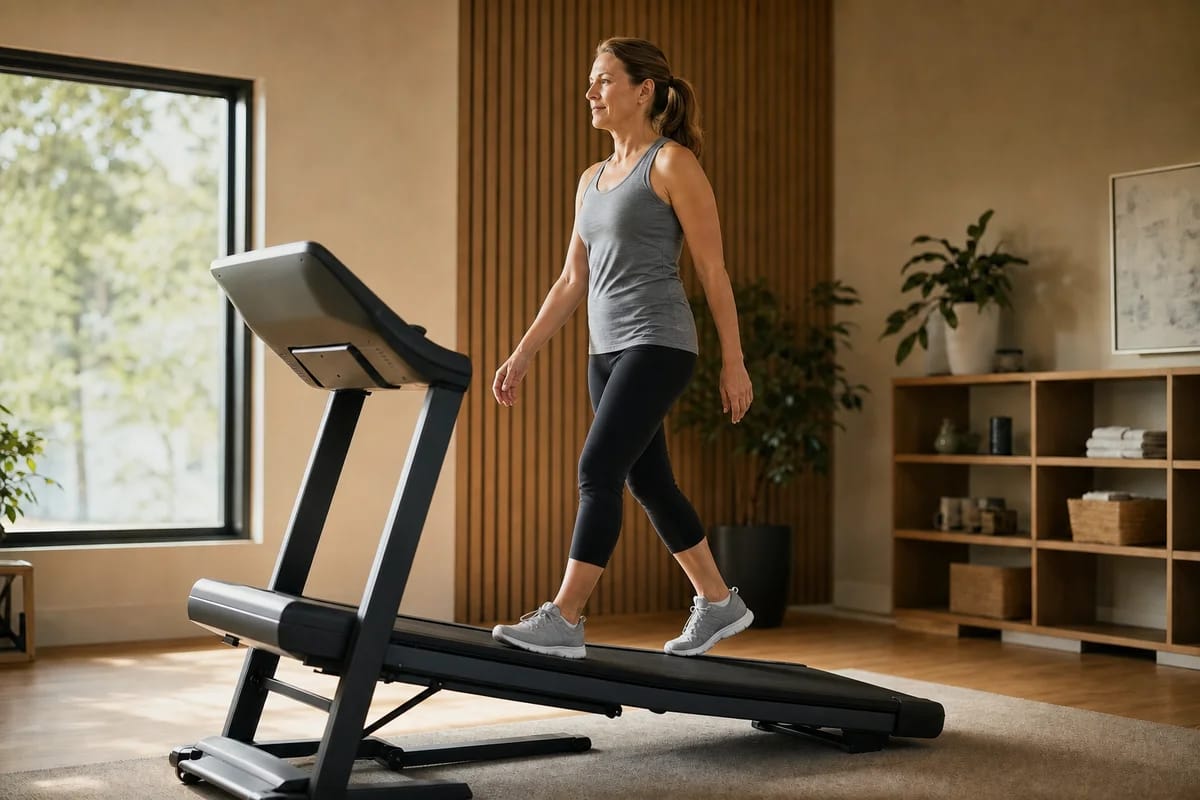
This is the actual promise of incline walking, and it comes down to simple mechanics. When you run, there's a moment where both feet leave the ground and your whole body weight comes crashing back down through one leg. Walking never does that. One foot is always in contact with the ground, incline or not, so you skip the hard landing entirely.
A 2025 study in the International Journal of Exercise Science tested this directly. Adults did two sessions that burned the same number of calories, one walking a steep 20 percent grade, one jogging on the flat, with motion sensors strapped to the foot and sacrum. Jogging produced far higher impact: peak accelerations around 22 m/s² at the foot and 27 m/s² at the sacrum, well above what the incline walk produced for the same metabolic cost.3 Same aerobic engine, a fraction of the jarring.
That's the trade worth knowing about if a knee, hip, or ankle has ever talked you out of running.
Grade and speed combos that land in zone 2
There's no single correct setting, because zone 2 is about effort, not the numbers on the console. But the ACSM equation gives good starting points:
- 2.8 mph at a 6 percent grade: about 5.5 METs, a solid moderate effort.
- 3.0 mph at a 5 percent grade: about 5.4 METs.
- 3.3 mph at a 4 percent grade: about 5.4 METs, for anyone who'd rather walk faster than steeper.
- 3.0 mph at an 8 percent grade: about 6.6 METs, near the top of the range for most people.
For a lot of middle-aged beginners, something in the 5 to 6 MET band lands right around zone 2, but that depends entirely on your own fitness. The only real way to check is the talk test: you should be able to get out a full sentence, and it should feel slightly annoying to do it. Chatting easily? Add a percent of grade. Gasping? Take one off. Once the incline is dialed in, fitting it around your strength days is the next thing worth planning.
Is 12-3-30 actually zone 2?
You've probably seen 12-3-30 on social media: 12 percent incline, 3 mph, 30 minutes. It's a real workout. It's just not the easy one people assume.
Run those numbers through the same equation and you land around 8.3 METs, a vigorous effort for most people, not the easy zone-2 pace this article is about. A genuinely fit person might sit at the top of zone 2 doing it. A typical 45-year-old just starting out is more likely working harder than they think. The numbers aren't magic either. They caught on because they're easy to remember, not because they're calibrated to anyone's fitness.
Use 12-3-30 if you like having a fixed target, but judge it by your breathing, not by the fact that it went viral. Can't talk through it? Drop the grade to 6 or 8 percent instead.
Two easy ways to undercut the effort
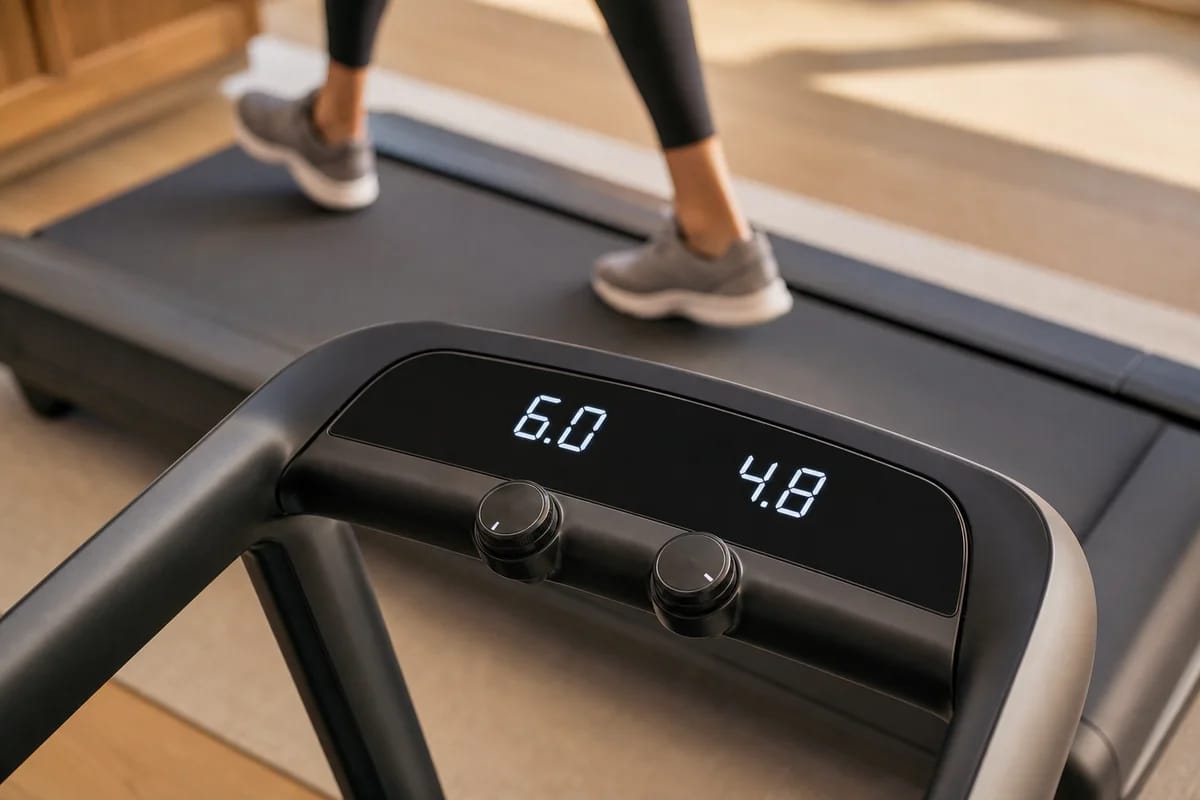
Gripping the front rail and leaning back is the big one. The instant you let the machine hold part of your weight, you cancel the exact thing grade is supposed to cost you: lifting your own body. If you can't walk the incline hands-free, the grade is set too high.
Going steep too fast is the other one. Your calves and Achilles do a lot more work climbing, which is why the muscle studies above light up the soleus and gastrocnemius. That's useful loading, in moderation. Jumping straight to a steep grade, or doing it with a history of Achilles trouble, is asking for it instead.
And treat every calorie or VO2 number the console shows you as an estimate, not a measurement. Treadmills don't measure your oxygen use, they run it through a population formula. Researchers who checked that formula against real measured energy use found it ran about 13 percent hot on average, and that different published versions of the formula disagreed with each other by as much as 37 percent for the identical walk.4 It's a fine starting point for picking a grade. It's not a precise readout of what your body did.
Common questions
Is incline walking as good as running for cardio? For building your aerobic base, yes, if you match the effort. Incline walking can hit the same calorie burn and the same metabolic demand as a jog, with a lot less impact. Running still earns its place at higher intensities, but for zone-2 work, incline walking is a fair swap.
What incline is best for zone 2? There's no universal number. A 5 to 8 percent grade at 2.8 to 3.3 mph lands many people in a moderate zone-2 effort, but the talk test is what actually decides it. Set the grade so you can speak a full sentence with some effort, and keep your hands off the rails.
Does incline walking build muscle? Not as a substitute for strength training, but it does load your glutes, calves, and lower back more than flat walking does. Think of it as light posterior-chain conditioning riding along with your cardio, not a way to add real strength or size.
Is 12-3-30 good for beginners? It can be a lot. At a 12 percent grade, it works out to a vigorous effort for most people, closer to zone 3 than the easy zone 2 most beginners actually want. A gentler 6 to 8 percent grade at 3 mph is usually a better place to start, and you can build toward steeper grades later.
Setting it yourself vs. having someone watch
Nothing about incline walking is complicated: pick a grade, walk it hands-free, check your breathing every few minutes. People who already track their own numbers and actually ease off when the talk test says to are the kind who run programs like this correctly on their own.
Where it goes wrong is quieter: creeping the incline up because a viral number said so, or gripping the rail without noticing the effort just dropped by half. At Bespoke Fit your coach sets your grade and pace from how you're actually responding that week, watches your form live over video, and adjusts session by session as your fitness changes. Your first month is $49. After that, founding members pay $299 a month, locked for life, with unlimited live 1-on-1 sessions and a 30-day money-back guarantee, while 25 founding spots last. See how it works if you'd rather not guess at the settings yourself.
Sources
-
American College of Sports Medicine. ACSM's Guidelines for Exercise Testing and Prescription. Wolters Kluwer. ↩
-
Browning et al., 2013. Obesity does not impair walking economy across a range of speeds and grades. Journal of Applied Physiology. ↩
-
Krieger et al., 2025. Accelerations and EMG Differences Between Isocaloric High-Incline Walking and Level-Grade Jogging. International Journal of Exercise Science. ↩
-
Weyand et al., 2021. Real-world walking economy: can laboratory equations predict field energy expenditure?. Journal of Applied Physiology. ↩