What your grip strength says about your health, by age
Weak grip is a warning light, not a cause. Check your number against norms by age and sex, test it at home in a minute, and see what actually raises it.

In this article8
The short answer
A weak grip is a surprisingly good warning light: in one big international study it predicted early death better than blood pressure did. But it's a gauge, not a lever. It reflects your strength and health all over, and a gripper moves the reading far more than it moves those.
Is your grip normal for your age?
No reading yet? Here's how to test at home, then come back.
These norms come from twelve British studies pooled together, nearly 50,000 people from childhood to their 90s, each squeezing a hand dynamometer as hard as they could.1 Readings are in kilograms, with pounds in brackets.
Women
| Age | Low | Typical | Strong |
|---|---|---|---|
| 20 | 21 (46) | 28 (62) | 36 (79) |
| 30 | 24 (53) | 31 (68) | 39 (86) |
| 40 | 23 (51) | 31 (68) | 39 (86) |
| 50 | 21 (46) | 29 (64) | 37 (82) |
| 60 | 18 (40) | 27 (60) | 34 (75) |
| 70 | 16 (35) | 24 (53) | 31 (68) |
| 80 | 13 (29) | 19 (42) | 26 (57) |
| 90 | 9 (20) | 14 (31) | 20 (44) |
Men
| Age | Low | Typical | Strong |
|---|---|---|---|
| 20 | 30 (66) | 40 (88) | 52 (115) |
| 30 | 38 (84) | 51 (112) | 64 (141) |
| 40 | 38 (84) | 50 (110) | 63 (139) |
| 50 | 35 (77) | 48 (106) | 60 (132) |
| 60 | 33 (73) | 45 (99) | 56 (123) |
| 70 | 29 (64) | 39 (86) | 49 (108) |
| 80 | 23 (51) | 32 (71) | 42 (93) |
| 90 | 16 (35) | 25 (55) | 33 (73) |
"Low" is the line the weakest tenth of people that age fall under. "Typical" is the middle: half are above it, half below. "Strong" is the top tenth. If you're between two ages, read between the rows.
Here's how to read where you landed:
- Anywhere from low to strong is the normal spread. Near typical is fine. Near strong is lovely. Keep doing what you're doing.
- At or under low for your age is worth acting on. Not with panic, with a plan: whole-body strength training, which comes further down. (If your fingers or wrists are sore or stiff, read when a low number isn't about your health first.)
- Under 16 kg (35 lb) for a woman or 27 kg (60 lb) for a man, at any age, is the line European specialists in older people's health use to flag low muscle strength. It's their key strength test for sarcopenia, the muscle loss that can come with age.2 If you're under it, mention it to your doctor.
Dodds and colleagues, 2014, twelve British studies
The middle of the pack doesn't reach the line until the late 80s, but the spread is wide: by 80, roughly a quarter of people are already under it.1 Strength training may help slow that late slide, and midlife is a good time to build a cushion against it.
One limit worth knowing: these are all British people, measured between 1990 and 2012. They're the best-documented norms there are, but treat them as a ballpark, not a verdict.
How to test your grip at home
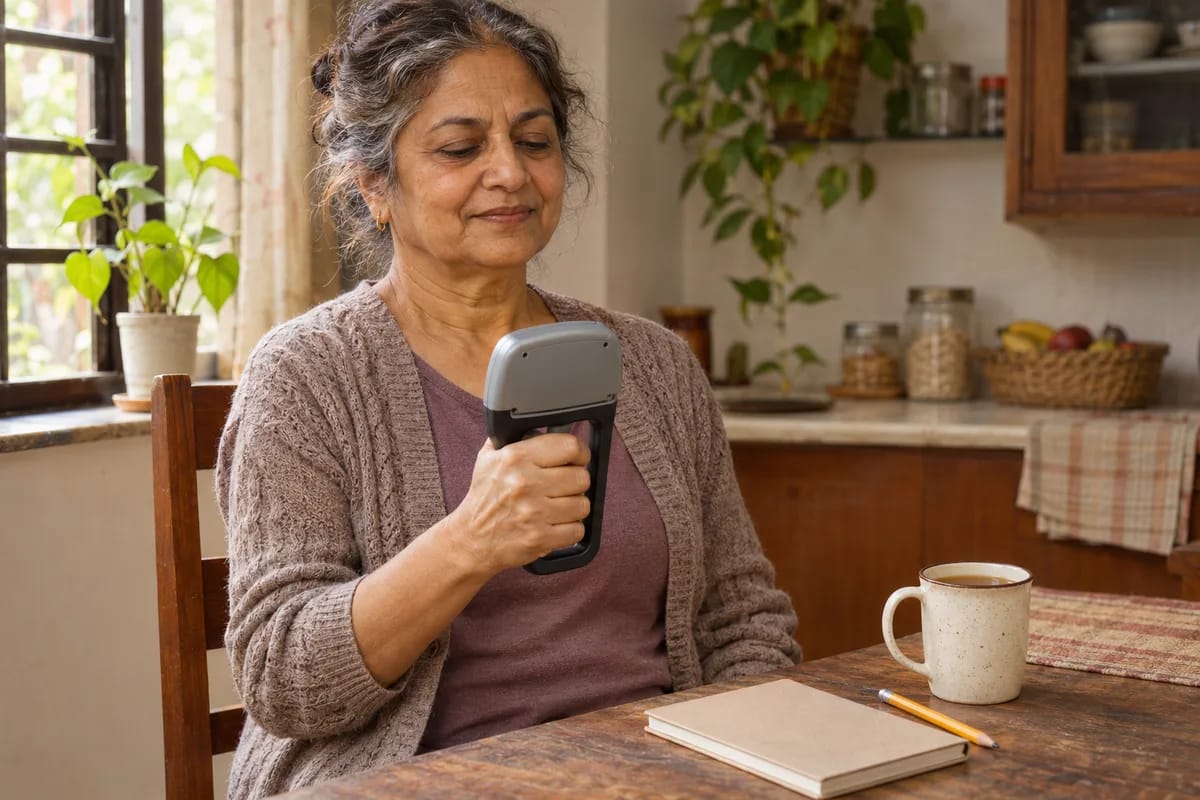
You need a hand dynamometer, the squeeze gadget with a dial or a screen. Inexpensive digital ones are fine. One that researchers have put to the test is the Camry, a popular low-cost model: two 2025 studies found it read within about a kilo (2 lb) of the lab devices they use.3 Or ask at a physical therapist's or your doctor's office, where there's often one in a drawer.
Sit tall in a firm chair
Upper arm by your side, elbow bent to about a right angle, wrist straight, thumb on top. Adjust the handle so it sits comfortably in your hand.
Squeeze as hard as you can for about three seconds
Breathe out as you squeeze rather than holding your breath. It should feel like a big effort, not a strain in your face and neck.
Do three tries with each hand
Alternate hands and rest a few breaths between tries. The first squeeze is often the weakest because you're still working out how hard to go.
Keep your single best number
Best of all your tries, from either hand. That's broadly how the tables were built: the best reading counted. Write it down with the date and the hand, so next time compares like with like.
Retest every six to twelve months
Same device, same chair, same time of day if you can. Your own trend tells you more than any one reading.
No dynamometer? A bathroom scale pressed with your hand measures a push, not a squeeze, so its numbers won't line up with the tables. A better free check is the chair stand: time how long you take to stand up from a chair and sit back down five times, arms folded. The same specialists treat more than 15 seconds as a sign of low strength, and it tests your legs, which matter at least as much as your hands.2 The sit-to-stand test and what your score means walks through it.
Daily life gives rougher clues. A jar you now hand to someone else, shopping bags you set down halfway home, a dishcloth you can't wring dry, a full kettle that feels like a two-hand job. None of these is a measurement, but if several have crept up on you, a proper test is worth doing.
What a weak grip actually predicts
The famous claim comes from the PURE study, which measured the grip of nearly 140,000 adults aged 35 to 70 in 17 countries and followed them for about four years.4 Every 5 kg (11 lb) less grip went with a 16% higher risk of dying in that time. Grip predicted death, from any cause and from heart disease, more strongly than systolic blood pressure did.
That doesn't make your blood pressure unimportant: high blood pressure does real damage, and you can treat it. It means a few seconds of squeezing carries a surprising amount of information.
The other findings, briefly:
- Deaths from heart disease, lung disease and several cancers (not prostate cancer) were more common with a weaker grip.5
- Slow walking decades later. Men in the weakest third for grip in midlife had nearly three times the odds of walking very slowly 25 years on.6 Walking speed is a health story of its own: why walking speed is a vital sign after 60.
- Memory. People with the strongest grip were about 40% less likely than the weakest to develop cognitive impairment over the following years, though the evidence is weak.7
- Type 2 diabetes, barely. PURE found no clear link,4 and pooled studies find only a small one, partly explained by body fat.8 Muscle matters for blood sugar by another route: your muscle is a glucose sink.
- Bones, disability and hospital. Weak grip goes with lower bone density, living with several long-term conditions, future disability, hospital admissions and more complications after surgery. Reviews also link it to falls and hip fractures,9 but PURE found no link with fall injuries or fractures,4 so treat that one as unsettled.
How worried should a "16% higher risk" make you?
Less than it sounds. A 16% higher risk doesn't mean a 16 in 100 chance of anything. It's 16% more of whatever your risk already was.
In PURE, about 2.4 in every 100 people died during the four years. Raise that by 16% and you get roughly 2.8 in 100.
Now put it on the tables. At most ages, low and typical sit about two of those 5 kg steps apart (a little less for women). Two steps compound to about a third higher risk, so being in the bottom tenth for your age rather than the middle means roughly 3.2 in 100 over four years instead of 2.4. That's our own rough arithmetic, averaged across everyone from 35 to 70. Across a whole population it's a meaningful difference. For one person, it's worth taking seriously, and not a reason to lie awake.
Your age changes the size of it. A 40-year-old starts from a lower risk than 2.4 in 100 and a 68-year-old from a higher one, so the same 16% means fewer extra deaths at 40 and more at 68. The link itself is no weaker when you're younger.5 There's just less risk for it to multiply.
And grip isn't a crystal ball. When the British researchers added grip to a doctor's usual risk check (age, sex, blood pressure, smoking, diabetes and weight), the predictions got better, but only slightly.5 It's a useful extra reading, not a replacement for the usual ones.
Why a squeeze of the hand knows so much
A dynamometer isn't really measuring your hand. It's measuring the end of a long chain: your forearm muscles, the nerves that fire them, the signal from your brain, and everything that keeps that chain in good repair, like food, protein, activity and sleep. Long-term illness and inflammation wear the chain down.
So a grip reading works like a car's temperature gauge. The gauge isn't the engine, but it sits downstream of a lot of things that matter. When it moves, you've learned something about the engine without opening the hood.
Two more things make grip so popular with researchers. It takes a minute and a handheld device, so you can test tens of thousands of people in a field study, where nobody could give everyone a full-body strength workup. And some of the link probably runs backwards: an illness that's already brewing can sap your strength before anyone has named it. The British team couldn't rule that out.5
Should you buy a hand gripper?
Squeeze a gripper most days for a month and your grip reading will probably go up, partly from practice at the test and partly from stronger forearms. That's a real change, just not the one the studies measured: they followed ordinary people going about their lives, not people training their hands. Even for getting stronger all over, the PURE team said plainly that it's still an open question whether it lowers the risk of dying.4
There's one twist. Holding a steady squeeze for a couple of minutes at a time, called isometric handgrip training, lowers resting blood pressure a little: about 5 points off the top number on average across 31 studies, more in people who already had high blood pressure. The usual routine is four 2-minute holds at 30% or more of your hardest squeeze, up to three times a week, for at least eight weeks.10 That comes from your blood vessels, not from a stronger grip. If you have high blood pressure or take medication for it, check with your doctor before you start.
What a gripper can do
- Raise your grip reading
- Make opening, holding and hanging on a little easier
- Lower resting blood pressure slightly, used as timed holds
What it can't do
- Strengthen your legs, hips and back
- Replace whole-body lifting
- Keep the reading an honest gauge of the rest of you
What raises your grip and the rest of you
The things that build a strong grip as a side effect are the same things that build a strong body, and muscle does far more than move you. None of these need a gym, and all of them start light.
- Carries. Pick up two heavy shopping bags, dumbbells or kettlebells and walk, tall, for 30 to 60 seconds. Your hands hold on, and your shoulders, trunk and hips do the rest. It's about as close as one exercise gets to everyday life.
- Rows. One hand and one knee on a sturdy chair or bench, pull a dumbbell up toward your hip. Your back does the work and your hand has to grip the whole time.
- A hinge. Hold a dumbbell or kettlebell, push your hips back with a flat back, let the weight slide down toward your shins, then stand up. It's the movement behind picking anything up off the floor.
- Hangs. Find a sturdy bar low enough that your feet stay on the ground, like the low bar at a playground or a park fitness area, and let your legs take some of your weight. Let them help less as it gets easier.
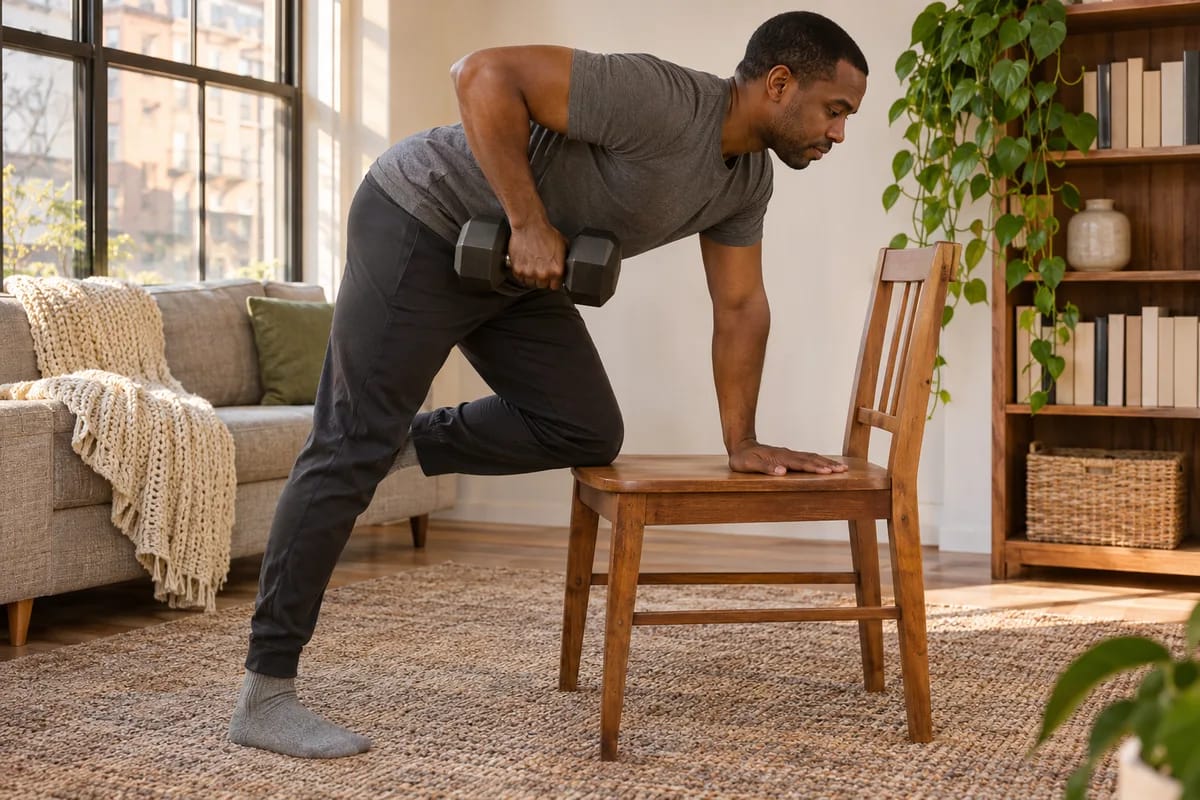
Two or three times a week is plenty, and it fits around walking or other cardio (zone 2 and strength, a longevity week shows one way). For rows and hinges, do two or three sets of 8 to 12, with a weight where the last couple of reps feel like work but your form stays tidy. For carries and hangs, do two or three rounds and rest as long as you like between them.
Add squats or sit-to-stands for your legs, even though they barely move your grip reading. If you're new to all of this, starting to lift at 50 with zero gym background covers the first month.
Expect your grip number to lag behind, though. Whole-body exercise only trains it on the side, and in trials with healthy people over 60, general exercise programs raised grip only a little.11 So after two months of training, your carries and rows may have climbed a long way while your grip barely moved. That isn't failure. Grip just changes slowly. Track what you lift week to week, and save the dynamometer for once or twice a year.
If you'd rather not work out the weights and the form on your own, that's the job of a Bespoke Fit coach. They write the carries, rows and hinges into your program and watch you do them live on a 1‑on‑1 video call. They fix your form mid-set and add weight when the last reps start to feel easy. The app logs what you lift each week. Here's what a live session looks like.
When a low number isn't about your health
Plenty of things pull a grip reading down that have nothing to do with your heart or your lifespan.
- Your hands themselves. Arthritis in the fingers or thumb, an old wrist fracture, carpal tunnel or a trigger finger can all cap your grip however strong the rest of you is. In that case, lean on the chair stand or your walking speed as your strength check instead. Ask your doctor or physical therapist what suits your hands. Strength training can still help, and lifting with arthritis explains why movement tends to be good for sore joints.
- The test. Cold hands, a tired day, standing instead of sitting, or a different device can each nudge a reading up or down. The British researchers found their norms held up across different devices and sitting or standing.1 Test the same way every time and these mostly wash out.
One thing is different. A sudden drop in grip, weakness in one hand only, numbness or tingling, or dropping things you used to hold easily is a reason to see a doctor, not a reason to train harder. That's a question about nerves or joints, and it deserves a proper look. If weakness in a hand or arm comes on suddenly, especially with a drooping face or slurred speech, call 911: those are signs of a stroke.
Common questions
Should I divide my grip strength by my body weight? Not for the tables or for what grip says about your lifespan. Bigger people do tend to grip harder, so it sounds fairer, but when researchers compared the options in about 9,600 American adults, the plain number in kilos predicted death as well as or better than any version adjusted for body size. Use the raw reading.12
Which finger matters most for grip strength? Your middle finger. In a study that measured each finger separately, it supplied about 35% of the squeeze, the ring and index fingers about a quarter each, and the little finger about 15%. That's why a sore or stiff middle finger can pull your whole reading down.13
Sources
-
Dodds RM, Syddall HE, Cooper R, et al., 2014. Grip strength across the life course: normative data from twelve British studies. PLOS ONE. ↩ ↩2 ↩3
-
Cruz-Jentoft AJ, Bahat G, Bauer J, et al., 2019. Sarcopenia: revised European consensus on definition and diagnosis. Age and Ageing. ↩ ↩2
-
Sánchez-Aranda L, Fernández-Ortega J, Martín-Fuentes I, et al., 2025. Reliability and concurrent validity of a low-cost handgrip dynamometer: the Camry. American Journal of Occupational Therapy. Also Panhale V, Kini R, Kothale S, 2025. Reliability and validity of Camry dynamometer for isometric hand grip strength measurement in healthy Indian adults. Journal of Hand and Microsurgery. ↩
-
Leong DP, Teo KK, Rangarajan S, et al., 2015. Prognostic value of grip strength: findings from the Prospective Urban Rural Epidemiology (PURE) study. The Lancet. ↩ ↩2 ↩3 ↩4
-
Celis-Morales CA, Welsh P, Lyall DM, et al., 2018. Associations of grip strength with cardiovascular, respiratory, and cancer outcomes and all cause mortality: prospective cohort study of half a million UK Biobank participants. BMJ. ↩ ↩2 ↩3 ↩4
-
Rantanen T, Guralnik JM, Foley D, et al., 1999. Midlife hand grip strength as a predictor of old age disability. JAMA. About 6,000 Japanese-American men in Hawaii, aged 45 to 68 at the start. ↩
-
Kunutsor SK, Isiozor NM, Voutilainen A, Laukkanen JA, 2022. Handgrip strength and risk of cognitive outcomes: new prospective study and meta-analysis of 16 observational cohort studies. GeroScience. ↩
-
Wu H, Gu Y, Wang X, et al., 2023. Association between handgrip strength and type 2 diabetes: a prospective cohort study and systematic review with meta-analysis. Journals of Gerontology, Series A. ↩
-
Bohannon RW, 2019. Grip strength: an indispensable biomarker for older adults. Clinical Interventions in Aging. ↩
-
Lin CW, Jun IB, Igbo V, et al., 2026. The optimal dosage of isometric handgrip exercise for blood pressure reduction: systematic review and meta-analysis. Journal of Clinical Hypertension. ↩
-
Labott BK, Bucht H, Morat M, Morat T, Donath L, 2019. Effects of exercise training on handgrip strength in older adults: a meta-analytical review. Gerontology. ↩
-
Chai L, Zhang D, Fan J, 2024. Comparison of grip strength measurements for predicting all-cause mortality among adults aged 20+ years from the NHANES 2011-2014. Scientific Reports. ↩
-
Talsania JS, Kozin SH, 1998. Normal digital contribution to grip strength assessed by a computerized digital dynamometer. Journal of Hand Surgery (British volume). ↩