Muscle growth at 80: what the frailty studies show
Nursing-home residents in their 80s and 90s built real strength and muscle under resistance training. Here's what that means if you think it's too late.
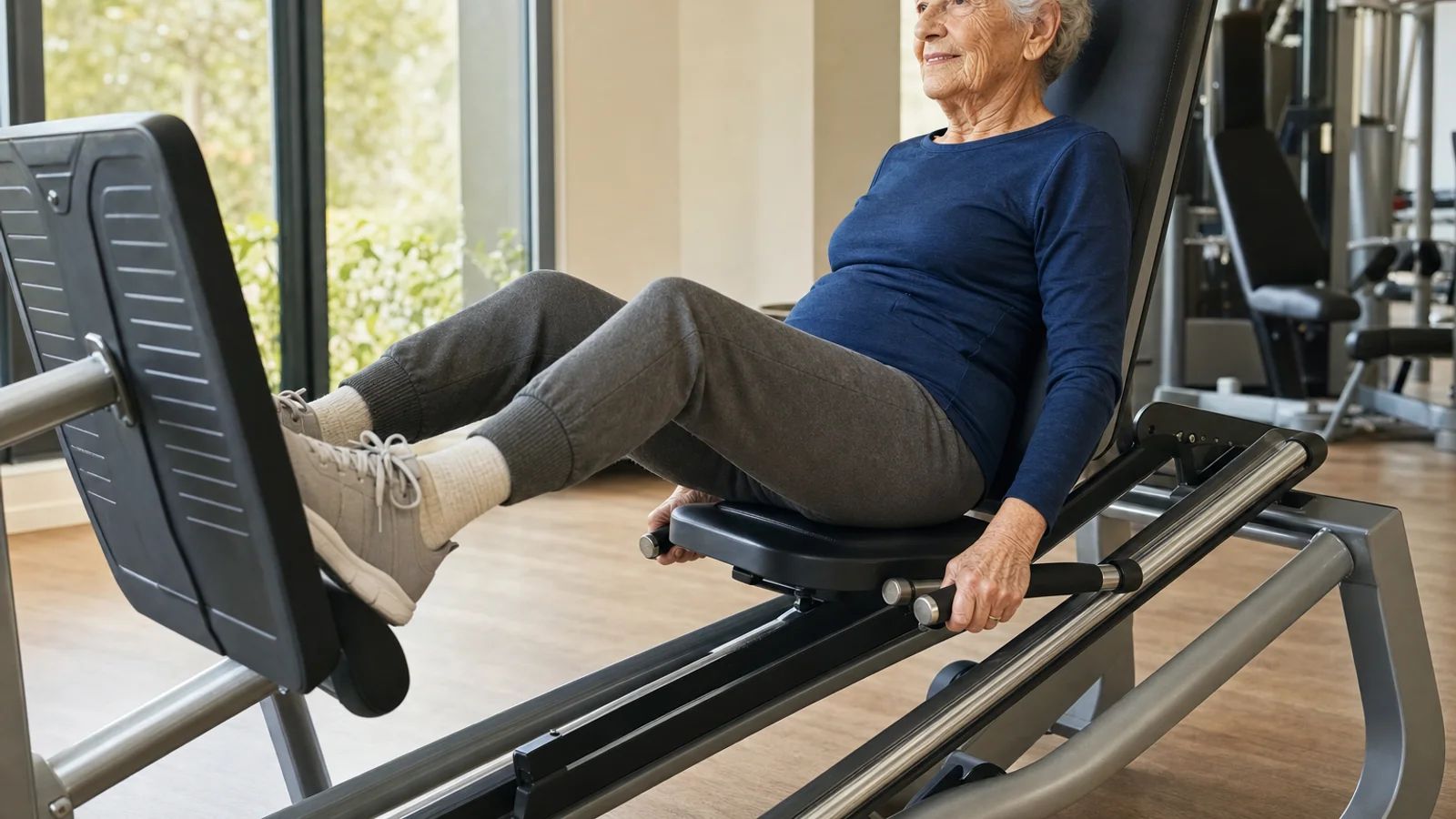
The people who prove muscle grows at 80 were not athletes. They were nursing-home residents in their 80s and 90s, some using walkers, some who hadn't stood up from a chair without help in years. Researchers put them on a real strength program, nothing gentle about it. Their muscles grew. In the largest of these trials, strength rose 113 percent in ten weeks.1
If training works on the frailest, oldest bodies scientists could find, age by itself is almost never why a 65 or 72-year-old can't build muscle. "I'm too old for that now" is one of the most expensive beliefs going. It's the one that keeps people out of the single activity most likely to keep them out of a wheelchair. The frailty trials are the clearest evidence we have that the belief is wrong. They're worth walking through.
Eight weeks, age 90, and a 174 percent jump
The earliest evidence came in 1990: ten institutionalized volunteers, average age 90, the oldest 96, put through eight weeks of high-intensity leg training. Their strength climbed by an average of 174 percent. The muscle itself grew too, about 9 percent by mid-thigh scan, and their walking speed picked up, tandem gait speed rose 48 percent.2
Ten people isn't enough to build a field on. But it was enough to make researchers ask a bigger question: would the same hold for a hundred people instead of ten, and for residents who were frailer still?
The trial that settled it
In 1994, the New England Journal of Medicine published a randomized, placebo-controlled trial of 100 frail nursing-home residents, average age 87, ranging up to 98. Researchers split them into four groups: resistance training, a multi-nutrient drink, both together, or neither, a design built to separate what the lifting did from what the food did.
The residents who lifted gained 113 percent in muscle strength over ten weeks. The residents who didn't lift gained about 3 percent, which is measurement noise, not progress. Thigh muscle grew in the lifters and slipped slightly in everyone else.
The gains showed up where they count: in movement. Gait speed rose almost 12 percent in the exercisers while it declined in the group that didn't train. Stair-climbing power, closer to real-world function than any single lift, improved about 28 percent. The exercisers also moved more on their own outside of sessions, what researchers call spontaneous physical activity. In people this frail, that's the line between managing alone and needing help.
The nutrition arm is the part people forget. On its own, the supplement changed nothing. Better food didn't substitute for loading the muscle. Something had to make the muscle work.
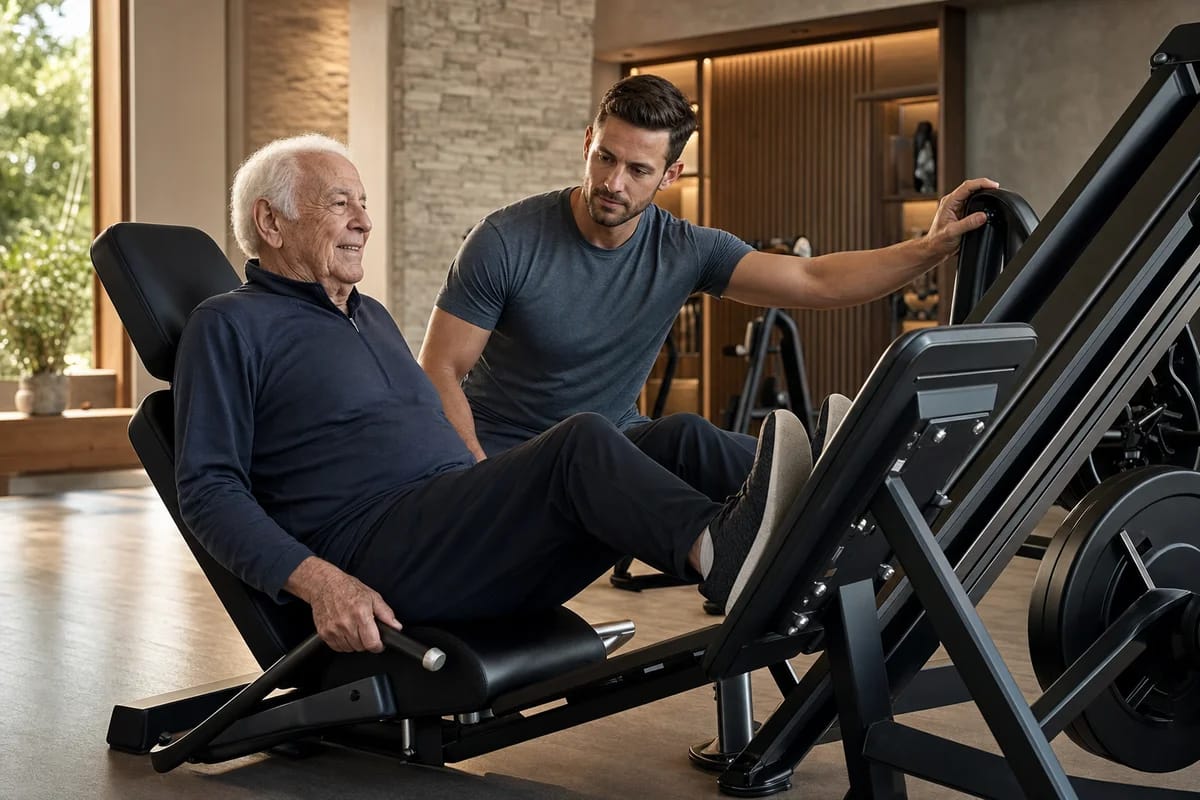
The frailest, oldest people in the building got stronger and moved better, and it was the lifting that did it, not the diet.
Why does muscle still respond this late?
The mechanism explains why age isn't the wall people assume it is. Muscle grows when you give it a stress it isn't used to, then feed and rest it. The tissue senses the load, speeds up the rate at which it builds new contractile protein, and adds a bit more next time. The old assumption was that this machinery rusts shut with age. It doesn't. It gets less sensitive, so it needs a clearer signal, but the response is still there.
One trial measured this directly in frail adults aged 76 to 92. After three months of supervised weight training, the rate at which their muscles built new protein rose significantly. In untrained people the same age, measured twice over the same stretch, it didn't move.3 The building crew still shows up in your 80s and 90s. It's just waiting for a real order.
There's a second piece to strength gains this late in life: the nervous system. Early on, a lot of new strength comes from your brain learning to recruit more of the muscle fibers you already have, before the muscle visibly grows. That's why strength numbers often jump faster than muscle size, the exact pattern both trials above show.
If 90-year-olds adapt, why does 70 feel too late?
Usually it isn't age doing the blocking. It's the things that travel with age and get blamed on it. A sore knee that never got looked at. A blood-pressure worry that makes lifting feel risky. Years out of practice, so the first session feels awful and gets read as proof. A program too gentle to trigger any adaptation, which then confirms the fear that nothing works anymore. None of that is your birthday. All of it is specific, and most of it is workable.
The frailty trials are the extreme end of the argument. Their subjects had every reason to be written off: poor baseline strength, multiple medical conditions, low activity. They still adapted. Someone in their 60s or 70s is usually starting from a much higher floor, which means more room to gain, not less.
The decade-by-decade playbook lives elsewhere. If you're in your 70s, the real questions are medical clearance, safe starting loads, and how fast to add weight, covered in training in your 70s. If you're in your 60s, the emphasis shifts toward power, balance, and bone, covered in training in your 60s.

Age is almost never the actual barrier. Usually it's one specific, fixable thing standing in front of it.
What the numbers don't tell you
I want to be straight about what these trials can and can't tell you. The frailty subjects started from a very low base, so their percentage gains look enormous next to what a fitter 68-year-old should expect: big relative jumps are easiest when you begin near the floor. Every trial here was supervised, someone setting the load and watching each set, which shaped both the results and the safety record. The programs were high-intensity progressive resistance training, not gentle range-of-motion classes, so a real stimulus is required, not just any movement. Your medications, joints, and health history will decide what a sensible start looks like far more than your age will. Treat all of this as a strong, well-supported direction, not a fixed dose.
Key takeaways
- Budget for two strength sessions a week at almost any age, and expect measurable progress within 8 to 10 weeks, the window these trials used.
- Load the muscle enough to matter. Pick a weight you can lift for about 8 to 12 solid reps and no more. Something you could do for 30 reps won't send the signal.
- Cover the moves that keep you independent: a sit-to-stand or squat, a push, and a pull. Stair power and getting out of a chair were what improved most in these trials.
- Don't lean on supplements alone. In the frailty trials, nutrition without exercise changed nothing for strength or frailty.
- Name your real barrier and treat that, not your age. A cranky knee, a blood-pressure question, or years off are all specific and fixable.
- If nursing-home residents near 90 can gain this much, someone in their 60s or 70s has more runway than they think.
Common questions
Can you build muscle at 80? Yes. The strongest evidence comes from trials of nursing-home residents in their 80s and 90s who gained real strength and muscle size on progressive resistance training. The gains come slower than they would for a 30-year-old and need a real load behind them, but the muscle still grows.
How long before you'd see results at that age? The frailty trials ran 8 to 10 weeks and produced large strength gains in that time. Expect the first noticeable changes, easier stairs, steadier standing, within a couple of months of consistent, progressive training.
Is heavy lifting safe for someone in their 80s? The trials that produced these gains used high-intensity training under supervision, with a strong safety record. Safe doesn't mean careless: the load matches the person, technique gets watched, and weight climbs gradually. Anyone with heart disease, uncontrolled blood pressure, or an unstable condition should check with a doctor first.
Do you need protein powder or supplements to build muscle at this age? The training is the non-negotiable part. In the frailty trials, a nutrition supplement without exercise did nothing for strength. Adequate protein helps older muscle respond. It supports the lifting. It doesn't replace it.
What a coach adds on top of this
The hard part was never whether an 80-year-old can build muscle. The research settled that. The hard part is the judgment: what load is enough to matter but still safe, when to add weight, which movement to swap around a bad knee, whether a session actually went well. In the trials, someone made those calls in real time, watching each set. A real coach does the same here, live over unlimited 1-on-1 HD video, watching your actual reps and adjusting every session from what they see, never an AI. How it works walks through what that looks like. Founding member pricing is $49 for your first month, then $299 a month locked in for life, 25 spots, with a 30-day money-back guarantee.
Before you commit to anything, ask yourself one thing: could you set your own loads, track your own progression, and catch your own form mistakes without someone else watching the bar? If yes, two sessions a week, weight heavy enough to be hard, and small steady jumps will take you most of the way there, close to what these residents did with a program and a supervisor. If that's a no, or you're not sure, that's the part a coach mainly speeds up, catching the two ways this goes wrong: training too light to trigger anything, or adding weight faster than your joints want.
Sources
-
Fiatarone and colleagues, 1994. Exercise training and nutritional supplementation for physical frailty in very elderly people. New England Journal of Medicine. ↩
-
Fiatarone and colleagues, 1990. High-intensity strength training in nonagenarians. Effects on skeletal muscle. JAMA. ↩
-
Yarasheski and colleagues, 1999. Resistance exercise training increases mixed muscle protein synthesis rate in frail women and men ≥76 yr old. American Journal of Physiology. ↩