How much protein you actually need after 40
Protein needs after 40, explained: why the same steak does less for your muscles now, and the g/kg target the research actually supports.
Updated
If you lift and you're past 40, aim for about 1.6 grams of protein per kilo of body weight a day, about 0.7 g per pound, split across three or four meals of 25 to 40 grams each. At 70 kg (about 154 lb) that's 112 g a day. At 90 kg (about 198 lb) it's 144 g. The meal most people get wrong is breakfast.
That's the answer. The rest of this is why the number climbed, because it did. You can eat the same steak you ate at 25 and your muscles will do less with it. The food didn't change. What your body does with it did.
Your number, in grams
Per-kilo targets are easy to nod at and hard to eat, so convert yours before anything else. Take your weight in kilos (pounds divided by 2.2) and multiply.
For a 70 kg person:
- RDA floor: 56 g/day
- Active target at 1.2 g/kg: 84 g/day
- Building muscle at 1.6 g/kg: 112 g/day, or roughly 28 g at each of four meals
For a 90 kg person:
- RDA floor: 72 g/day
- Active target at 1.2 g/kg: 108 g/day
- Building muscle at 1.6 g/kg: 144 g/day, or roughly 36 g at each of four meals
If you're carrying a lot of extra body fat, base the target on a healthier goal weight. Fat tissue doesn't demand protein the way muscle does.
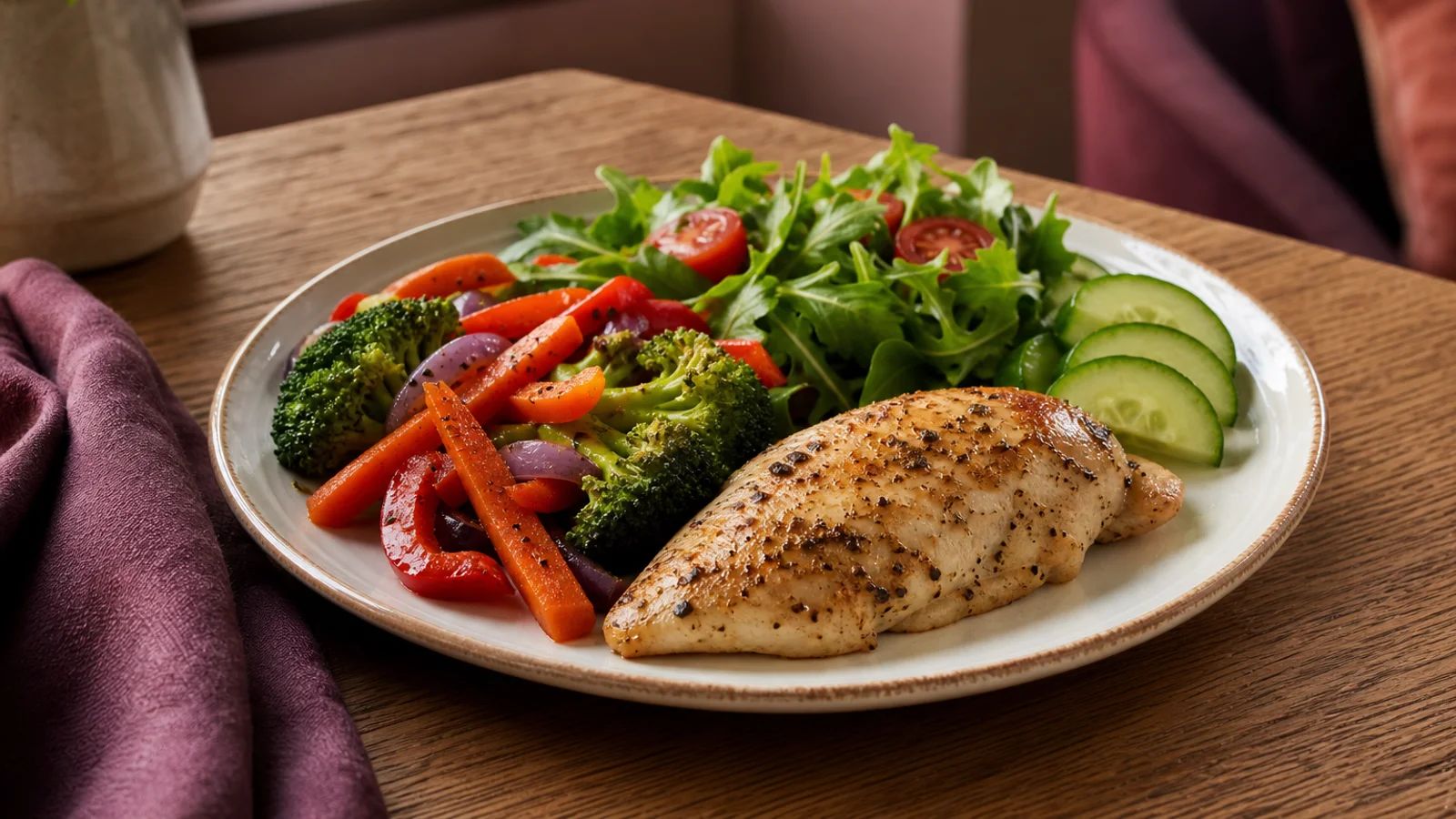
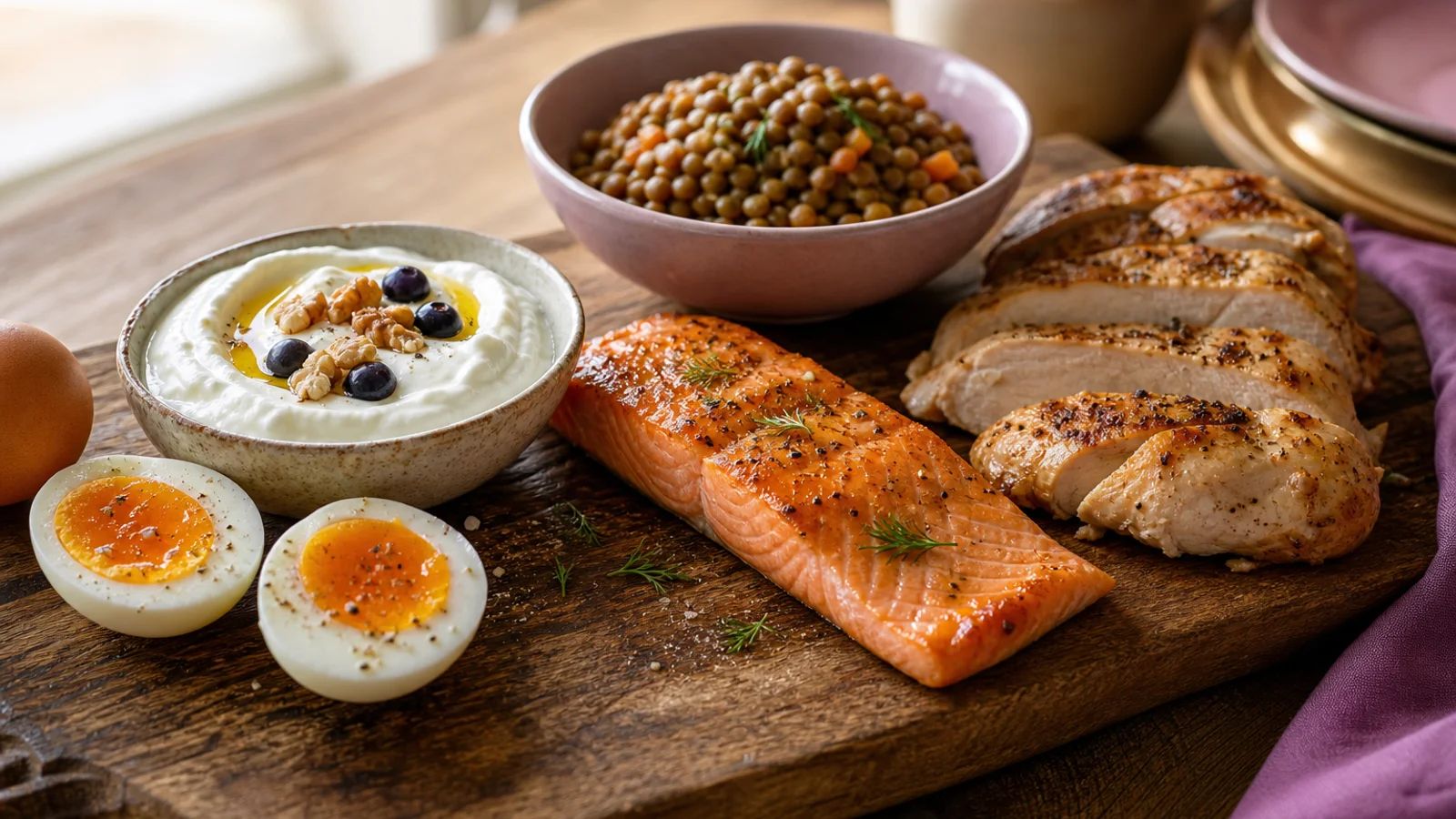
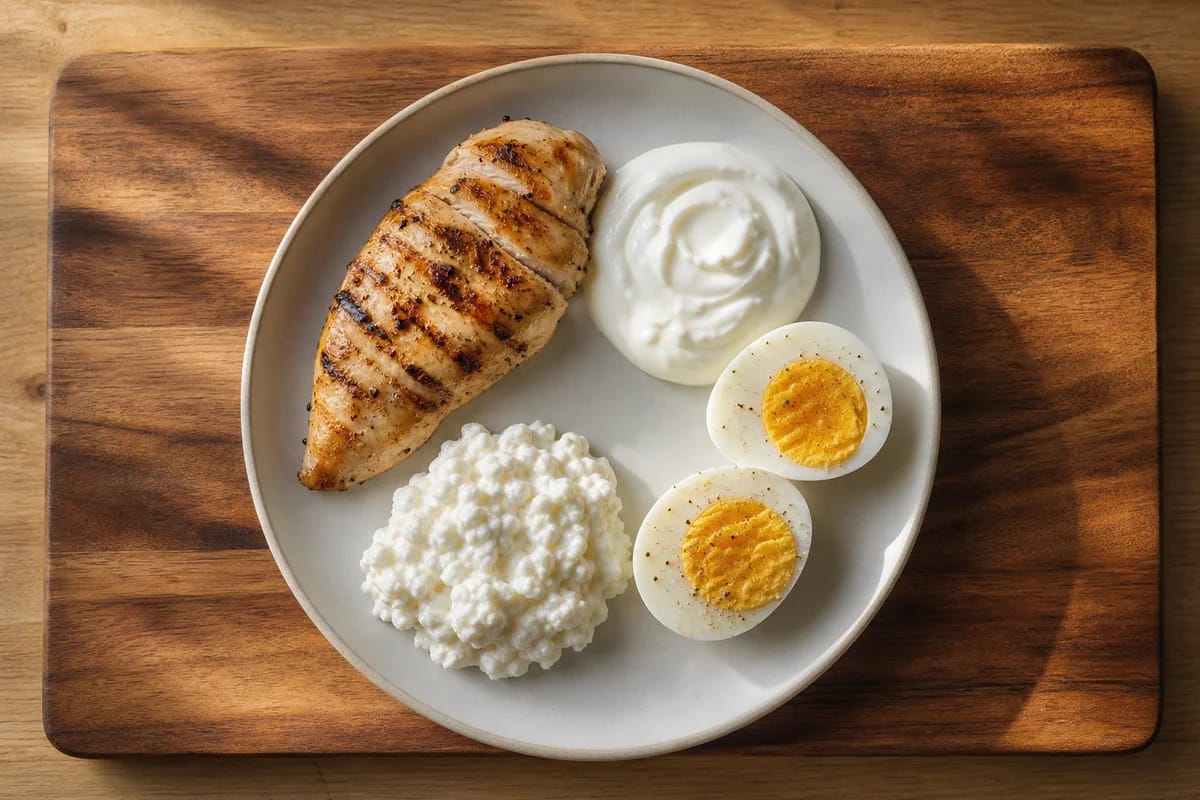
Thirty grams looks like a palm-sized chicken breast, or three eggs plus a Greek yogurt, or a can of tuna on toast. For a plant-forward meal you need bigger portions of lentils, tofu and edamame, because plant proteins carry less leucine, the amino acid that flips the muscle-building switch.
Those per-meal numbers, 28 to 36 g, aren't a coincidence. They land almost exactly on the dose an older muscle needs before it fully responds. That number is the next section.
Why the same steak does less now
Protein does two jobs when you eat it. The amino acids are building blocks, and they're also a signal. The signal switches on muscle protein synthesis, the process that builds new tissue to replace what gets broken down. Leucine is the switch.
With age, that switch gets stiff. Researchers call it anabolic resistance. Same protein, smaller and slower rise in muscle protein synthesis. The building blocks arrive on time. The muscle is just slow to pick them up.
You can put a number on the cost. A 2015 study in the Journals of Gerontology pooled tracer data from healthy older men (around 71) and younger men (around 22), looking for the dose that maxes out muscle protein synthesis. The younger men needed about 0.24 g of protein per kg of body weight per meal. The older men needed about 0.40 g/kg.1 Nearly double, for the same result.
That's why the per-meal number matters more than it used to. Under the bar, a meal barely counts.
The RDA is a floor, not a goal
The official Recommended Dietary Allowance for protein is 0.8 g/kg/day, and it sounds authoritative. It's the amount that keeps most healthy people out of deficiency, set from short nitrogen-balance studies in younger adults. It was never meant to describe what keeps an aging body strong. Treating it as an optimum is like treating minimum wage as a good salary.
The people who study this say so out loud. In 2013 an international panel of geriatric and nutrition researchers, PROT-AGE, put the target for older adults at 1.0 to 1.2 g/kg/day, and 1.2 g/kg or more for anyone active.2 A year later the European clinical nutrition society, ESPEN, landed in the same place: 1.0 to 1.2 g/kg for healthy older adults, 1.2 to 1.5 g/kg for people who are ill or recovering.3
So two separate panels put the real target 25 to 50 percent above the RDA. Not because the RDA is wrong, but because it answers a different question.
Where 1.6 comes from
If you lift, there's a cleaner number to aim at. The biggest pooled analysis on protein and resistance training, 49 trials and 1,863 people, went looking for the point where extra protein stops adding muscle and strength. It landed at about 1.6 g/kg/day.4
Below that, more protein meant more muscle. Above it, the extra stopped showing up as anything measurable. So 1.6 is a ceiling worth reaching, not a number to keep chasing past.
Two caveats sit right next to it. That plateau was an average with a wide spread around it, and the benefit shrank with age. Which is exactly why an over-40 lifter should sit at the top of the range rather than treat 1.6 as generous.
Three or four meals beat one big dinner
Timing matters more here than people expect, and it follows straight from anabolic resistance. If every meal has to clear a higher bar, how you spread protein across the day starts to count.
A small feeding trial tested it head-on. Healthy adults ate the same daily protein two ways: evenly spread, about 30 g at each of three meals, or the way most of us actually eat, with a light breakfast and a big protein dinner. Over 24 hours, muscle protein synthesis ran about 25 percent higher on the even pattern.5 It was 8 people in a tightly controlled setup, so take it as a strong hint rather than a law. It points the same direction the mechanism does.
Your muscle can only act on so much protein at once. Three or four meals that each clear the bar beat one giant dinner that overshoots while breakfast and lunch fall short.
Most people over 40 are fine at dinner and short at breakfast, so fixing breakfast closes most of the gap on its own. None of it needs powder or a spreadsheet. Build the meal around a protein source instead of parking a small one next to a pile of rice.
If you want the mechanism behind the timing, the leucine threshold, and why protein timing changes with age goes deeper on the switch itself and why its per-meal threshold rises.

Is this bad for your kidneys?
For healthy kidneys, no. Pooled across 28 trials and 1,358 people, higher-protein diets didn't hurt kidney function in healthy adults, measured as change in glomerular filtration rate.6 More protein does make your kidneys work a bit harder. In a healthy person that's normal function, not damage.
Real kidney disease is the exception that counts. If your kidney function is already reduced, protein gets managed carefully and individually, and that's a conversation with your doctor rather than with an article.
What protein does for appetite and fat loss
Gram for gram, protein is the most filling of the three macronutrients, so a protein-forward meal keeps you satisfied longer and takes some of the pull out of snacking. It also costs your body more energy to digest than fat or carbohydrate.
The bigger payoff shows up when you're losing weight. Cut calories and some of what you lose is muscle, not just fat. Enough protein during a deficit, alongside resistance training, protects lean mass so more of the loss is fat. That matters more after 40, when muscle is already under pressure.
Where these numbers get fuzzy
The dosing figures come from tracer studies in men, so the exact per-meal number for women is less certain, though anabolic resistance itself holds across sexes. The distribution study was tiny, 8 people in a lab. The 1.6 g/kg analysis leaned on younger, mostly male subjects, which is why I'd nudge older readers to the top of the range instead of treating 1.6 as gospel. And a rise in muscle protein synthesis over a few hours isn't the same thing as being visibly stronger a year later, even though the two track together over time.
Individual variation is wide. Treat all of this as a starting point, not a prescription.
One more thing worth saying plainly: protein without training builds very little. It's the raw material, not the stimulus. Lift first, then feed. And if you have kidney disease or any other medical condition, set your target with your doctor, not with a blog.
Common questions
Is 0.8 g/kg enough protein after 40? It's enough to avoid deficiency, which is all the RDA was built to measure. It's below what expert panels recommend for holding onto muscle as you age. PROT-AGE and ESPEN both put the target at 1.0 to 1.2 g/kg or higher, and it's closer to 1.6 g/kg if you lift.
Can I build muscle after 40 at all? Yes. Anabolic resistance means you need a stronger stimulus, more protein per meal plus consistent resistance training, but aging muscle still grows. The response is blunted, not gone. That's a very different thing from being over.
Do I need protein powder to hit these numbers? No. Most people can reach 1.6 g/kg from whole food by building each meal around dairy, eggs, meat, fish, or a decent portion of soy or legumes. Powder is a handy top-up when you're short at breakfast or straight after training. It's convenience, not a requirement.
The number is the easy part
Three or four meals a day built around a real protein source, next to real training, will hit 1.6 g/kg on its own. If you have a clinical need, a dietitian is the right call, not a coach and not an article.
Knowing the target takes five minutes. Hitting it takes years, because protein only pays off when it's attached to a training stimulus, and both have to keep happening well past the motivated fortnight. That's the piece our coaches work on with members: getting the strength sessions to reliably happen, then layering in one or two protein habits that stick, like a proper breakfast. If you want the case for why the muscle you're feeding is worth this much trouble, muscle is an organ that does far more than move you makes it. The coaching itself is on the how it works page, and founding membership is $49 your first month, then $299/mo locked for life, with 25 of those spots.
Sources
-
Moore et al., 2015. Protein ingestion to stimulate myofibrillar protein synthesis requires greater relative protein intakes in healthy older versus younger men. The Journals of Gerontology: Series A. ↩
-
Bauer et al., 2013. Evidence-based recommendations for optimal dietary protein intake in older people: a position paper from the PROT-AGE Study Group. Journal of the American Medical Directors Association. ↩
-
Deutz et al., 2014. Protein intake and exercise for optimal muscle function with aging: recommendations from the ESPEN Expert Group. Clinical Nutrition. ↩
-
Morton et al., 2018. A systematic review, meta-analysis and meta-regression of the effect of protein supplementation on resistance training-induced gains in muscle mass and strength in healthy adults. British Journal of Sports Medicine. ↩
-
Mamerow et al., 2014. Dietary protein distribution positively influences 24-h muscle protein synthesis in healthy adults. The Journal of Nutrition. ↩
-
Devries et al., 2018. Changes in Kidney Function Do Not Differ between Healthy Adults Consuming Higher- Compared with Lower- or Normal-Protein Diets: A Systematic Review and Meta-Analysis. The Journal of Nutrition. ↩