Training in your 40s: what changes and what doesn't
What actually shifts in your 40s: recovery, hormones and VO2 max drift slowly, but muscle and strength are still very much yours to build.
Updated

Four things are quietly moving in your 40s. Muscle mass has begun a slow slide. VO2 max is drifting down. Hormones are shifting. Hard sessions leave you flat for a bit longer than they used to.
All four are real, all four are gradual, and none of them touches the part that matters most. Load a 45-year-old muscle properly and it still grows. That machinery is close to full working order in this decade, which makes your 40s a window rather than the start of the descent.
So the useful question isn't what you're losing. It's what moved, how far, and what's still completely yours to work with.
What's actually moving, and by how much
Muscle mass is the headline, and it's slower than the headlines suggest. A 2000 paper in the Journal of Applied Physiology measured whole-body skeletal muscle by MRI in 468 adults aged 18 to 88. Relative muscle mass starts slipping in your 20s, but a noticeable drop in absolute muscle mass doesn't show up until the end of your 40s.1 So through most of this decade the slide is quiet. It's started. It's just very slow.
Aerobic capacity drifts too. VO2 max is the ceiling on how much oxygen your body can use, and reviews of the aging literature put the average loss at about 10% per decade in men and women, regardless of how active they are.2 That's the average across all of adulthood, though. In your 40s the yearly loss sits at the gentle end. It steepens later.
Hormones move. In men, a long-running study that followed 1,156 of them found total testosterone dropping about 1.6% a year, with free testosterone falling faster, around 2 to 3% a year.3 In women, perimenopause commonly starts somewhere in the 40s, and estrogen begins to swing around and trend down, which affects muscle, bone and recovery.
Two quieter ones round it out. Tendons and ligaments turn over more slowly now, so they adapt to a new load at a more patient pace than they did at 25. And recovery narrows: the same hard session keeps you sore or flat a little longer.
Every one of those moves a notch. None of them jumps.
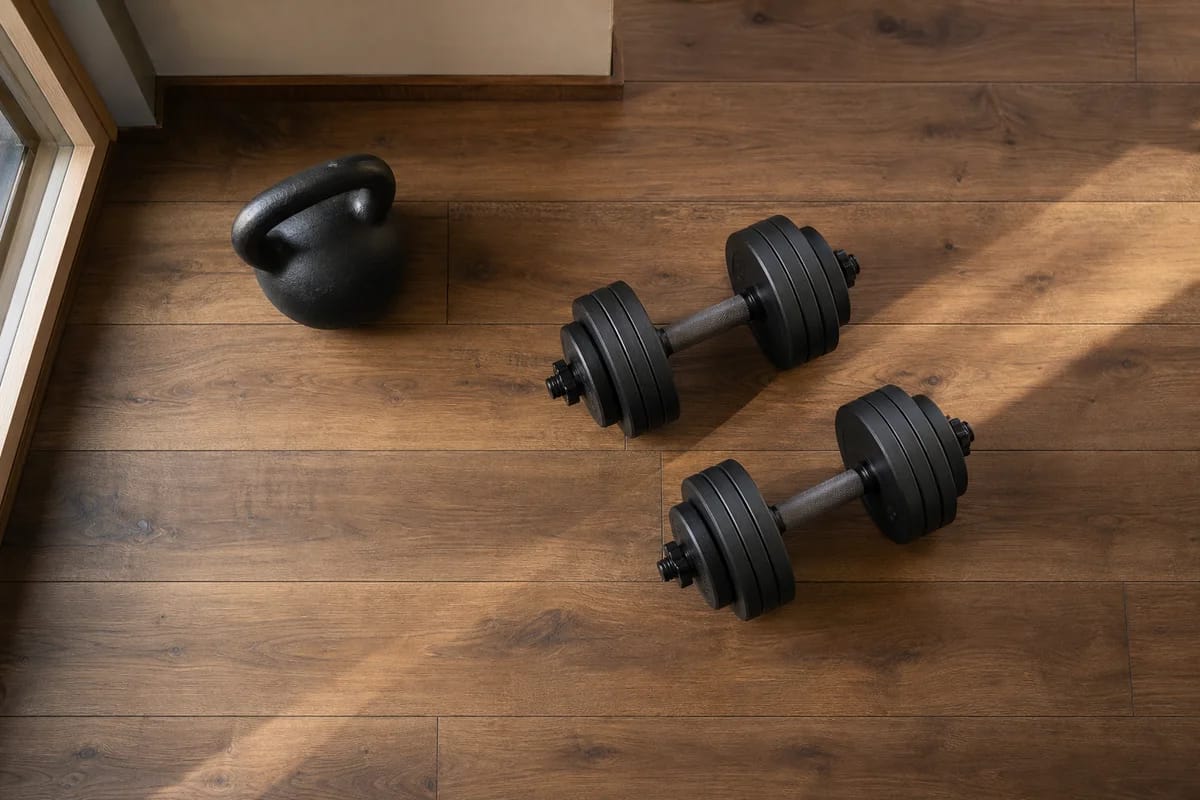
Muscle still answers when you ask
Muscle grows in a 45-year-old for the same reason it grows in a 25-year-old. You hand it a load it can't currently handle, it comes up short, and it rebuilds thicker and stronger so it can. That doesn't switch off in midlife. It gets less sensitive with advanced age, and the 40s are early on that curve, not late.
The proof comes from people a lot older than you. Pooled across 47 resistance-training studies in adults 50 and over, strength went up by something like 10 to 32 kg depending on the lift, roughly 20 to 70 lb.4 A companion analysis of 49 studies and 1,328 adults found resistance training added about 1.1 kg of lean body mass on average, call it two and a half pounds, and the older subjects gained less than the younger ones did.5 If people well past 50 still put measurable weight on the bar and real tissue on their frame, someone in their 40s has more headroom, not less.
You can still get visibly stronger and add real muscle in this decade. Nothing about the biology is in the way.
Why a deposit now beats one at 70
Treat your strength, power and aerobic capacity as savings you'll draw on for the rest of your life. Right now the leak is slow and your ability to build is high, so deposits are cheap. Both of those flip later, especially past 70, when you're building slower against a faster leak. Capacity you add at 44 is worth a great deal more than capacity you try to claw back at 75.
The later steepening isn't one single thing going wrong. You gradually lose fast-twitch muscle fibers and the nerves that fire them, mitochondria thin out, and connective tissue stiffens. Each has its own slope, and they stack. In your 40s all of those slopes are still shallow, so what you put in now compounds for decades.
You can't borrow from your 70-year-old self. You can only lend, and right now lending is cheap. If you want to plan it backward from the life you want at 85 instead of forward from today, backcasting your training from age 90 does that arithmetic.
What a 40s training week actually looks like
There's no special over-40 program. It's the basics, run consistently, with recovery treated as part of the plan instead of what happens when you stop.
Lifting leads. Two or three resistance sessions a week built on compound movements, pushes, pulls, hinges, squats and carries, is the highest-value thing on the list, because muscle and strength are both what fades and what you're still very good at building.
Power gets its own few minutes: a handful of fast, explosive reps like jumps or quick step-ups, once or twice a week. Power drains faster than strength and it's much easier to keep than to rebuild, so the cheap time to train it is while you still have it.
Underneath all that, an easy aerobic base. A couple of hours a week at conversational pace defends the VO2 max that's slowly drifting. It sits alongside the lifting rather than competing with it.
Protein is the nutrition change worth making. Aging muscle responds less to a given dose, so the amount that kept you fine at 25 quietly leaves you short now. How much protein you actually need after 40 has the target and how to split it across meals.

Then the one change in emphasis that's actually about your age: manage recovery, not intensity. You can still train hard in your 40s. You just want more care about sleep, about spacing the hard sessions, and about easy days being genuinely easy. The goal is to train hard often, which means never digging a hole you spend the rest of the week climbing out of.
Where these averages stop describing you
Every number above is a population average, and the spread around each one is enormous. Plenty of 48-year-olds are fitter and stronger than sedentary 30-year-olds. Your genes, your training history and your health tilt your own curve a long way in either direction.
"Your 40s" hides a lot too. A 41-year-old and a 49-year-old aren't in the same place, and ten years of lifting behind you is a different track than starting this month. Averages flatten all of that.
These are slopes, not cliffs. Nothing switches off on a birthday. The research here describes gradual changes measured across whole populations over years, which is exactly why building reserve now beats waiting to see what happens. Treat the percentages as a rough map, not a verdict on you.
Common questions
Is it too late to build muscle in your 40s? Not close. Adults well past 50 still add measurable strength and lean mass from resistance training, so someone in their 40s has more headroom, not less. What actually slows results at any age is inconsistent training, not your birth year.
Do I need a different program because I'm over 40? Not really. Compound lifts, a bit of power, an easy cardio base and enough protein are the same fundamentals that work at 30. The one adjustment worth making is paying closer attention to recovery, so you can keep training hard week after week.
Does falling testosterone mean lifting won't work for me? The decline is real but slow, roughly 1.6% a year for total testosterone, and it doesn't stop resistance training from building muscle in your 40s. If you have symptoms like low energy or a drop in libido, that's a conversation with your doctor and a blood test, not a reason to skip the gym.
What changes in my 50s? The same slow changes keep going and the losses start to steepen, which raises the value of everything you build now. Training in your 50s picks it up, and the short version is that recovery becomes the thing that limits you.
The version you run yourself
None of this is a secret, so here's the recipe. Put two or three lifting sessions in the calendar and defend them like meetings. Build each one around four or five compound movements. Write down every set, and add a rep or a little weight whenever the last set felt clean. Bolt on a few explosive reps twice a week. Walk or ride easy for a couple of hours. Fix breakfast so the protein isn't all crammed into dinner. Sleep, and keep the easy days easy. Run that for a year and the results show up, whether or not anyone's watching.
What a coach changes is calibration and follow-through. Knowing when to push and when to back off, keeping form clean on the fast reps when you're tired, turning "build reserve for later" into this week's actual sets: that's the part that quietly slips when you're on your own. At Bespoke Fit a real coach watches every rep live over video and adjusts the session while it's happening. Your first month is $49. After that, founding members pay $299 a month locked for life, with unlimited live 1-on-1 sessions, 25 founding spots and a 30-day money-back guarantee. See how it works. The reserve is yours to build either way.
Sources
-
Janssen I, Heymsfield SB, Wang ZM, Ross R, 2000. Skeletal muscle mass and distribution in 468 men and women aged 18-88 yr. Journal of Applied Physiology. ↩
-
Hawkins S, Wiswell R, 2003. Rate and mechanism of maximal oxygen consumption decline with aging: implications for exercise training. Sports Medicine. ↩
-
Feldman HA, et al., 2002. Age trends in the level of serum testosterone and other hormones in middle-aged men: longitudinal results from the Massachusetts Male Aging Study. The Journal of Clinical Endocrinology & Metabolism. ↩
-
Peterson MD, Rhea MR, Sen A, Gordon PM, 2010. Resistance exercise for muscular strength in older adults: a meta-analysis. Ageing Research Reviews. ↩
-
Peterson MD, Sen A, Gordon PM, 2011. Influence of resistance exercise on lean body mass in aging adults: a meta-analysis. Medicine & Science in Sports & Exercise. ↩