Building muscle after 60: how much you can still gain
Yes. In trials, people averaging 65 added about 2.4 lb (1.1 kg) of lean mass in five months. What to expect, what decides it, and a 12-week plan.
In this article6
The short answer
Yes. In trials, people averaging 65 added about 2.4 lb (1.1 kg) of lean mass in five months, and older beginners grew by about the same percentage as younger ones. It takes two or three weekly sessions of hard sets, and enough protein.
Spread over your whole body, 2.4 lb is a little more than a quart of milk weighs. It won't change your shirt size in a month. It does change how the stairs, the grocery bags and getting up off the floor feel, and it's the muscle that keeps those things easy later on.
The part you control starts with how hard each set is, which isn't the same as how heavy the weight is. If you'd rather just start lifting, the plan is further down.
How much muscle to expect after 60
The clearest answer to "am I too old?" comes from Finland. Researchers there pooled their training studies of adults aged 19 to 78 who had never lifted. Age made no difference to how much people's muscle grew, and neither did being a man or a woman. The average was about 5%.1
What the average hides is how much people differ. Results ran from an 11% loss to a 30% gain, and age didn't predict who got which. If a friend your age grows faster than you, it says more about the two of you than about your birthdays.
Gains in pounds do shrink a little with age.2 But there's no age where it stops, as far as anyone has found: people averaging 87 grew their thigh muscle as much as 68-year-olds in 12 weeks of lifting.3 Building muscle at 80 has more.
Don't judge it on the bathroom scale. Men around 60 who lifted for 16 weeks gained about 4.4 lb (2 kg) of lean mass and lost about the same in fat, so their weight barely moved, while their strength went up about 40%.4 A tape measure around your upper arm and thigh, and a notebook of what you lift, tell you far more. Strength shows up first, often within a few weeks, and visible change takes a few months; how long it takes to see results has the week-by-week version.
It doesn't have to be heavy. It has to be hard.
A lot of advice for older adults says "light weights, lots of reps" and stops there. Half of that is right.
In a Belgian trial, older adults did leg presses and leg extensions for 12 weeks. One group lifted heavy, a weight they could manage for about 10 to 15 reps. Another lifted very light, one long set of 80 to 100 reps. Every set went until they couldn't do another rep. Their thigh muscle grew by the same amount.5 The heavy group did gain more in the heaviest single lift they could manage.
Nobody wants to do 100 reps, and you don't need to. The point is that the number on the dumbbell matters much less than how close each set gets to the rep you can't do. A light weight lifted 10 times and put down easily does far less. The same weight taken until the reps grind to a slow stop builds muscle.
The rule for this page: pick a weight you can lift 8 to 15 times, and end each set when you have 1 to 3 good reps left.
An illustration of the pattern, not measured data
How to tell you're close:
- The reps slow down by themselves, even though you're pushing just as hard.
- You could do one, two or three more, with the same form. Not five.
- You need the rest. Your breathing is up and you're glad to put the weight down.
- Your form is still clean. If your knees cave in, your back rounds or you hold your breath, the set ended a rep ago.
Guessing reps in reserve gets easier with practice; rating effort like a coach shows how to calibrate it.
Sore knees or shoulders? Go lighter, lower each rep over three seconds and keep to a range of motion that doesn't hurt. Do more reps and stop at the same point. The set stays hard without loading the sore spot. Joint-friendly strength training goes move by move.
Check with your doctor first if you have a heart condition, get chest pain, dizziness or unusual breathlessness when you exert yourself, have had recent surgery, or have blood pressure that isn't under control. Everyone else can fill in the free PAR-Q+ questionnaire before the hard weeks; strength training in your 70s walks through its questions, and strength training for seniors covers the rest of starting safely.
What else decides it
More sets beat more days. The programs behind the number at the top averaged nearly three sessions a week and about 20 sets a session, and the ones with more sets built more muscle.2 You don't need to start there. Start with two sets of each move and add sets over the weeks, which is what the plan below does. Once your sessions feel long enough, a third day is the easiest place to fit more.
Each meal needs a bigger serving of protein. Older muscle needs more at one sitting than younger muscle to respond fully: about 30 g a meal for a 165 lb (75 kg) person.6 Breakfast is usually the one that falls short; two eggs and a 6 oz (170 g) cup of plain Greek yogurt get you there. Across the day, aim for about 0.7 g per pound of body weight (1.6 g per kilo). In lifting trials, extra protein stopped adding muscle around there.7 How much protein you need after 40 and the leucine threshold go meal by meal.
Supplements: food first, then creatine. A protein shake is fine, but it's only a convenient way to hit the same numbers. The one supplement with good evidence for muscle at this age is creatine. In trials of people in their late 50s to 70 who lifted two or three days a week, those taking it gained about 3 lb (1.4 kg) more lean mass than those on a placebo, and got a little stronger.8 Lean mass counts everything that isn't fat, water included, so not all of that is new muscle. The usual dose is 3 to 5 g of creatine monohydrate a day; at 3 g a day, your muscles' stores build up gradually over about four weeks.9 If you have kidney disease or take medicines that affect your kidneys, ask your doctor before you start creatine or raise your protein.
Keeping the muscle takes more than it used to. In one trial, after four months of lifting three times a week, people who cut back to a third of that kept their new muscle if they were 20 to 35, and didn't if they were 60 to 75. Both groups kept most of their strength.10 The routine you can keep up all year beats a perfect one you drop in March.
A 12-week plan, twice a week
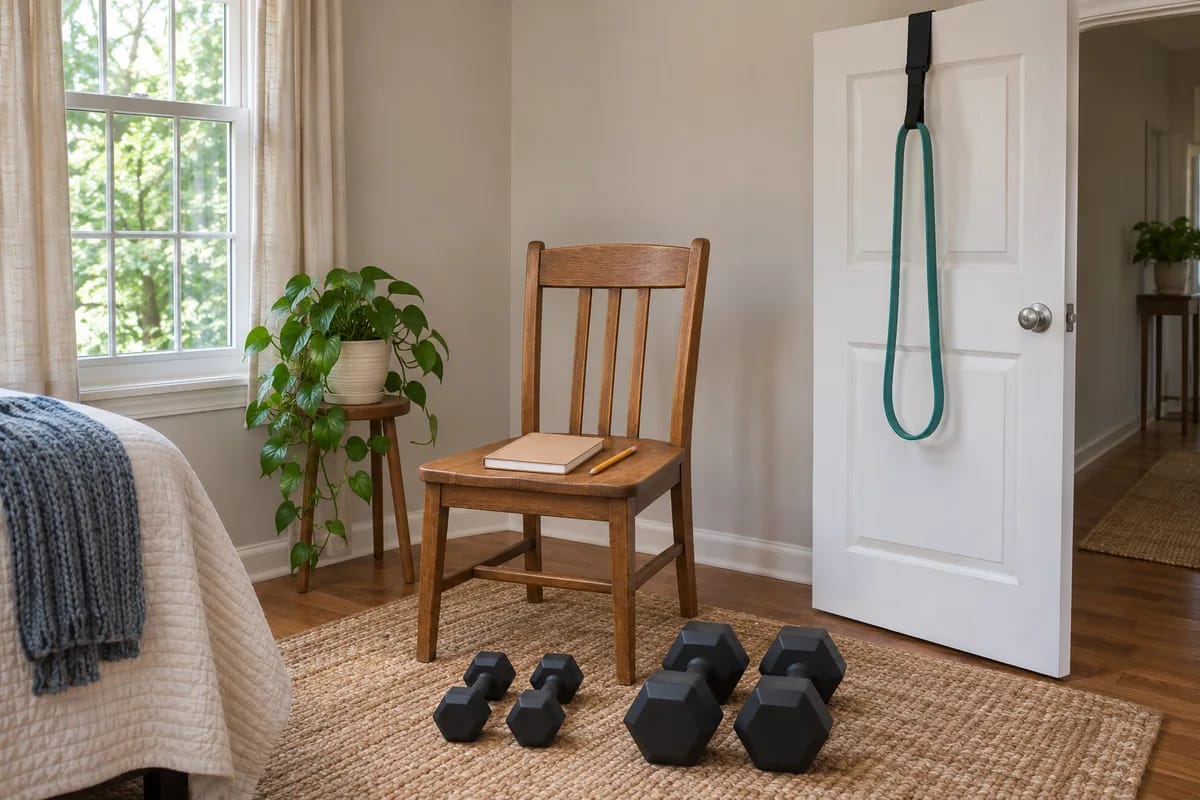
Two full-body sessions, A and B, with a day or more between them (Monday and Thursday works). Each has five moves. At home you need a sturdy chair, a resistance band with a door anchor, and dumbbells: a lighter pair around 5 to 10 lb (2 to 4.5 kg) and a heavier pair around 15 to 25 lb (7 to 11 kg), or one adjustable pair. In a gym, use the right-hand column.
Session A
| Move | At home | In a gym | Reps |
|---|---|---|---|
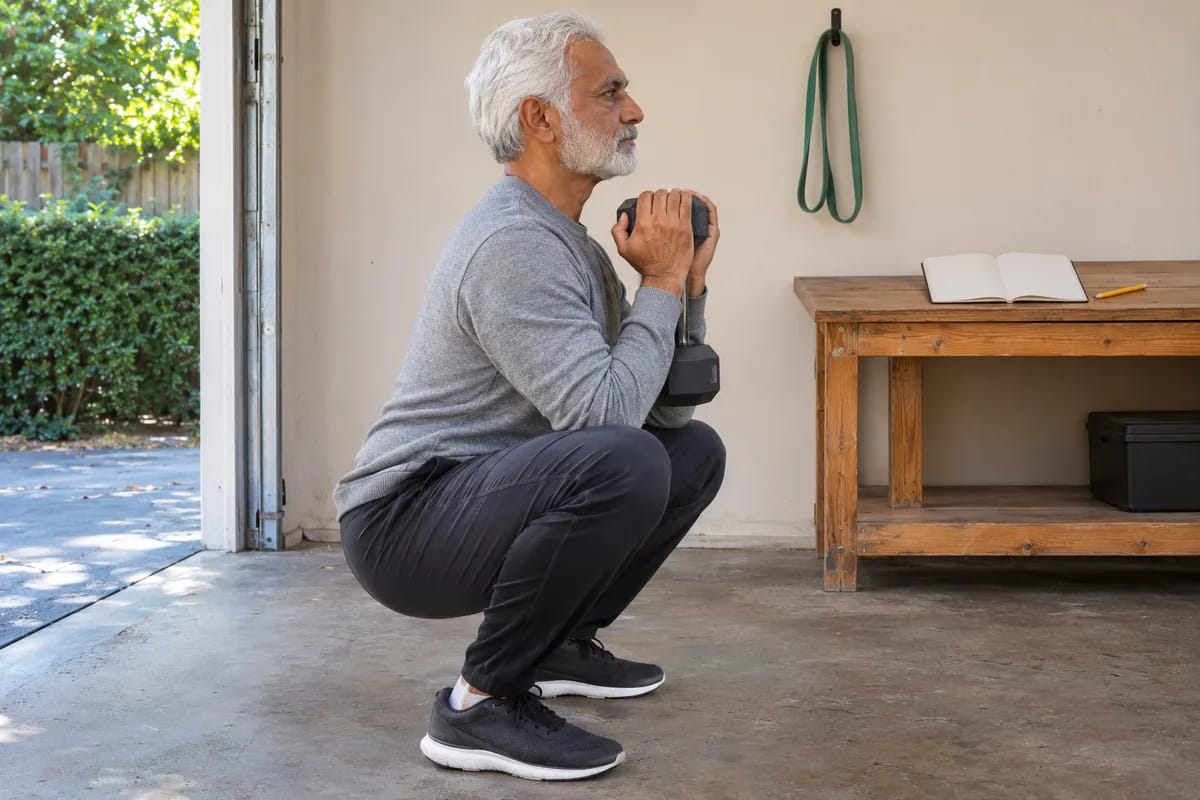
| Squat | Goblet squat, to a chair if you like | Leg press | 8 to 15 |
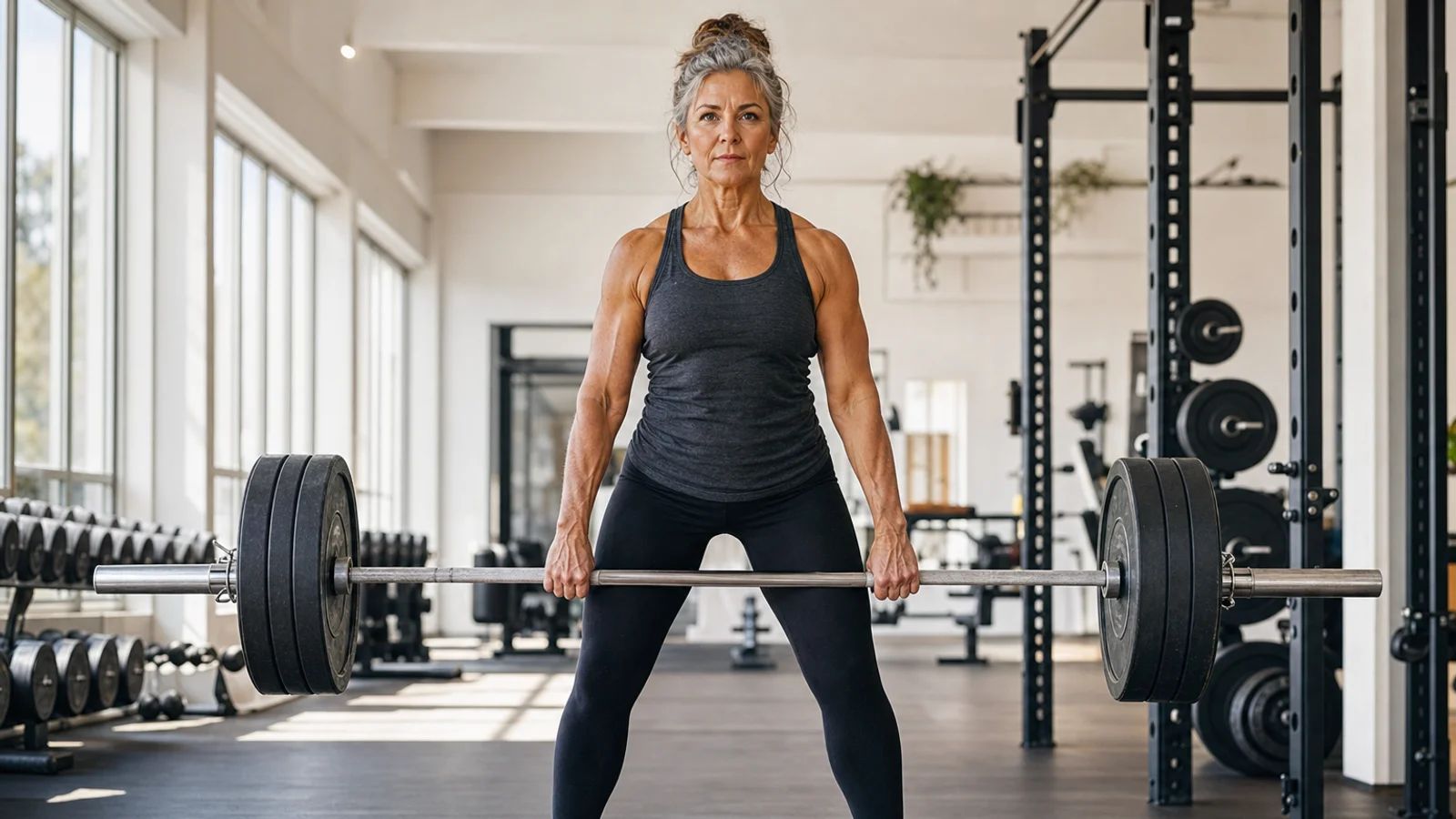
| Hinge | Romanian deadlift with dumbbells | Romanian deadlift with dumbbells | 8 to 15 |
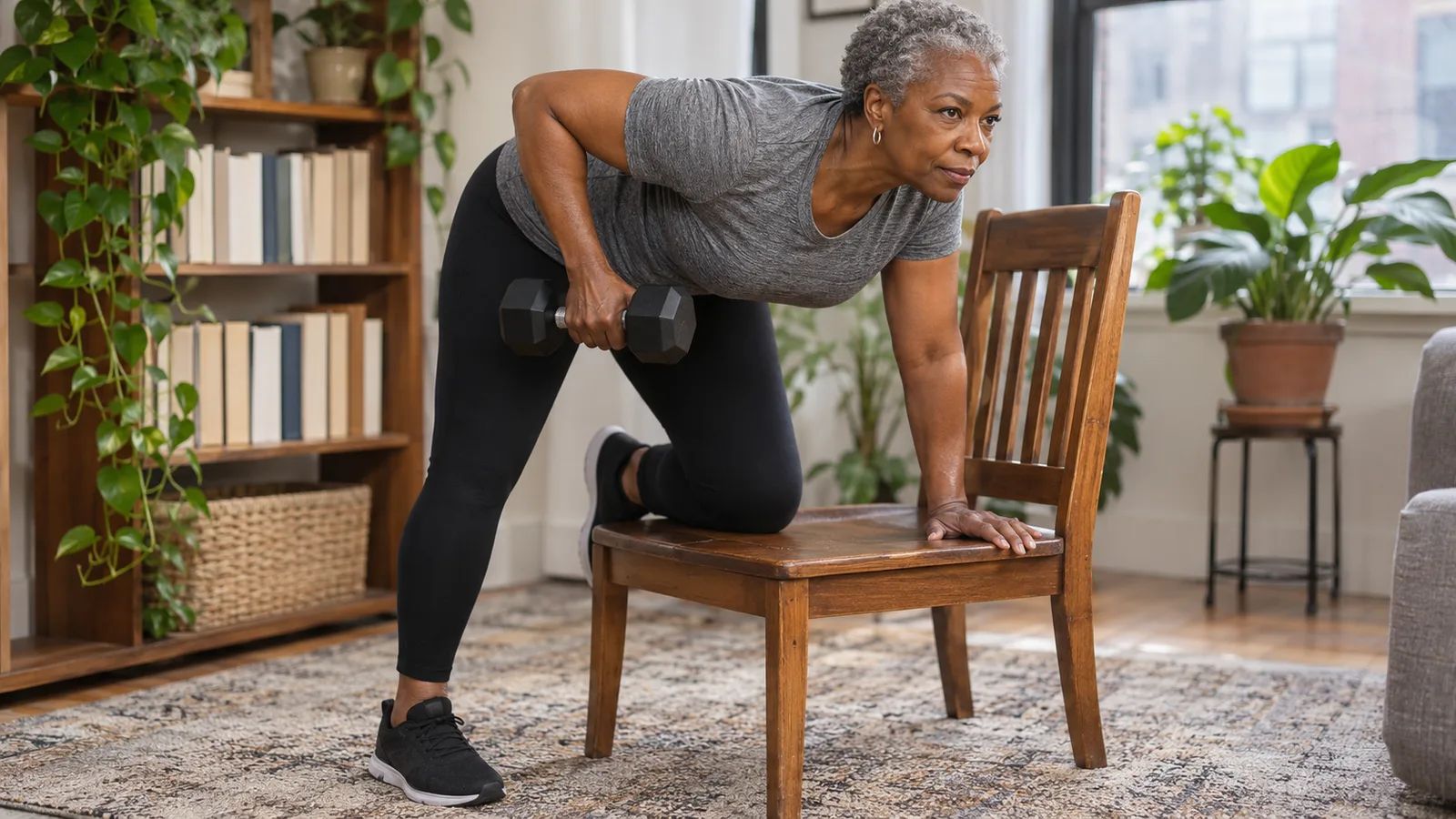
| Pull | One-arm row, a hand on a chair | Seated cable row | 8 to 15 |
| Push | Counter push-up or floor press | Chest press machine | 8 to 15 |
| Arms | Biceps curl | Biceps curl | 10 to 20 |
Session B
| Move | At home | In a gym | Reps |
|---|---|---|---|
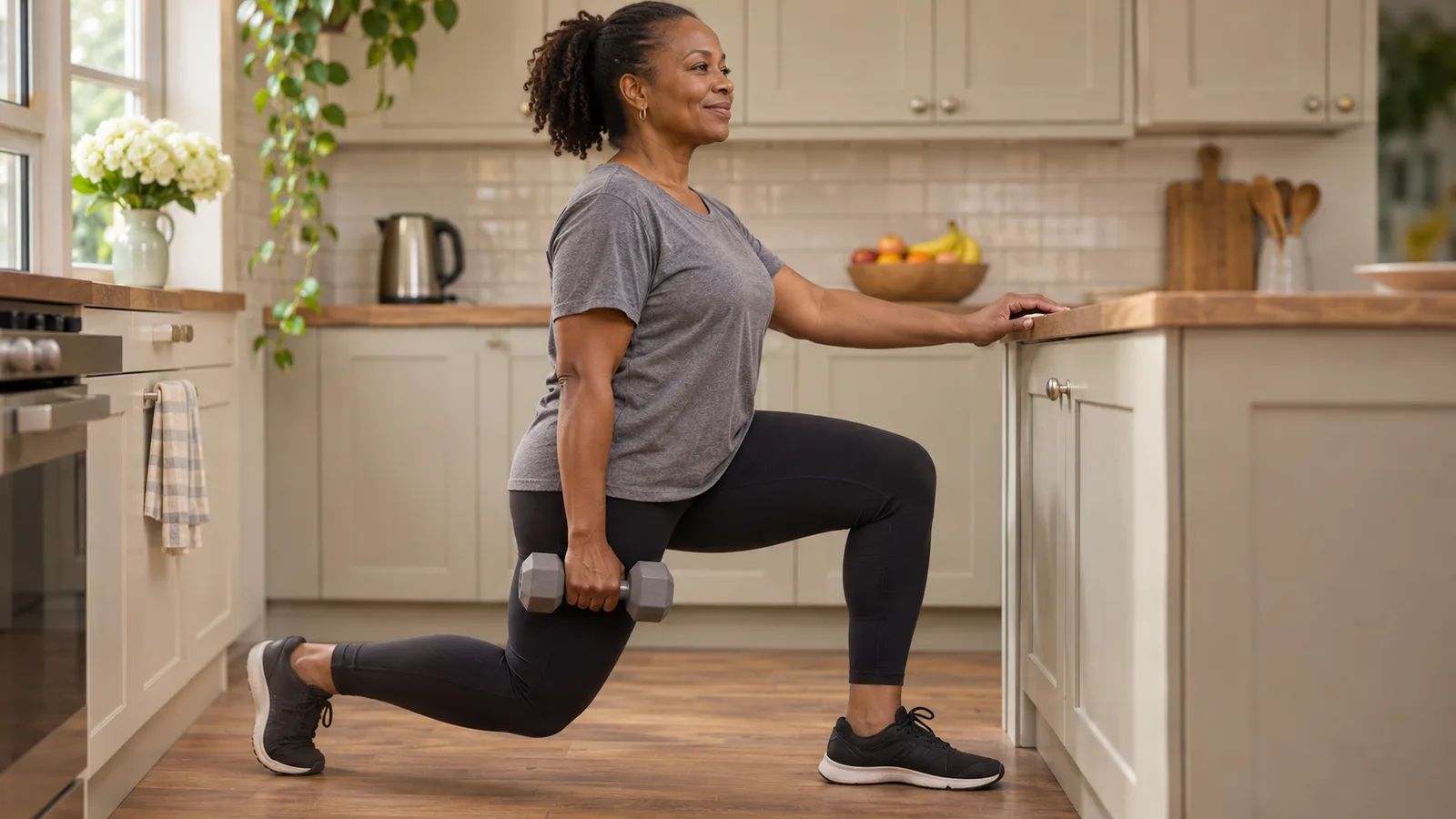
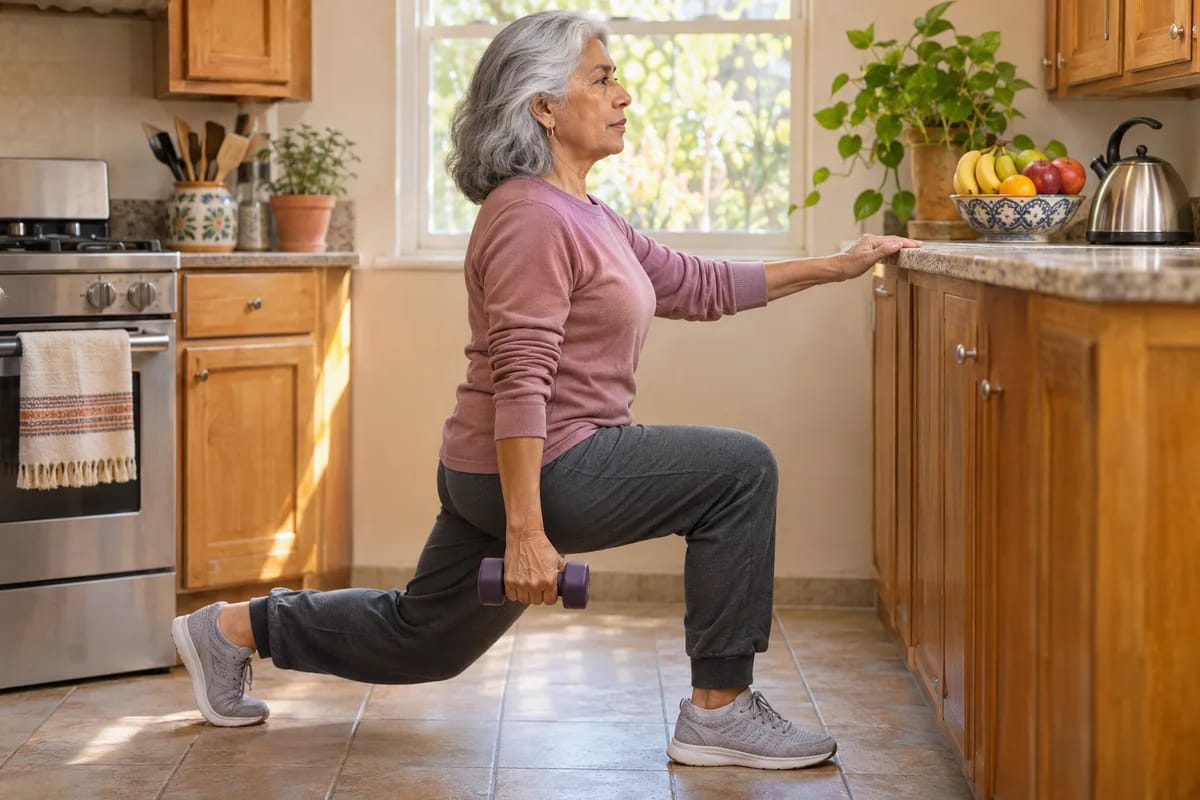
| One leg | Split squat, a hand on the counter | Split squat | 8 to 15 a side |
| Hips | Hip bridge, a dumbbell across your hips | Hip thrust machine, or the same bridge | 10 to 20 |
| Pull | Band pull-down from the top of a door | Lat pulldown | 8 to 15 |
| Press | Seated dumbbell shoulder press | Shoulder press machine | 8 to 15 |
| Arms | Triceps extension, one dumbbell | Triceps pushdown | 10 to 20 |
New to the names? A goblet squat is a squat holding one dumbbell upright at your chest. A Romanian deadlift is the hinge: knees soft, you push your hips back and slide the weights down your thighs until you feel the backs of your legs, then stand tall. A split squat is a lunge where your feet stay put and you sink straight down. All three are shown step by step in the dumbbell leg workout, the row in the dumbbell back workout, and the counter push-up in how to do a proper push-up.
Warm up for about five minutes. Walk or march on the spot until you feel warm, then do one easy set of the first move at about half your working weight. What makes a good warm-up has the longer version.
The weeks add sets and effort, not new exercises:
| Weeks | Sets of each move | End each set with | About how long |
|---|---|---|---|
| 1 to 2 | 2 | 3 reps left. Learn the moves, find your weights | 30 min |
| 3 to 4 | 2 | 2 reps left | 30 min |
| 5 to 8 | 3 | 1 to 2 reps left | 45 min |
| 9 to 12 | 4 on the first three moves, 3 on the last two | 1 to 2 reps left | 55 min |
Finding your weights. If you can do more than 15 clean reps and still have three left, the dumbbell is too light; try the next one up sooner than feels natural. Your legs will usually want a heavier pair than your arms.
By weeks 9 to 12 each session is 18 hard sets, close to the roughly 20 a session in the trials. The times are our arithmetic, with the warm-up and about two minutes' rest between sets of the same move. To save time, alternate a lower-body and an upper-body move and rest about a minute between them.
If you can manage a third day, alternate the sessions: A, B, A one week and B, A, B the next.
When to add weight. Stay with a weight until you reach the top of the rep range on every set, then go up a step and start back near the bottom. Here's the goblet squat in weeks 5 to 8, reps 8 to 15:
| Session A, week | Dumbbell | Reps in each set |
|---|---|---|
| 5 | 20 lb (9 kg) | 12, 11, 10 |
| 6 | 20 lb (9 kg) | 14, 13, 12 |
| 7 | 20 lb (9 kg) | 15, 15, 15: go up next time |
| 8 | 25 lb (11 kg) | 10, 9, 9 |
At home, 20 to 25 lb is a 25% jump. If you can't reach 8 reps with the heavier dumbbell, stay with the lighter one a little longer and lower each rep over three seconds, or add a set, before you try again.
Why the trials had a coach watching
The number at the top of this page came from supervised training: the pooled analysis behind it left unsupervised programs out.2 And across trials in people over 65, supervised training improved strength more than the same kind of training done alone.11 Effort is a likely reason, because it's hard to judge from inside your own set: in one study, people who trained with a trainer picked noticeably heavier weights than people choosing on their own.12
Supervising a set is mostly watching it: counting the reps, seeing when they slow, calling the end, deciding when the weight goes up. A coach on camera can do all of that. What they can't do is spot you or hand you a dumbbell, and nothing in the plan above needs either.
At Bespoke Fit, every session is a live 1‑on‑1 video call with your own coach, in our app on iPhone, Android or a browser. It arrives as a calendar invite with a reminder, and your coach watches through your camera, so a spare room, a garage or a hotel room is enough. Here's what that changes for building muscle:
- Your coach calls the end of each set, and writes the next workout. They watch every rep, see when the reps slow or your knees start to cave, and stop the set before your form goes. The climb from two sets to four is paced to how your knees and shoulders take it, and after each session the app shows what you lifted, so you see the strength coming before the mirror does.
- A third day costs nothing extra. One flat price covers unlimited sessions of 45 to 90 minutes, and most people settle at around an hour. When your coach wants more sets for you, that's where they go.
- A coach who waits for you and remembers you. Each coach has 12 members at most, and we hold to it, so yours remembers which knee was grumbling last week. A booked session with a person waiting is hard to drop for a busy month, which is the answer to the keeping-it problem.
"I was skeptical about doing training over video at my age, but it has been much easier than I expected. My trainer is patient and adjusts everything to what my body can handle. I have exercised more in the past two months than in the last ten years. My friends can see the difference."
Wanda, 70, a member who trains with JP
You start with a 30-minute call with a head coach, who matches you to your coach; every coach spends 90 days onboarding with our founder before training a member. It's 14 days free, then $299/mo, and the 14 days start at your first session, not when you sign up. Cancel anytime. Three sessions a week is about 13 a month, so roughly $23 a coached session; twice a week, about $35. What a personal trainer costs has in-person prices to set that against.
It's not the right fit if:
- you already lift steadily and keep adding weight or reps. The plan above is all you need.
- you'd rather have a trainer in the room with you. We train you over video.
- you want help with meals, protein or supplements. Our coaches don't do nutrition coaching.
- $299 a month would be a stretch. Do the plan on your own; it works, and it works better with a friend on the same two days.
Common questions
Is building muscle after 60 different for women? No. In the Finnish studies near the top, women's muscle grew by about the same percentage as men's, so the moves, sets and effort rule are the same. Use the weight check under the plan, and don't be shy about reaching for the heavier pair.
What's the quickest way to regain muscle after an illness or a fall? If the fall left an injury, or you've had surgery or a hospital stay, ask your doctor or physical therapist first when to start and what to avoid. Then begin with lighter weights and two sets of each move, and build the sets back up over a few weeks rather than picking up where you left off. Get a proper serving of protein into every meal, breakfast included.
Can I build muscle with just walking or yoga? Not much. Walking is great for your heart and your mood, and some yoga poses are hard work, but neither takes a muscle close to its limit set after set the way lifting does, and that's the signal that makes it grow. Keep them, and add two strength sessions a week.
Sources
-
Ahtiainen, J.P., Walker, S., Peltonen, H., and colleagues, 2016. Heterogeneity in resistance training-induced muscle strength and mass responses in men and women of different ages. Age. Pooled data from earlier Finnish training studies: 287 previously untrained adults aged 19 to 78, 72 of them non-training controls. Muscle size rose 4.8% on average (range -11% to +30%); age and sex did not affect the response. ↩
-
Peterson, M.D., Sen, A. & Gordon, P.M., 2011. Influence of resistance exercise on lean body mass in aging adults: a meta-analysis. Medicine and Science in Sports and Exercise. 49 studies, 1,328 adults aged 50 to 83 (average 65.5); average gain 1.1 kg of lean body mass. Programs averaged about 20 weeks, 2.8 days a week and about 20 sets a session; unsupervised programs were excluded. Higher-volume programs gained more; older participants gained less. ↩ ↩2 ↩3
-
Marzuca-Nassr, G.N., and colleagues, 2023. Muscle mass and strength gains following resistance exercise training in older adults 65-75 years and older adults above 85 years. International Journal of Sport Nutrition and Exercise Metabolism. 29 healthy adults, 12 weeks, three times a week; thigh (quadriceps) muscle grew 10% in the 68-year-olds and 11% in the 87-year-olds, with no difference between the groups. ↩
-
Treuth, M.S., Ryan, A.S., Pratley, R.E., and colleagues, 1994. Effects of strength training on total and regional body composition in older men. Journal of Applied Physiology. 13 untrained men aged 60 on average, 16 weeks; fat-free mass up 2 kg, fat down 2 kg. ↩
-
Van Roie, E., Delecluse, C., Coudyzer, W., Boonen, S. & Bautmans, I., 2013. Strength training at high versus low external resistance in older adults: effects on muscle volume, muscle strength, and force-velocity characteristics. Experimental Gerontology. 56 older adults, 12 weeks; heavy sets at 80% of their one-rep max against light sets at 20%, all to failure, muscle measured by CT scan. ↩
-
Moore, D.R., Churchward-Venne, T.A., Witard, O., and colleagues, 2015. Protein ingestion to stimulate myofibrillar protein synthesis requires greater relative protein intakes in healthy older versus younger men. Journals of Gerontology, Series A. A retrospective analysis of lab studies in men only: about 0.40 g per kilo of body weight in a meal for the older men against 0.24 g for the younger, a wide estimate just short of statistical significance; per kilo of lean mass the gap was clear (0.60 against 0.25 g). Below those amounts, smaller servings still stimulated muscle building, just less. ↩
-
Morton, R.W., Murphy, K.T., McKellar, S.R., and colleagues, 2018. A systematic review, meta-analysis and meta-regression of the effect of protein supplementation on resistance training-induced gains in muscle mass and strength in healthy adults. British Journal of Sports Medicine. 49 trials, 1,863 people; above a total intake of about 1.6 g per kilo a day, extra protein added no further lean mass. ↩
-
Chilibeck, P.D., Kaviani, M., Candow, D.G. & Zello, G.A., 2017. Effect of creatine supplementation during resistance training on lean tissue mass and muscular strength in older adults: a meta-analysis. Open Access Journal of Sports Medicine. 22 randomized trials, 721 people; 1.37 kg more lean tissue than placebo. ↩
-
Kreider, R.B., Kalman, D.S., Antonio, J., and colleagues, 2017. International Society of Sports Nutrition position stand: safety and efficacy of creatine supplementation in exercise, sport, and medicine. Journal of the International Society of Sports Nutrition. Once muscle stores are full, 3 to 5 g a day maintains them; 3 g a day of creatine monohydrate for 28 days is given as an alternative to a high-dose loading week. ↩
-
Bickel, C.S., Cross, J.M. & Bamman, M.M., 2011. Exercise dosing to retain resistance training adaptations in young and older adults. Medicine and Science in Sports and Exercise. 70 adults trained three days a week for 16 weeks, then spent 32 weeks stopping completely or doing a third or a ninth of the training. ↩
-
Lacroix, A., Hortobágyi, T., Beurskens, R. & Granacher, U., 2017. Effects of supervised vs. unsupervised training programs on balance and muscle strength in older adults: a systematic review and meta-analysis. Sports Medicine. The authors note the small number of studies and their moderate quality. ↩
-
Ratamess, N.A., Faigenbaum, A.D., Hoffman, J.R. & Kang, J., 2008. Self-selected resistance training intensity in healthy women: the influence of a personal trainer. Journal of Strength and Conditioning Research. 46 resistance-trained women aged about 27; those who trained with a personal trainer chose about 51% of their one-rep max, against about 42% for those who chose alone. ↩