Dumbbell back workout: 5 moves you can do without a bench
A dumbbell back workout for home: five moves in about 35 minutes, no bench, how heavy to go, how to feel it in your back, not your arms, and when to go up.
In this article10
Five moves, about 35 minutes with the warm-up, and all you need is dumbbells, a sturdy chair and a patch of floor. No bench and no pull-up bar. Do it twice a week (on a busy day, there's a 15-minute version), stop each set with two or three good reps left, and add a rep or a weight when the top of the range gets easy.
The session
Warm up for five minutes first: walk or march on the spot, then do one light set of the first two moves. What a useful warm-up looks like has more if you want it.
| Move | Sets × reps | Rest | |
|---|---|---|---|
| 1 | One-arm row, hand on a chair | 3 × 8 to 12 each arm | 60 sec after both arms |
| 2 | Romanian deadlift | 3 × 8 to 12 | 90 sec |
| 3 | Floor pullover, one dumbbell | 2 × 10 to 15 | 60 sec |
| 4 | Two-arm bent-over row | 3 × 8 to 12 | 90 sec |
| 5 | Seated reverse fly | 2 × 12 to 15 | 60 sec |
| + | Suitcase carry (optional) | 2 walks of 30 to 40 sec each hand | 60 sec |
The pullover, done lying down, sits between the two moves that ask most of your lower back, so your back gets a rest in between.
How heavy to start
Pick a weight you can lift 8 to 12 times with a little left in the tank. For the one-arm row and the Romanian deadlift, our usual starting point is 8 to 12 lb (4 to 5 kg) if you've never lifted and 15 to 20 lb (7 to 9 kg) if you're active but new to weights. How much weight to start with has the full table and a three-set test to find your number. The reverse fly takes much less: start with your lightest pair.
Are 25 lb (11 kg) dumbbells enough? For most people starting out, yes. Light weights build muscle too, as long as the sets are hard (the studies behind this took every set to failure, which is more than you need),1 and the progression tricks below keep a light pair useful for months.
If your back hurts now, you've had a recent back injury or operation, or you have osteoporosis or a disc problem, ask your doctor or physio which of these moves suit you, especially the bent-over ones and the Romanian deadlift. And stop any move that gives you sharp or shooting pain, as opposed to tired muscles.
The five moves
1. One-arm row
Works: the big muscles down the sides of your back (the lats), the middle of your upper back, the backs of your shoulders.
Set up: put your left hand on the seat of a sturdy chair, left foot forward, right foot back. Back flat, roughly level with the floor. The dumbbell hangs under your right shoulder.
The cue: pull until the dumbbell reaches your lower ribs, then lower it slowly, all the way down. Then the other side. If you feel it mostly in your arm, the fix comes right after the moves.
Easier: hand on a kitchen counter, so you stand more upright. Harder: take three seconds to lower each rep.
2. Romanian deadlift
Works: the backs of your legs, your glutes, and the long muscles beside your spine that hold your back in shape while you lift.
Set up: stand tall, feet hip width, a dumbbell in each hand in front of your thighs, knees soft.
The cue: push your hips back as if closing a car door with your bottom. The dumbbells slide down the front of your thighs. Stop when the backs of your legs feel tight or your back wants to round, often around the knee, then stand up by pushing your hips forward.
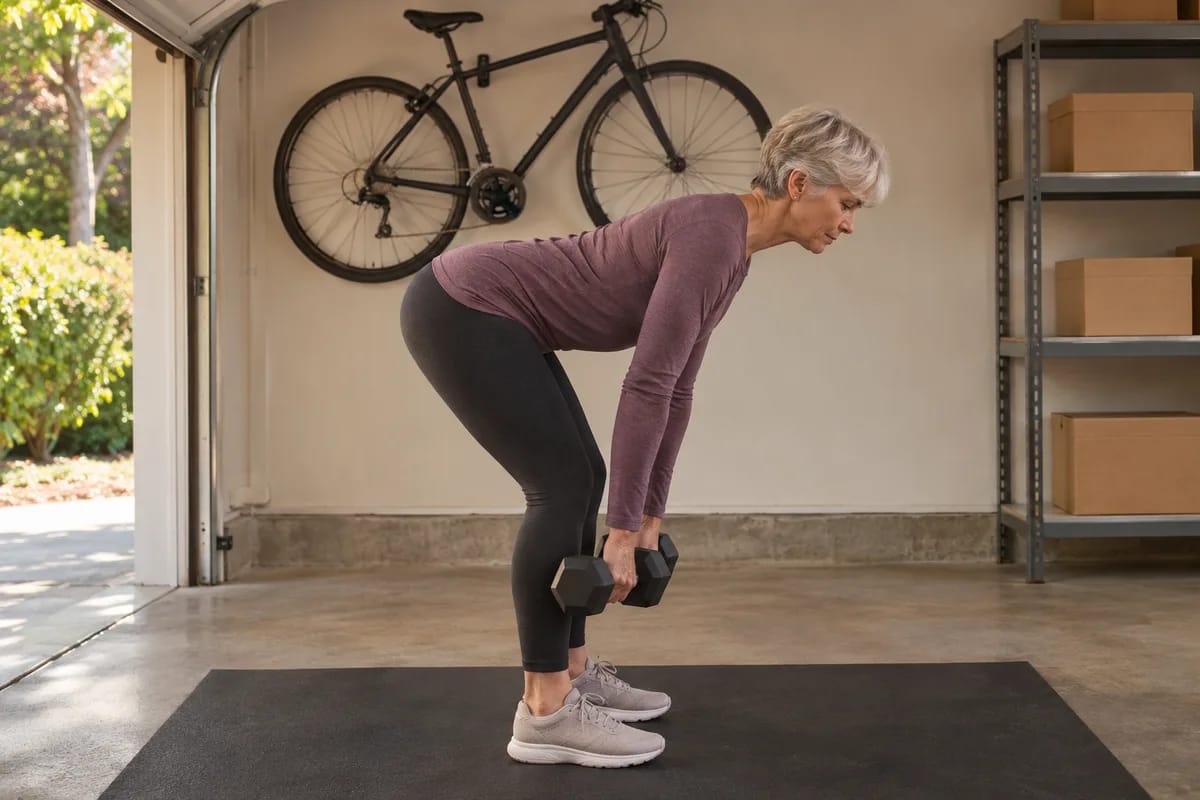
Easier: reach your hips back toward a chair behind you and stop when you touch it. Harder: do it on one leg, with a fingertip on the wall.
3. Floor pullover
Works: the lats and the chest together.2
Set up: lie on your back on a mat, knees bent, feet flat. Hold one dumbbell above your chest with both hands cupped under the top end.
The cue: keep your ribs down as you lower the dumbbell back past your head, as far as your shoulders allow, then pull it back over your chest. The floor stops your arms before they go too far, which is kind to stiff shoulders.
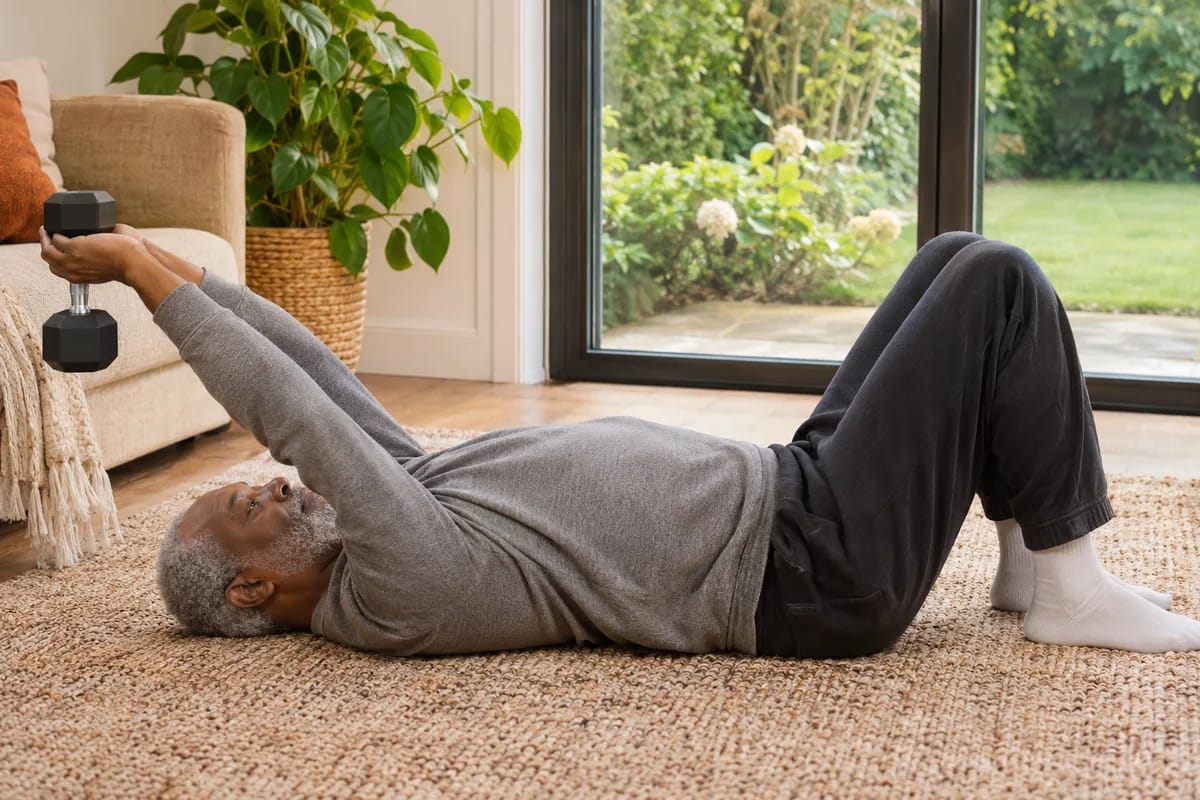
Easier: a shorter range. Harder: a three-second lowering.
An honest word on this one. Dumbbells can't pull from overhead the way a pull-up or a lat pulldown does. The pullover is the nearest dumbbell move, not a replacement. For that pull, a resistance band with a door anchor is cheap; our first $300 home gym prices one.
4. Two-arm bent-over row
Works: the whole upper back. Your lower back works hard too, holding you still: in one small study of three rows, a standing bent-over row loaded the lower back most.3
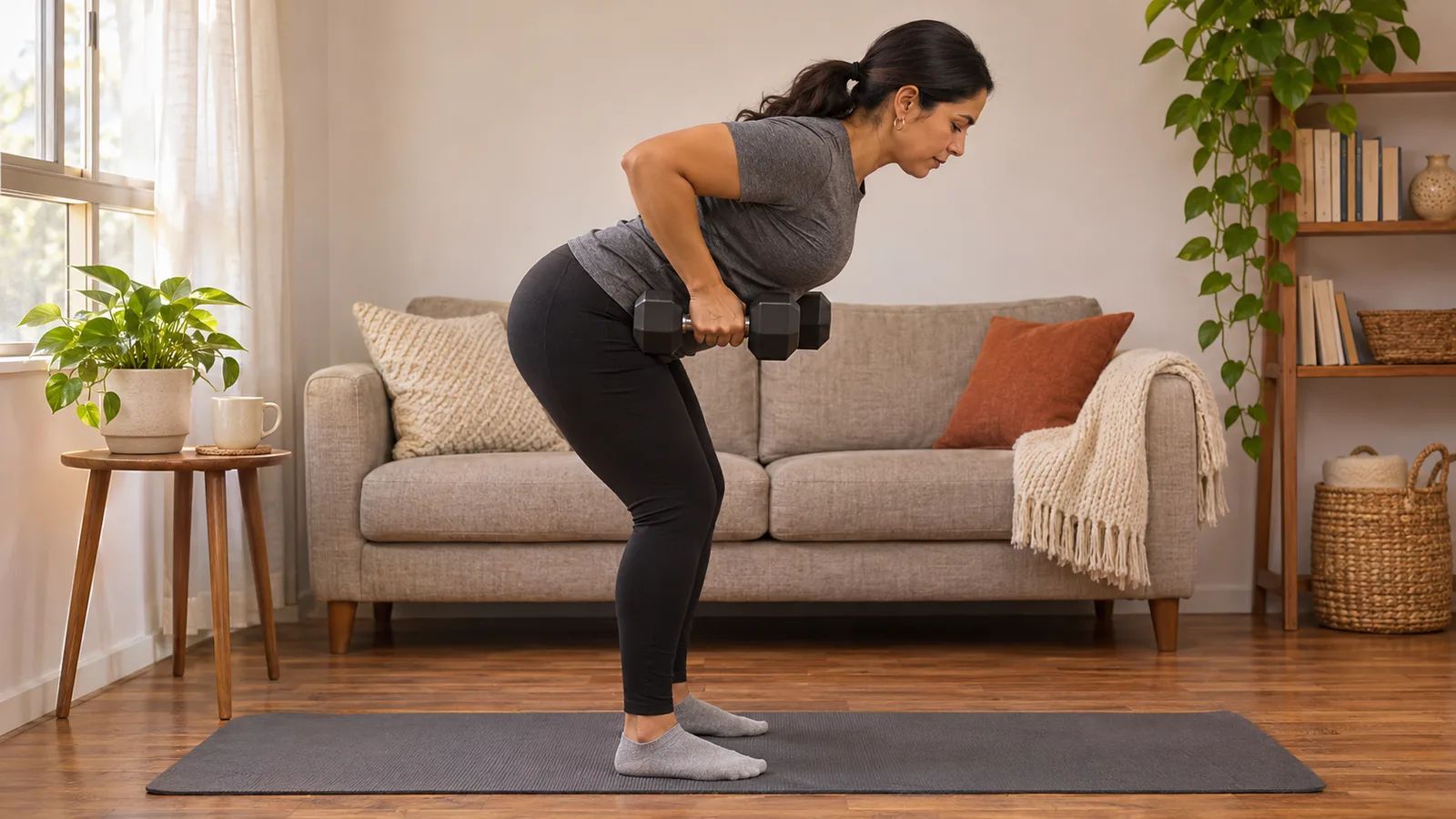
Set up: feet hip width, knees soft, hinge forward from the hips until your chest is about halfway between standing and level with the floor. Arms hang straight down.
The cue: your chest stays where it is, and only your arms move. Elbows go back toward your hips, then lower slowly.
Easier: if your lower back tires, do one-arm rows with a hand on the chair instead. Harder: hold for a second at the top, elbows back.
5. Seated reverse fly
Works: the backs of your shoulders and the muscles between your shoulder blades, the ones that hold your shoulders back.
Set up: sit near the front edge of a chair, feet flat, and lean your chest toward your thighs. The dumbbells hang beside your calves, palms facing each other.
The cue: with a slight bend in the elbows, lift the weights out to your sides, like opening wings, until your arms are in line with your back. Lower in two seconds.
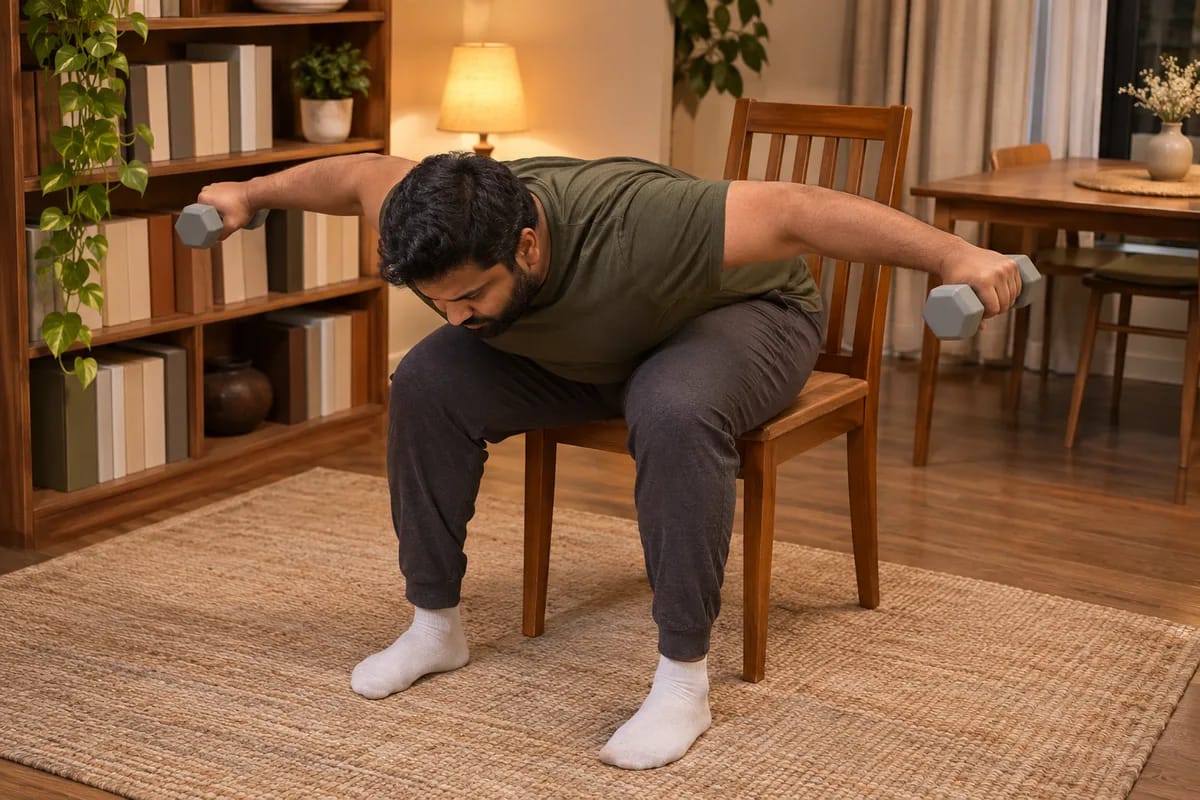
Easier: one arm at a time. Harder: do it standing, bent over like the two-arm row.
Optional: suitcase carry
Hold your heaviest dumbbell in one hand and walk tall around the room without leaning toward it. It works your grip, the tops of your shoulders and the sides of your trunk.
You won't find upright rows here (more a shoulder move, and one that many shoulders complain about), renegade rows (mostly a plank with small rows on top) or shrugs (the carry already works the tops of your shoulders).
Feel it in your back, not your arms
The most common complaint about rows is "I only feel it in my arms". Usually the hand is doing the pulling, so the biceps take over. Coaches fix it by moving your attention from the hand to the elbow. Many also use a rule of thumb: elbows travelling back toward your hips favour the lats, and elbows flaring out wide, as on the reverse fly, favour the upper back. That's a coaching cue, not settled science. Leading with the elbow is the part that matters.
Three cues fix most of it:
- Think elbow, not hand. The hand is a hook. Loosen your grip a little and drive the elbow toward your back pocket.
- Shoulder first, then elbow. Start each rep by drawing your shoulder back, away from your ear. That also stops the shrug.
- Check where it finishes. At your lower ribs is right. If the dumbbell ends up near your armpit, your arm finished the rep for your back.
What goes wrong, and the fix
| Fault | What it looks like | The fix |
|---|---|---|
| Twisting open (one-arm row) | Your chest turns toward the ceiling to get the weight higher | Keep both shoulders facing the floor; end the rep where the twist starts |
| The deadlift turns into a squat | Knees push forward, the weights drift away from your legs | Hips back, shins close to upright, weights brushing your thighs |
| Swinging the reverse fly | Your body bounces to throw the weights up | Go lighter and take two seconds to lift |
| Ribs flaring on the pullover | Your lower back arches off the floor as the weight goes back | Breathe out as you lower, and shorten the range |
The arm taking over and the twist are the hardest to spot, because you can't see your own back. Prop your phone on the floor side-on and film one set; what a video catches and what it misses helps you read it. With a coach watching on a live 1‑on‑1 video call, the way every Bespoke Fit session runs, you hear "elbow to your pocket" while you're still in the set and the next rep changes, instead of spotting it on the clip after the set is over.
Making it harder each week
End each set with two or three good reps left
Not all the way to failure. The last rep or two mostly adds tiredness; how close to failure you need to go explains why.
Hit the top of the range on every set, then go up
Next session, use the next weight and drop back to the bottom of the range.
Next dumbbell too big a jump? Make the same weight harder
Lower in three seconds, then add a one-second pause with the elbow back, then add a fourth set.
Home dumbbells often jump 5 lb (2 kg) or more at a time, which can be a big step on a reverse fly. The last step is how you keep going in between. Progressive overload without adding weight has more ways to do it.
Shorter, one-dumbbell, no-bending and bench versions
| Version | What changes |
|---|---|
| 15 minutes | Do moves 1 and 2 back to back for 3 rounds, then moves 4 and 5 back to back for 2 rounds. Rest 60 sec after each pair. |
| One dumbbell | Do the one-arm row twice: once as move 1, and again in place of the two-arm row. Hold the dumbbell by its ends for the deadlift. Reverse fly one arm at a time, the other hand on the chair. |
| Little bending | One-arm row with your hand on a counter. Swap the reverse fly for a band pull-apart, standing tall. Swap the deadlift for hips back to a chair, or for a glute bridge on the floor. |
| Have a bench | Chest down on an incline bench for the two-arm row, so your lower back doesn't have to hold you up. One-arm row with a knee and a hand on the bench. |
Where it fits in your week
Twice a week, with a day or more between, is the simple target. It matches the US guideline of muscle-strengthening work on at least two days a week, with the back named among the muscles to cover.4 Short on time? Use the 15-minute version on busy days rather than training your back once a week. The best workout split shows how that sits beside your legs and pushing work.
Will a stronger back fix your posture?
It can help. In people whose head juts forward and shoulders round (what clinicians call upper crossed syndrome), strengthening and stretching programs have improved those angles.5 But that's not the best reason to train it.
Train your back because you'll use it: carrying shopping, lifting a suitcase into the overhead bin, picking up a grandchild. Push-ups and presses are the usual home staples; this session is the pulling half.
Common questions
Are 3 exercises enough for a back workout?
Yes, if you pick a row, a hinge like the Romanian deadlift, and either the pullover or the reverse fly, and you work them with hard sets twice a week. The 15-minute version above is exactly that, plus a second row. Add the other moves when you have the time.
What are the big 3 exercises for lower back?
Usually the three trunk exercises spine researcher Stuart McGill made popular: the curl-up, the side plank and the bird dog. If you're asking because your back hurts, let a physio or doctor choose your moves. For a healthy back, the Romanian deadlift and the carry in this workout cover the strength side.
Sources
-
Schoenfeld, B.J., Grgic, J., Ogborn, D. & Krieger, J.W., 2017. Strength and hypertrophy adaptations between low- vs. high-load resistance training: a systematic review and meta-analysis. Journal of Strength and Conditioning Research. 21 studies in healthy adults, all sets taken to failure; similar muscle growth with light and heavy loads, more one-rep strength with heavy loads. ↩
-
Marchetti, P.H. & Uchida, M.C., 2011. Effects of the pullover exercise on the pectoralis major and latissimus dorsi muscles as evaluated by EMG. Journal of Applied Biomechanics. A small study of 8 men doing a barbell pullover; the chest muscle was more active than the lats, so treat the pullover as a chest-and-lats move. ↩
-
Fenwick, C.M., Brown, S.H. & McGill, S.M., 2009. Comparison of different rowing exercises: trunk muscle activation and lumbar spine motion, load, and stiffness. Journal of Strength and Conditioning Research. 7 healthy young men did a standing bent-over row, a standing one-arm cable row and an inverted row; the bent-over row produced the highest lower-back load and the inverted row the lowest. Supported dumbbell rows were not tested. ↩
-
Centers for Disease Control and Prevention. Adult activity: an overview. Muscle-strengthening activity on at least 2 days a week that works all major muscle groups, including the back. ↩
-
Sepehri, S., Sheikhhoseini, R., Piri, H. & Sayyadi, P., 2024. The effect of various therapeutic exercises on forward head posture, rounded shoulder, and hyperkyphosis among people with upper crossed syndrome: a systematic review and meta-analysis. BMC Musculoskeletal Disorders. 22 studies in people with upper crossed syndrome; strengthening, stretching and combined programs improved forward head, rounded shoulder and upper-back curve angles. ↩