Full body workout: 6 moves for home or gym, any level
One full body workout for home or gym: 6 moves, about 45 minutes, an easier and harder version of each, and a 20-minute cut for busy days.

In this article8
A full body workout trains your legs, hips, back, chest, shoulders, arms and middle in one session, so two or three a week cover everything without planning a split. Here's one you can start in the next ten minutes: six moves in three pairs, about 45 minutes, with a version for no equipment, for dumbbells and for a gym.
Short on time? There's a 20-minute version. New, or coming back after years off? Every move has an easier and a harder rung.
The workout
| Move | No equipment | Dumbbells | Gym |
|---|---|---|---|
| A1 Squat | Squat to a chair | Goblet squat | Leg press or goblet squat |
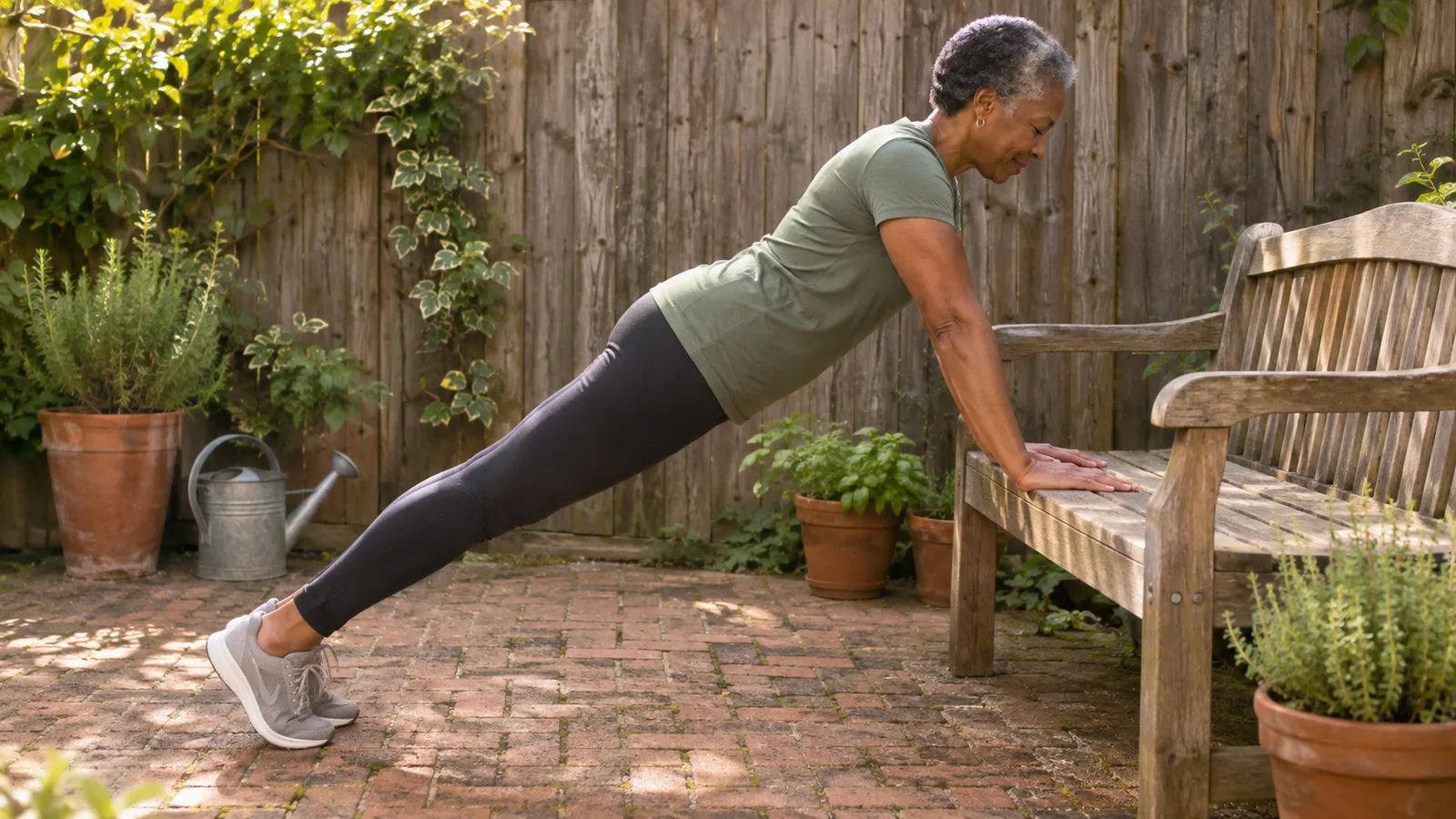
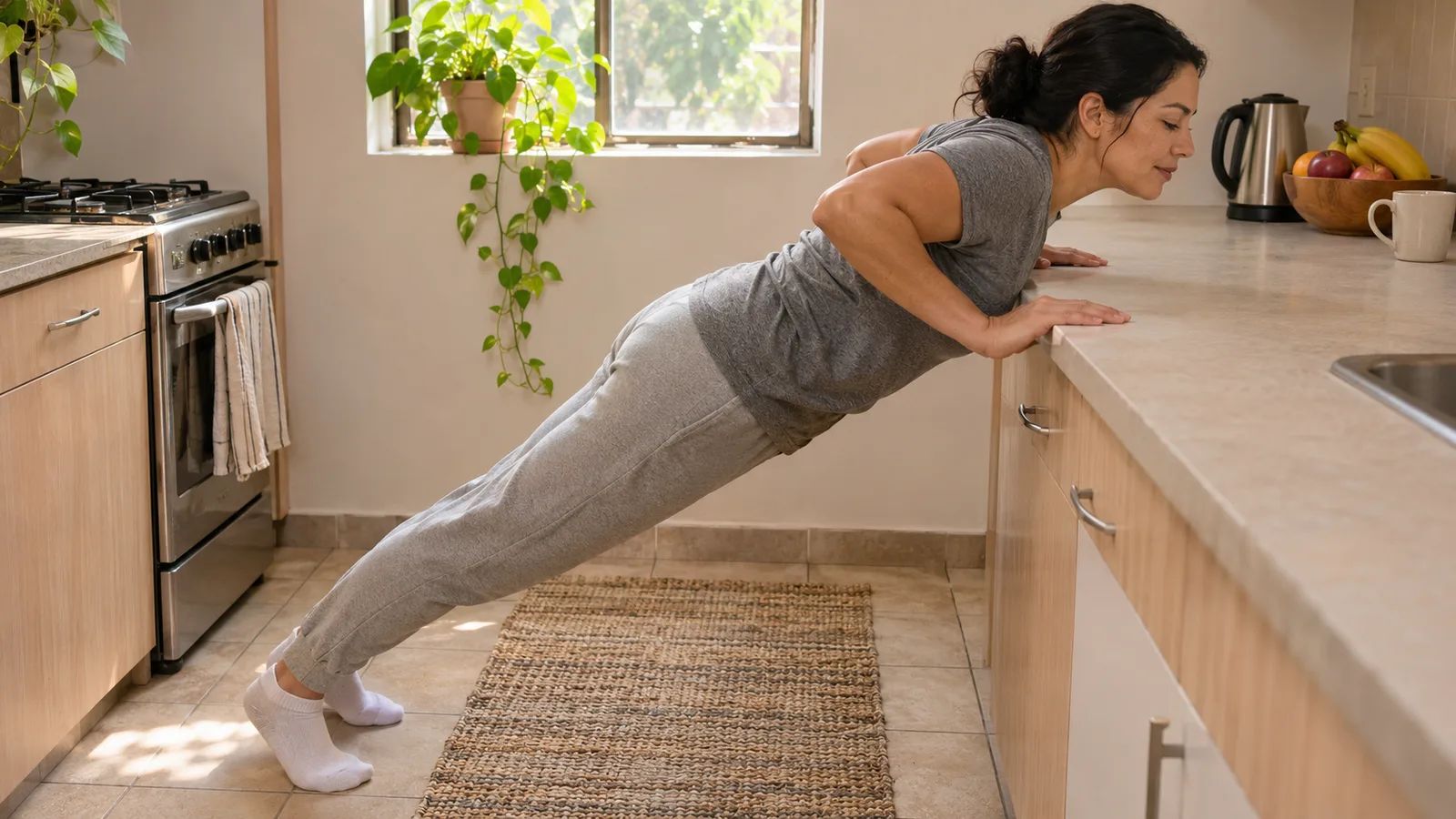
| A2 Push | Push-up, hands on a chair or the floor | Floor press | Dumbbell bench press |
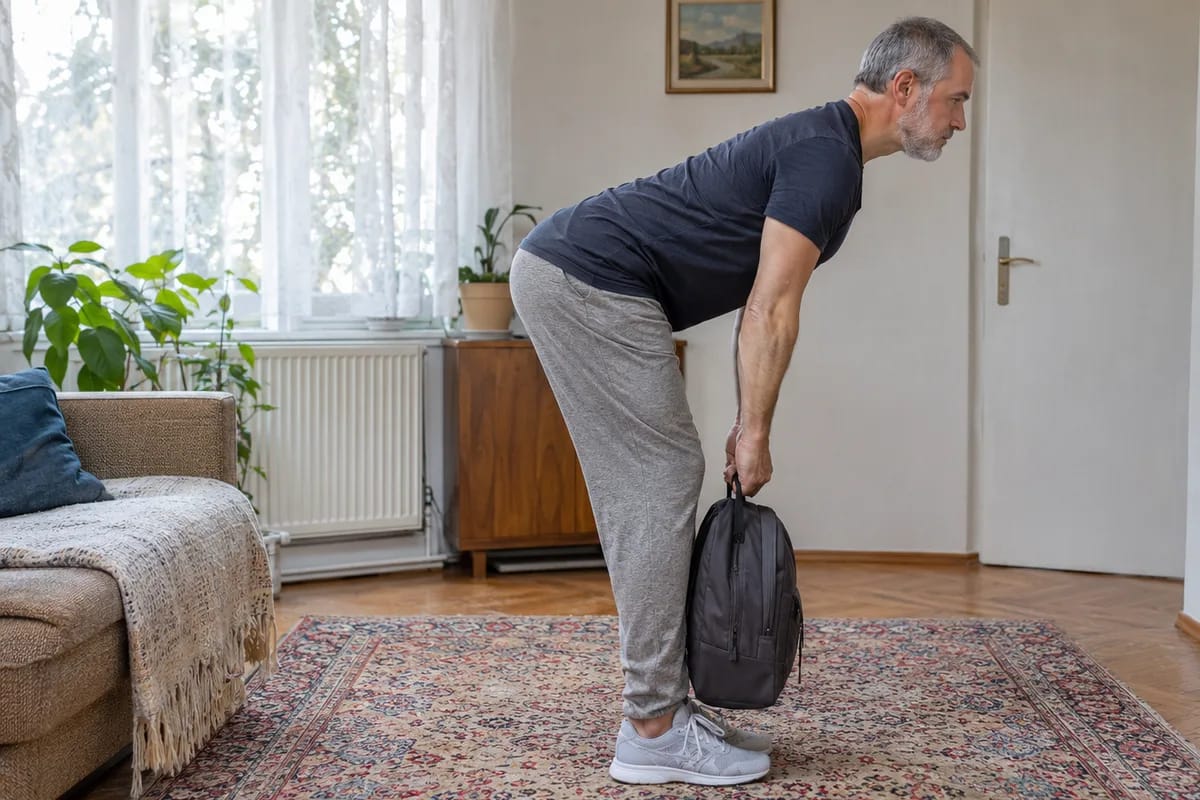
| B1 Hinge | Backpack Romanian deadlift | Romanian deadlift | Romanian deadlift |
| B2 Pull | Backpack one-arm row | One-arm row | Seated cable row |
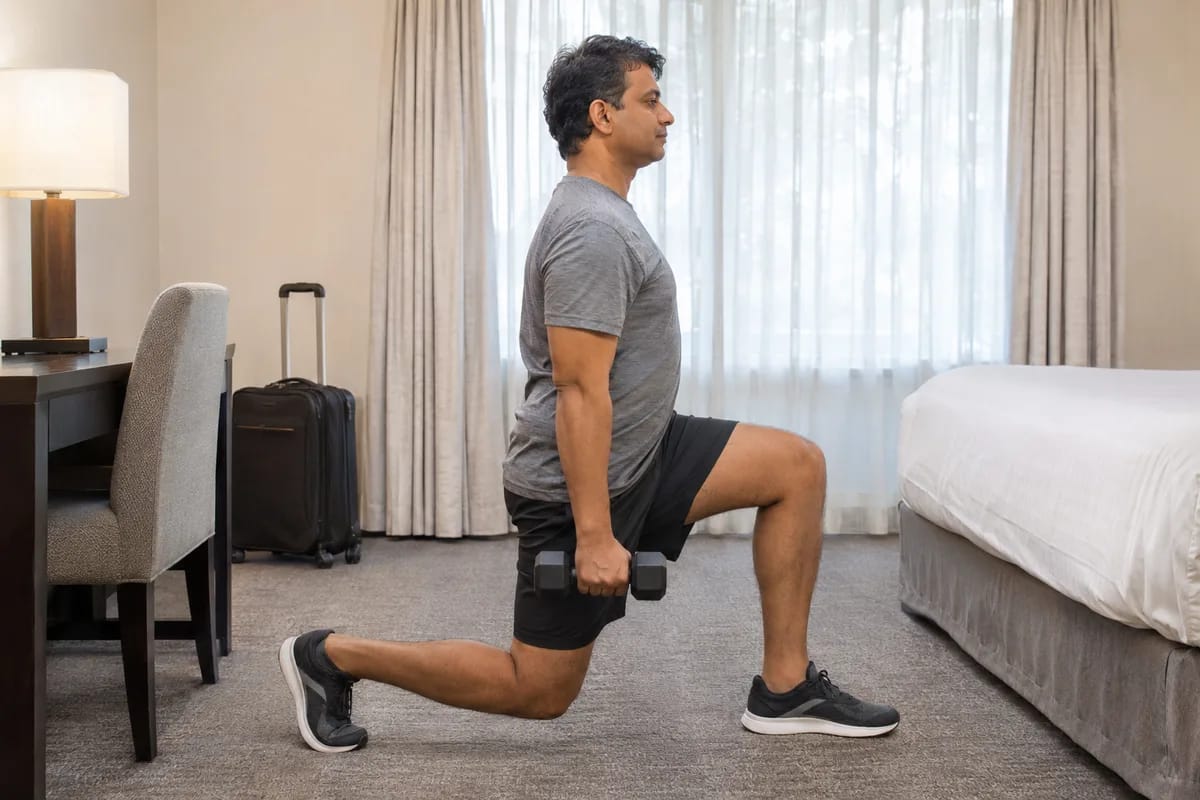
| C1 One leg | Split squat | Split squat with dumbbells | Step-up with dumbbells |
| C2 Trunk | Dead bug, or carry the backpack | Suitcase carry | Farmer's carry |
At a glance: 3 rounds of each pair. 8 to 12 reps (up to 20 on body-weight moves). About a minute's rest after each move. Stop every set with 2 or 3 good reps left.
"No equipment" means nothing you'd have to buy: a sturdy chair pushed against a wall, a kitchen counter and a backpack with a few books in it. The squat, hinge, push and pull cover the big muscles. The one-leg move evens out a stronger side, and the carry teaches your middle to hold you upright, the job it does when you haul groceries up the stairs.
How to run it. Warm up for five minutes first (how). Then do the pairs in order, alternating within each: a set of A1, rest, a set of A2, rest, and repeat until you've done three rounds. Then move on to pair B. Pairing saves time, because one muscle rests while the other works.1
The odd ones out. Count reps on each leg for the split squat and step-up. For a carry, walk about 40 steps and back, switching hands at the turn if you hold one weight. For the dead bug, 6 to 10 slow reps a side.
How hard. With two or three reps left, the last reps slow down but still look like the first one.2 If you could have done six more, it's too light. If your form changed to finish, it's too heavy. How much weight to start with gives starting weights for the goblet squat, press, row and Romanian deadlift.
New to a name? Here they are in a line each:
- Squat to a chair: sit back until your bottom just touches the seat, then stand up without resting on it.
- Goblet squat: a squat holding one dumbbell upright against your chest.
- Floor press: a bench press lying on your back on the floor. Your upper arms stop when they touch it.
- Romanian deadlift: the hinge. Knees soft, push your hips back and slide the weights down the front of your thighs until the backs of your legs feel tight, then stand tall. With no dumbbells, hold the backpack by its top handle in both hands.
- One-arm row: one hand on a chair seat, back flat, pull the weight up beside your ribs toward your hip.
- Split squat: a lunge where your feet stay put. One foot forward, one back, lower your back knee toward the floor and stand up again.
- Step-up: step onto a box or bench about knee height or lower, 12 to 18 inches (30 to 45 cm), stand tall, then step down.
- Suitcase carry: walk holding one heavy weight at your side, like a suitcase, without leaning toward it. A farmer's carry is the same walk with a weight in each hand.
- Dead bug: lie on your back, arms up, knees bent above your hips. Slowly lower one arm and the opposite leg toward the floor, keeping your lower back gently pressed down, then switch.
Pick your level
The standard rung is the move in the workout table. Start on the rung where every rep of your first set looks like the first one. Mixing rungs is normal: plenty of people start on counter push-ups and standard squats.
| Move | Easier | Harder |
|---|---|---|
| Squat | Sit fully on a higher seat and stand, hands on your knees | Heavier goblet squat, 3-count down |
| Push | Hands on a counter, or knees down on the floor | Feet on a step, or a heavier press |
| Hinge | Glute bridge: on your back, lift your hips | One-leg Romanian deadlift, a hand on the wall |
| Pull | Door-frame row: a solid frame, lean back, pull in | Heavier row, 1-second squeeze at the top |
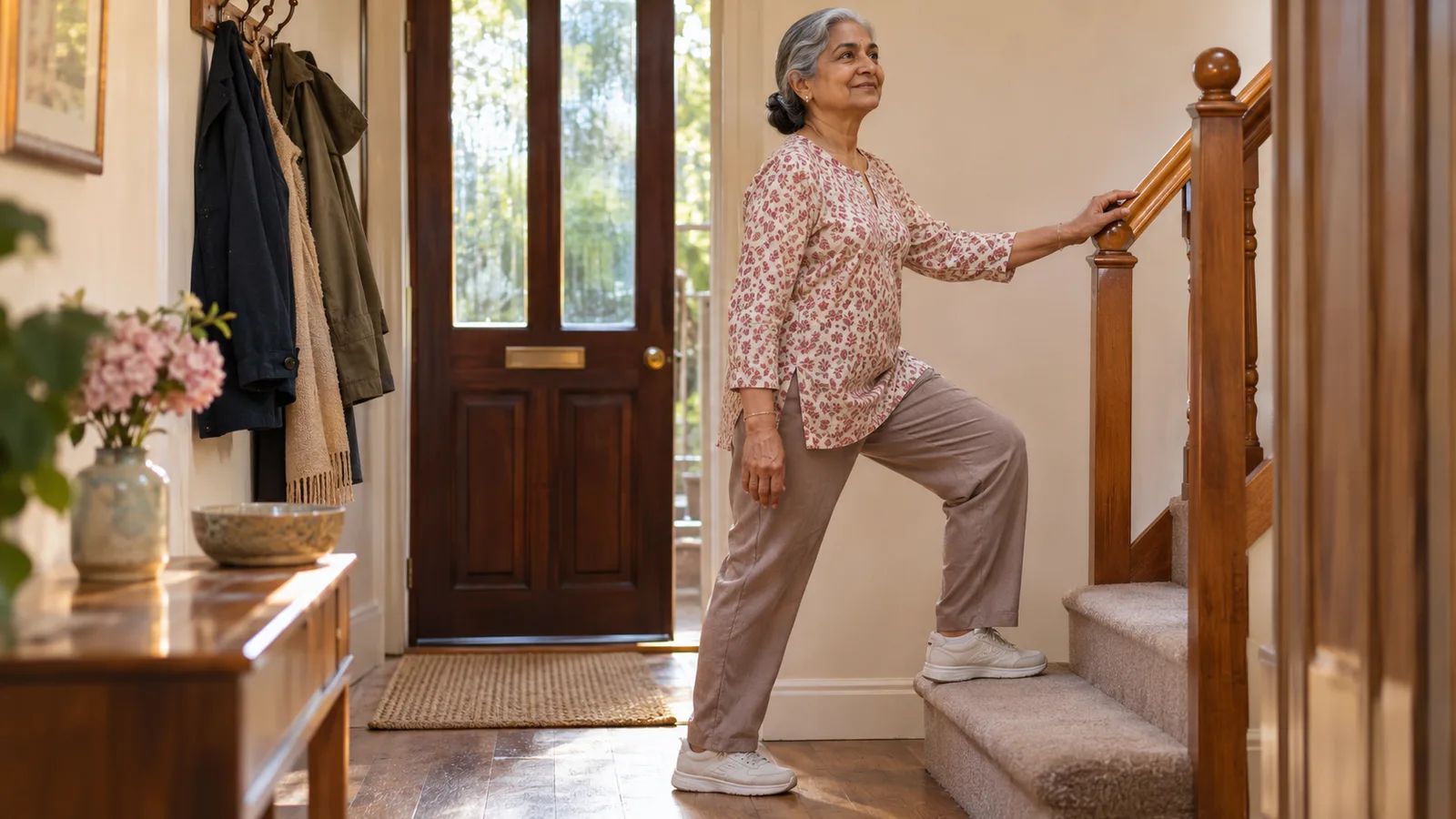
| One leg | Step-up onto the bottom stair, holding the rail | Back foot on a chair (Bulgarian split squat) |
| Trunk | Dead bug, knees bent, tapping one heel down at a time | Slow dead bug with straight legs, or a heavier carry |
If you have a heart or blood pressure condition, are pregnant, have had recent surgery or a joint replacement, or have pain that doesn't settle, check with your doctor or physical therapist before you start.
Pick your time
Every version starts with the five-minute warm-up.
| Time you have | What to do |
|---|---|
| 20 minutes | Pairs A and B, 2 rounds each |
| 30 minutes | All three pairs, 2 rounds each |
| 45 minutes | The full workout, 3 rounds of each pair |
| 60 minutes | The full workout, then a fourth pair: overhead press and calf raise, 3 rounds |
The 20-minute version still has a squat, a hinge, a push and a pull. That's the minimum worth doing, and on a bad day it beats nothing. Wondering if 45 minutes is enough? For most people it is.
For the hour's fourth pair, press dumbbells (or the backpack, held by its sides) from your shoulders to straight arms overhead, then rise onto your toes and lower slowly, a hand on the wall: 8 to 12 of each, same rules.
Warm up for five minutes
No long stretching routine. Warm up with light sets of the moves you're about to do, and stretch only if flexibility is your goal.1 If your joints like more time, this 10-minute warm-up is the longer version.
Two minutes of easy movement
March in place, walk the stairs, or set out your weights while moving around.
One light round of pair A
8 reps of each, on the easier rung or with about half your working weight.
One light set of the hinge before pair B
The hinge is the move that most needs a rehearsal. Pair C can start cold.
What goes wrong, and the fix
Keep this open on your phone between sets.
| Move | You'll notice | Do this instead |
|---|---|---|
| Squat | Heels lift, or knees fall inward | Weight through the middle of your foot, knees pointing where your toes point. Squat to a chair until it feels steady |
| Push-up | Hips sag toward the floor | Squeeze your bottom so you're one line from head to heels. Still sagging? Raise your hands to a chair or counter |
| Hinge | It turns into a squat: knees push forward, hips drop | Knees soft but still. Hips go back, as if shutting a car door with your bottom |
| Hinge | Your back rounds as the weights go down | Stop higher. Keep the weights brushing your legs and your chest proud |
| Row | Your shoulder shrugs to your ear, or you twist to lift | Go lighter and pull your elbow toward your back pocket |
| Split squat | You wobble, or the front knee drifts in | Feet hip-width apart, like train tracks, not a tightrope. Hold a wall or a chair back |
| Carry | You lean toward the weight | Walk tall, as if the bag were empty. Go lighter until you can |
| Dead bug | Your lower back arches off the floor | Make it smaller: lower the arm and leg less far |
Effort is fine. A sharp or pinching pain isn't: stop that move and use the easier rung, and if it still hurts, leave it out for now.
Two things on this page are hard to judge on your own: whether you really had two or three reps left, and which side of that drawing your hinge looks like, since you can't see your own shins mid-set. A coach watching the set live catches both while you're still holding the weights. A phone camera shows a coach more than you'd think. Training alone, prop your phone side-on at hip height and film one set of each move in your first week.
How often, and what to do next week
Two or three times a week, with a day off lifting between: Monday, Wednesday and Friday, or Tuesday and Friday. A walk on the days off is fine. What builds muscle is the number of hard sets each muscle gets across the week, more than how many days you spread them over.1 Two sessions a week already meet the US guideline for strength training.3
Next week, do a little more. Write down the weight and the reps. When every set reaches the top of the range (12, or 20 for body-weight moves) with reps to spare, go up a rung or one dumbbell size next time and start back near 8. Say your goblet squats went 12, 12, 12 with 20 lb (9 kg) and two reps left each time. Next session, pick up 25 lb (11 kg) and expect something like 9, 8, 8. No heavier weight to go up to? Progress without adding weight covers slower lowering, pauses and harder rungs.
Where to go from here:
- A full week, with a second workout to alternate: the 3-day full body workout, or the 2-day version if two days is what you've got.
- Brand new, and you'd like the first four weeks laid out: workout plans for beginners.
- Nothing at home at all: the no-equipment home workout.
- Lifting steadily for six months and sessions running long: time to look at the best workout split for your week.
If you'd rather someone ran it with you
This workout costs nothing and works on your own. Bespoke Fit is for people who'd like someone to choose the weights, watch the reps and be waiting for them on Friday. Your coach writes your sessions onto your training calendar, full body or otherwise, and is live on every one over video. Each coach has 12 members at most, so yours remembers that your hinge drifted toward a squat last week and watches for it this week. One flat price covers as many sessions as you want, 45 to 90 minutes each. Most people settle at around an hour, about the length of the 60-minute version above. It's 14 days free, then $299/mo.
Common questions
Can I do a full body workout every day? You can, as long as each day is small: a pair or two, not the whole session. Most people do better with two or three full sessions and a day off between, because the hard sets stay hard and sore legs get a rest.
What is the 3-3-3 rule for workouts? It has no single meaning. One version is three moves for three sets each, three days a week: a smaller cousin of this workout. Another is a week with three strength sessions, three cardio sessions and three easier recovery days, some of them sharing a day. Both are rules of thumb, not programs anyone has tested in a study.
Is a full body workout better than a split? Neither, in the studies that compare them with the same weekly work, so pick the one you'll keep doing. Full body is the more forgiving: miss a session and every muscle still comes up again within a few days.
Will a full body workout tone my body? Toned usually means a bit more muscle with a bit less fat over it. This workout builds the muscle part. How much fat sits on top mostly comes down to what you eat and how much you move the rest of the day, so give it a couple of months before you judge it in the mirror.
Sources
-
Iversen, V.M., Norum, M., Schoenfeld, B.J. & Fimland, M.S., 2021. No time to lift? Designing time-efficient training programs for strength and hypertrophy: a narrative review. Sports Medicine. Recommends at least one leg-pressing exercise, one upper-body pull and one upper-body push; supersets roughly halve training time while keeping the volume; weekly training volume matters more than training frequency; warm-ups limited to exercise-specific sets, with stretching only when flexibility is the goal. ↩ ↩2 ↩3
-
Currier, B.S., D'Souza, A.C., Singh, M.A.F., and colleagues, 2026 (Phillips, S.M., senior author). American College of Sports Medicine position stand. Resistance training prescription for muscle function, hypertrophy, and physical performance in healthy adults: an overview of reviews. Medicine and Science in Sports and Exercise. Recommends high-effort training at least twice a week with all major muscle groups engaged, sets taken near failure or to about 2 or 3 reps in reserve. ↩
-
Centers for Disease Control and Prevention. Adult activity: an overview. Adults need muscle-strengthening activities on 2 or more days a week that work all major muscle groups: legs, hips, back, abdomen, chest, shoulders and arms. ↩