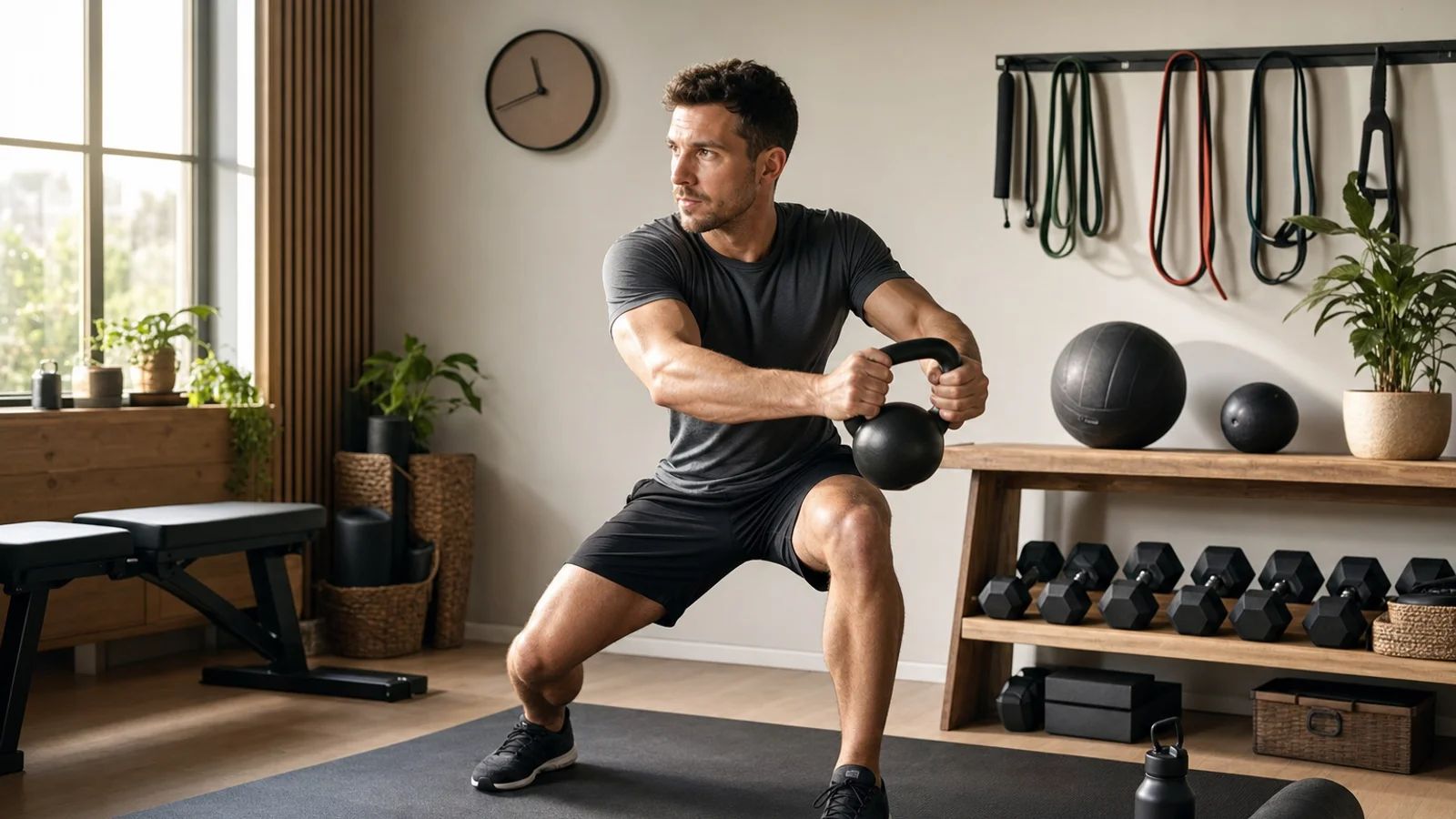
2 day full body workout: a 12-week plan for gym or home
Two full-body workouts a week build real strength and muscle. Both sessions for gym or home, which days to pick, and 12 weeks of what to add and when.
In this article8
Do two different full-body workouts, A and B, two or three days apart. Each has six moves, mostly 3 sets, and you stop every set while two or three more good reps are still in you. That's 50 to 60 minutes with a warm-up, less on a short night. Two sessions like this build real strength and muscle, at 25 or at 75, and you don't need a third day to start.
If you have a heart or blood pressure condition, are pregnant, are recovering from surgery or have pain that doesn't settle, check with your doctor or physical therapist first.
Workout A
Each workout has a home column (two pairs of dumbbells and a resistance band) and a gym column. Do the moves in this order. Rest 2 to 3 minutes between sets of the first two, about 90 seconds on moves 3 and 4, and a minute on the last two.
| Move | At home | In a gym | Sets × reps |
|---|---|---|---|
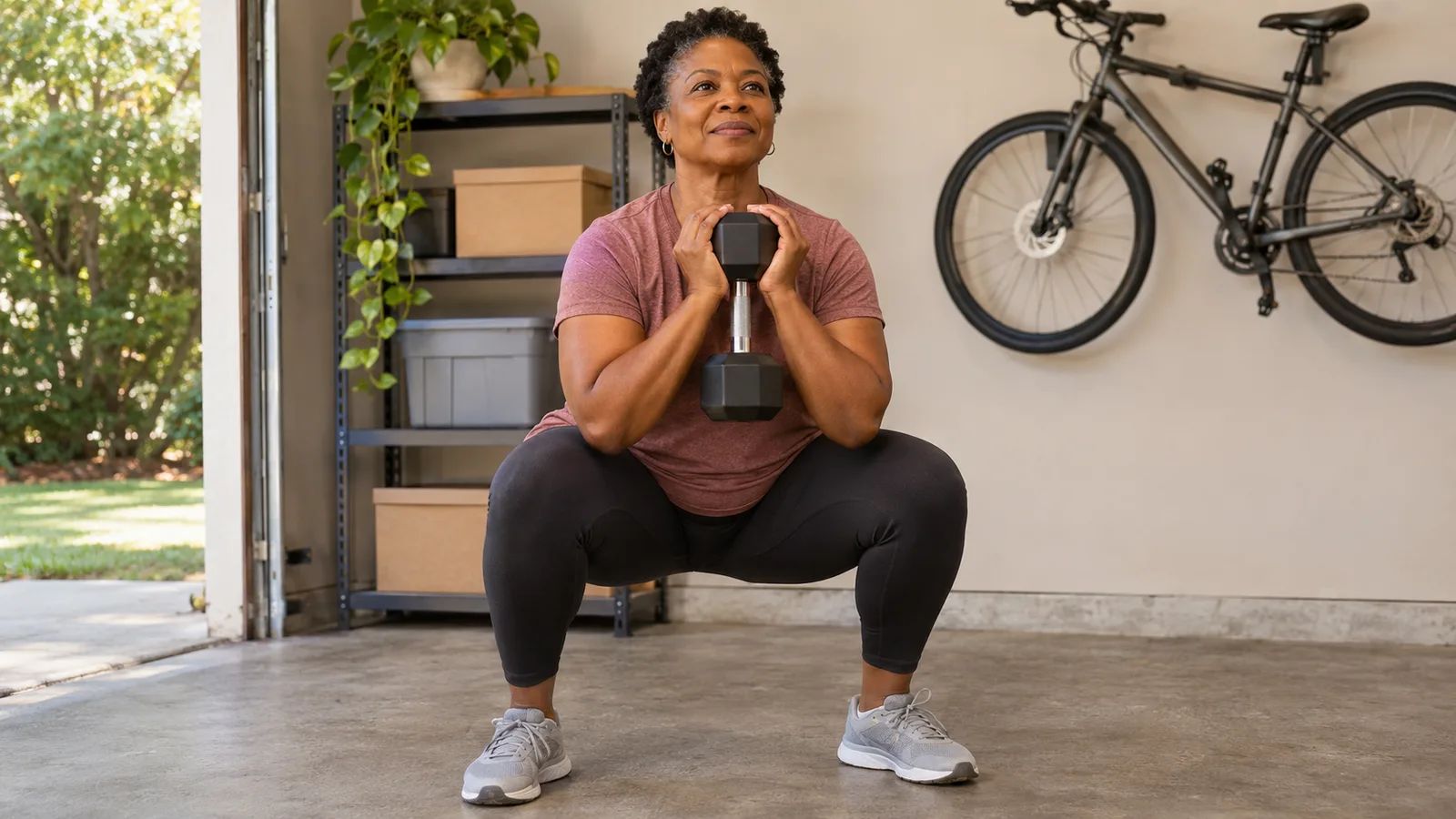
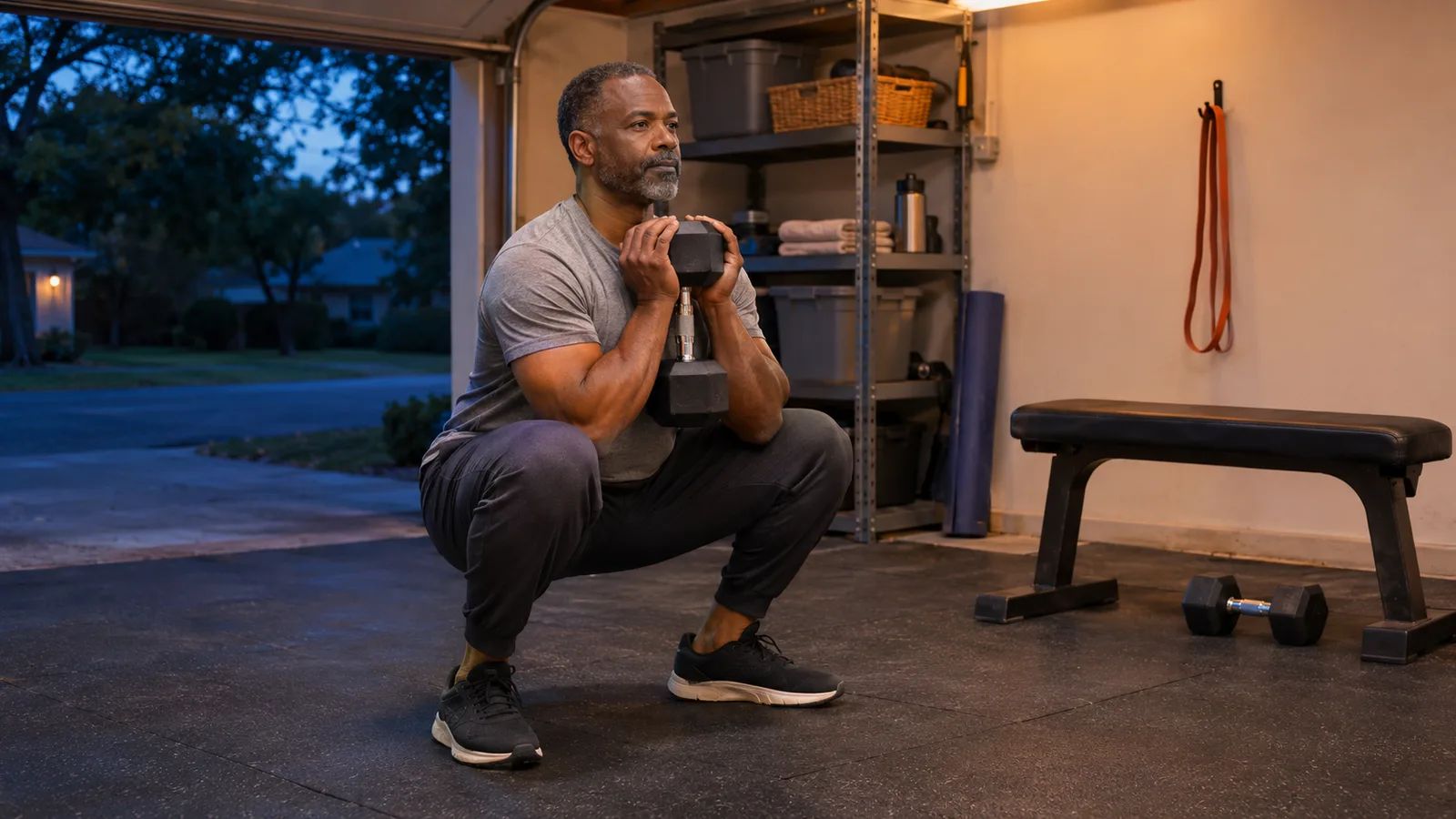
| 1. Squat | Goblet squat, one dumbbell held at your chest | Back squat, goblet squat or the leg press | 3 × 6 to 10 |
| 2. Press | Dumbbell floor press | Bench press, or a chest press machine | 3 × 6 to 10 |
| 3. Row | One-arm dumbbell row, a hand on a chair | Chest-supported dumbbell row, or seated cable row | 3 × 8 to 12 |
| 4. Hinge | Romanian deadlift with two dumbbells | Romanian deadlift with a barbell or dumbbells | 3 × 8 to 12 |
| 5. Shoulders | Lateral raise with light dumbbells | Dumbbell or cable lateral raise | 2 × 12 to 15 |
| 6. Calves | Calf raise off a stair | Standing calf raise machine | 2 × 10 to 15 |
Workout B
Same rests as A. For moves done one side at a time, the reps are per side.
| Move | At home | In a gym | Sets × reps |
|---|---|---|---|
| 1. Single leg | Split squat, a dumbbell in each hand | Bulgarian split squat, or walking lunges | 3 × 8 to 12 |
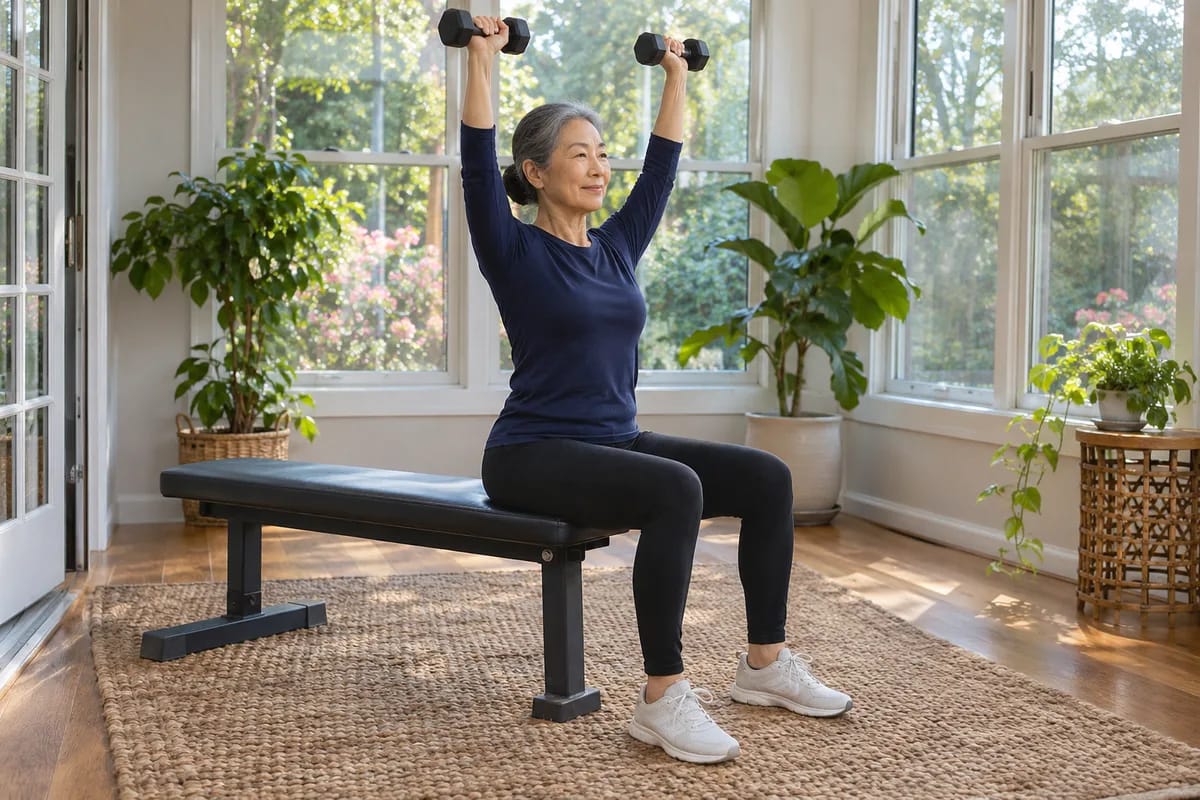
| 2. Overhead press | Seated dumbbell press | Dumbbell or machine shoulder press | 3 × 6 to 10 |
| 3. Pull-down | Kneeling band pulldown, door anchor | Lat pulldown, or assisted pull-up | 3 × 8 to 12 |
| 4. Hips | Hip thrust off the sofa, dumbbell on hips | Barbell or machine hip thrust | 3 × 8 to 12 |
| 5. Press | Push-ups, hands on a step if needed | Incline dumbbell press | 2 × 8 to 12 |
| 6. Carry | Suitcase carry, one heavy dumbbell | The same, with a dumbbell or kettlebell | 2 × 30 to 40 steps each hand |
The four moves people ask about:
- Floor press. A bench press lying on the floor. The floor stops your elbows at a safe depth, so you don't need a bench or a spotter.
- Split squat. A lunge where your feet stay put: one foot forward, one back, and you sink straight down until the back knee nearly touches the floor. The Bulgarian version rests your back foot on a bench.
- Hip thrust. Shoulders against the edge of a sofa or bench, feet flat, weight across your hips. Push your hips up until your body is flat from knees to shoulders, squeeze, lower.
- Chest-supported row. Lie face down on an incline bench and row two dumbbells up. The bench holds your back still, so your back muscles do the work, not momentum.
The goblet squat, Romanian deadlift, one-arm row and suitcase carry each get a line in the beginners plan.
No curls or crunches? That's on purpose. The rows and pulldowns work your biceps, the presses work your triceps, and the carry makes your middle hold you upright. If you want direct arm work and have 10 minutes spare, add 2 sets of dumbbell curls and 2 of overhead triceps extensions at the end of either workout, one set of each, back and forth.
What you need at home: two pairs of dumbbells (a lighter pair for shoulders, a heavier pair for legs and back) or one adjustable pair, a resistance band with a door anchor, a stair and a sofa. The first $300 of a home gym says what to buy first.
Warm up for five minutes. A few minutes of anything easy, like marching on the spot or a few trips up the stairs, then one or two light sets of the first move.
How hard. A good rep looks like your first one: same depth, same speed, no swinging. Stop each set while two or three more of those are still in you. The American College of Sports Medicine's 2026 review names that as one way to put in enough effort, and found going all the way to failure isn't necessary.1 It's a guess for everyone at first, and it gets easier with practice. If a move pinches a joint, go lighter or shorten the range, and if it still pinches, leave it out for now. Not sure what weight to pick up first? Starting weights by exercise has a table and a three-set test.
By our count, the two workouts give each big muscle group about 4 to 12 hard sets a week: hamstrings and chest at the low end, glutes at the high end. Four a week already builds muscle and about 10 builds it well, so if one area matters most to you, that's where an extra set goes. How many sets per week your muscles need shows the counting.
What two days a week will and won't do
Two good sessions a week will make you stronger and build muscle, and the gap to three days is smaller than most people think. One small trial put 46 healthy people aged 65 to 79 on the same heavy program once, twice or three times a week for six months.2 All three groups got about 40% stronger, with no real difference between them, and they got quicker at standing up from a chair too. The people who didn't train barely changed.
Taaffe and colleagues, 1999
Once a week did nearly as well here, but this is one small study of older adults lifting heavy under supervision, so don't read the bars as a law. The larger reviews agree on the main point: extra days add strength and muscle mainly because they add sets, and with the same weekly sets, the number of days makes little difference.34 Two days still beats one as a floor: it's the minimum US guidelines and the American College of Sports Medicine set for strength work,15 and one session can only hold so many good sets. This plan fits about as many as an hour allows.
What two days won't do:
- Get an experienced lifter as big as possible. If you've lifted for years and want every last bit of muscle, more weekly sets help, and past a point that means more days. The best workout split picks one for however many days you have.
- Count as your cardio. US guidelines ask for 150 minutes a week of moderate activity, like brisk walking, on top of strength work on at least 2 days.5 This plan ticks the strength box. Walks on the other days cover the rest.
Which two days
Aim for two or three days apart. Wednesday and Saturday works too. Every muscle gets a couple of days to recover before it's asked again, and the week has an even rhythm.
Pick a spare slot too, the dashed box: an evening you don't plan to train but could. Put it in your calendar now.
Saturday and Sunday works if that's what you have. The studies above don't settle back-to-back days, so this is our coaching view rather than a finding: do A on the first day, since it has the heavier squat, and B on the second. If your legs are still heavy on Sunday, take one set off the split squats and keep everything else. Expect a little slower progress than with the days spread out, and a lot more than from no days at all.
Twelve weeks: what to add and when
The method is called double progression. Each move has a rep range, like 8 to 12. Keep the same weight and add reps until you hit the top of the range on every set. Next time, go up one weight step and start again near the bottom. A step is usually 5 lb (2 kg) per dumbbell on the big moves, and the smallest jump you have on lateral raises.
Weeks 1 to 2
Learn the moves, find your weights
Two sets of everything, stopping with four or more reps left. The first time you do each move, find a weight where the last couple of reps slow down but still look like the first. Write every weight and rep count down.
Weeks 3 to 6
Three sets, add reps
Full sets from the tables, two or three reps left on each. Each session, try to beat last time by a rep or two somewhere. When a move hits the top of its range on every set, it goes up.
Weeks 7 to 10
Keep climbing
Same method. If your sessions have room, add a fourth set to move 1 of each workout. Most moves should have gone up a weight step at least once by now.
Week 11
One harder set
On moves 1 and 2, take the last set to about one rep left. Everything else stays the same.
Week 12
A light week
Same weights and days, about half the sets, every set stopped three or more reps short. Then start again at week 3 with your new weights, and swap a move or two for a variation if you fancy a change.
Here's how that might look for the Romanian deadlift at home. It's in Workout A only, so it comes up once a week. These numbers are an example, not a target, and weeks 7 and 9 landed between the rows either side.
| Week | Dumbbells, each hand | Reps in the 3 sets |
|---|---|---|
| 3 | 25 lb (11 kg) | 12, 11, 10 |
| 4 | 25 lb (11 kg) | 12, 12, 11 |
| 5 | 25 lb (11 kg) | 12, 12, 12 |
| 6 | 30 lb (14 kg) | 9, 8, 8 |
| 8 | 30 lb (14 kg) | 11, 10, 10 |
| 10 | 30 lb (14 kg) | 12, 12, 12 |
Two things get in the way. At home, the next dumbbell can be a big jump; progressive overload at home shows how to make the same weight harder instead. And if a move doesn't budge for three sessions in a row, look at sleep and effort before you blame the plan; how plateaus work goes through the usual causes. The week 12 light week is explained in deload weeks.
When you've only got 45 or 25 minutes
To save time, cut in this order:
- Pair moves 3 and 4, and moves 5 and 6. One set of each, back and forth, with about a minute's rest between. It saves roughly 10 minutes and none of the work.
- Drop move 6, then move 5.
- Keep moves 1 and 2. They're the heaviest and do the most.
For the evening that's fallen apart, there's a 25-minute version: a three-minute warm-up, then the first three moves of whichever workout is next, 2 sets each. It keeps the habit and the heaviest work. Is 45 minutes enough runs the numbers on short sessions, and rest between sets explains why the first two moves keep their long rests.
When a session falls out
With two days a week, one missed session is half your week. That's the one real weakness of this plan, so deal with it before it happens.
Missed one? Do it in your spare slot. If that's gone too, do the missed workout next time and carry on in order: A, B, A, B, whatever the calendar says. Don't do both in one day to catch up, and don't skip ahead. A week or two away costs very little strength, so one missed session is nothing to panic about. A pattern of them is what stalls people.
This is also where someone counting on you helps most. With Bespoke Fit, your coach writes your workouts, books both sessions with you and is live on the call when you show up. They have 12 members at most, so they notice when Thursday goes missing, and someone waiting for you at 7 that evening is often what gets it done. They also take over the guess about "two or three left": they watch the set, tell you when to stop and when the weight goes up. It's 14 days free, then $299/mo for unlimited sessions of 45 to 90 minutes. Most people settle at around an hour, which makes it about $35 a coached hour at two a week, and a third day costs nothing extra if one opens up. If two sessions on your own are already working, though, keep going. This page is the whole plan.
Common questions
Is upper/lower better than full body for two days a week? Not on two days. Upper/lower trains each half of you once a week, so each muscle gets its whole week in one long session, and the last sets are done tired. Full body on two days trains every muscle twice, which is what US guidelines and the American College of Sports Medicine both ask for. Upper/lower comes into its own at four days.
Can I add a third day, or some cardio? Yes to both. If a third lifting day opens up most weeks, keep alternating the two workouts: A, B, A one week and B, A, B the next, with a day off between each. For cardio, try to keep a hard run or ride off the day before Workout A, so your legs arrive fresh for the squats.
Sources
-
Currier, B.S., D'Souza, A.C., Singh, M.A.F., and colleagues, 2026 (Phillips, S.M., senior author). American College of Sports Medicine position stand. Resistance training prescription for muscle function, hypertrophy, and physical performance in healthy adults: an overview of reviews. Medicine and Science in Sports and Exercise. Covers 137 systematic reviews. Recommends high-effort training at least twice a week covering all major muscle groups; gives near-failure or 2 to 3 reps in reserve as ways to reach enough effort, while noting the evidence is too thin to set exact targets; found training to momentary failure is not necessary. ↩ ↩2
-
Taaffe, D.R., Duret, C., Wheeler, S. & Marcus, R., 1999. Once-weekly resistance exercise improves muscle strength and neuromuscular performance in older adults. Journal of the American Geriatrics Society. 46 healthy adults aged 65 to 79, randomized to 1, 2 or 3 days a week for 24 weeks, 3 sets of 8 exercises at 80% of their one-rep max; strength rose 37.0%, 41.9% and 39.7% against 3.9% for controls, with no difference between the training groups. ↩
-
Grgic, J., Schoenfeld, B.J., Davies, T.B., Lazinica, B., Krieger, J.W. & Pedisic, Z., 2018. Effect of resistance training frequency on gains in muscular strength: a systematic review and meta-analysis. Sports Medicine. 22 studies, mostly in people new to lifting. With volume matched, frequency made no significant difference; the frequency effect was significant in young adults but not in middle-aged and older adults. ↩
-
Schoenfeld, B.J., Grgic, J. & Krieger, J., 2019. How many times per week should a muscle be trained to maximize muscle hypertrophy? A systematic review and meta-analysis of studies examining the effects of resistance training frequency. Journal of Sports Sciences. 25 studies; no meaningful difference in growth when weekly volume was equal. ↩
-
Centers for Disease Control and Prevention. Adult activity: an overview. Adults need at least 150 minutes of moderate-intensity activity a week and muscle-strengthening activity that works all major muscle groups on at least 2 days a week. ↩ ↩2
More on