Dumbbell leg workout: 6 moves, with sets, reps and weights
A full dumbbell leg workout: 6 moves with sets, reps and rest, how heavy to go on each, the common faults, and what to do when your dumbbells feel light.
In this article7
Six moves, about 40 to 45 minutes after a warm-up, twice a week. It works with one pair of dumbbells at home or a full rack at the gym, and it trains the things your legs do all day: getting out of a chair, carrying something heavy, climbing stairs, walking uphill.
The workout
| Move | Sets × reps | Rest | Helps with |
|---|---|---|---|
| 1. Goblet squat | 3 × 8 to 12 | 90 s to 2 min | Getting out of a chair |
| 2. Romanian deadlift | 3 × 8 to 12 | 90 s to 2 min | Picking things up |
| 3. Split squat | 2 to 3 × 8 to 12 each leg | 1 min | Kneeling down and getting back up |
| 4. Step-up | 2 × 8 to 12 each leg | 1 min | Stairs and hills |
| 5. Glute bridge | 2 × 10 to 15 | 1 min | Hip strength for walking and lifting |
| 6. Single-leg calf raise | 2 × 10 to 15 each side | 30 to 60 s | Walking uphill, steady ankles |
New to lifting? Do two sets of everything for the first two weeks. The next eight weeks build you up to the full table.
Order matters. The two big moves go first, while you're fresh and can lift the most. The single-leg moves come next, then the small ones that don't mind tired legs.
Short on time? The first three moves, two sets each, take about 15 minutes and still cover a squat, a hinge and a single-leg move, which is a proper leg day. Add the step-ups and it's about 25.
Warm up first, about ten minutes: walk or march on the spot until you're warm, do 10 squats and 10 hip hinges with no weight (bowing forward from the hips with a flat back, as in move 2), then two or three light sets of goblet squats. Short on time? Keep the light sets. More on warming up.
How heavy to go on each move
Leg moves don't all take the same weight. A goblet squat or a Romanian deadlift takes far more than a split squat or a step-up, because on the single-leg moves one leg is already lifting most of your body. So one pair of dumbbells is often heavy for some moves and light for others.
These are our starting points for someone new to lifting. The squat and deadlift rows line up with our guide to starting weights.
| Move | First two weeks | After a month or two |
|---|---|---|
| Goblet squat (one dumbbell) | Body weight, then 8 to 12 lb (4 to 5 kg) | 12 to 20 lb (5 to 9 kg) |
| Romanian deadlift | 8 to 12 lb (4 to 5 kg) per hand | 15 to 20 lb (7 to 9 kg) per hand |
| Split squat | Body weight, then 5 to 8 lb (2 to 4 kg) per hand | 10 to 15 lb (5 to 7 kg) per hand |
| Step-up | Body weight, a hand on the rail | 5 to 10 lb (2 to 5 kg) per hand |
| Glute bridge (one dumbbell on your hips) | 10 to 15 lb (5 to 7 kg) | 20 to 30 lb (9 to 14 kg) |
| Single-leg calf raise | Body weight, a hand on the rail | 10 to 15 lb (5 to 7 kg) in one hand |
If you've lifted before, skip the table and use the rule that makes any table personal: pick the weight where the last two or three reps are hard but still look like the first one. You should feel you could do one to three more if someone paid you. Grinding all the way to failure doesn't clearly build more muscle than stopping just short.1
Are 20 lb dumbbells enough to build your legs?
For most people, yes, for months. Lighter weights, like a pair of 20s (9 kg each), build about as much muscle as heavy ones when the sets are pushed hard, close to the rep you can't do.2 What heavy weights win on is your one-rep max, the most you can lift once. If that's not your goal, it doesn't matter much.
There is a floor: sets so light you could do dozens of reps build noticeably less.3 Our rule of thumb, not a study's: once a move goes past about 20 reps before it gets hard, switch to its harder version rather than doing more reps.
How to do each move
Three cues each, plus an easier and a harder version. If a move feels wrong, check the faults table further down.
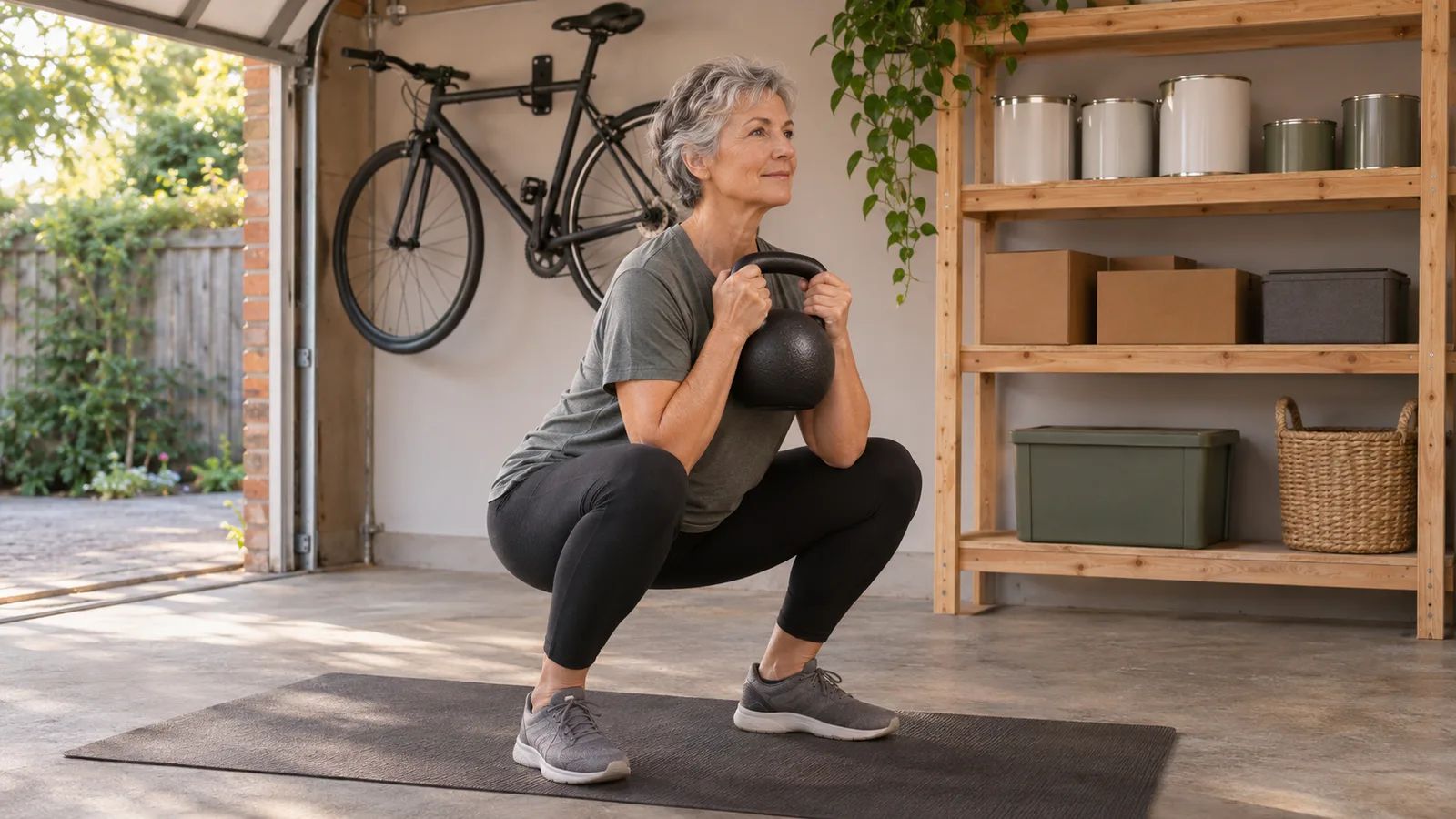
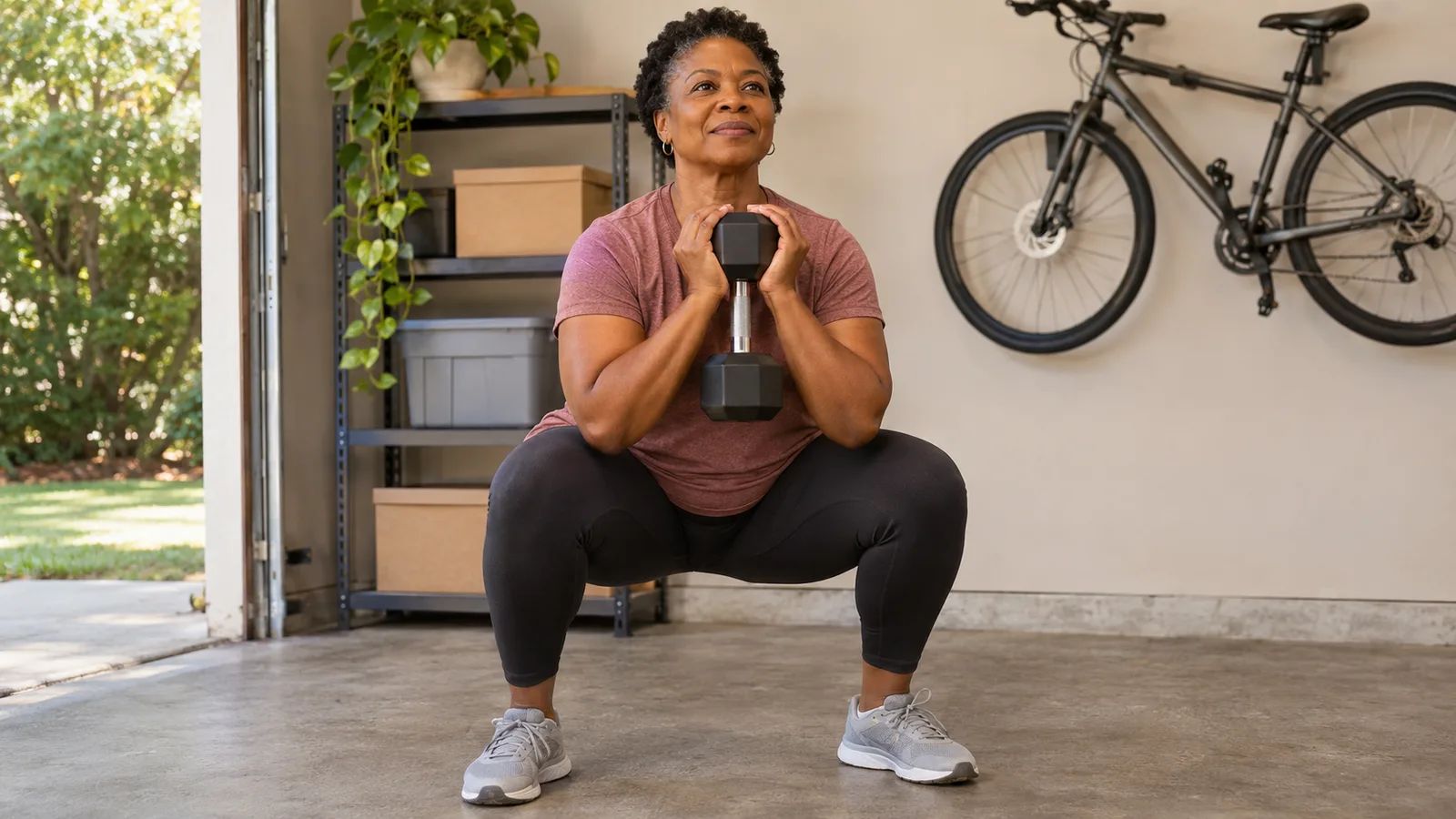
1. Goblet squat
Works the fronts of your thighs and your glutes.
- Hold one dumbbell upright against your chest, both hands cupping the top end, elbows pointing down.
- Feet a little wider than your hips, toes turned out slightly. Sit down between your heels, and let your knees travel out over your toes.
- Go as low as you can with your heels down and your chest up, then stand by pushing the floor away.
Easier: squat down to a chair, touch it lightly and stand. Harder: take 3 seconds to lower and pause for 2 at the bottom.
2. Romanian deadlift
Works the backs of your thighs (hamstrings) and your glutes. It's the pattern you use to pick things up off the floor, and the move beginners most often turn into a squat by accident.
- Stand tall with a dumbbell in each hand in front of your thighs, knees soft but not bent.
- Push your hips back, as if closing a car door behind you with your bottom. The weights slide down the front of your thighs and your back stays flat.
- Stop when you feel a strong stretch in the backs of your legs, usually around or just below the knee. Stand back up by squeezing your glutes and driving your hips forward.
Easier: practice the hinge with your hands on your hips and no weight, or hold one dumbbell with both hands. Harder: the single-leg version, one fingertip on a wall for balance.
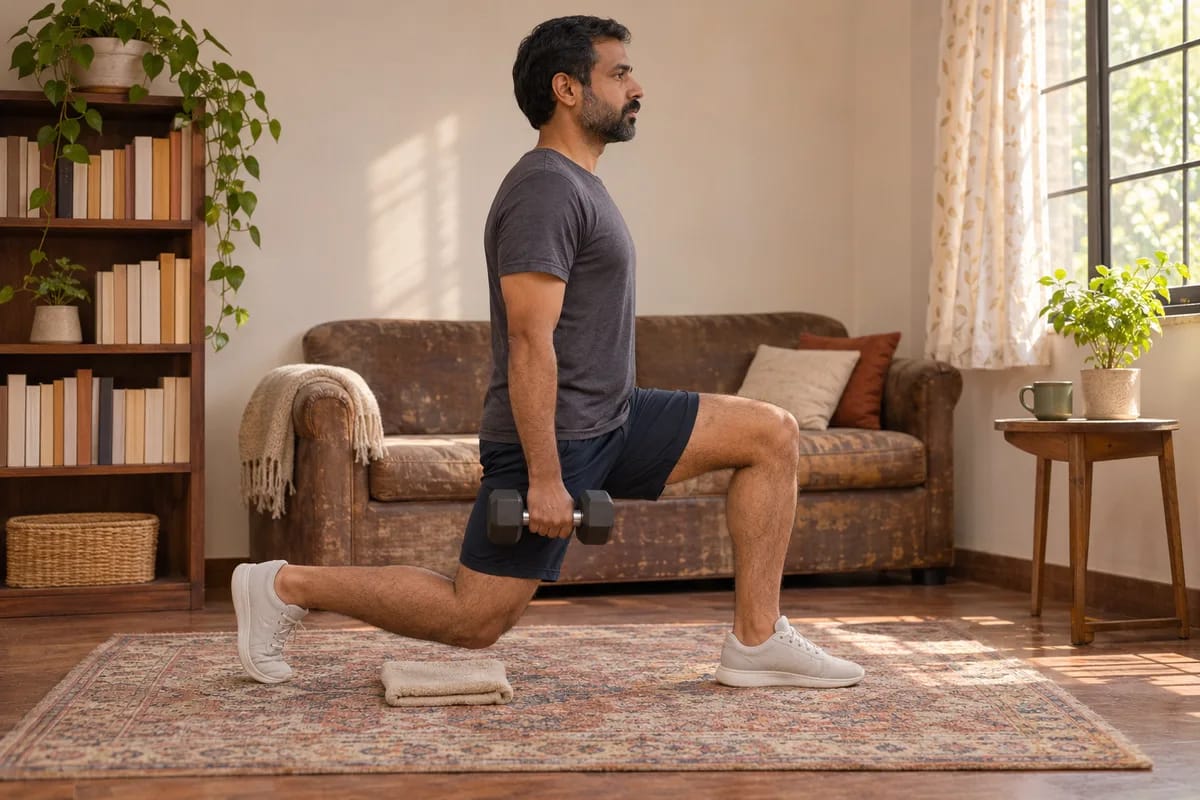
3. Split squat
Works your front thigh and glute, one leg at a time. It's a lunge where your feet don't move.
- Take a long step, feet hip width apart side to side, so you're standing on two rails, not a tightrope. Back heel up.
- Drop straight down until your back knee is just above the floor (a folded towel under it helps), front heel flat.
- Push up through the whole front foot, mostly the heel. Your back leg is there for balance, not to lift you.
Staying upright works more of your front thigh; a small forward lean from the hips shifts some of the work to your glute. Neither is wrong, so pick one on purpose rather than drifting between them mid-set.
Easier: hold the back of a chair, and only go as low as feels steady. Harder: rest your back foot on a sofa edge or a step (often called a Bulgarian split squat). It's much harder with the same dumbbells.
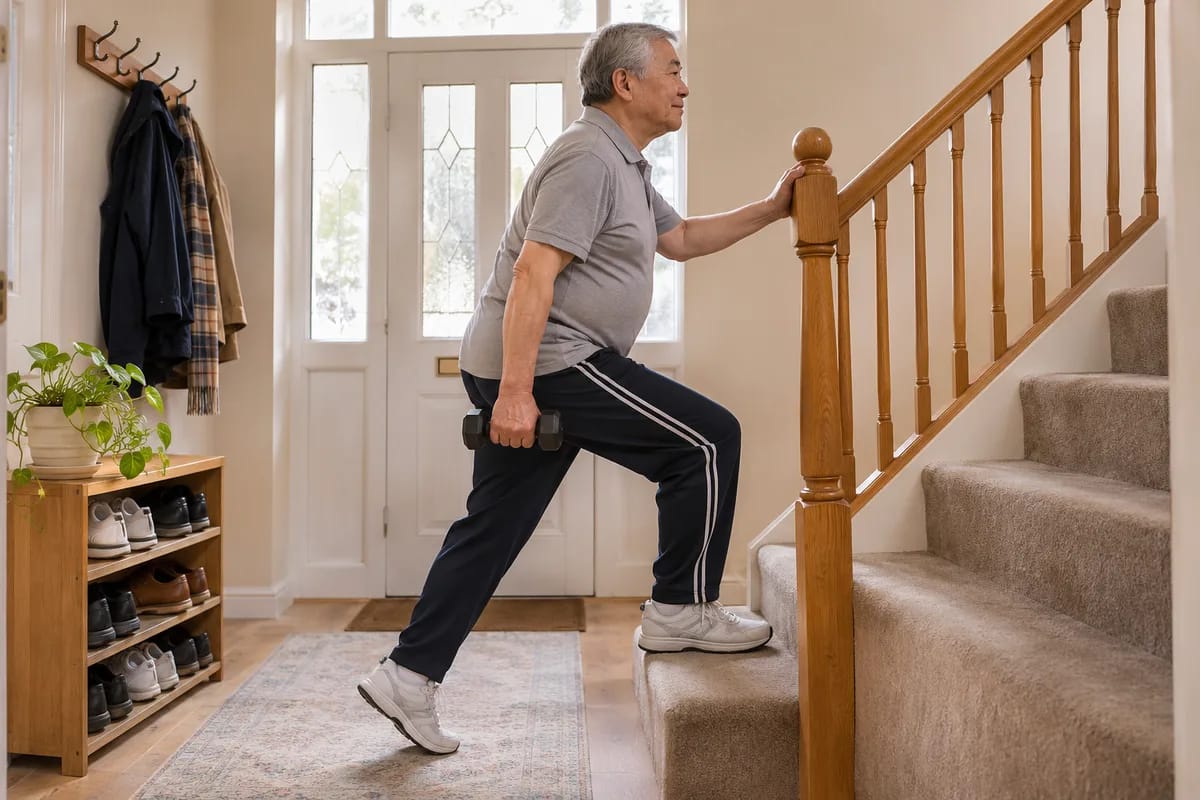
4. Step-up
Works your thighs and glutes the way stairs and trails do.
- Use a bottom stair or a sturdy box, low enough that your thigh stays below level when your foot is on it. Put your whole foot on, not just the toes.
- Lean forward a little and stand up through the front heel. The back foot comes along for the ride.
- Lower yourself slowly, taking about 2 seconds. That's half the exercise.
Easier: a lower step and a hand on the rail. Harder: a higher step, or dumbbells in both hands.
5. Glute bridge
Works your glutes and, a little, your hamstrings.
- Lie on your back, knees bent, feet flat and hip width apart. Rest one dumbbell across your hip bones with a folded towel under it, and hold it in place with both hands.
- Push through your heels and lift your hips until you're in a straight line from shoulders to knees.
- Squeeze at the top for a second without arching your lower back, then lower slowly.
Easier: no weight. Harder: one leg at a time, or your shoulders on the edge of a sofa so your hips travel further (a hip thrust).
6. Single-leg calf raise
Works your calves, which do a lot of the pushing when you walk uphill.
- Stand on one foot on the edge of a stair, the ball of your foot on the step and your heel hanging off. Hold the rail.
- Lower your heel slowly below the step, about 2 seconds down.
- Rise as high as you can onto your toes and pause for a second. No bouncing.
Easier: both feet at once, on the flat floor. Harder: a dumbbell in the hand on the same side as the working leg.
What going wrong looks like
| Fault | What you'll notice | The fix |
|---|---|---|
| Knees caving in (squats, split squats) | Your knees drift toward each other as you stand up | Push your knees out over your middle toes. Go lighter until they stay there |
| Heels lifting (squats) | Your weight rolls onto your toes at the bottom | Sit down between your heels, widen your stance a little, or squat to a chair |
| Rounded back (Romanian deadlift) | Your shoulders hunch and your lower back curves as the weights pass your knees | Stop the hinge higher, keep the weights touching your thighs, chest up |
| Squatting the hinge (Romanian deadlift) | Your knees bend a lot and your hips drop instead of going back | Knees soft, not bent. Hips go back, not down |
| Front heel lifting (split squat) | You're on the ball of your front foot at the bottom | Take a longer step, push through your front heel |
| Back knee slamming (split squat) | A thud at the bottom of each rep | Slow down, stop just above the floor, put a towel there |
| Pushing off the back foot (step-up) | The leg on the floor does the work and you bounce up | Keep your back toes light, or lift them before you stand |
| Bouncing (calf raise) | Fast, short reps | Pause at the top, take 2 seconds down |
Your knees going past your toes is not a fault. It's an old rule that still scares people into sitting so far back they tip over. In a small lab study of squats, blocking the knees from passing the toes eased the load on the knees a little but shifted far more onto the hips and lower back, and the authors concluded a good squat may need the knees to travel slightly past the toes.4 What matters is that your knees track over your feet and your heels stay down.
Muscle burn and hard breathing are the work. Sharp or pinching pain in a joint is not: stop that move and switch to its easier version. If the pain keeps coming back, or you've had a knee or hip replaced, ask a physical therapist or your doctor which versions suit you. There's more on that in strength training after a knee or hip replacement.
Most of these faults are easy to see and hard to feel. Prop your phone on a shelf at hip height, side on, and film one set of each move; the side view shows knee and hip angles a mirror hides. The camera shows you what went wrong after the set. A coach watching live catches it on rep 6, while you can still fix rep 7. That's how a live 1‑on‑1 video session with a Bespoke Fit coach works. Your coach also judges how many reps you really had left, the hardest call on this page to make alone. They pick the weight for each move and write your progression.
The next eight weeks
The plan for progress is called double progression: add reps first, then weight.
Weeks 1 and 2
Learn the moves
Two sets of each, with weights from the first column of the table. Stop every set with about three reps left. Expect sore legs after the first session or two. It fades fast, and soreness isn't the sign a workout worked.
Weeks 3 and 4
Move to the full table
Three sets of the goblet squat and the Romanian deadlift, and of split squats if you have the time. Same weights. Try to add a rep or two to each set each week.
Weeks 5 and 6
Go up a weight
When a move gets 12 clean reps on every set with a rep or two left, use the next dumbbell up, usually 5 lb (2 kg) heavier, and drop back to about 8 reps. Climb back to 12 the same way.
Weeks 7 and 8
Keep climbing, or make it harder
Out of heavier dumbbells for a move? Use its harder version instead: slower lowering, a pause at the bottom, one leg, or the back foot raised. A split squat with your back foot on the sofa makes the same 15 lb (7 kg) dumbbells feel far heavier.
When the harder versions run out too, progressive overload without adding weight has more ways to keep going, and the home gym on a budget covers which heavier dumbbells are worth buying.
When your grip gives out before your legs
Heavier weights bring a new problem: your forearms quit at rep 9 of the Romanian deadlift while your legs had five more in them. Three fixes:
- Hold one heavier dumbbell at your chest instead of two at your sides, on squats, split squats and step-ups. Your arms carry it against your body, not from your fingertips.
- Lifting straps for the Romanian deadlift. They loop around your wrist and the handle, so the strap holds the weight instead of your fingers.
- A backpack with books or water bottles in it, worn on your front for squats or on your back for split squats and step-ups.
Fitting it into your week
Do it twice a week, with at least two days between sessions, so Monday and Thursday rather than Monday and Tuesday. That also lines up with the US guideline of strength work on two or more days a week.5 The guideline covers your whole body, though, so pair this with upper body work on other days, or see the best workout split for how leg days fit in a full week.
If you already do full-body sessions that include a squat and a hinge, once a week of this is plenty. If you run or hike, keep it away from the day before your longest run or walk. And if you're starting from getting out of a chair rather than a squat, leg exercises for seniors begins there.
Common questions
What are the big three leg exercises?
A squat, a hinge and a single-leg move. With dumbbells that's the goblet squat, the Romanian deadlift and the split squat, the first three moves of this workout. Two sets of each is the 15-minute version.
What dumbbell exercises work the hamstrings?
The Romanian deadlift is the main one, and the single-leg version works them harder with the same weight. Glute bridges help too. Squats do much less for the backs of your thighs than for the fronts.
What if I only have one dumbbell?
You can do the whole workout. Hold it at your chest for squats, split squats and step-ups, with both hands in front of your thighs for Romanian deadlifts, across your hips for bridges, and on the working side for calf raises. When it gets light, move to the harder versions in weeks 7 and 8 before buying more.
Sources
-
Refalo MC, Helms ER, Trexler ET, Hamilton DL, Fyfe JJ, 2023. Influence of resistance training proximity-to-failure on skeletal muscle hypertrophy: a systematic review with meta-analysis. Sports Medicine. ↩
-
Schoenfeld BJ, Grgic J, Ogborn D, Krieger JW, 2017. Strength and hypertrophy adaptations between low- vs. high-load resistance training: a systematic review and meta-analysis. Journal of Strength and Conditioning Research. ↩
-
Lasevicius T, Ugrinowitsch C, Schoenfeld BJ and colleagues, 2018. Effects of different intensities of resistance training with equated volume load on muscle strength and hypertrophy. European Journal of Sport Science. Over 12 weeks, legs trained at 20% of their one-rep max grew less than half as much thigh muscle as legs trained at 40 to 80%. ↩
-
Fry AC, Smith JC, Schilling BK, 2003. Effect of knee position on hip and knee torques during the barbell squat. Journal of Strength and Conditioning Research. Seven weight-trained men. ↩
-
Centers for Disease Control and Prevention. Adult activity: an overview. ↩