How to get stronger: 5 things that matter, 7 that don't
Lift a weight you could manage about 10 times, 2 or 3 sets, twice a week. The 5 things that build strength at any age, and 7 you can stop worrying about.
In this article7
The short answer
Pick a weight you could lift about 10 times at most. Do 2 or 3 sets of 6 to 8, stopping two or three reps short, with full range, first in your session, twice a week or more. When 8 gets easy, go heavier.
That's the whole recipe. It comes from the best summary of the research we have: the American College of Sports Medicine's 2026 review, which pulled together more than a hundred earlier reviews.1 It works with a pair of dumbbells in a spare room as well as a barbell in a gym, and it works at 25 or 75. The same review calls lifting safe for healthy adults of all ages.
If you've never lifted anything, our beginner plans give you a full week to follow.
One check first. If you have heart, kidney or metabolic disease such as diabetes, or you get chest pain, dizziness or unusual breathlessness when you exert yourself, talk to your clinician before you start lifting hard. Sharp pain during a lift, or joint pain that hangs around for days, means stop that move and get it looked at.
The five things that build strength
1. Lift something heavy for you
This is the one that matters most. Strength grows best with heavy loads, around 80% of the most you could lift once.1 You don't need to know that number: a weight you could lift about 10 times, and no more, is close to it.2
| The most reps you could do with it | For strength, that weight is | What to do |
|---|---|---|
| About 5 | Very heavy | Fine later on. Not where to start |
| About 6 to 10 | Heavy enough | Sets that stop two or three reps short. Most people should live here |
| About 11 to 15 | A bit light | Still builds strength, just less. Go up a weight when you can |
| 20 or more | Light | Good for stamina, not much for strength. Make the move harder |
You don't need to test this to the last rep. Do a set of 8, then ask yourself how many more you could have done with good form. If it's "loads", the weight is too light. This is where most beginners go wrong: they stop at 8 because the plan says 8, with six more in them. Starting from zero? How much weight to start lifting with walks through the first session.
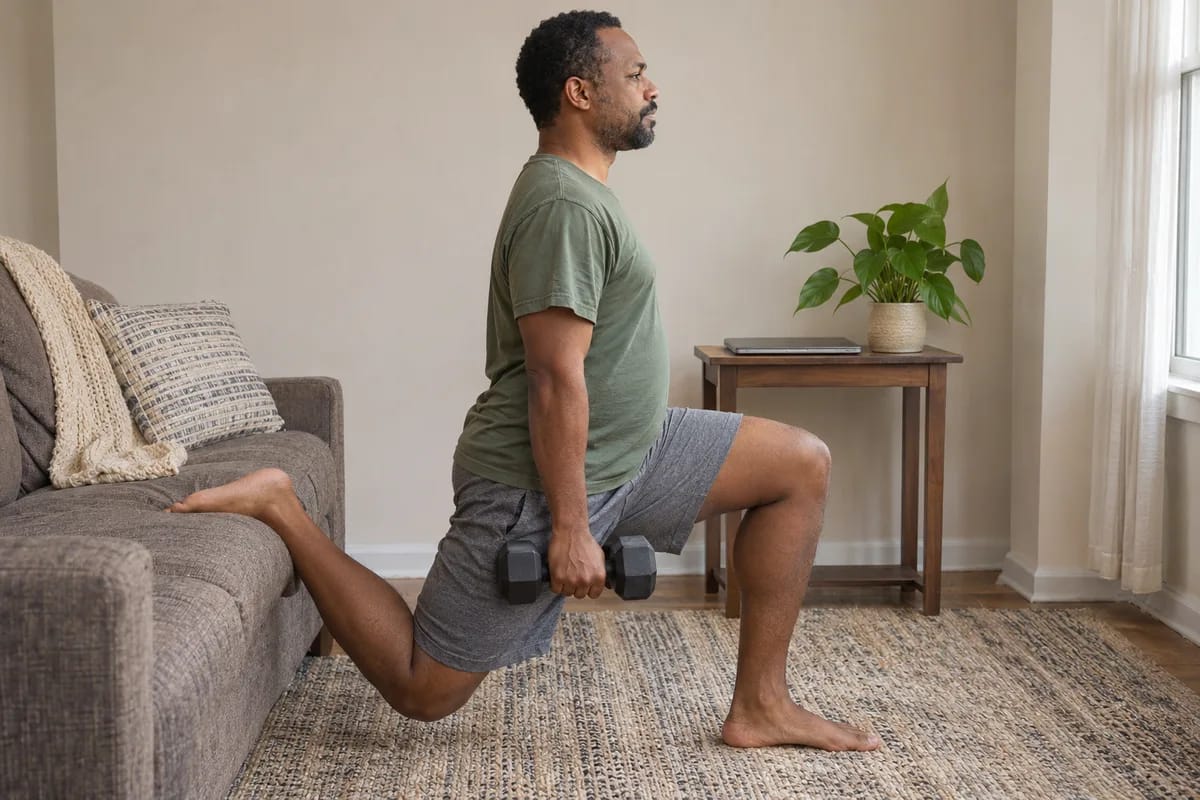
When your dumbbells are too light. This is the most common problem at home. If you can do 25 squats holding a pair of 10 lb (4.5 kg) dumbbells, they're light for your legs. Before you buy more, make the move harder. Go one side at a time: a split squat or a one-leg Romanian deadlift puts nearly all the load on one leg. Add a band on top of the dumbbell. The table further down gives a harder version of each move.
Then keep it heavy as you get stronger. Add a rep every week or two. When you can do 8 on every set and still have three or more in the tank, the weight has stopped being heavy for you: go up to the next weight and drop back to 6. The textbook step up is small, 2 to 10%.3 Dumbbells jump further: going from 15 to 20 lb (7 to 9 kg) is a third more. If the next pair only allows 3 or 4 reps, stay with the lighter one for a week or two, on a harder version of the move or pushed to 10 or 12 reps. That's the "a bit light" row above: still strength, just less.
None of this works from memory. Write down the weight and reps after every session, on paper or in your phone's notes, and next time beat one number.
2. Use the whole range of motion
Full-range reps build more strength than partial ones.1 Full range means as far as you can go with control and no pain: thighs about level with the floor or lower in a squat, chest close to the floor in a push-up, arms straight at the bottom of a row.
If you can't get there yet, lighten the weight, or squat down to a chair seat for now and use a lower seat as you improve. Watch the last hard reps of a set: that's where the range quietly shrinks.
3. Do 2 or 3 sets, and stop a couple of reps short
Two sets beat one, and the extra benefit flattens out after about three per exercise.1 So two or three sets of each main move is the target, not five.
Each set should be hard, but not all-out. The review points to stopping about two or three reps short, though it says the exact number isn't proven.1 How close to failure is close enough shows how to judge it.
Rest until you're ready for another good set; 2 to 3 minutes is typical after a big move like a squat. How long to rest between sets explains why.
4. Do your main lift first
Strength gains were bigger for the exercise done at the start of a session than at the end.1 Put the lift you most want stronger first, straight after a warm-up, while you're fresh. Core work and arm exercises go at the end.
5. Train at least twice a week
Two sessions a week is the floor for strength.1 Three is good if your week has room. Training the whole body each time is the simplest way to fit it in: a squat, a hinge (bending at the hips, like lifting a box off the floor), a push, a pull and something you carry.
Strength is specific, so keep your main moves for months and change the weight, not the exercise.
Seven things you can stop worrying about
The same review checked a long list of things people argue about online. For strength, none of these made a consistent difference:1
- Going to failure. Grinding out reps until you can't do another didn't add strength, and the review suggests it may be unwise for some groups, older people among them.
- Machines or free weights. Use what you have. A leg press counts, and so does a dumbbell.
- Wobble boards and balance balls. Lifting on an unstable surface didn't build more strength. Stand on the floor.
- Slow tempo. Reps taking more than two seconds each way didn't build more strength than quicker ones. Lift with control and don't drop the weight; that's enough.
- The time of day. Morning or evening, whichever you'll keep.
- Fancy set styles. Drop sets, cluster sets and the like. Plain sets work.
- Planned phases and constant variety. Periodization (changing your training in planned blocks) didn't consistently change results, and there wasn't enough evidence that rotating exercises helps strength. Your muscles don't need to be kept guessing.
Spend the energy you save on the five above, mostly the first one.
What to lift: nothing, a few dumbbells or a gym
Pick the column that matches what you've got. Each row is one movement; do all five, two or three times a week, and you have a complete strength program.
| Movement | With nothing | Light dumbbells or a band | In a gym |
|---|---|---|---|
| Squat | Split squat, then back foot raised on a couch | Goblet squat, then split squat holding both dumbbells | Leg press or barbell squat |
| Hinge | One-leg hip bridge | Romanian deadlift, then one leg at a time | Romanian deadlift or trap-bar deadlift |
| Push | Push-up from a counter, then a chair, then the floor | Floor press, or push-ups with a band across your back | Bench press or chest press machine |
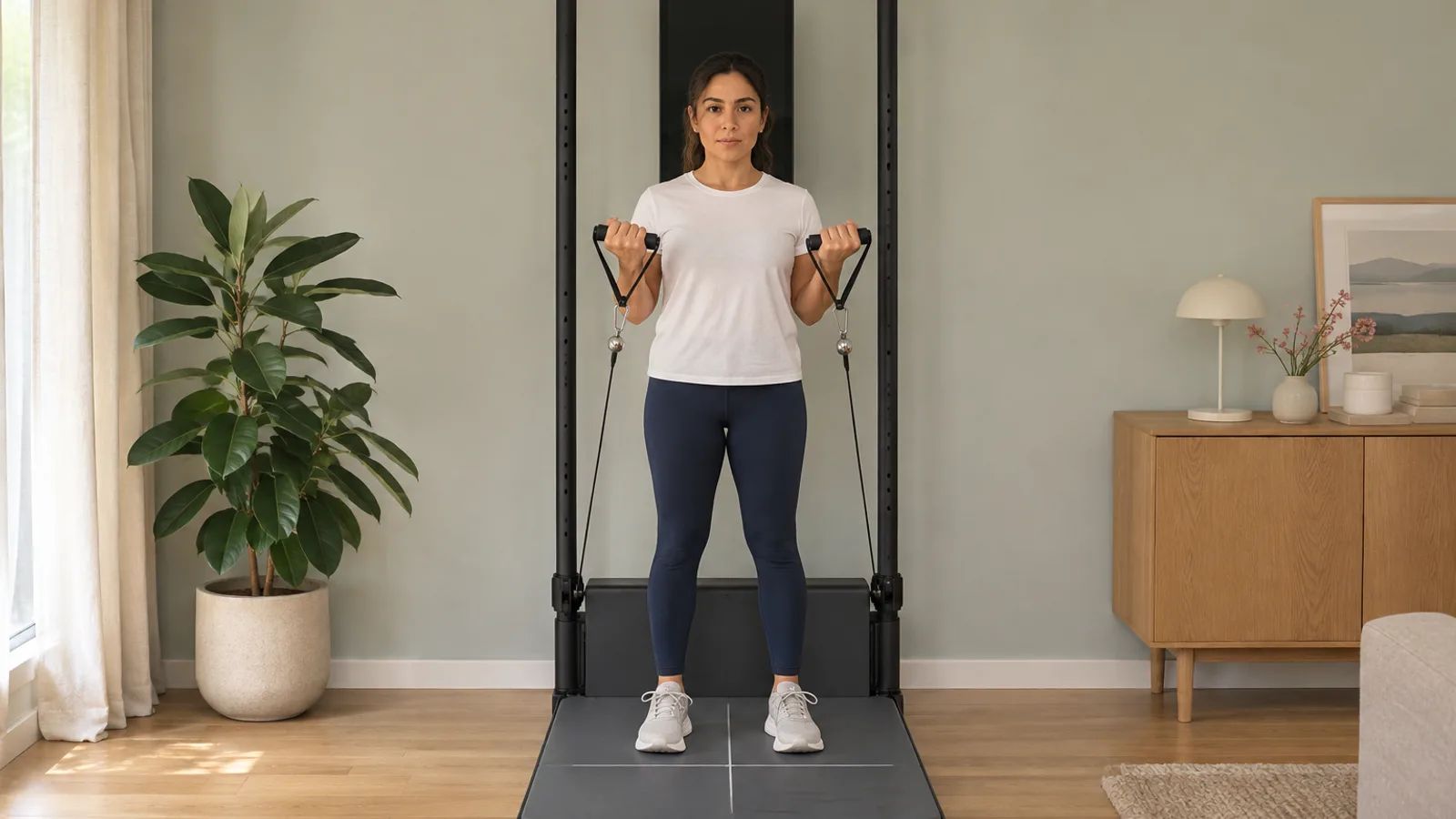
| Pull | A band anchored in a door, the one thing worth buying | One-arm row, band pull-down | Cable row, lat pulldown |
| Carry | Two full grocery bags, about 40 steps | A dumbbell in each hand, about 40 steps | Heavier dumbbells or a trap bar |
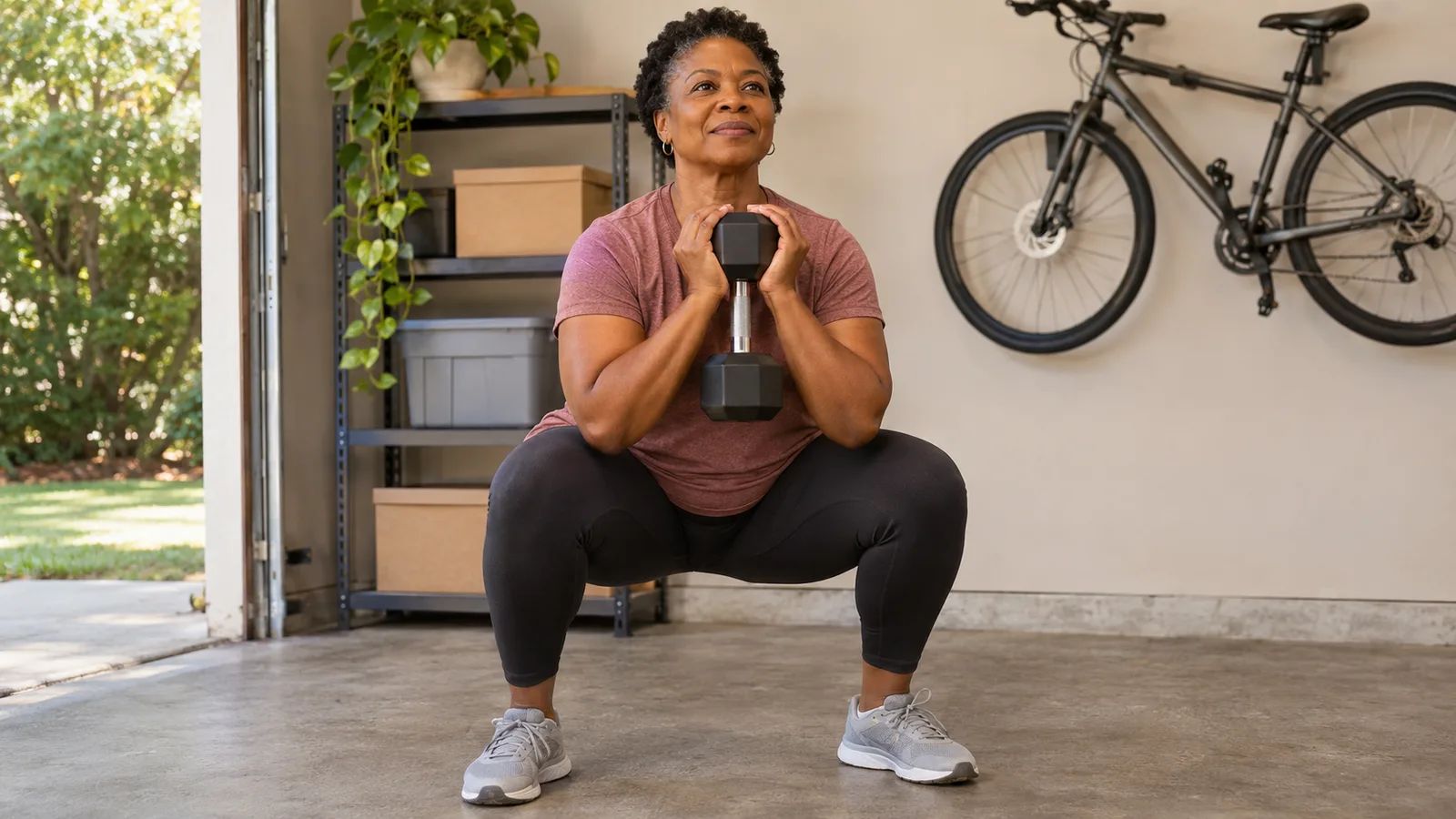
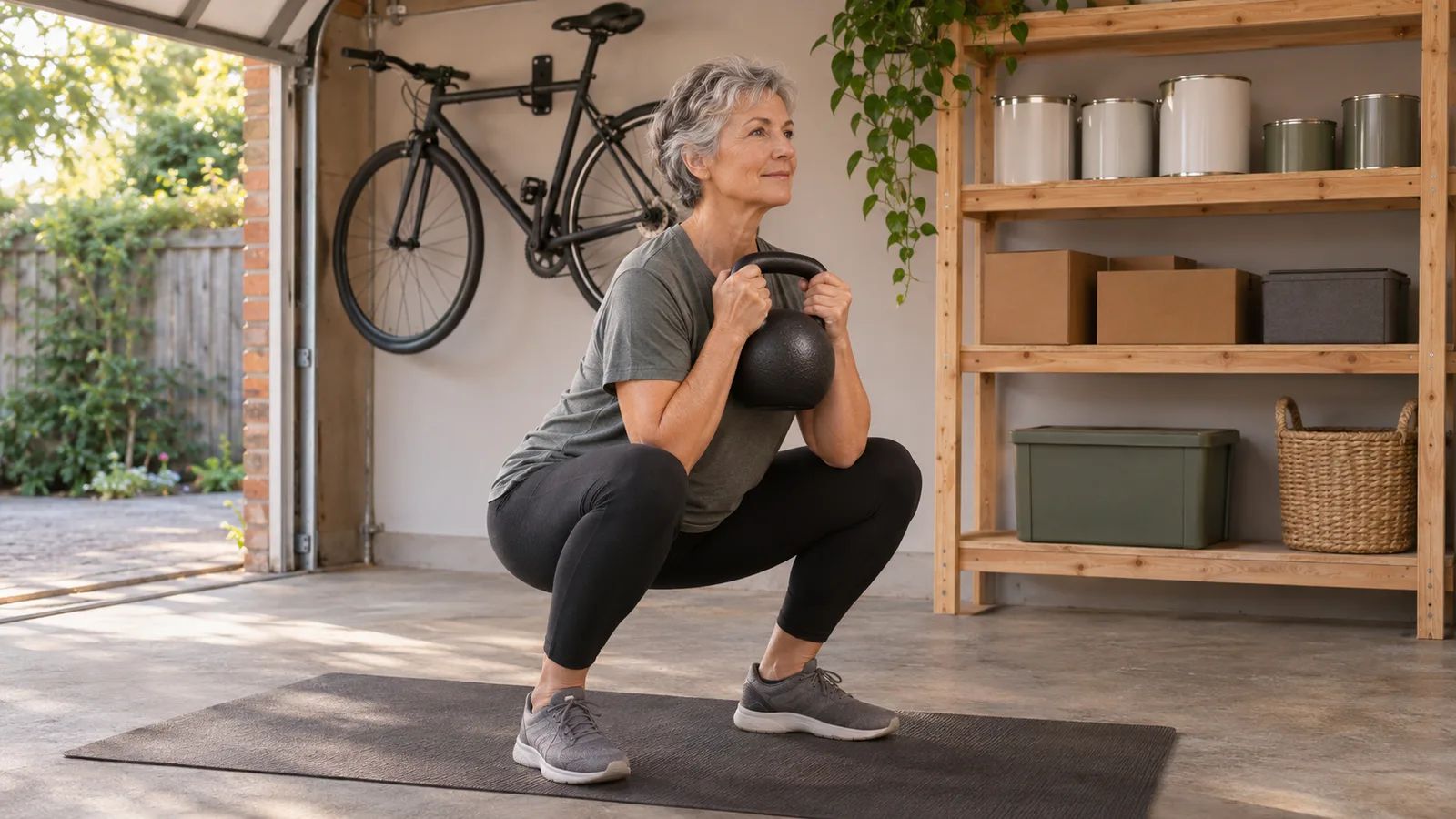
New to the names? A goblet squat is a squat holding one dumbbell at your chest. A split squat is a lunge where your feet stay put. A Romanian deadlift is the hinge: knees soft, push your hips back and slide the weights down your thighs, then stand tall. A floor press is a bench press lying on the floor.
When the heaviest dumbbells you own stop being heavy for you, even with the harder versions above, that's the point where buying heavier ones or joining a gym earns its money.
Sleep and protein, the short version
- Sleep. One bad night barely touches strength. Several short nights in a row can sap it on big moves like squats, though less on small ones like curls.4 On a run of bad nights, keep the session and take a little weight off.
- Protein. In trials where lifters took extra protein, it added a modest amount of strength, about 5.5 lb (2.5 kg) on a one-rep max. The muscle benefit stopped growing once total intake reached a little over 0.7 g per pound of body weight a day (1.6 g per kilo), and it was smaller in older people.5 For a 160 lb (73 kg) person that's roughly 110 to 120 g a day. If you have kidney disease, check protein with your clinician first.
How fast you'll get stronger
Quickly at first. In the first few weeks a lot of the gain is your body learning the movement: you get better at squatting before your legs grow much (why beginners get stronger so fast). Then the numbers settle into a slower, steadier climb.
How much? When researchers in Finland pooled their studies of beginners aged 19 to 78, strength rose 21% on average, but the range ran from 8% weaker to 60% stronger, and age and sex made no difference. Muscle size grew far less, about 5%.6 If you're gaining slower than a friend, that's ordinary variation, not a sign you're doing it wrong.
Here's what adding reps, then weight, looks like on paper. It's an invented example, not a real person's log: a goblet squat, twice a week.
| Weeks | Weight | Sets × reps |
|---|---|---|
| 1 to 2 | 20 lb (9 kg) | 2 × 6, learning the move |
| 3 to 4 | 20 lb (9 kg) | 3 × 6, then 3 × 8 |
| 5 | 20 lb (9 kg) | 3 × 8 with four left in the tank, so time to go up |
| 6 to 7 | 25 lb (11 kg) | 3 × 5, then 3 × 6 |
| 8 | Missed, a cold | Nothing |
| 9 to 10 | 25 lb (11 kg) | 3 × 6 again, then 3 × 7 |
| 11 to 12 | 25 lb (11 kg) | 3 × 8, getting easy, with 30 lb (14 kg) next |
Look at the flat stretches. A cold, a busy two weeks, a session where nothing moved: progress is a staircase with landings, and the landings are normal. The longer view is in how long until you see results from lifting.

Getting stronger with a coach watching
Everything above is free, and plenty of people get strong with it on their own. The rules are easy to read and harder to keep, because you're judging your own effort mid-set, by yourself, on a tired Tuesday.
At Bespoke Fit every session is a live 1‑on‑1 video call with your own coach, in our app on iPhone, Android or a browser, with your phone propped where it can see all of you. Three of the rules get much easier:
- Heavy enough. Your coach watches every rep and your form, so they can judge how many you had left and call the next weight. That's hard to do from inside the set.
- Full range. The squat that gets shallower on the last reps gets fixed during the set, not a day and a half later from a video you filmed and sent in. And if a move doesn't suit your knees or back, your coach sees it on the call and changes it in your program.
- Twice a week or more. Your coach books the sessions with you, and a person is waiting on the call at that time. That's what gets the second session of the week done (the appointment effect).
Say you've done your Romanian deadlift at 3 × 8 with 25 lb (11 kg) for two weeks, stopping at 8 because 8 felt like enough. On the call, your coach sees the last reps are still quick and your back stays flat: you had four or five more in you, the beginner's mistake from the top of this page. They tell you to pick up the 30 lb (14 kg) pair and cue you to push your hips further back so the range stays full. Some weeks it goes the other way: the last reps start cutting short at the bottom, so the weight stays put. The recap after each session logs it, and your top lifts build into a strength trend in the app.
You don't need to buy anything first. Your coach writes your program, so start by telling them what you have. Each coach has 12 members at most, and we hold to it when we assign coaches, because a coach who is live on every session can't look after hundreds. A head coach matches you to yours on a 30-minute call first.
"From day one, Coach Angela believed in me even when I didn't always believe in myself. She celebrates every small win and pushes me to become stronger every session. I've grown not only in strength but also in confidence."
April, a Bespoke Fit member
It's 14 days free, then $299/mo, cancel anytime, and the 14 days start at your first session. That buys unlimited sessions of 45 to 90 minutes; most people settle at around an hour. Twice a week works out at about $35 a session, three times about $23, against the $50 to $100 an hour a personal trainer typically charges (what trainers cost). A third session costs nothing extra, so the plan follows what you need rather than what each session costs.
It isn't for everyone. If you already add weight steadily on your own, or $299 a month would strain your budget, this page and the free beginner plans above are enough. If you need to train whenever a gap opens up, want someone in the room spotting a heavy barbell, or want meal plans, look elsewhere: sessions are booked, we coach on video, and we don't do nutrition.
Common questions
How can I get stronger fast? There's no shortcut past the five things above. The first month is the fastest part anyway, because you're learning the moves, so the most useful thing is not to miss sessions.
Can I get stronger without getting bigger? Mostly, yes. Strength climbs much faster than muscle grows, so you'll add some muscle, but slowly.
Is one set enough? One set still builds strength, so on a rushed day do one rather than skip. Two or three build more, and each set after that adds less.
How often should I change my workout routine? Rarely. Swap a move when it hurts, when you've run out of ways to make it harder, or when you're bored enough to start skipping sessions. Otherwise keep it and add weight, because you get stronger at the moves you practice.
How do you get extremely strong? In our view, the same five things, done for years. The strongest people practice a few big movements and keep adding weight to them, usually with a barbell and often with a coach checking their technique. This page is the same idea at the start.
Sources
-
Currier, B.S., D'Souza, A.C., Singh, M.A.F., and colleagues, 2026 (Phillips, S.M., senior author). American College of Sports Medicine position stand. Resistance training prescription for muscle function, hypertrophy, and physical performance in healthy adults: an overview of reviews. Medicine and Science in Sports and Exercise. 137 systematic reviews, more than 30,000 healthy adults. Strength improved most with heavier loads (80% of a one-rep max or more), full range of motion, 2 to 3 sets, lifting at the start of the session and at least two sessions a week, with sets stopped near failure (about 2 to 3 reps in reserve, though the authors note there is not enough evidence to set an exact number). Failure, machines versus free weights, unstable surfaces, fast versus slower (more than 2 seconds) contractions, time of day and set structure did not change strength, and the authors suggest failure may be inadvisable for some groups such as older people; periodization did not consistently change outcomes, and there was too little data on varied exercise selection. ↩ ↩2 ↩3 ↩4 ↩5 ↩6 ↩7 ↩8
-
Nuzzo, J.L., Pinto, M.D., Nosaka, K. & Steele, J., 2024. Maximal number of repetitions at percentages of the one repetition maximum: a meta-regression and moderator analysis of sex, age, training status, and exercise. Sports Medicine. 269 studies, 7,289 people; about 5 reps at 90% and 15 at 70%; at 80%, about 9 on the bench press and 13 on the leg press. Sex, age and training status made little difference. ↩
-
American College of Sports Medicine, 2009. Progression models in resistance training for healthy adults. Medicine and Science in Sports and Exercise. Recommends a 2 to 10% increase in load once the current load can be lifted for one or two reps over the target. ↩
-
Knowles, O.E., Drinkwater, E.J., Urwin, C.S., Lamon, S. & Aisbett, B., 2018. Inadequate sleep and muscle strength: implications for resistance training. Journal of Science and Medicine in Sport. 17 studies of moderate or weak quality; a night without sleep had little effect, while consecutive nights of short sleep could reduce force in multi-joint but not single-joint movements. ↩
-
Morton, R.W., Murphy, K.T., McKellar, S.R., and colleagues, 2018. A systematic review, meta-analysis and meta-regression of the effect of protein supplementation on resistance training-induced gains in muscle mass and strength in healthy adults. British Journal of Sports Medicine. 49 studies, 1,863 people; supplementation added 2.49 kg to one-rep max gains; beyond total intakes of about 1.62 g per kg a day it added no further gain in lean mass, and its effect on lean mass was smaller with increasing age. ↩
-
Ahtiainen, J.P., Walker, S., Peltonen, H., and colleagues, 2016. Heterogeneity in resistance training-induced muscle strength and mass responses in men and women of different ages. Age. Pooled data from earlier studies at the University of Jyväskylä: 287 untrained healthy adults aged 19 to 78, 72 of them non-training controls. With training, strength rose 21.1% on average (range -8% to +60%) and muscle size 4.8% (range -11% to +30%); age and sex did not affect the response. ↩