At-home workout plan without equipment: 12 weeks, any level
A 12-week at-home workout plan with no equipment. Find your starting version of each move, then train 2 or 3 times a week as the moves get harder.
In this article9
This is a whole plan you can start tonight. Two short workouts, A and B, done two or three times a week for about 30 minutes, with a chair, a door frame and the floor. You keep the same ten moves for all 12 weeks and make each one harder on a schedule, so your notes show you getting stronger.
It works. Bodyweight training builds muscle and everyday strength, as long as the sets get hard; it's weaker for your heaviest single lift, which needs real weight (the evidence). And if you can't do a push-up yet, or getting down to the floor is a project, there's a version for you. Your first session finds it.
The plan
| Order | Session A | Session B |
|---|---|---|
| 1a Legs | Squat | Split squat, each leg |
| 1b Pull | Door-frame row | Table row or backpack row |
| 2a Push | Push-up | Slow push-up |
| 2b Back of the legs | Glute bridge | Sliding leg curl |
| 3 Middle | Dead bug | Side plank, each side |
Order and rest. Do 1a and 1b back to back, rest about a minute, and repeat until their sets are done. Then 2a and 2b the same way, and finish with 3. Each muscle gets two minutes or so between its own sets without you standing around.
Reps and when to move up. Start each move on a version you can do 8 to 15 times. Stay on it and add reps week by week. When your first set reaches the number in the moves list (25 for most moves), move up one version, which drops you back to about 8 to 15. Two sets of each move in weeks 1 and 2, then three.
How hard. End every set with one to three good reps still in you. That's hard enough to change you and easy enough to come back for. How close to failure you need to go explains why.
Which days. Twice a week, do A then B, with a day or more between them. Three times a week, alternate: A, B, A one week and B, A, B the next, on any days with a gap between them.
Before each session, five minutes of warm-up: march on the spot, swing your arms, then an easy set of the first two moves. Warm-ups that actually prepare you to lift has more if you want it.
On the other days, walk. US guidelines ask adults for 150 minutes a week of moderate activity like brisk walking, plus muscle-strengthening work on at least two days.1 This plan is the strength half. A walk most days covers the rest.
Nothing in the plan jumps. That's on purpose: jump squats and burpees are hard on sore knees and unkind to downstairs neighbors, and a strength plan doesn't need them.
What you need
- Clear a patch of floor about 6.5 ft (2 m) square
- Pick a sturdy chair that won't slide, with its back against a wall
- Find a door frame you can grip on both sides, or a heavy table
- Put a towel or mat on the floor for the lying-down moves
- Open a note on your phone, or a notebook, for your log
Your first session, tonight
Many no-equipment workouts give a fit 25-year-old and someone who hasn't exercised in a decade the same "10 push-ups". This one starts you where you are. Your first two workouts double as a placement test: session A's moves tonight, session B's next time. The test set counts as your first set.
Warm up for five minutes
Take the first move at its easiest version
Do up to 15 reps. You're looking, not proving. If the easiest version is clearly too easy, skip ahead and start one version below where you think you are.
If 15 came easily, rest a minute and try the next version
Keep going up one version at a time.
Stop on the version where you get 8 to 15 clean reps with 1 to 3 left
That's your starting version, and that set was your first. If a version gives you fewer than 8 good reps, step back one.
Rest a minute, do your second set on it, write it down
The move, the version and the reps go in your log. Then go to the next move.
The side plank counts seconds instead: start on the version you can hold for 15 to 30. Tonight takes 30 to 40 minutes, a bit longer than later sessions because you're trying versions. From session 3 you switch to the pairs above.
A wall push-up is a perfectly good result. So is a sit-to-stand with your hands on your thighs. Plenty of people start there.
Talk to your doctor or physio first if any of these fit you:
- a heart, lung, kidney or metabolic condition
- chest pain, unusual breathlessness or dizziness when you're active
- osteoporosis or a recent operation
- pregnancy, or a baby in the last few months
Muscle burn is normal. Sharp pain in a joint means stop that move; joint-friendly programming that still builds strength covers training around sore joints.
The moves, easiest version first
Each line gives the versions from easiest to hardest, the count that moves you up, and the one cue that matters most.
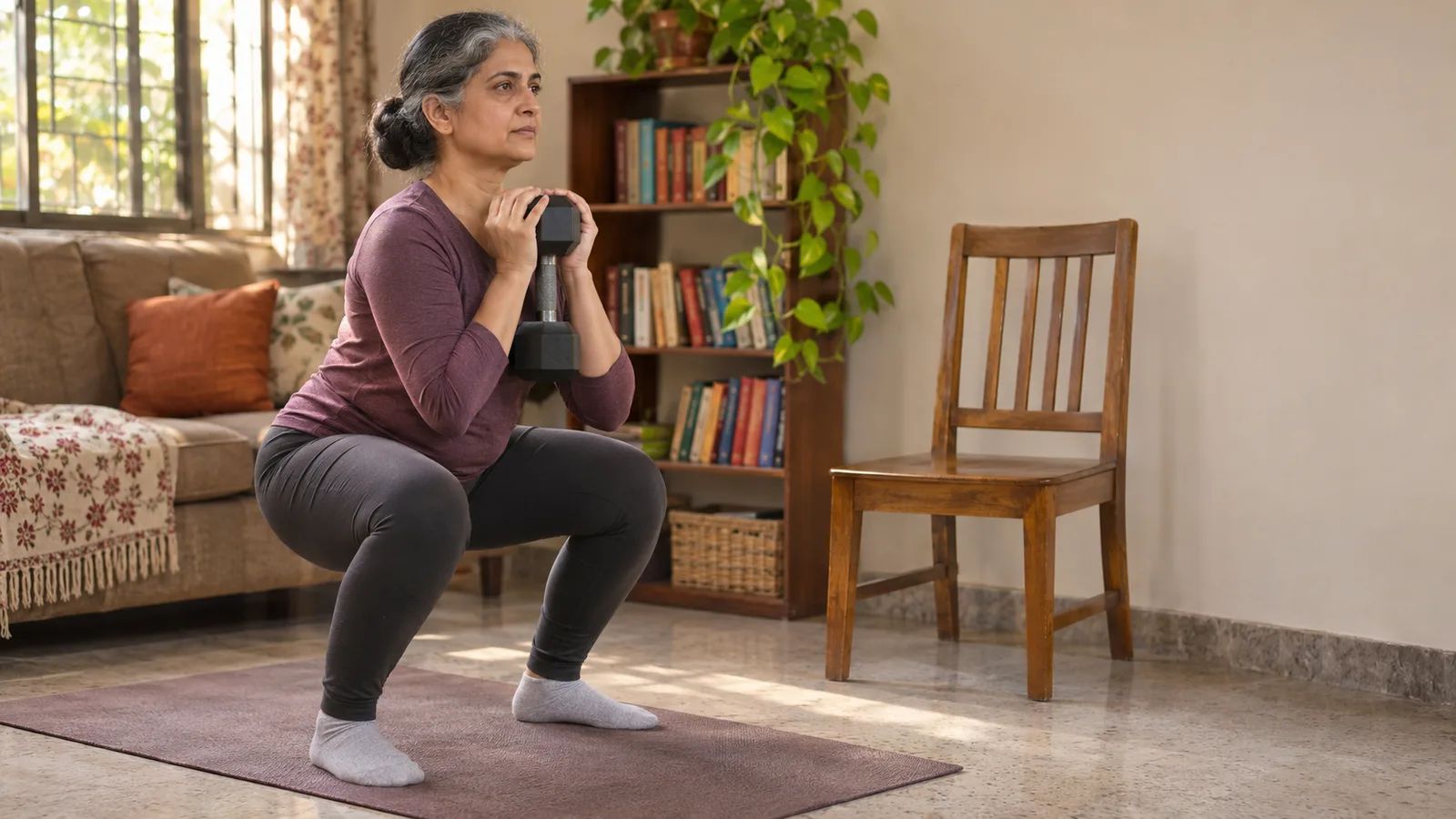
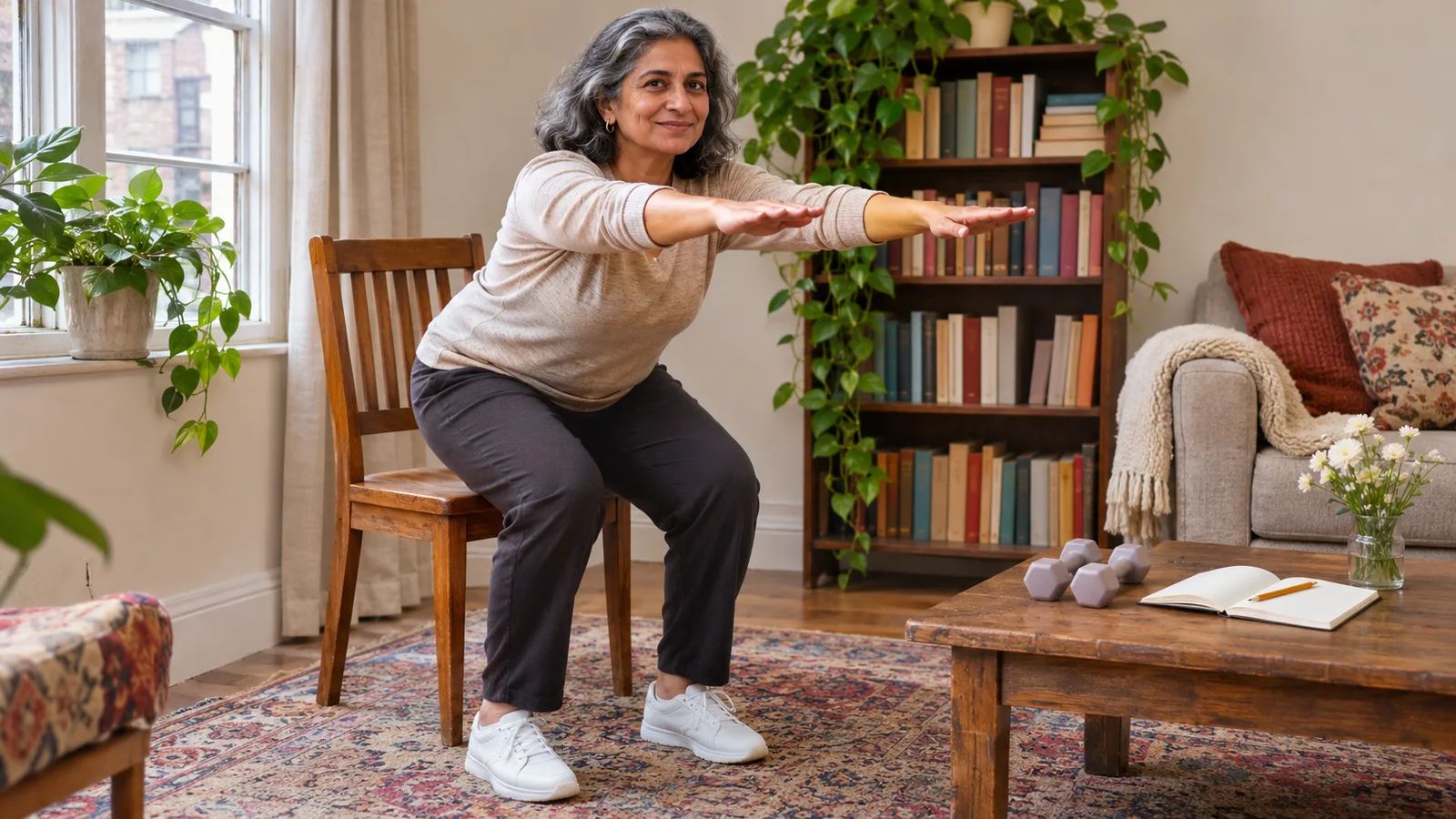
- Squat (move up at 25). Sit-to-stand from a chair, hands on thighs → arms crossed → from a lower seat → bodyweight squat → squat with a 2-second pause at the bottom. Cue: sit back as if the chair is a little further behind you than it is, knees following your toes.
- Split squat (25 a leg). Holding a counter, short range → holding a counter, back knee near the floor → no hands → back foot on the bottom stair or the sofa. Cue: most of your weight on the front foot; the back knee drops straight down, like a lift.
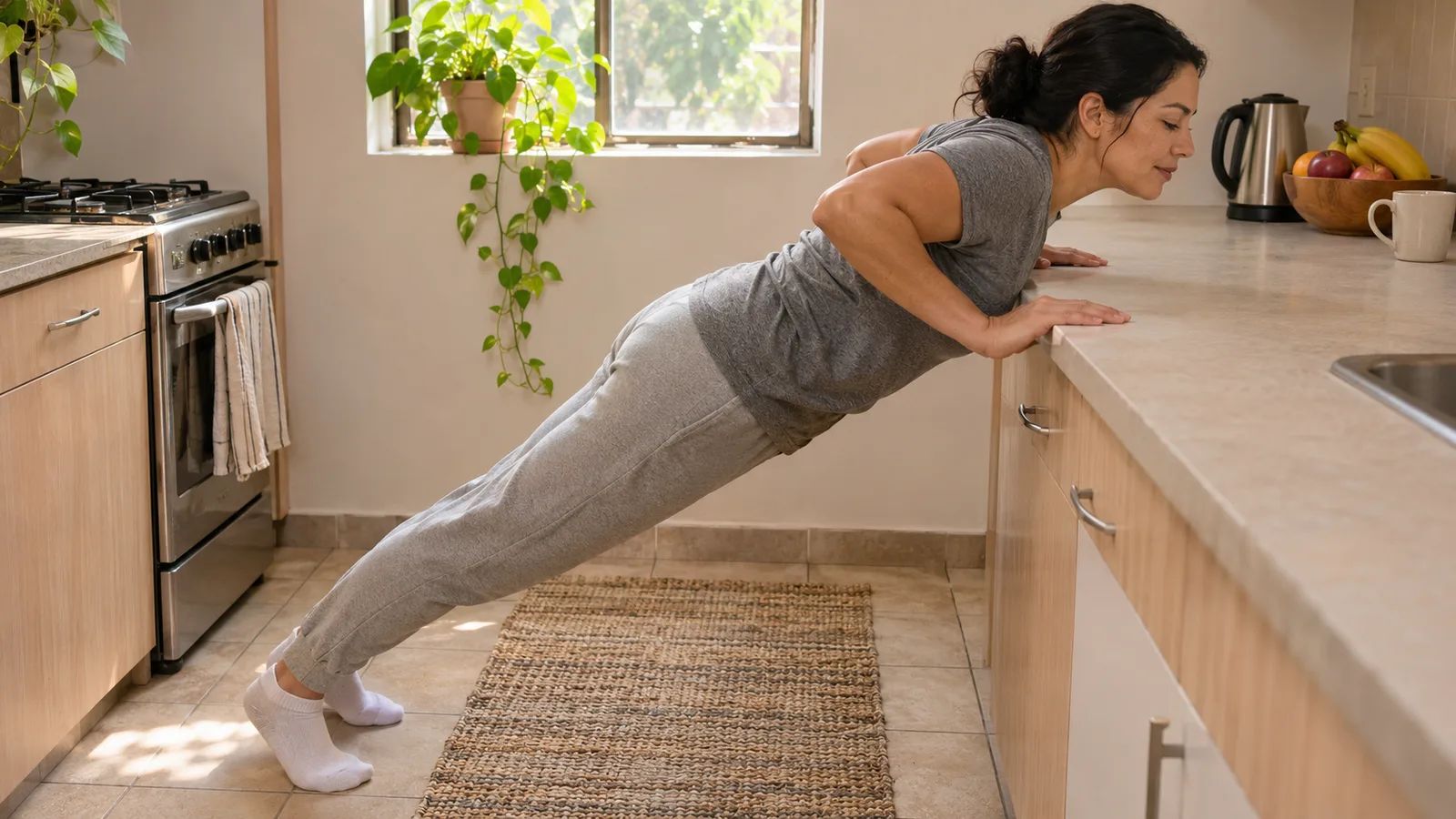
- Push-up (25). Wall → kitchen counter → table edge or the second stair → knees on the floor → floor → feet on the bottom stair. Cue: one straight line from head to heels (or knees), and your chest gets close to the surface, not just your chin.
- Slow push-up (15). The same ladder, 3 seconds down, a 1-second pause, normal speed up. Cue: count the seconds out loud; the last reps are where people rush.
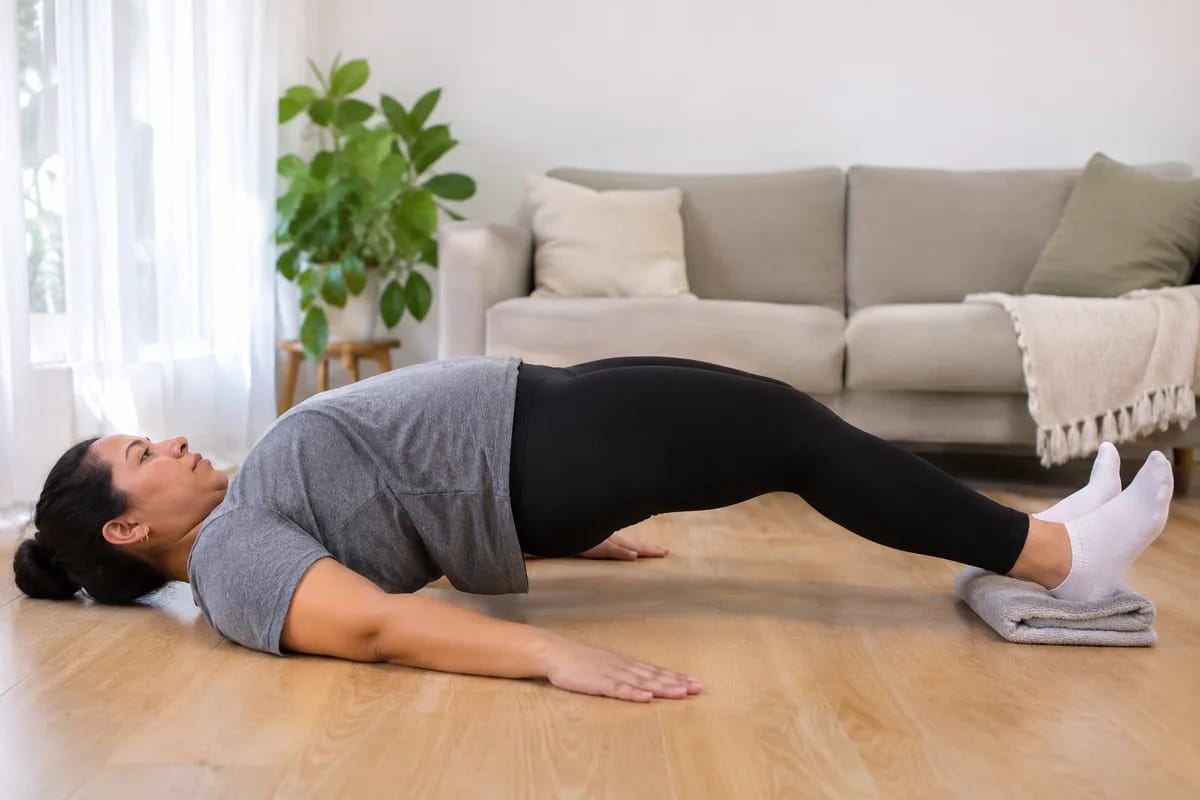
- Glute bridge (25). Both feet down → 2-second squeeze at the top → upper back on the sofa (hip thrust) → one foot down. Cue: push through your heels and squeeze your bottom at the top. If your lower back is doing the lifting, you've gone too high.
- Sliding leg curl (15). Lie on your back, heels on a towel. Lift your hips, slide your heels out slowly, then lower your hips and pull your heels back in → keep your hips up the whole way → one leg. Cue: socks on a smooth floor work too. If your hamstrings cramp in the first weeks, bend your knees less.
- Door-frame row (25). Feet close, small lean → feet further, bigger lean → one arm. Setup below.
- Table or backpack row (25). Table row, knees bent → legs straight. Backpack: more books. Setup below.
- Dead bug (15 a side). Lie on your back, arms pointing at the ceiling, knees bent over your hips with your shins level. Lower one heel to the floor at a time → opposite arm and leg together → the same, legs straighter and slower. Cue: keep your lower back resting on the floor, and breathe out as you reach.
- Side plank (45 seconds a side). On your knees → on your feet. Cue: stack your hips one over the other. If they sag toward the floor, the set is over.
Progressive overload at home without adding weight has the full ladder for each move, from the wall to archer push-ups, plus what to do when the next version is too big a jump.
Pulling, the move most plans skip
Pull-ups need a bar, so most home routines quietly leave pulling out, and your back and the fronts of your arms get nothing for 12 weeks. Here are two ways round it. Expect pulling to climb the slowest of your ten moves; it's the hardest pattern to load at home.
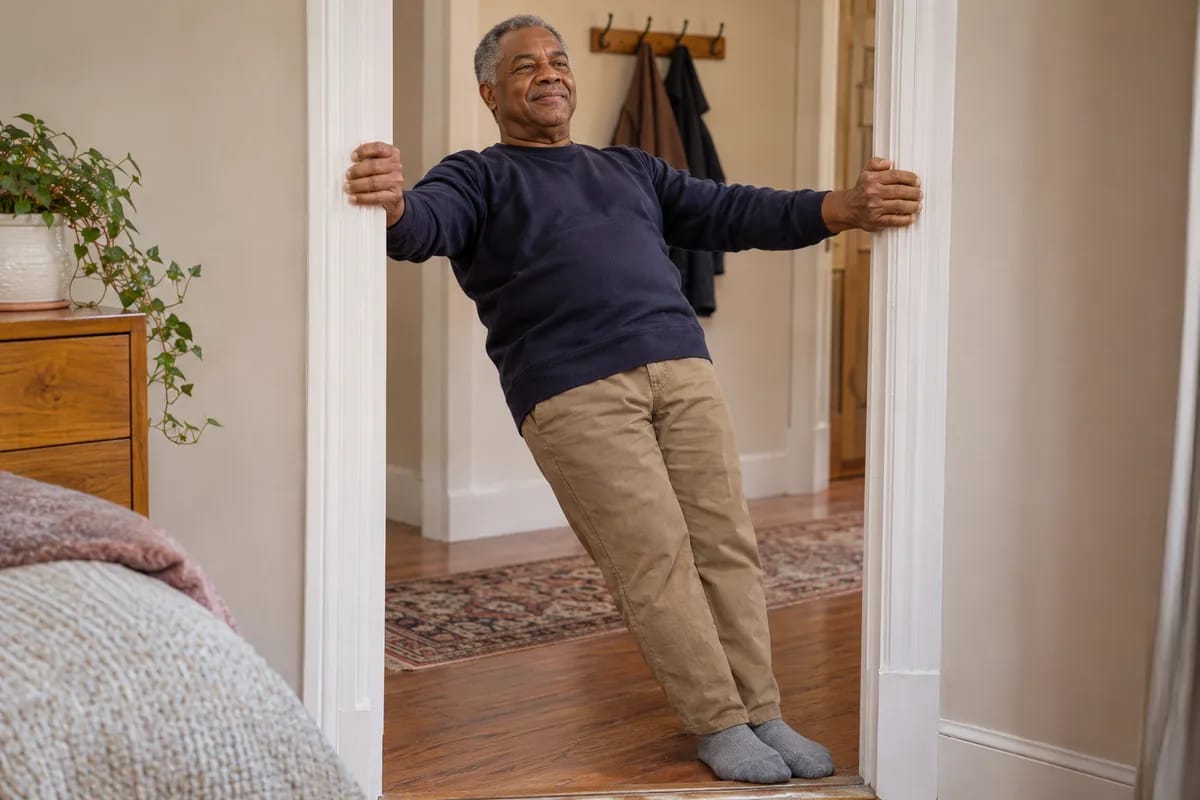
The door-frame row. Stand facing an open doorway with your toes near the frame. Hold both sides at chest height, lean back on straight arms, then pull yourself in. Keep the lean small at first, so a slipped grip means a step back, not a fall. Use a solid wooden frame, not a sliding door or a flimsy one.
The table row. Lie under a heavy table, hold the edge and pull your chest up to it. Test it first by hanging your weight off one edge: it shouldn't shift or tip. Skip folding tables and any table on a single central leg. If you don't trust any table in your home, fill a backpack with books, put one hand on a chair and row the bag with the other.
Your 12 weeks
Two rules on top of the rep rule:
- Judge the week, not the day. Some days nothing moves.
- A rep only counts at full depth. When the squats get shallower or the push-ups stop at halfway, the set is done, whatever the number says.
Weeks 1 to 2
Learn the moves
Your two placement sessions, then two sets each, stopping with about three reps left. It'll feel like learning a dance, and strength rises fast because most early strength is your nervous system learning the moves, with muscle growth catching up after a few weeks. Your first strength gains are neural explains it.
Weeks 3 to 6
Build
Three sets. Add reps where you can. Expect to move up a version on at least one move in this stretch.
Week 7
An easier week, if you want one
Two sets of each move on the same versions, stopping early. If life already gave you a week off, that was it. Why backing off makes you stronger covers the idea.
Weeks 8 to 11
Harder versions
Back to three sets, climbing toward the next version. If a jump is too big, make the version you're on harder first: 3 seconds on the way down, or a 2-second pause at the bottom. If you've been training twice a week, this is a good time to try a third session.
Week 12
Retest
Use the first two sessions of the week to repeat the placement test, and put the results next to your first log entries.
After week 12, you have four good options. Keep climbing, because most ladders have years of versions left. Wear a backpack of books for squats and split squats. Buy one thing: the first $300 of a home gym says what's worth it, and a resistance band for pulling is often first. Or get someone to watch you train, which the coach section covers.
When your week or your body needs a different version
Only 20 minutes
Do two sets instead of three, keep the pairs, and rest about 60 seconds between rounds. On a rushed day, drop the middle move. A 20-minute session keeps the habit and most of the progress. A skipped week does neither.
Getting down to the floor is hard

Every floor move has a version you can do standing or on a bed:
| Instead of | Do this |
|---|---|
| Push-up on the floor | Stay on the wall, counter or table versions longer. They're real training. |
| Split squat | Step up onto the bottom stair, holding the rail |
| Glute bridge | The same bridge, lying on a firm bed |
| Sliding leg curl | A single-leg hinge: hold the counter, tip forward from your hips on one leg, stand back up by squeezing your bottom |
| Dead bug | Counter plank: forearms on the kitchen counter, body in a straight line, hold 20 to 40 seconds |
| Side plank | Wall side plank: forearm on the wall at shoulder height, feet a step away, hold |
The squat and both rows are already standing moves.
An upstairs flat or thin walls
The loudest moment in the plan is your back foot landing after a split squat, and a folded towel takes care of that. Lifting in an apartment covers floors and neighbors in more detail.
A hotel room
Push-ups on the desk, split squats with your back foot on the edge of the bed, and a backpack row with your packed bag. The rest works on any floor. Staying consistent while traveling has more for trips.
Your log
Copy this into a note or a notebook and fill in a row per move each session.
| Day | Move and version | Reps per set | Notes |
|---|---|---|---|
| Week 3, Mon | Push-up, counter | 15, 13, 12 | Last reps slow |
| Week 3, Mon | Door-frame row, small lean | 14, 14, 12 | Grip felt fine |
Always write the version as well as the reps. Twelve on the counter and twelve on the floor are very different days, and in week 12 the version is where your progress shows.
Does a plan with no equipment actually work?
US activity guidelines count bodyweight moves like push-ups as muscle-strengthening, as long as you work until another rep is hard.2
The research on load was done with weights, but it points the same way. Pooled across 21 studies, light loads built about as much muscle as heavy ones when every set went to the limit, while heavy loads built more one-rep strength.3 A hard set of push-ups is a light load taken close to the limit, so we'd expect the same, though those studies didn't test bodyweight directly. If your goal is the biggest possible deadlift, you'll want a barbell at some point. If it's a stronger body that carries the shopping and gets up off the floor easily, this plan has plenty to give.
Harder versions carry over to weights too. In one small four-week trial, young men who worked through harder push-up versions raised their bench press, as did men who bench pressed, and no change in muscle thickness was detected in either group yet.4 That fits the timeline above: stronger first, visibly different later. How long until you see results gives a realistic picture.
Running the plan with a coach on the call
Everything above works on your own. Four parts are hard alone, and they're where plans usually stall: picking the right version, knowing whether a rep counted, deciding when to move up, and turning up on the evening you'd rather not.
That's the job Bespoke Fit does. Every session is a live 1‑on‑1 video call with your own coach, in our app on iPhone, Android or a browser. Your coach writes your plan around what you have, including nothing at all, and you log each set in the app as you go.
Say you'd have picked knee push-ups in the placement test. Your coach sees your hips sag from rep six and moves your hands up to the stairs, where all twelve reps are clean. When your back knee stops getting near the floor late in a set of split squats, your coach tells you during the set, so the last reps count. A few weeks later your stair push-ups stay crisp to the end, and your coach moves you to the floor that evening, before you'd have trusted yourself to try.
A follow-along video or a workout app can hand you a routine for much less, any time you like. Neither has a person watching your reps, and neither is waiting for you. Your coach books each session with you, and it arrives as a calendar invite with reminders. Skipping means telling a person who's expecting you, which is a big part of why the tired evening still happens.
The price is flat and sessions are unlimited, so each one gets cheaper the more you train: about $23 at three a week (13 a month), under $18 at four. Echelon Coach, which also trains you live 1‑on‑1 on video, charges $80 for a single hour, or about $56 each in its biggest monthly bundle.5 And your coach has 12 members at most, so they remember which stair you were on in week three.
Sessions run 45 to 90 minutes, and most people settle at around an hour. With nothing at home, that leaves room for a proper warm-up, more sets and harder versions of the same moves. Wear an Apple Watch or a Bluetooth heart rate strap and your coach watches your heart rate live, using it to set how long you rest between pairs. After each session a recap shows your sets and any records, and you can message your coach between sessions, photos included.
Deejay, 24, a member who trains with JP, put it this way: "He adjusts my workouts depending on where I am, whether that's a commercial gym, my home studio, or traveling with no equipment at all. He makes any space work."
It's 14 days free, then $299 a month, cancel anytime. The 14 days start at your first session, not when you sign up. You begin with a 30-minute call with a head coach, who matches you to your coach. How it works walks through a session.
Keep going on your own if your log is filling up and you like running it yourself. That's the plan doing its job. The same goes if $299 a month would pinch: film one set from the side every couple of weeks and you'll catch some of what a coach would, after the set rather than during it. And if you want meal plans or someone in the room, we're the wrong pick. We don't do nutrition coaching, and your coach watches through your camera.
Common questions
Will this plan help me lose weight? Not by itself. Thirty minutes of bodyweight strength work burns roughly 110 to 140 calories for a 165 lb (75 kg) adult.6 Weight comes off mainly through what you eat, and a registered dietitian is the right person to ask about that. What the plan does is help you keep and build muscle while you lose, and the walks on the other days add up.
I'm sore after the first session. Should I skip the next one? Usually not. Soreness a day or two after new moves is normal, and it eases as your body gets used to them. Do the next session on its planned day and go a little easier if you're stiff.
What is the 3-3-3 rule for workouts? It means different things on different sites. One common version is three exercises of three sets, three days a week. There's nothing special about the number three, and this plan lands close to it anyway: three sets once you're past week two, and up to three sessions a week.
Sources
-
Centers for Disease Control and Prevention. Adult activity: an overview. ↩
-
Centers for Disease Control and Prevention. What counts as physical activity for adults. Lists "exercises that use your body weight for resistance, such as push-ups or sit-ups", done "to the point where it's hard to do another repetition without help". ↩
-
Schoenfeld BJ, Grgic J, Ogborn D, Krieger JW, 2017. Strength and hypertrophy adaptations between low- vs. high-load resistance training: a systematic review and meta-analysis. Journal of Strength and Conditioning Research. All studies used external loads with sets taken to failure. ↩
-
Kotarsky CJ, Christensen BK, Miller JS, Hackney KJ, 2018. Effect of progressive calisthenic push-up training on muscle strength and thickness. Journal of Strength and Conditioning Research. 23 moderately trained men (mean age about 23), 3 days a week for 4 weeks; both groups' bench press 1RM rose, with no significant change in muscle thickness. ↩
-
Echelon Coach. Plans and pricing, checked 11 Nov 2026. A single session is $80 for 60 minutes; the 24-session monthly plan works out at $55.80 a session. ↩
-
Adult Compendium of Physical Activities, 2024. Conditioning exercise. Lists "body weight resistance exercises (e.g., squat, lunge, push-up, crunch), general" at 3.0 METs and moderate-effort calisthenics at 3.8. The calories are our arithmetic, using the usual estimate of about 1 calorie per kg of body weight per hour for each MET. ↩