Lifting in an apartment: noise, floors and neighbors
The thud that travels through your building isn't your effort, it's impact. Here's how to lift hard in an apartment without starting a noise war.
In this article7
Most people think the problem is noise. It isn't, not really. You can grind through a brutal set of squats and your downstairs neighbor won't hear a thing. What gets you a knock on the door is one specific event: metal hitting the floor. So the real goal was never quiet. It's getting rid of impact.
That distinction changes what you actually need to fix. You don't need to train softer or lighter. You need to kill the sudden, sharp collisions that travel through the building's bones, and you can do that without giving up a single hard set. A home gym on a budget covers what to buy to get started at home. This post is the narrower problem: keeping the peace with the people who share your walls and floor.
It's the drop, not the effort
Picture a loaded barbell falling a few inches onto a hard floor. One moment it's moving, the next it's dead still. All that downward momentum has to go somewhere, and it goes there in a tiny slice of time. The shorter the stop, the bigger the force.
That's really the whole story. Force is about how fast something's motion changes. Lower a weight slowly and the force stays gentle, spread out over half a second or more. Let it fall and stop dead, and you get a spike many times larger, packed into a few thousandths of a second. Engineers call that a transient, and buildings are very good at carrying it.
This is why a drop spreads through a whole building. An apartment floor is one stiff, connected structure of concrete, joists, and subfloor. A sudden impact sends a pulse of vibration into it, and the structure passes that pulse to everything it touches: the ceiling below you, the walls, the frame of the next unit over. Your downstairs neighbor isn't hearing the air in your room. They're hearing their own ceiling and walls shake, driven by the hit you just sent into the floor. That's structure-borne sound, and it's why a thud two floors up can feel like it's happening in the room with them.
A slow, heavy squat doesn't do any of this. It puts a large but steady load on the floor, and the structure carries it quietly, the same way it carries a loaded bookshelf. It's the suddenness that travels, not the weight and not how hard you're working.
The floor barely notices a heavy weight resting on it. It broadcasts a heavy weight slamming into it. Kill the slam and you've solved most of the problem.
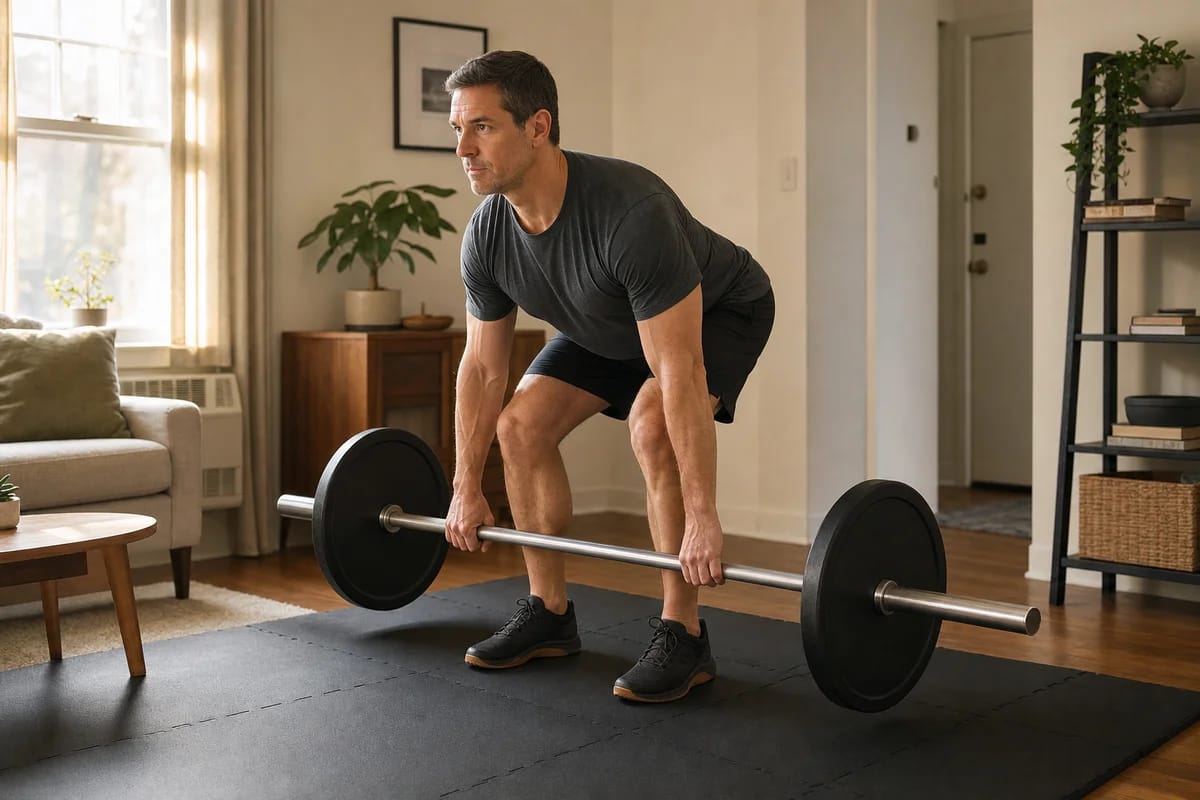
Lower it under control and you've fixed most of it
This costs nothing and beats any mat you can buy. Set a deadlift down under control instead of letting it drop from your hips, and you stretch that stop from a few thousandths of a second to something like half a second. A longer stop means a much lower peak force and a much smaller pulse into the floor.
There's a training bonus buried in here too. The lowering phase of a lift, the eccentric, is where a lot of muscle actually gets built, so controlling the weight down isn't a favor you're doing your neighbors. It's often better training, which why the lowering phase builds the most muscle covers in more depth.
In practice: on any lift where the weight would otherwise hit the floor, keep your hands on it the whole way down. Lower deadlifts, don't drop them. Never bail a rep by throwing the bar.
Control the way down and you've removed the single loudest event in most home workouts.
Rubber mats beat foam for a real reason
For lifting, rubber wins, and the reason comes back to impact. A floor covering can do two things: add mass, and add damping. Dense rubber does both far better than cheap foam.
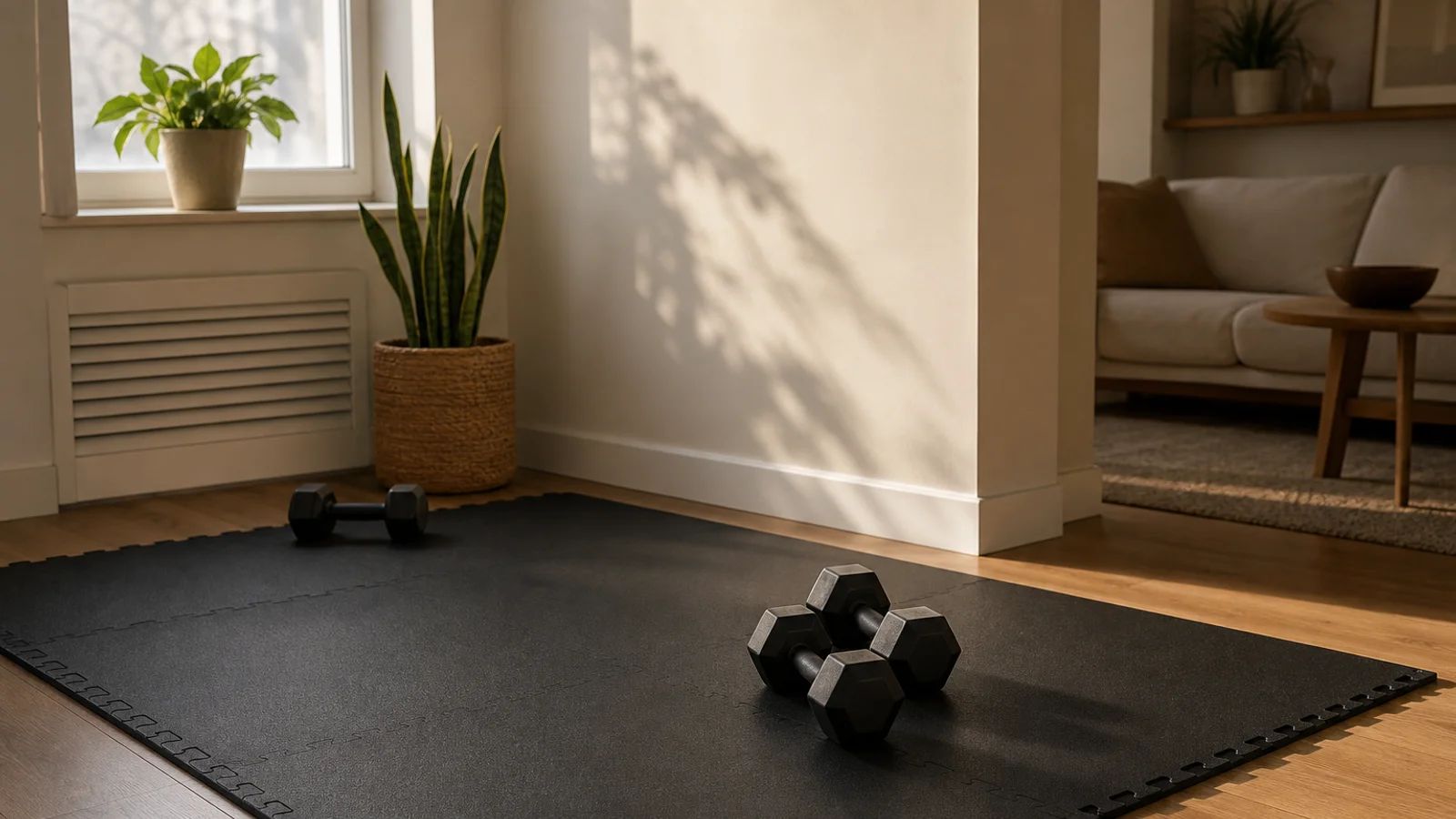
Rubber stall mats, the kind sold for barns, are thick and heavy, often around three quarters of an inch and dozens of pounds each. That mass and density soak up vibration and turn any weight that does touch down into a soft, dead landing instead of a hard ring. They also give you a stable, firm surface to lift on, which matters with a loaded bar overhead.
Interlocking foam tiles are cheap, light, and fine for stretching, bodyweight work, and protecting the floor from a dropped dumbbell. Under a heavy barbell they have two problems. They compress and feel squishy, which is genuinely unsafe when you're balancing real load. And because they weigh almost nothing, they do little to stop vibration reaching the structure. Soft isn't the same as isolating.
The setup that actually works is layered: something compliant underneath to absorb shock, mass on top to damp it and give you a solid platform. Some people build a small lifting platform, plywood topped with rubber over a layer of foam, so the whole thing floats slightly and decouples from the floor. You don't need to overthink it though. A couple of stall mats where you lift covers most of what a home lifter needs.
Foam protects the floor. Rubber protects your neighbor's ceiling. For lifting, you want the rubber.
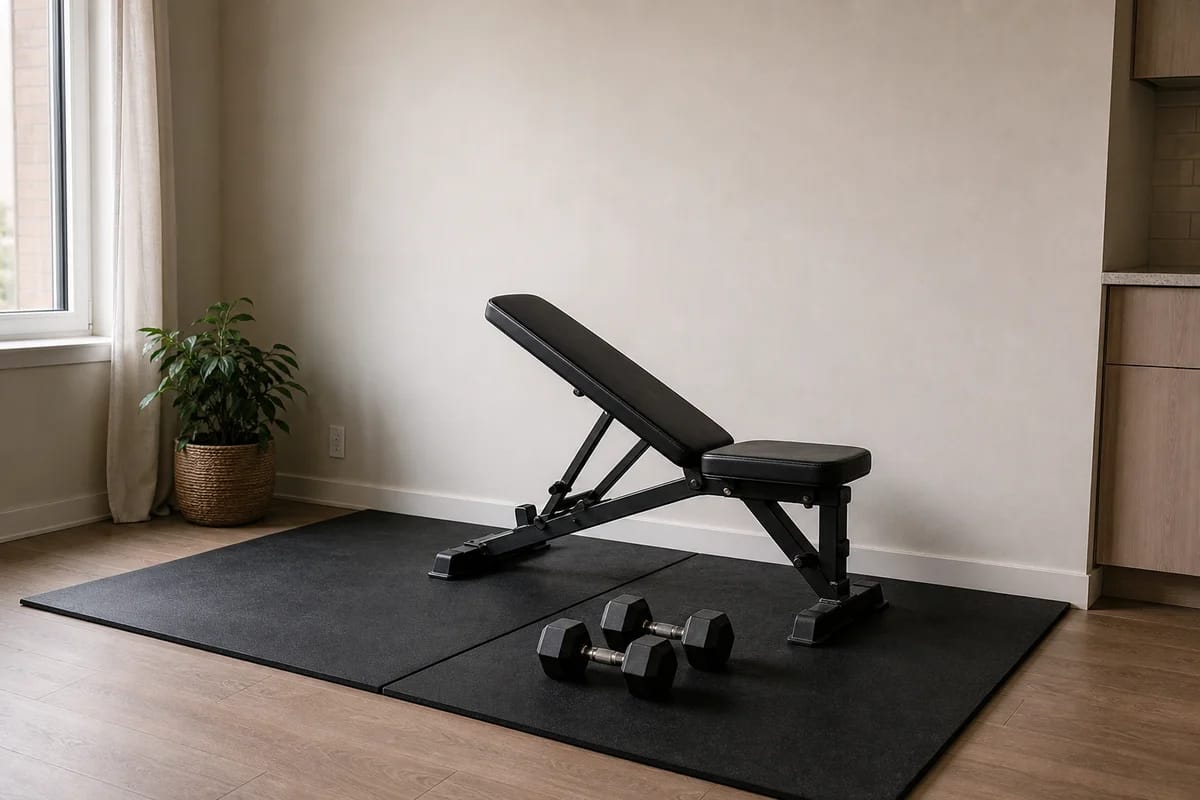
Swap the exercises that end in a crash
Once you stop assuming you need a barbell crashing to the floor, you've got plenty of options. Almost every exercise that draws a complaint shares one feature: a weight leaving your control and landing hard. Cut those, keep the rest.
Dumbbells help a lot here. You can set them down quietly, they're easy to control, and a heavy dumbbell workout builds real strength and size. Tempo work, where you deliberately slow the lift down, makes a lighter weight feel brutal with zero impact, which is useful on days you can't go heavy.
For the deadlift, the usual apartment problem is the return to the floor. Two fixes: pull from blocks or stacked mats so the bar starts higher and the drop is shorter, or switch to a trap bar, which is easier to lower under control than a straight one. Better still, lean on movements that never touch the floor hard at all. Heavy carries like farmer's walks load your whole body and grip while staying quiet, and Romanian deadlifts lowered to just below the knee train the same posterior chain without ever landing.
What to skip is short. Box jumps, dropped kettlebell swings, cleans and snatches finished by dumping the bar, repeated jumping, plyometrics on hard floors. None of it is necessary to get strong, and all of it thumps.
If a movement is built to end with something hitting the ground fast, there's almost always a quieter version that builds the same muscle.
What mats and good form can't fix
Not every building behaves the same, and you can't always tell from inside your own unit. A concrete high-rise handles impact very differently from an old timber-framed walk-up, where footsteps alone carry through the ceiling. Some floors forgive a bit. Some will telegraph a dropped dumbbell three units away. You often won't know which one you've got until a neighbor mentions it, so start conservative, keep your heaviest sessions inside sensible hours, and ask early rather than waiting for a complaint.
Mats and platforms cut impact. They don't erase it. Even a good rubber setup passes some vibration into a lively floor, especially under heavier loads. If you're training late at night in a sensitive building, your technique and exercise choices matter more than any product, because the best floor covering still can't undo a genuine drop.
And there's a real limit in a rental. If you're set on repeated heavy barbell deadlifts from the floor at full weight, no apartment fix makes that reliably neighbor-proof. That's a case for saving your heaviest pulls for a gym and keeping everything else at home, not for buying a thicker mat.
Common questions
Will rubber mats stop my downstairs neighbor from hearing me? They'll cut the impact from a set-down weight a lot and give you a stable surface, but they won't fully block a genuine drop on a lively floor. Mass and damping reduce the pulse that reaches the structure, they don't cancel it. Pair the mats with controlled lowering and quiet exercise choices, and that combination does far more than mats alone.
Is it the weight or the dropping that makes the noise? The dropping. A heavy weight resting or moving slowly puts a large, steady load on the floor, and the structure carries that quietly. A weight that hits the floor stops in a fraction of a second, and that sudden stop sends a sharp spike of force through the building. Lift as heavy as you like. Just don't let it fall.
Can I do deadlifts in an apartment at all? Yes, with some adjustments. Pull from blocks or stacked mats to shorten the return, use a trap bar so lowering is easier, and set the bar down under control on every rep instead of dropping it. If you want to pull very heavy from the floor for reps, that specific lift is worth saving for a gym while the rest of your training stays home.
What time of day is acceptable to lift at home? There's no universal rule, but roughly 8am to 9pm is a safe default, and many buildings enforce quiet hours after 10 or 11pm. Structure-borne thumps feel much worse to a neighbor early or late, so keep your loudest work to the middle of the day when you can, and ask the person below you what actually bothers them.
Mats are the easy part
None of this is complicated on its own. Control the eccentric, put down a couple of rubber mats, build your program around dumbbells and carries. Ask yourself one thing: four sets into a tired, rushed Friday session, do you actually catch yourself before a rep turns into a drop? If that's true every time, you already have what you need.
Where it gets harder is staying consistent with that discipline over months, choosing swaps that keep building strength while the reps stay quiet, and knowing which lifts genuinely can't be made apartment-friendly no matter what you do. At Bespoke Fit, your coach watches your setup live over HD video, sees your actual space and floor, and builds a plan around it, with a real coach every session and never AI. The coaching is equipment-agnostic and works fine in a small room. Your first 14 days are free, then it's $299 a month, with unlimited live 1‑on‑1 sessions.
More on