Workout plans for women: 4 free routines for home or the gym
Four free workout plans for women: new at home, new at the gym, home with dumbbells, or coming back after a break. Sets, reps and when to add weight.
In this article12
The short version
Two or three full-body strength sessions a week, 30 to 60 minutes each, built on five moves: a squat, a hip hinge, a push, a pull and a carry. Add a rep or a little weight every week or two.
That's the whole recipe, and it's the same one a good coach would give a man (why, below). What differs from one woman to the next is the starting point: a living room or a gym, never lifted or lifted for years before life got in the way.
So here are four plans, sorted by where you're starting, with every set and rep written out and every move explained. Save the page. You'll want it on your phone mid-session.
Which plan is yours
| If you're | Your plan | Each week | Kit |
|---|---|---|---|
| New to lifting, at home | Plan 1 | 2 days, about 30 min | A chair, light dumbbells or a backpack |
| New to lifting, at a gym | Plan 2 | 3 days, 45 to 60 min | Machines and dumbbells any gym has |
| At home with dumbbells, ready for more | Plan 3 | 3 days, 40 to 50 min | Two or three pairs, or one adjustable pair |
| Coming back after a break | Plan 4 | 2 days, then 3 | Whatever you'll train with |
Two days a week is the floor the US guidelines set for strength work.1 Three is better if your week allows it: across studies of women who lifted, training more often went with bigger strength gains.2 If you can only promise two, pick two and keep them. Two that happen beat three that don't.
How every plan works
Learn these four things once and every table below makes sense. If a move's name is new to you, the moves, in plain words describes each one, after the plans.
Warm up for 5 to 10 minutes. March on the spot, swing your arms, do a few slow squats with no weight, then one light set of your first move. Warm-ups that work has more if you want it.
End each set with about two reps left in you. The last few reps should slow down and take real effort, but still look like the first one. If you could have done five more, go heavier. If your form fell apart to finish, go lighter. Most beginners start with 5 to 10 lb (2 to 5 kg) for arm moves and about double for legs; how much weight to start with has a number for each move, and reps in reserve shows how to judge the effort. You never need to grind a set until you physically can't move the weight.
Add reps, then weight. Every move below has a rep range, like 8 to 12. Climb it like this:
Start at the bottom of the range
Pick a weight you can lift for the lowest number, here 8, with about two reps to spare.
Add a rep or two when you can
Same weight, a rep or two more each session, until every set reaches the top of the range, here 12.
Go up one weight and drop back to the bottom
Use the smallest jump you have, start again at 8, and climb again.
At home there's often no heavier dumbbell to go to. Then keep adding reps to about 25 and switch to a harder version of the move. Progressive overload at home has a ladder of versions for each one.
On a rough day, shrink the session instead of skipping it. Bad sleep, a heavy period, a long shift: do one set of each move with lighter weights. It still counts, and the habit survives the week.
Plan 1: brand new, at home
Two sessions a week, about 30 minutes each, for 6 to 8 weeks. Monday and Thursday works, or any two days with a gap between them. You need a sturdy chair without wheels, a bit of floor and a pair of light dumbbells. No dumbbells yet? A backpack with a few books in it does the row and the carry.
Do the moves in order and rest about a minute between sets.
| Move | Sets × reps | Easier, harder |
|---|---|---|
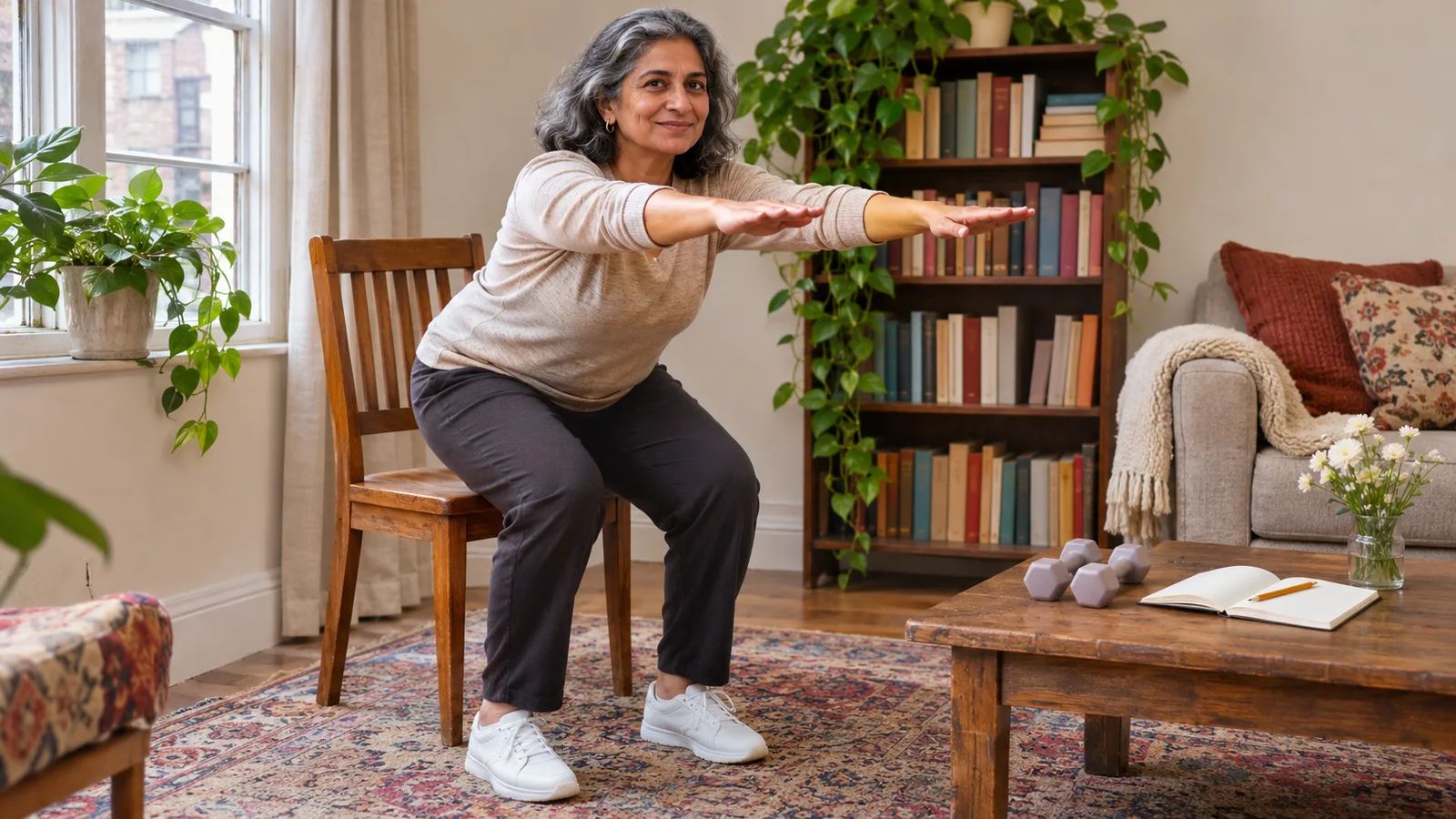
| Sit-to-stand from a chair | 2 × 8 to 12 | Easier: push off your thighs. Harder: hold one dumbbell at your chest |
| Glute bridge | 2 × 10 to 15 | Harder: pause 2 seconds at the top, or rest a dumbbell on your hips |
| Wall push-up | 2 × 8 to 12 | Harder: hands on a kitchen counter, then a sturdy table |
| One-arm row | 2 × 10 to 12 each side | Harder: a heavier weight, or a 2-second pause at the top |
| Dead bug | 2 × 6 to 8 each side | Easier: move only your legs. Harder: go slower |
| Suitcase carry | 2 × 30 seconds each side | Harder: a heavier weight, or walk longer |
When to move on: after 8 weeks, or sooner if the sit-to-stand with a dumbbell and the counter push-up both reach the top of their ranges. Staying home? Go to Plan 3; you'll want a heavier pair or two, and the first $300 of a home gym shows what to buy first. Joining a gym? Plan 2.
Plan 2: brand new, at a gym
Three sessions a week, 45 to 60 minutes each, for 8 to 12 weeks. Monday, Wednesday and Friday works, or any three days with a rest day between. There are two workouts, A and B, and you alternate them: A, B, A one week, then B, A, B the next. Rest about two minutes after each set of the first two moves, and about a minute on the rest.
Workout A
| Move | Sets × reps | Watch for |
|---|---|---|
| Leg press | 3 × 10 to 12 | Knees bend to about a right angle, lower back stays on the pad |
| Dumbbell Romanian deadlift | 3 × 8 to 10 | Dumbbells stay close to your legs all the way down |
| Chest press machine | 3 × 8 to 12 | Set the seat so the handles sit level with your chest |
| Seated cable row | 3 × 10 to 12 | Sit tall, pull to your belly, shoulders down |
| Plank | 2 × 20 to 30 seconds | Knees on the floor is fine |
Workout B
| Move | Sets × reps | Watch for |
|---|---|---|
| Goblet squat | 3 × 8 to 12 | Knees track over your toes |
| Hip thrust on a bench, or the machine | 3 × 10 to 12 | Chin tucked, pause at the top |
| Lat pulldown | 3 × 8 to 12 | Bar to your upper chest, never behind your neck |
| Seated dumbbell shoulder press | 2 × 8 to 12 | Back against the bench |
| Farmer's carry | 2 × 30 to 40 seconds | Shoulders down, no shrugging |
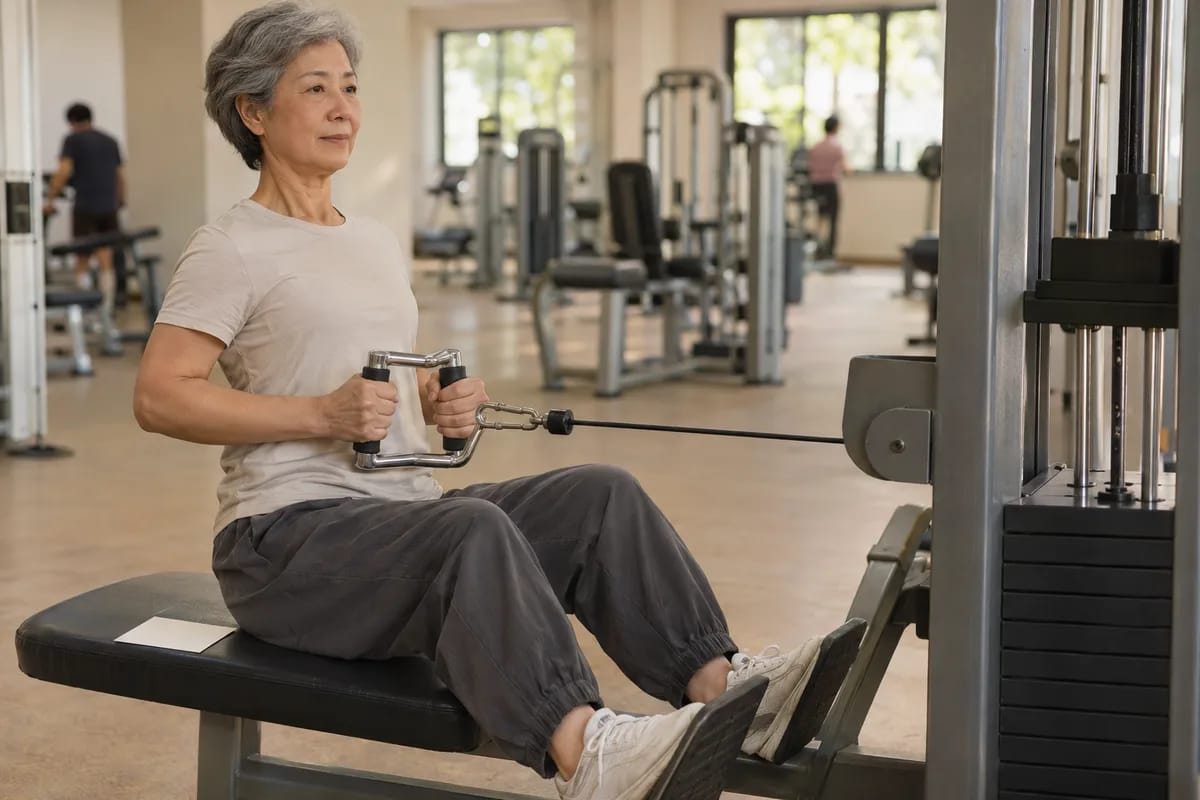
Machines are a perfectly good place to start. They hold you in position while you learn, and the American College of Sports Medicine's 2026 review of the evidence found that the type of equipment didn't consistently change results. Neither did training to all-out failure.3
The hard part of a new gym is rarely the exercises. It's walking onto a floor that feels like someone else's room. These make the first weeks easier:
Before your first gym session
- Write both workouts in your phone's notes, so you never stand there wondering what's next
- Ask the front desk when the gym is quietest, and go then for the first two weeks
- Ask a staff member to show you the seat settings on the leg press, chest press and row, and note them down
- Set up the dumbbell moves in one corner with a bench, and do them all there
- Take the weight you can actually handle, even if the person next to you is lifting more
After 12 weeks, if three days a week is a habit and you want more, the usual next step is four days, two for the upper body and two for the lower. The best workout split lays out that week and the others.
Plan 3: at home with dumbbells
For when Plan 1 has got easy, or you've trained before and own some weights. Three sessions a week on days with a rest day between, 40 to 50 minutes each, for 8 to 12 weeks. You need dumbbells in two or three weights, or one adjustable pair, a mat, and a sofa or a sturdy bench. If someone lives below you, lifting in an apartment covers which moves make noise.
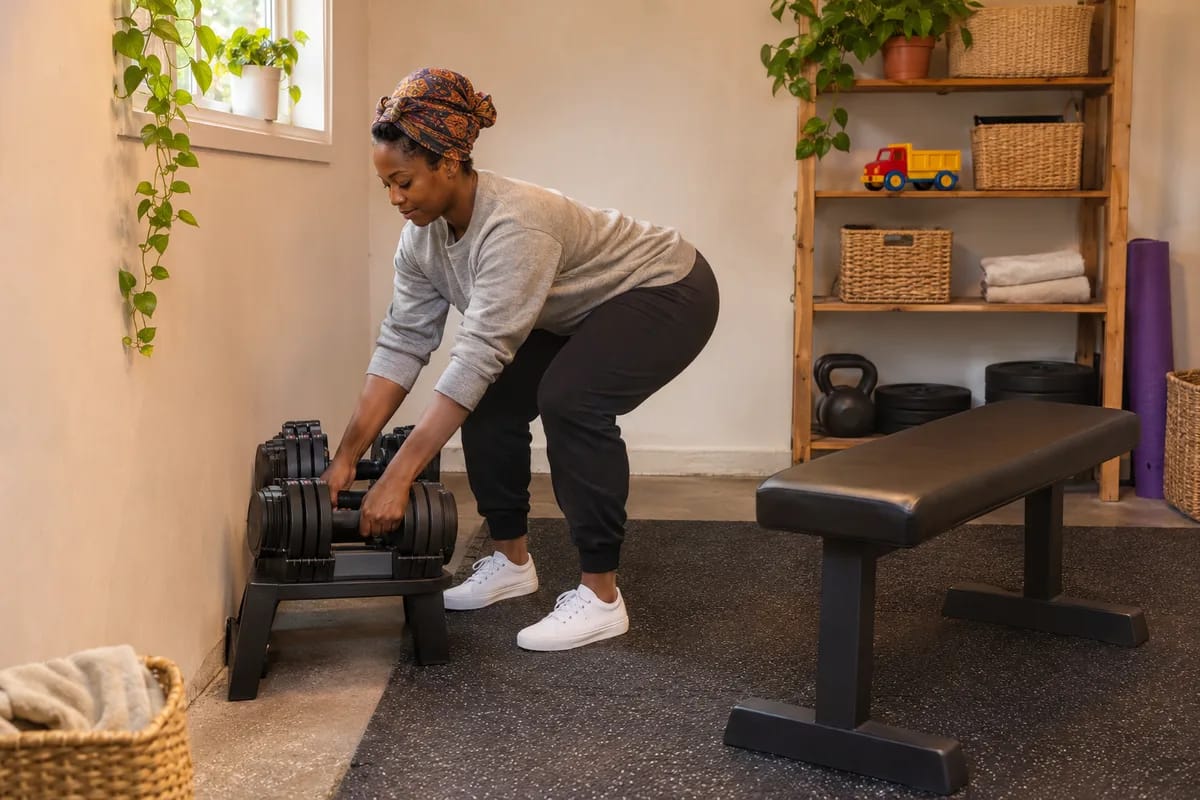
It's the same workout every session, except the first move on your middle day. Rest about 90 seconds on the first three moves and a minute on the rest.
| Move | Sets × reps | When it's too easy |
|---|---|---|
| Goblet squat (middle day: split squat) | 3 × 8 to 12, each leg for the split squat | Back foot up on a step, then on the sofa |
| Dumbbell Romanian deadlift | 3 × 8 to 12 | One leg at a time, the other foot resting lightly behind you |
| Floor press | 3 × 8 to 12 | Lower in 3 seconds and pause with your elbows on the floor |
| One-arm row | 3 × 10 to 12 each side | Pause 2 seconds at the top, lower in 3 |
| Hip thrust | 2 × 10 to 15 | One leg at a time |
| Side plank, or suitcase carry | 2 × 20 to 30 seconds each side | Longer, or a heavier weight for the carry |
After 12 weeks, run it again with the harder versions as your new starting point. Plenty of people train on a plan this shape for years, at home, and keep getting stronger.
Plan 4: coming back after a break
The usual mistake on the way back is picking up where you stopped. Strength tends to return faster than your tendons catch up, so the first month is deliberately easy. How to restart training after falling off scales this to exactly how long you were away. Here's the shape for a break of a few months or more, using the moves from Plan 2 at a gym or Plan 3 at home.
Weeks 1 and 2
Two light sessions a week
Two sets of each move with about a third of your old weights. It should feel almost too easy, and that's the point: the weights climb quickly from here. Never wrote your numbers down? Use weights that leave lots of reps spare.
Weeks 3 and 4
Three sessions, a little heavier
Add the third day and a third set on the first two moves. Raise the weights a step at a time, as long as every set still ends with two or more reps spare.
Week 5 on
The full plan
Switch to the full Plan 2 or Plan 3 at the weights you've reached, and climb with the rep rule from there.
Coming back after a baby, an operation or an illness is different. Read the section below first.
The moves, in plain words
Every move from the four plans, once, grouped by the five jobs from the short version. Gym machines (leg press, chest press, seated cable row, lat pulldown) usually have a diagram on the frame. A staff member can set the seat for you, and Plan 2's tables give the one thing to watch on each.
Squat: sit down and stand up
- Sit-to-stand. Sit on the front half of a chair, feet flat and hip-width apart. Lean forward a little, stand up without using your hands, then sit back down slowly.
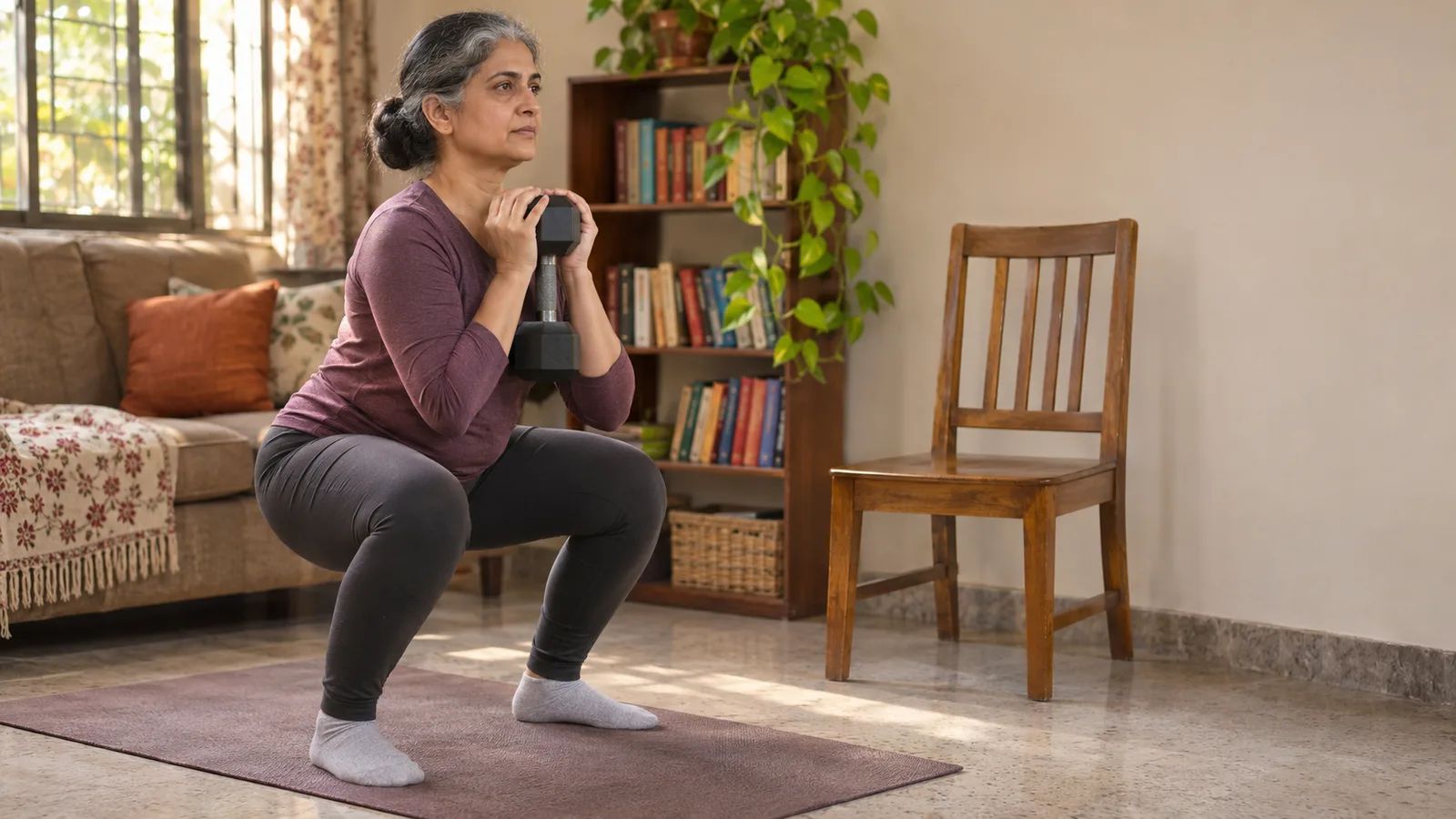
- Goblet squat. Hold one dumbbell upright against your chest with both hands. With your feet a little wider than your hips, sit down between your heels as far as feels comfortable, chest up, then stand.
- Split squat. A lunge that stays in place. One foot forward, one back, and you bend both knees to lower straight down, then stand up again.
Hinge: bend from the hips, not the back
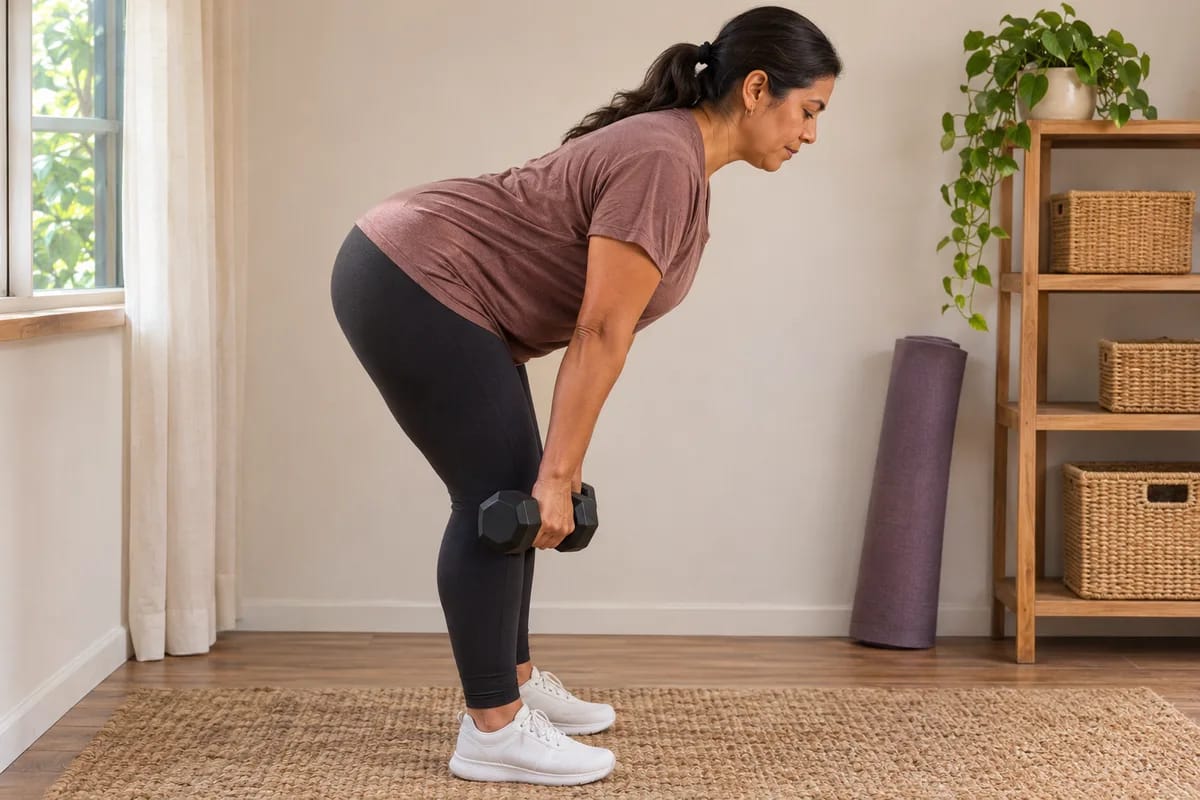
- Romanian deadlift. The move most worth practising. Stand tall, feet hip-width, a dumbbell in each hand in front of your thighs. Soften your knees and keep them there. Push your hips back, as if shutting a drawer with your bottom, and let the dumbbells slide down the front of your legs while your back stays flat. Stop when you feel a stretch down the backs of your thighs, which for most beginners is somewhere around the knees, then push your hips forward to stand. Try it with no weight first, side-on to a mirror or a dark window, so you can see your back stay flat.
- Glute bridge. Lie on your back, knees bent, feet flat near your bottom. Squeeze your bottom and lift your hips until there's a straight line from your knees to your shoulders, then lower slowly.
- Hip thrust. A glute bridge with your shoulder blades on the edge of a sofa or bench, and a dumbbell held across the crease of your hips. A folded towel under it helps.
Push
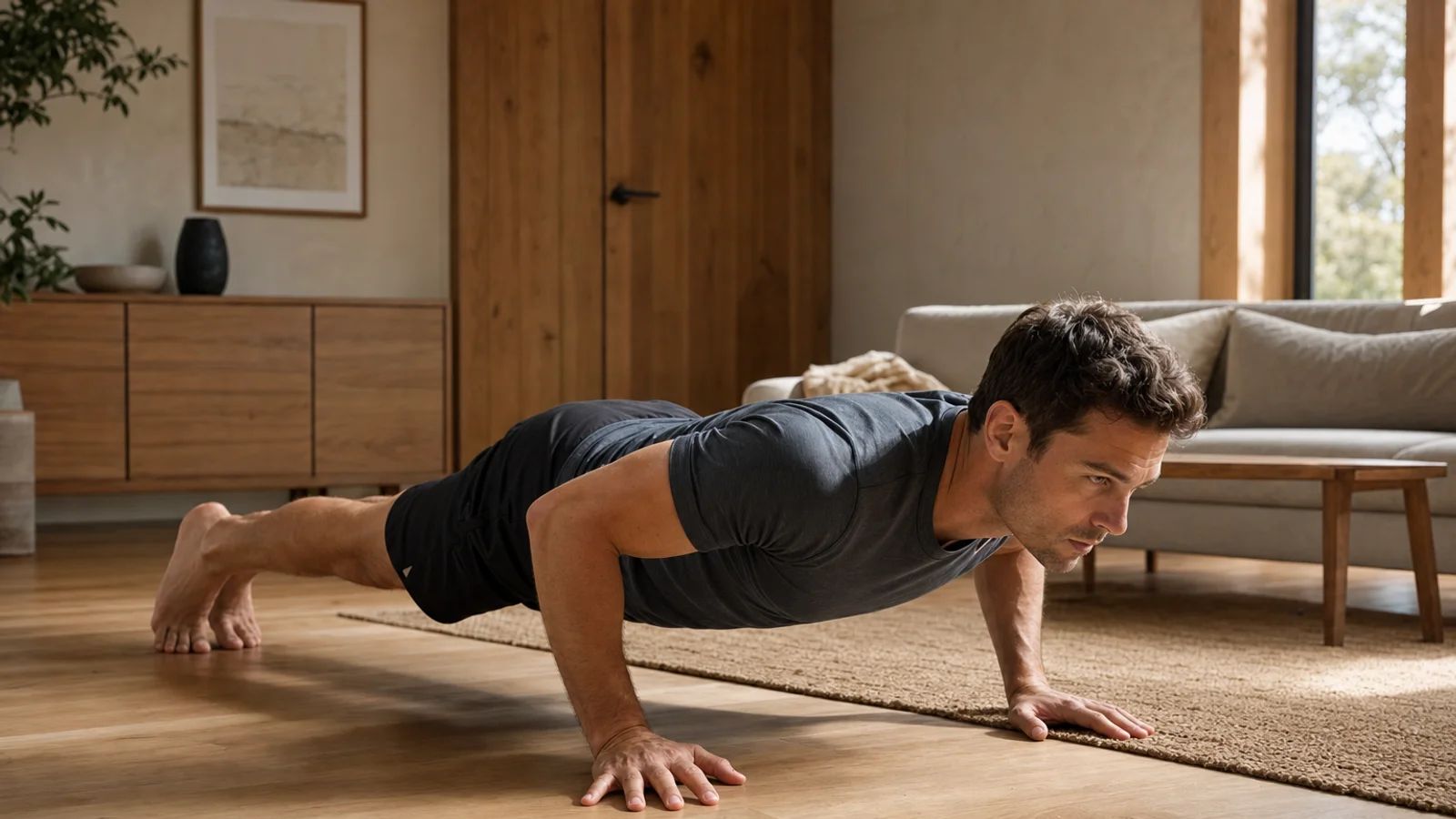
- Wall push-up. Hands on the wall at shoulder height, a little wider than your shoulders. Walk your feet back until your body is one straight line, bend your elbows to bring your chest toward the wall, then push away.
- Floor press. Lie on your back, knees bent, a dumbbell in each hand above your chest. Lower until your upper arms touch the floor, then press back up.
- Seated shoulder press. Sit on an upright bench with the dumbbells at shoulder height. Press up until your arms are nearly straight, then lower back to your shoulders.
Pull
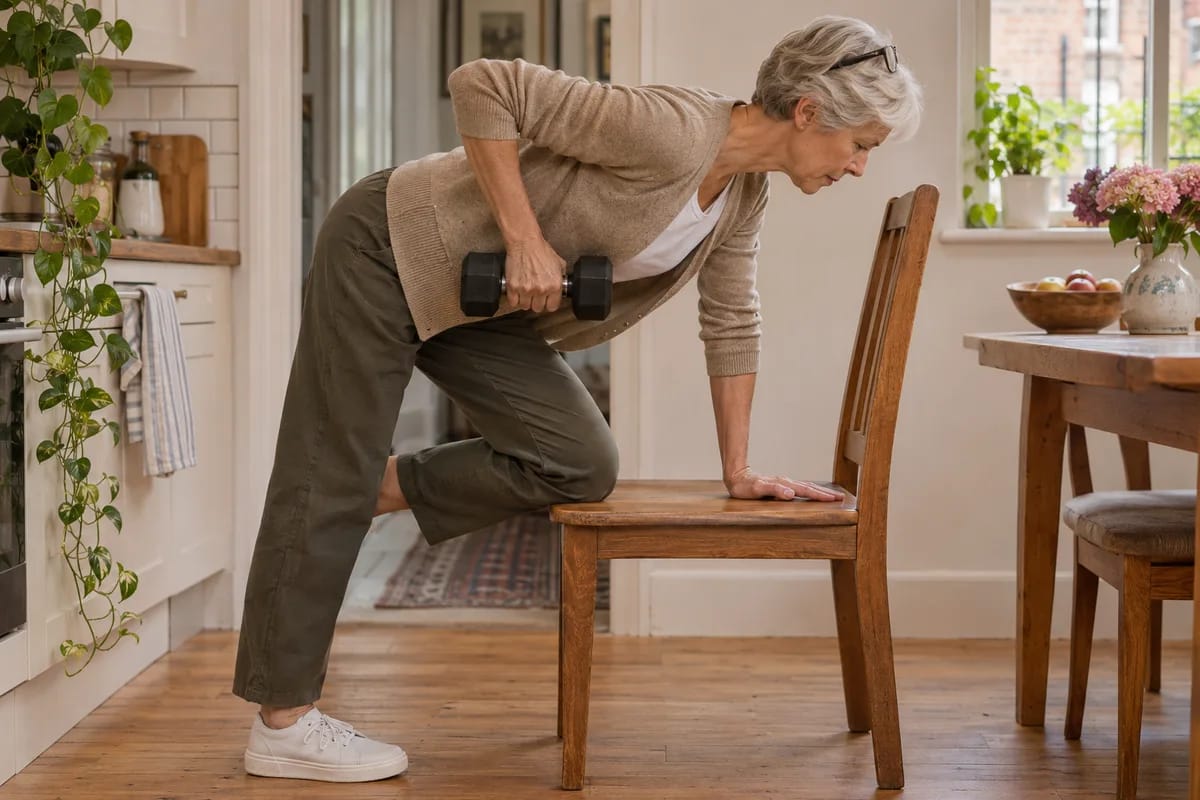
- One-arm row. One hand on a chair seat, feet staggered, back flat. Let the dumbbell hang, pull your elbow back toward your hip, then lower it slowly.
Carry and core
- Suitcase carry. Hold one weight at your side and walk around the room, standing tall without leaning toward it. A farmer's carry is the same with a weight in each hand.
- Dead bug. Lie on your back, arms pointing at the ceiling, knees bent above your hips. Slowly lower one arm and the opposite leg toward the floor, keeping your lower back still, then bring them back and switch sides.
- Plank. Forearms on the floor, elbows under your shoulders, body straight from your head to your knees or feet. Breathe normally.
- Side plank. Lie on one side with your elbow under your shoulder and your knees bent. Lift your hips until your body is straight; straighten your legs to make it harder.
Where walking fits
The same US guidelines ask for 150 minutes of moderate activity a week on top of the two strength days.1 Moderate is a pace where you can talk but couldn't sing. Brisk walking counts, and so does cycling to work or dancing round the kitchen. Thirty minutes on five days covers it, or a 20-minute walk every day and a bit more at the weekend.
Put it on the days you don't lift, or after a session rather than before, so your legs are fresh for the squats. It's there for your heart and your head. It isn't a way of paying off what you ate.
What's true about women and lifting
You don't need a special plan for women. On the same program, studies find no measurable difference between women and men in how fast they gain muscle and lower-body strength relative to where they start, and women gain upper-body strength faster.4 Why isn't settled, and the studies being short may be part of it. Either way, a plan that works for anyone works for you.
Lifting heavy won't make you bulky by accident. Muscle comes on slowly for everyone, over months, and you're in charge the whole time. Like where it's going? Keep climbing. Want to stay as you are? Hold the weights where they are. How long until you see results has the realistic timeline.
"Toning" is just building some muscle. There's no light-weight mode that firms a muscle without growing it. Light weights can build as much muscle as heavy ones, but only when the last reps of every set are genuinely hard; heavy weights build more maximum strength.5 A pair of 2 lb (1 kg) dumbbells lifted 15 easy times won't change much, whatever the packaging says.
Ab exercises don't burn belly fat. People who did ab work five days a week got stronger abs and no smaller waists.6 You can't choose where fat comes off. The plank and the dead bug are in the plans so your middle holds steady when you lift and carry, not for how it looks.
You don't have to plan around your period. Performance may dip very slightly around your period, and even that rests on weak evidence. Researchers who reviewed the reviews concluded it's too early to say your cycle appreciably changes your strength or your results.78 Train as normal.
Pregnant, postpartum, menopause or over 50
These are the times to talk to your own clinician before you start or change a plan.
Pregnant. If you're healthy and the pregnancy is normal, the American College of Obstetricians and Gynecologists says it's safe to continue or start regular exercise, and to talk it through with your ob-gyn at your early prenatal visits. It also says to avoid lying flat on your back as much as you can, so swap the floor moves for versions done sitting, standing or on hands and knees. Stop and call your ob-gyn if you have warning signs such as bleeding, dizziness or feeling faint, chest pain, calf pain or swelling, regular painful contractions or fluid leaking.9
After a baby. Get your clinician's go-ahead first, then start with Plan 4's first two weeks, however fit you were before. Leaking, a feeling of heaviness low down, or a bulge or gap down the middle of your tummy are good reasons to see a pelvic health physiotherapist before you load up.
Perimenopause and menopause. The same plans work, and now they matter more for your bones. Bone loss speeds up late in perimenopause, when periods are months apart, and keeps that pace for the first few years after menopause.10 So keep the weights climbing. Broken sleep and achy joints can make one week very different from the next, which is what the rough-day rule is for.
Over 50. The plans work as written. For bone, heavy means a weight you could lift only about 8 times. Why women over 50 should lift heavier than they think shows how to build up to that safely, and who should check with a doctor first.
At any age, see a clinician before you start if you get chest pain, dizziness or unusual breathlessness when you exert yourself, if you have a heart, metabolic or kidney condition, or if you have pain that changes how you move.
When the plan isn't the hard part
Everything above is free, and it works. Follow it two or three times a week for three months and you'll be stronger. Most people who stall don't stall on the plan. They stall on three things a page can't do, and those are what Bespoke Fit is for.
Every session is a live 1‑on‑1 video call with your own coach, in our app on iPhone, Android or a browser. Prop the phone up in your living room, or on a bench at your gym. Your coach writes your program onto your training calendar, so you open today's workout and start. Then a person takes care of the three hard parts.
Choosing the weight. "Two reps to spare" is hard to judge from inside the set. In one study of women who already lifted, those who trained with a personal trainer picked noticeably heavier weights than women training alone, and were stronger on three of the four machines tested.11 It compared two groups at one point in time, so take it as a strong hint rather than proof. Your coach watches every set and picks the weight for the next one from what they just saw. On a rough day (a heavy period, a bad perimenopause week, a short night), they see how your first set goes and change the session, so you're not judging it alone. Wear an Apple Watch or a Bluetooth heart rate strap and they see your heart rate live too, and use it to decide when to push and when to rest longer.
Seeing your own form. Knees drifting in on a squat, or a back rounding on the deadlift, are obvious from the side and invisible from inside. Your coach says "knees out" while you're still in the rep, not a day and a half later from a video you sent in.
Turning up. Nobody notices when Thursday quietly doesn't happen; why most people quit the gym by week six shows how ordinary that fade is. Here each session is a set time in your calendar, with an invite, reminders the day before and shortly before, and your coach waiting on the call. Skipping means telling a person who's expecting you.
"2 months in and I haven't skipped a single workout, which has literally never happened before. I don't have to plan anything. I just put on my clothes and fill my water bottle, and my coach does the rest."
Deqa, 27, a member who trains with Angela
"I was skeptical about doing training over video at my age, but it has been much easier than I expected. My trainer is patient and adjusts everything to what my body can handle. I have exercised more in the past two months than in the last ten years. My friends can see the difference."
Wanda, 70, a member who trains with JP
Each coach has 12 members at most, and we hold to that when we assign coaches. A coach who is on every session can't hold more: twelve people training two or three times a week for about an hour is already 24 to 36 hours of live calls a week. So yours remembers last week.
You start with a 30-minute call with a head coach, who matches you with your coach. Sessions run 45 to 90 minutes at the same price, and most people settle at around an hour. It's 14 days free, then $299 a month, for as many sessions as you and your coach put in the calendar. The 14 days start at your first session, not when you sign up, and a reminder comes 3 days before the first charge. Cancel anytime. Twice a week works out at about $35 a session; three times, about $23. Our training for women page has more.
It's the wrong pick if the plans above are already working for you (keep going, they're free), if you want someone in the room or a class, if you want meal plans (we don't coach nutrition), or if $299 a month would strain your budget. Then a friend who trains in the same time slot is the best free upgrade there is. App coaching is the cheaper paid one: trainwell is $149 a month, billed every three months, and Future is $199 a month. Both give you a real coach who writes your plan and checks in, though nobody is on the workout with you while you train.1213
Common questions
Can I use these plans to lose weight? Yes, alongside eating a little less, which does most of the work on the scale. In a trial of dieting adults over 65, three groups doing different exercise each lost the same 9% of their weight. The ones who lifted lost less muscle than those who only did cardio, and got stronger while the weight came off.14 A daily walk helps too. We don't coach nutrition, so for a food plan a registered dietitian is the right person to ask.
What is the 3-3-3 rule for workouts? It has no fixed meaning. You'll see it used for three strength days, three cardio days and three rest days a week, for three sets of three exercises, and for short circuits, among others. The useful core is three strength days a week, which is what Plan 2 and Plan 3 already are.
How long before I notice a difference? Most people feel stronger within 3 to 4 weeks. A slight visible change usually takes until month 2 or 3, and an obvious one until month 4 to 6. Track the weights and reps you lift in the meantime, because they move first.
Sources
-
Centers for Disease Control and Prevention, 2023. Adult activity: an overview. 150 minutes of moderate-intensity activity a week, and muscle-strengthening activity on 2 or more days a week that works all major muscle groups. The talk-but-not-sing rule of thumb for moderate intensity is from the guidelines' questions and answers, Office of Disease Prevention and Health Promotion, read November 12, 2026. ↩ ↩2
-
Hagstrom, A.D., Marshall, P.W., Halaki, M. & Hackett, D.A., 2020. The effect of resistance training in women on dynamic strength and muscular hypertrophy: a systematic review with meta-analysis. Sports Medicine. 24 studies of women. Training frequency and volume moderated strength gains; the authors found publication bias, so the effect sizes are likely smaller than reported. ↩
-
Currier, B.S., D'Souza, A.C., Singh, M.A.F. and colleagues, 2026. American College of Sports Medicine position stand. Resistance training prescription for muscle function, hypertrophy, and physical performance in healthy adults: an overview of reviews. Medicine and Science in Sports and Exercise. 137 reviews covering more than 30,000 people. ↩
-
Roberts, B.M., Nuckols, G. & Krieger, J.W., 2020. Sex differences in resistance training: a systematic review and meta-analysis. Journal of Strength and Conditioning Research. Studies of young and middle-aged adults. ↩
-
Schoenfeld, B.J., Grgic, J., Ogborn, D. & Krieger, J.W., 2017. Strength and hypertrophy adaptations between low- vs. high-load resistance training: a systematic review and meta-analysis. Journal of Strength and Conditioning Research. 21 studies. Light was 60% of a one-rep max or less, and every set in these studies went to failure. ↩
-
Vispute, S.S., Smith, J.D., LeCheminant, J.D. & Hurley, K.S., 2011. The effect of abdominal exercise on abdominal fat. Journal of Strength and Conditioning Research. A small six-week trial: 24 sedentary adults, 14 men and 10 women. ↩
-
McNulty, K.L., Elliott-Sale, K.J., Dolan, E. and colleagues, 2020. The effects of menstrual cycle phase on exercise performance in eumenorrheic women: a systematic review and meta-analysis. Sports Medicine. 78 studies; a trivial dip in the early follicular phase (the days of and just after a period), with the evidence rated low quality. ↩
-
Colenso-Semple, L.M., D'Souza, A.C., Elliott-Sale, K.J. & Phillips, S.M., 2023. Current evidence shows no influence of women's menstrual cycle phase on acute strength performance or adaptations to resistance exercise training. Frontiers in Sports and Active Living. An umbrella review. ↩
-
American College of Obstetricians and Gynecologists. Exercise during pregnancy, patient FAQ, read November 12, 2026. The full list of warning signs is on that page. ↩
-
Finkelstein, J.S., Brockwell, S.E., Mehta, V. and colleagues, 2008. Bone mineral density changes during the menopause transition in a multiethnic cohort of women. Journal of Clinical Endocrinology and Metabolism. 1,902 women in the US SWAN study, followed for up to six years: little change before or early in perimenopause, then spine and hip bone density fell substantially in late perimenopause and at a similar pace in the first years after menopause. ↩
-
Ratamess, N.A., Faigenbaum, A.D., Hoffman, J.R. & Kang, J., 2008. Self-selected resistance training intensity in healthy women: the influence of a personal trainer. Journal of Strength and Conditioning Research. 46 women who already lifted, average age about 27, 19 of them with a trainer. For a set of 10, those with a trainer chose about 51% of their max and those without about 42%. ↩
-
trainwell, FAQ ($149 a month, billed in 3-month increments), read November 11, 2026, and How it works, read November 12, 2026: "Sessions aren't supervised in person, so if you need hands-on spotting or real-time correction on every rep, an in-person trainer may suit you better." trainwell is a competing service. ↩
-
Future, Membership plans and pricing, read November 11, 2026: $199 a month, or $149 a month on a prepaid year. In a workout "you'll hear your coach's voice introducing your workout and guiding you through key movements": What should I expect from a Future Pro workout, read November 11, 2026. Future is a competing service. ↩
-
Villareal, D.T., Aguirre, L., Gurney, A.B. and colleagues, 2017. Aerobic or resistance exercise, or both, in dieting obese older adults. New England Journal of Medicine. 160 adults over 65 with obesity, six months; the three diet-and-exercise groups each lost 9% of body weight. Lean mass fell 2 to 3% in the groups that lifted against 5% with cardio alone, and strength rose 18 to 19% against 4%. ↩