How to stay consistent with workouts while traveling
Work travel breaks the cues your workout habit runs on, not your fitness. Here's how to keep training across hotel rooms and time zones.
If you travel for work, you know the pattern. You train like clockwork at home, then a trip lands and the whole thing falls apart, even though nothing about your body changed. Your strength's still there. So is your fitness. What's gone is everything around the workout: the same kitchen, the same 6 am alarm, the drive past the gym.
Travel doesn't wreck your fitness. It strips out the cues your habit was quietly running on. Fix that and training on the road gets a lot easier: set a floor instead of a personal best, have a plan that works in a hotel room, and anchor the workout to a time instead of a place.
Why the habit disappears the moment you leave home
A habit was never just "exercise." It was "exercise, in this place, at this time, right after this other thing." Take away the place and the time, and the automatic part usually goes with them.
A 2005 study in the Journal of Personality and Social Psychology followed students who'd just transferred to a new college and tracked everyday habits like exercising and reading the paper.1 The ones that survived the move were the ones where the daily context stayed roughly the same. Change the surroundings enough and the automatic behavior broke down. People went back to deciding, consciously, every single time.
That's what a trip does to your workout. In a familiar setting, the habit basically runs itself. Take the setting away and there's no autopilot left, just a tired traveler making a fresh decision in an unfamiliar room. Tired travelers decide against exercise more often than not.
You didn't lose your discipline on the road. You lost the cues that meant you never had to use it.
Set a floor, not a personal record
On a heavy travel week, the goal isn't your best session of the year. It's a floor: the smallest amount of training that still counts as keeping the promise to yourself. Two short sessions that actually happen beat four perfect ones you only planned.
The physiology backs this up. A review of exercise-maintenance research found younger adults held onto their strength for weeks on as little as one session a week, older adults needed about two. Endurance held for up to 15 weeks on as few as two sessions, even with the workload cut by a third to two-thirds.2 The one thing that can't drop is effort: keep intensity high and you can lose a lot of frequency and volume without losing fitness.
Those numbers come from structured lab studies, and a real trip is messier than a lab, so treat "one or two hard sessions a week" as a floor that works, not a license to coast for a month.
Miss one day and nothing breaks. What actually erodes a habit is a run of missed days, the kind that quietly turns "I train" into "I used to train." A short session on the road keeps that chain intact, so there's nothing to restart once you're home. Our piece on training on vacation with two dumbbells goes further into this for longer trips, including how to make light or improvised gear feel heavy.
A 25-minute hotel room workout that covers everything
"Do some bodyweight stuff" is where good intentions go to die, so the plan needs to be concrete. Here's a full session that needs nothing but floor space and maybe a chair.
Warm up for three minutes: slow air squats, hip circles, arm swings. Then run three rounds of this circuit, resting only when you need to:
- Tempo squats, 12 reps, four slow seconds on the way down each rep. The tempo is what makes bodyweight hard on your legs.
- Push-ups, as many clean reps as you can manage. Feet up on the bed to make them harder, hands on the desk to make them easier.
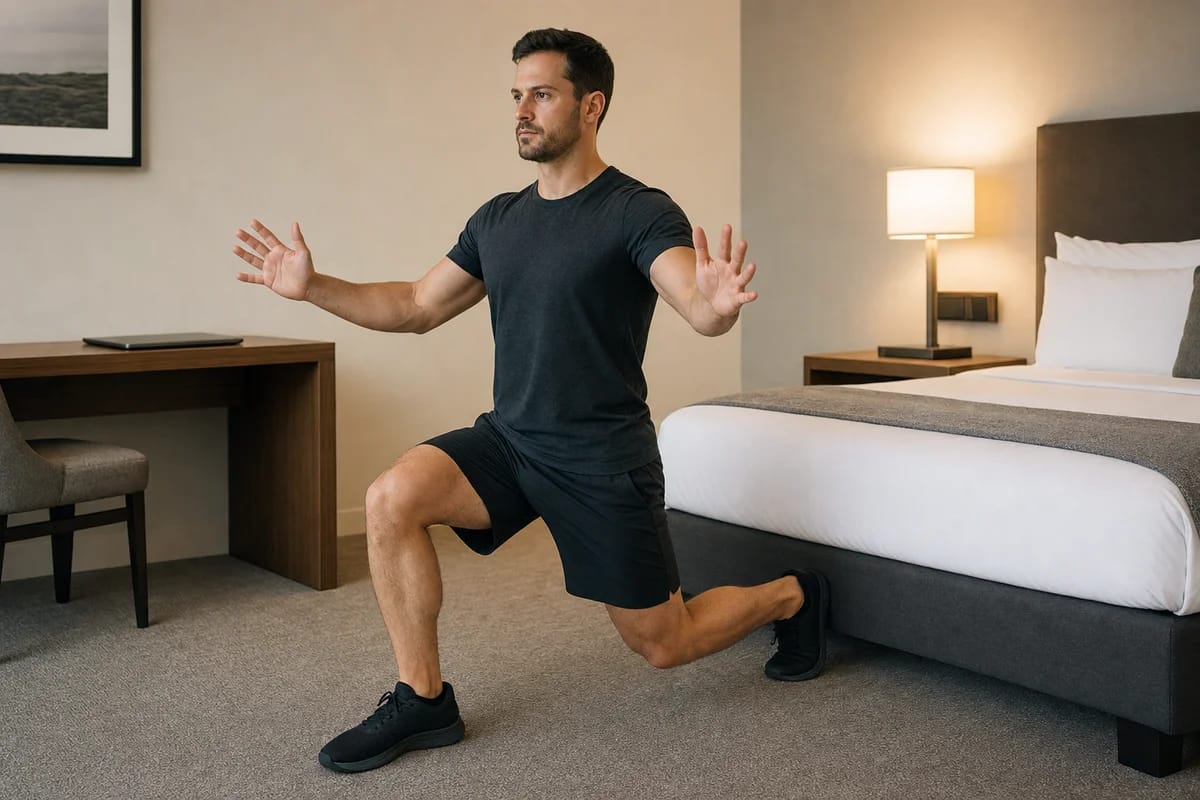
- Split squats, 10 per leg, back foot on the floor or up on a chair. One leg at a time doubles the load without adding any weight.
- Single-leg hip hinges, 10 per side, for the back of your legs.
- Plank, 30 to 45 seconds, ribs down, glutes tight.
Cut the rest between rounds and it turns into conditioning as well as strength. Down to 10 minutes? Do one round and go. That still holds the floor. None of this replaces a proper gym session. It just takes "there was no gym" off the table as an excuse.
Time your workouts to fight jet lag
Timing matters more on the road because exercise doesn't just tire you out, it nudges your body clock. Research mapping how exercise shifts the human circadian rhythm by time of day found a clear pattern: morning exercise, around 7 am, and early afternoon, roughly 1 to 4 pm, shift the clock earlier. Evening exercise, around 7 to 10 pm, shifts it later.3
That's a simple lever for jet lag. Flying east, where you need your body to think it's earlier, a morning session helps pull your clock forward. Flying west, an evening session helps push it back. It's a modest effect, not a reset button, but it lines the workout up with the direction you're already trying to shift.
Don't expect a workout alone to fix serious jet lag, though. This effect is small next to daylight, sleep, and meal timing. On a normal week, train whenever fits. On a time-zone jump, let the clock pick the hour, and get outside for daylight while you're at it. Light is the stronger signal.
Anchor the workout to a time, not a city
With the old context gone, you need a new one, and it has to travel with you. Anchor training to something that stays the same in every city. Not the gym itself, since that's different everywhere you land.
The most portable anchor is a fixed morning slot: same wake-up time, same first 30 minutes, before email and meetings get a chance to eat them. Mornings work on the road precisely because the rest of a trip is unpredictable. Dinners run long, clients keep you late, plans shift without warning. A slot you defend before the day starts is the one nobody can book over.
Then chain the session to a ritual you already repeat everywhere: right after the hotel coffee, straight after your shower, before you open the laptop. You're rebuilding the "after this, then that" link that home used to give you for free. It's the same logic behind the appointment effect, just aimed at a moving target. The workout survives because it's pinned to a time and a trigger, not floating somewhere in "I'll fit it in later."
Nobody's tested hotel-room habit anchoring in a randomized trial. This is the same mechanism that broke your habit in the first place, aimed on purpose instead of by accident: reasoned from how habits work, not proven on travelers specifically. And people vary, so the exact version of this that sticks for you is something you find by trying it on a couple of trips, not something anyone can hand you finished.
Key takeaways
- Set your floor before you leave: pick two sessions you'll actually do, and treat anything more as a bonus.
- Protect effort over everything else. Cut frequency and volume if you have to, but keep intensity up.
- Book a fixed morning slot in every city and chain it to a ritual you already repeat, like coffee or a shower.
- Flying east, train in the morning. Flying west, train in the evening. Either way, get outside for daylight early.
- Don't restart from zero at home. You kept the floor, so you just resume, maybe with one lighter session first.
Common questions
Will I lose progress on a one-week work trip? Almost certainly not. Maintenance research shows strength and endurance hold for weeks on as little as one to two sessions, as long as the effort stays high. The real risk isn't the trip. It's letting a one-week gap turn into a month once you're back home.
Should I train right after landing from a long flight? A light session can help, especially if the timing nudges your clock the right way: morning after flying east, evening after flying west. Keep it easy if you're wrecked. The goal is resetting the routine, not setting records.
Is it worth packing resistance bands? Sometimes, honestly. They're light, useful for rows, presses, and pull-aparts, and cost you almost nothing in bag space. But bodyweight tempo work and single-leg exercises cover most of what you need on their own, so treat bands as a nice-to-have, not the thing standing between you and a session. The item actually worth the space is a pair of shoes you can train or walk in.
The appointment that travels with you
A gym membership is stuck in one city. A booked coaching session isn't tied to any room, which makes it the natural thing to anchor a trip around.
It also fixes the specific failure point above: the moment your context changes, you're on your own to redesign the session in a strange room, and that's exactly the moment most people just skip the workout instead. On a Bespoke Fit call, your coach sees whatever room you're actually in and builds around it live. No barbell, a chair, and six feet of floor, fine, here's tonight's session. Sessions are unlimited, so an odd travel schedule never costs extra, there's nothing to freeze while you're away, and in-app messaging reaches your coach between calls (more in the FAQ). Your first month is $49, and founding members lock in $299 a month for life, out of 25 founding spots.
I'd still rather you keep the floor and the morning slot even if you never book a session with anyone. The habit doesn't care whether the person holding you to it gets paid.
Sources
-
Wood, Tam & Witt, 2005. Changing circumstances, disrupting habits. Journal of Personality and Social Psychology. ↩
-
Spiering, Mujika, Sharp & Foulis, 2021. Maintaining physical performance: the minimal dose of exercise needed to preserve endurance and strength over time. Journal of Strength and Conditioning Research. ↩
-
Youngstedt, Elliott & Kripke, 2019. Human circadian phase-response curves for exercise. The Journal of Physiology. ↩
More on