A training plan for executives who travel every week
If you fly out most weeks, the plan that survives isn't a fixed program. It's a fixed weekly session that travels, with exercises that flex to any hotel gym.
Most advice for people who travel for work says find a good hotel gym, or pack the right gear. That's backwards. If you fly out most weeks, what keeps you training isn't a nicer gym or a stricter program. It's a fixed appointment that goes wherever you go, with exercises that change to fit whatever room you land in. Travel days already carry more movement than people give them credit for: we measured how far you walk inside 74 airports.
The more your weeks vary, the less you want a rigid plan and the more you want a fixed anchor. Tell yourself "barbell back squat, five sets" and the first hotel with no barbell breaks the whole week. Tell yourself "legs, hard, whatever's here" and nothing can break it. Keep the appointment fixed. Let the movements flex.
Programs assume a gym that stays put
A program is a list of exercises, sets, and loads. It assumes the equipment will be there. Train in one gym all year and that assumption holds, so a detailed program works fine. Land in a new city every week and it breaks constantly, and a broken program feels like a failed week. Miss enough of those and you stop bothering.
An anchor is a different promise. It's about when you train and how hard, not which machine you use. That distinction matters because habits are tied to context, not just willpower. Change your surroundings and the automatic behavior tends to disappear with them, which is why a routine that runs itself at home falls apart on the road. We cover that research in how to stay consistent with workouts while traveling: the workout was never just the workout, it was the workout in that place, at that time. Take the place away and the habit needs something else to hold onto.
An anchor is that something else. It's the one part of your training you can carry through customs.
Defend one session like a meeting nobody can cancel
Pick one weekly session and make it non-negotiable, not "I'll train four times if the week cooperates." One session happens no matter what, in every city, treated like a meeting you can't reschedule. Everything else is a bonus on top.
The easiest slot to defend is early morning, before email and meetings get to it. Work travel is unpredictable: dinners run long, clients keep you late, the afternoon gets hijacked. The first 30 minutes after you wake up is the one block nobody else can book.
Then pin the session to something you already do everywhere, so it doesn't float. Train right after the hotel coffee, or straight after your shower, or before you open the laptop. You're rebuilding the "after this, then that" chain your home routine gave you for free. That's the appointment effect applied to a moving target: the session survives because it's tied to a time and a trigger, not a building.
One defended session a week won't build your best physique. It isn't meant to. It keeps the chain intact, so there's nothing to restart when you get home, which is where most of the real damage happens.
Plan the pattern, not the exercise
This is what makes the anchor work. Instead of planning exact exercises, plan movement patterns, with a short menu of options under each one. Walk into the hotel gym, pick whichever version the room allows, and get to work. No squinting at a program built around a cable machine you don't have.
Five patterns cover a full body. For each, here's a full-gym option, a dumbbell-only option, and a nothing-but-the-room option:
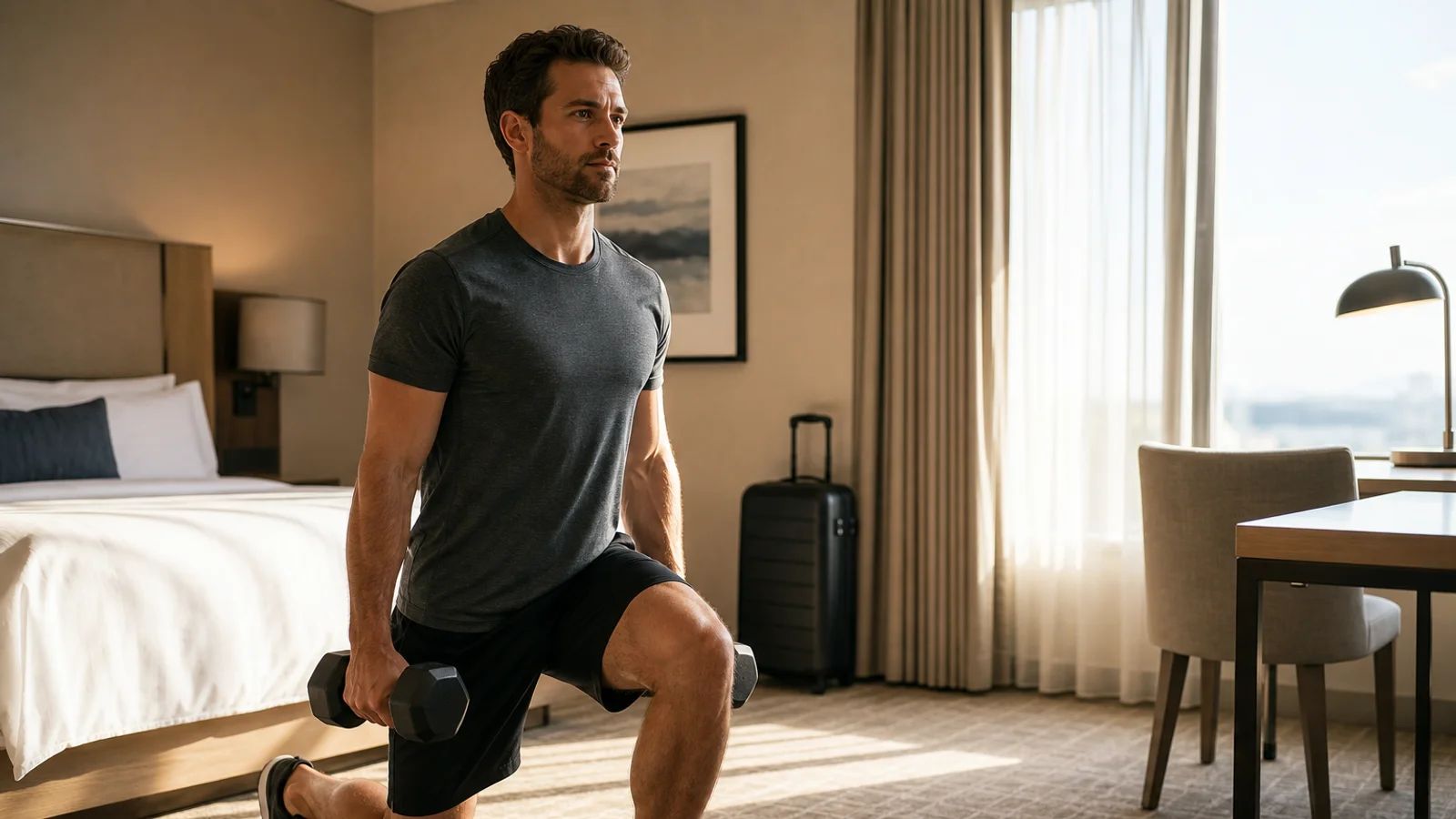
- Squat, for your quads and knees. Full gym: front or goblet squat. Dumbbells: goblet squat with a slow four-second lower. Bodyweight: tempo squats, then split squats one leg at a time to add load with no weight.
- Hinge, for your hips, hamstrings, and lower back. Full gym: Romanian deadlift or kettlebell swing. Dumbbells: single-leg Romanian deadlift. Bodyweight: single-leg hip hinge and glute bridges.
- Push. Full gym: bench or overhead press. Dumbbells: floor press and overhead press. Bodyweight: push-ups, feet up on the bed to make them harder, hands on the desk to make them easier.
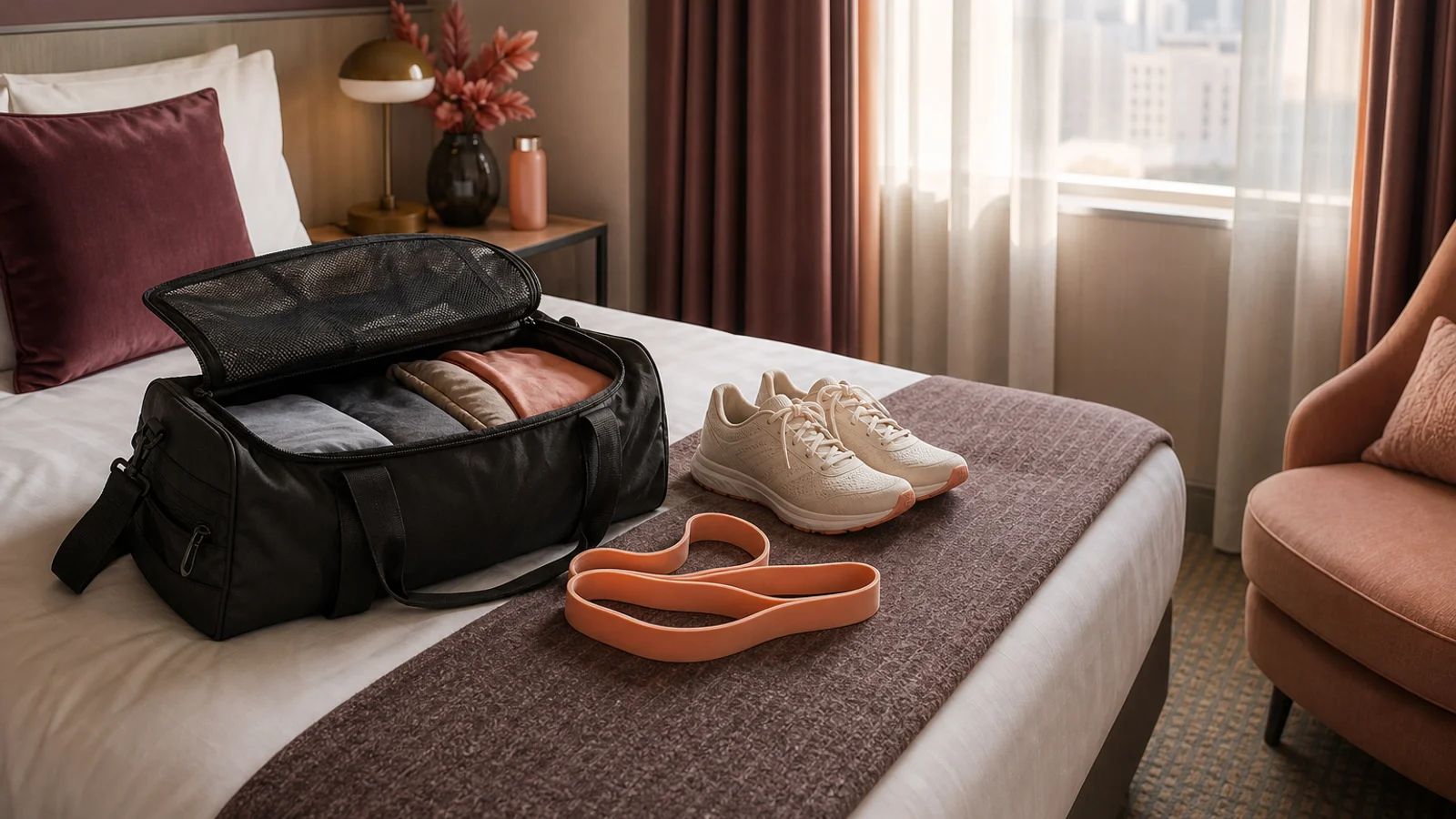
- Pull. Full gym: rows and pulldowns. Dumbbells: one-arm rows. Bands: band rows and pull-aparts, which is why a band is the one thing worth packing. Bodyweight: inverted rows under a sturdy table.
- Carry, the one most people skip. Full gym: farmer carries. Anywhere: a suitcase carry with one heavy bag, or laps of the hallway with a loaded backpack.
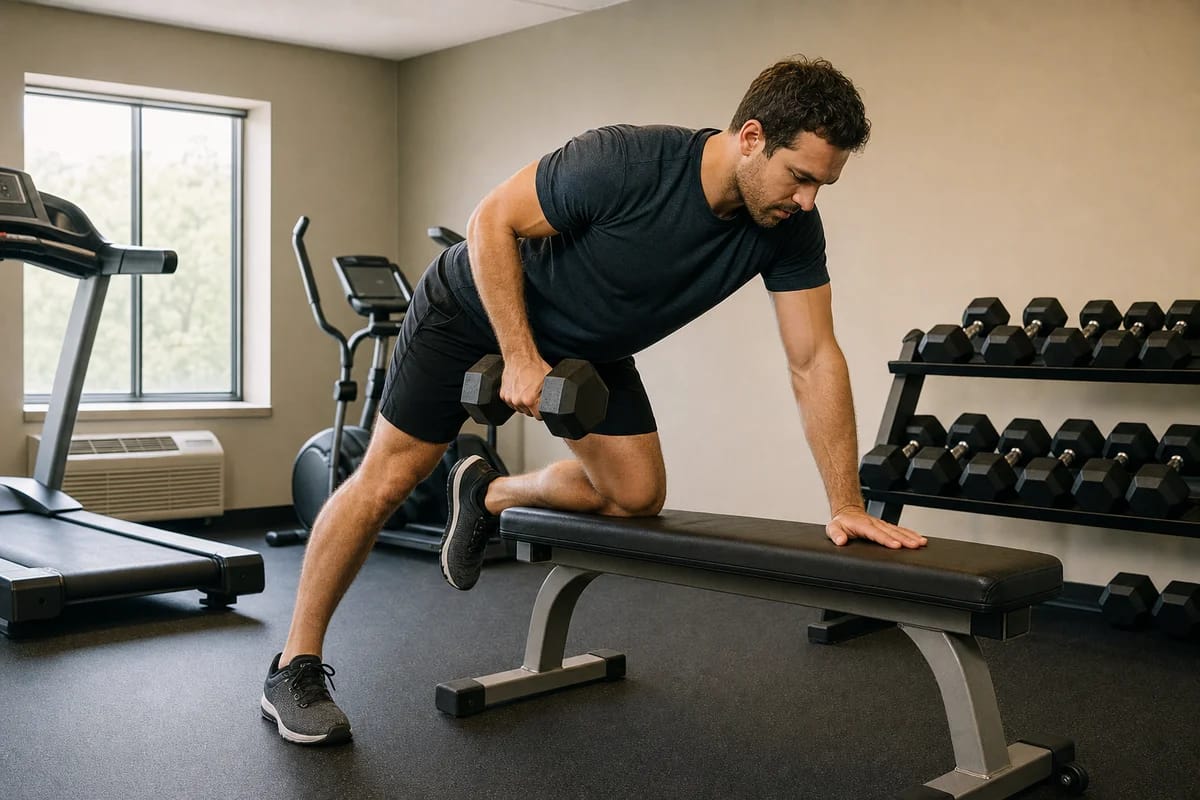
Hit two or three patterns a session and you've trained your whole body, whatever the room had. To make light or improvised gear feel heavy, slow the lowering phase down, work one limb at a time, and cut your rest between sets. Training on vacation with two dumbbells walks through those tricks in more detail.
Don't plan lifts. Plan patterns. The pattern stays fixed, the exercise is just whatever that pattern looks like in this particular room.
Let your flight direction set your training hour
On a normal week, train whenever fits. Cross several time zones, though, and the hour becomes a small lever worth pulling, because exercise doesn't just tire you out. It nudges your body clock.
The clearest evidence on this comes from a 2019 trial in The Journal of Physiology, which mapped how exercise timing shifts the clock across 48 younger and 51 older adults: morning sessions, around 7 am, and early-afternoon sessions, roughly 1 to 4 pm, pulled it earlier.1 Evening sessions, around 7 to 10 pm, pushed it later. That maps straight onto jet lag: an earlier shift helps after flying east, a later one after flying west.
So flying east, where you need your body to think it's earlier than it feels, lean toward a morning session. Flying west, lean toward evening. Get outdoor daylight around the same time you train, since light is the stronger signal and the workout just reinforces it.
Where this advice runs out
The anchor idea comes from how habits break, which is well studied, more than from a trial that tested this exact routine on business travelers. Treat it as a sound principle, not a proven protocol.
The maintenance point holds up: you can hold fitness on fewer, harder sessions. But a real travel week is messier than any study, so treat "one hard session holds the line" as a floor, not a license to coast for a month.
The circadian effect of exercise is real but modest next to daylight, sleep, and meal timing. Don't expect one workout to fix serious jet lag on its own.
And the pull pattern is genuinely hard to train with no equipment. If there's one thing worth packing, it's a resistance band. People differ here too. The routine that keeps you steady is something you learn by running it a few trips in a row.
Key takeaways
- Anchor training to one fixed weekly appointment that moves with you, not to a gym or a rigid program.
- Program by movement pattern: squat, hinge, push, pull, carry, and let the room decide the exact lift.
- Frequency can drop on the road. Intensity can't, if you want to hold onto strength and endurance.
- Pack a resistance band. It's the one piece of gear that saves the pull pattern.
- On a jump of three or more time zones, train in the morning after flying east, in the evening after flying west, and get daylight at the same time.
Common questions
Will training once or twice a week on the road cost me progress? For a single travel week, almost certainly not. Strength and endurance hold for weeks on far less volume than you run at home, as long as the effort stays high. The real risk isn't the trip. It's letting the trip turn into a multi-week gap once you're home.
What if the hotel has no gym at all? Then the room is your gym. Tempo squats, split squats, push-ups, single-leg hinges, and a loaded backpack carry cover four of the five patterns in about 25 minutes. Only the heavy pull is hard to replace, which is what the band is for.
Should I try to match my home program while traveling? No. Matching your home program is exactly the rigid approach that breaks on the road. Keep the anchor session and the patterns. Let go of the specific lifts and loads until you're back in your usual gym.
Is it better to train right after a long flight, or wait? A light session can help, especially if the timing nudges your clock the right way. Keep it easy if you're wrecked. The goal is resetting the routine and shifting your body clock a little, not setting records on no sleep.
The gap a coach actually closes
A coach earns their place at exactly the moment this system is built to survive: your room changes and you're the one who has to redesign the session on the spot, though you can run every part of this yourself if you keep it up trip after trip. With Bespoke Fit, the appointment is already booked and it travels with you: same coach, live HD video, any city, no gym memberships to juggle. They see the room on the call, the two dumbbells, the chair, the six feet of floor, and rebuild the plan around it while you're standing there. A real coach, every session, never AI. Your first month is $49, then founding members lock in $299 a month for life, with unlimited live 1-on-1 sessions, 25 spots, and a 30-day money-back guarantee, no questions asked. See how it works.
Sources
-
Youngstedt and colleagues, 2019. Human circadian phase-response curves for exercise. The Journal of Physiology. ↩
More on