Why am I gaining weight while working out? Usually water
A few pounds up since you started training? In the first weeks it's usually water, not fat. How to tell which it is, how to weigh, and when to see a doctor.
In this article9
The short answer
In the first few weeks it's almost always water, not fat: muscles you've started working store extra fuel and fluid. If your weekly average is still climbing at six weeks and your waist is growing too, it's usually food.
Which one is yours?
| What you're seeing | Most likely | What to do |
|---|---|---|
| Up a few pounds in weeks 1 to 3, waist the same or smaller | Water. Your muscles are stocking fuel and repairing, and if you started cardio, you're making more blood | Keep going. Weigh the way shown below and read the trend from week 4 |
| Up a pound or two overnight: after a hard leg day, a salty dinner, a weekend, or around a period | Short-term water | Ignore the single reading. Compare weekly averages |
| Up 1 to 2 lb (0.5 to 1 kg) in the first week of loading creatine | Water drawn into muscle with the creatine | Expected, and not fat |
| Still creeping up at week 6, waist the same or bigger, hungrier than before | Eating back the exercise, usually without noticing | Food is the lever, not more exercise. See below |
| Slowly up over months, waist smaller, lifts clearly going up | Some new muscle | Good news. Carry on |
| Fast gain with no clear reason, gain after starting a new medicine, or gain with swollen ankles, breathlessness, feeling cold or hair loss | Not the workout | Talk to a doctor |
Most people who search this are in the first two rows.
Why the scale jumps in the first few weeks
Water is heavy. A pint weighs about a pound, so drinking a 32 oz bottle (about a liter) puts roughly 2 lb (0.9 kg) on the scale until it passes through. Anything that makes your body hold a little more water shows up fast.
Starting to exercise makes your body hold more water in three ways at once.
Your muscles stock up on fuel. Muscles store carbohydrate as glycogen, and every gram of it is packed with at least 3 grams of water.1 Work a muscle regularly and it keeps a bigger store on hand. Cleveland Clinic puts this early water gain at 1 to 3 pounds, and says it's short-lived, ending within a few weeks to a month.2 The bigger store stays, but the scale stops climbing once it's full.
Worked muscles hold repair fluid. New exercise causes tiny amounts of damage, and your body sends fluid to fix it. After one hard session it's usually gone in a day or so,2 which is one reason the morning after a hard leg day can read high. In the first weeks of a program, when almost every session is new, it can build up.
Cardio adds blood. Regular endurance exercise expands your blood volume, and in the first two to four weeks nearly all of that is extra plasma, which is mostly water.3 It's one of the ways your heart gets fitter, and it weighs something.
On top of those, a few everyday things move the number:
- Creatine. Loading it (a bigger daily dose for the first week or so) pulls about 1 to 2 lb (0.5 to 1 kg) of water into your muscles in the short term. Weight gain is the only side effect that turns up consistently in the research.4
- Your period. Women tracking it daily report the most fluid retention on the first day of their period and the least in the week or so after,5 so expect that week to read higher. Compare it with the same week last month, not the week before.
- A salty or carb-heavy meal. More salt and more stored carbohydrate both mean more water held for a day or two.
- The weekend. Daily weighers tend to be heaviest on Sunday and Monday. Researchers who tracked it call that swing normal, not weight gain.6
How to weigh so the number means something
A single weigh-in can swing a pound or two (up to about 1 kg) either way for reasons that have nothing to do with fat. The fix is to weigh the same way every time and read the trend.
Weigh under the same conditions every time
First thing in the morning, after the bathroom, before you eat or drink, in the same clothes or none, on the same scale on a hard floor.
Average the week, then compare weeks
Weigh daily or most days and take the average for each week. Compare this week's average with last week's, never one morning with another. If daily weighing gets to you, weigh once a week on the same day, and remember Mondays tend to run high.
Measure your waist every two weeks
Wrap a soft tape around your waist at your belly button, standing relaxed, after a normal breath out. Same spot each time, snug but not pressing in. Take it twice and use the average. In one study, people measuring themselves at home got readings about an inch (2.5 cm) apart from one try to the next,7 so treat a smaller change as noise and trust one that holds two measurements in a row.
Write down what you lift
The exercise, the weight and the reps. Lifts going up while the scale sits still is the clearest sign the change you want is happening.
Read the trend at week 4, decide at week 6
From week 4, read the weekly averages, the tape and the lifts together. Call it food only if the average is still rising at week 6, with the tape the same or bigger.

An illustration, not real data
On a single morning, that Monday looks like a disaster. Across the week, you're down.
The fat math
Here's the arithmetic that should calm you down. A pound of body fat stores roughly 3,500 calories. That's a rule of thumb, and it fits best for people carrying more fat.8
So to gain 3 lb (1.4 kg) of fat in one week, you'd need to eat about 10,500 calories more than you burned that week. That's 1,500 extra calories every day, on top of everything you normally eat. If you didn't do that, and you'd probably know if you had, the jump isn't fat.
One more reason not to judge exercise by the scale: it trims the deep belly fat around your organs, the kind most linked to health problems, even when your weight doesn't change.9
Is it muscle?
Probably not yet, and anyone who tells you a 4 lb (1.8 kg) jump in week two is all muscle is being kind rather than accurate. Pooling more than a hundred studies of men lifting weights, researchers found programs added about 3.3 lb (1.5 kg) of muscle and lean mass on average.10 That's the payoff of a whole program, not two weeks.
So muscle explains a slow climb over months with a smaller waist, not a sudden jump. (And muscle doesn't "weigh more than fat". A pound is a pound. Muscle is denser, so a pound of it takes up less room.) For a realistic timeline, see how long it takes to build muscle.
Still climbing after six weeks? It's usually food
If that's you, the most common reason is plain: exercise made you hungrier, and you ate a bit more without noticing. In a 24-week trial, adults carrying extra weight who took up supervised exercise ate a little more each day, and their metabolism hadn't slowed.11 How much varies a lot. In another study, 35 inactive adults carrying extra weight did the same supervised program five times a week for 12 weeks, and results ranged from losing about 32 lb (about 15 kg) to gaining about 4 lb (1.7 kg).12 If you're at the gaining end, your body isn't broken. It's responding to exercise the way plenty of bodies do.
Part of the problem is that a workout burns less than it feels like it does. Thirty minutes of ordinary weight lifting burns about 108 calories for a 155 lb (70 kg) person,13 about the same as one medium banana (105 calories).14 And the calorie number on your watch is a rough guess: in one test of wrist devices, none got it within 20%.15
What helps, without a diet plan:
- Don't eat back the number on your watch. Treat it as a rough signal, not a budget.
- Plan what you eat after training instead of meeting the hunger at the fridge. A normal meal with some protein in it beats a reward snack. There's more on how much protein in how much protein you need after 40.
- Protect your sleep. When people sleep less than usual, they eat about 385 calories a day more and burn no extra.16
For a real eating plan, see a registered dietitian. If you want to lose fat and build muscle at the same time, skinny fat: should you bulk or cut? walks through it. Over 45? Body composition after 45 explains what changes.
When it's not the workout
Training doesn't add weight that fast. If you've gained a lot quickly, say 10 or 20 lb (4.5 or 9 kg) in a couple of weeks, or the gain comes with other changes, talk to your doctor rather than adjusting your training.
The US National Library of Medicine's list of signs to call about, alongside weight gain, includes:17
- swollen feet with shortness of breath
- gaining a lot with no known cause
- feeling cold more often, hair loss or constipation
- hunger you can't control, with a racing heart, shaking and sweating
- changes in your vision
If swelling or breathlessness comes on suddenly or badly, don't wait for a routine appointment; get seen urgently.
The same page lists medicines that can cause weight gain, including birth control pills, steroids, some diabetes drugs and some medicines for depression, bipolar disorder and schizophrenia. If you started one of these around the time you started training, mention it to your doctor; don't stop a medicine on your own. Pregnancy, menopause and thyroid problems can all move the scale too.
And cortisol, since it comes up a lot. Hard exercise raises it by the end of a session and easy exercise doesn't,18 but stress mostly reaches the scale through eating: in a lab study, women whose cortisol rose most under stress ate more that day than women whose cortisol rose less.19 That's the food row again. Cushing's syndrome, the cortisol condition that genuinely piles on weight, most often follows long-term use of high-dose steroid medicines and is otherwise rare. It brings other signs, such as a rounder face, thin arms and legs, easy bruising and wide purple stretch marks,20 so it's a doctor question too.
Reading the scale with a coach on your side
On your own, a heavier week lands like a verdict, often at a bad moment: in one UK study of gym visits, the biggest drop came in weeks 5 to 8, as we covered in when most people quit the gym. A jump on the scale is a very ordinary reason to stop.
At Bespoke Fit, every session is a live 1‑on‑1 video call with your coach, who writes your program and is on the call for every set, watching through your camera. Your coach has 12 members at most, so they know your week without looking it up. Here's what week three looks like.
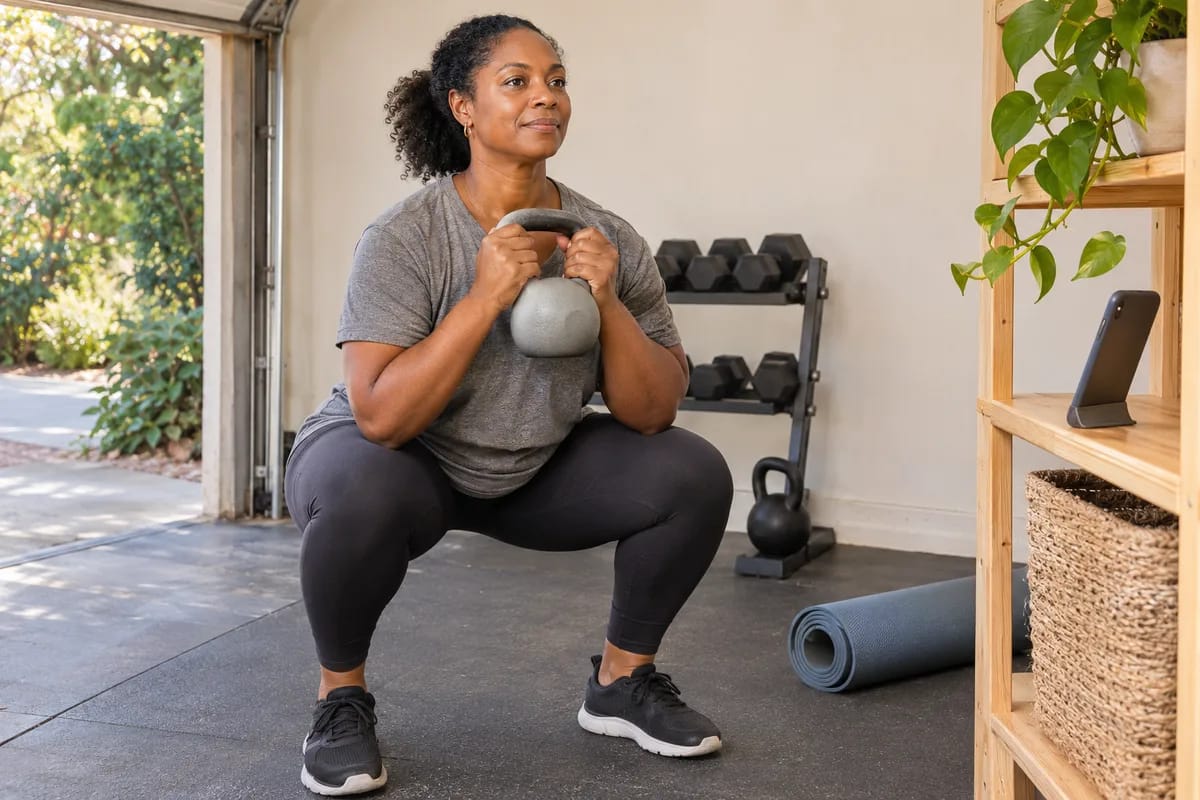
Week three, 3 lb up
You message your coach a photo of the scale: up 3 lb (1.4 kg), should you stop? They watched every set of Tuesday's leg day, the hardest you've done, and they remember you started creatine last week. They ask what the tape says: same as before. Hard leg day, new creatine, same waist: that's the water rows of the table, and your coach can put it together with you because they were on the call that week, not reading a logged workout. Thursday is still on: a set time, with your coach waiting on the call, which is what gets you there on a morning the scale reads high. On Thursday you add 5 lb (about 2.3 kg) to your squat, and the recap after the call shows it.
Henrik, 36, a member who trains with Tris, puts that part plainly: "Knowing Tris is waiting for me at every session means I actually go."
If it's the food row instead, your coach won't hand you a meal plan, because we don't do nutrition coaching; a registered dietitian is the person for that. Your sessions carry on, and your lifts, weigh-ins and waist measurements sit in the app, so you can see whether what you change is working.
It's 14 days free, then $299 a month, cancel anytime, with unlimited sessions of 45 to 90 minutes; most people settle at around an hour. Training twice a week, that's about $35 a session; three times, about $23. An extra session in a wobbly week costs nothing more.
Two weeks may not settle the water, so don't judge the trial on the scale. Judge it on whether the number stopped deciding whether you train.
Skip it if you already train steadily on your own and your only question is food: a dietitian is the better spend. If $299 a month would strain your budget, the weighing method above costs nothing.
Common questions
Do you gain weight before you lose it?
Often, for the first few weeks, because newly worked muscles hold more water. It isn't a stage you have to go through, and it isn't fat. It usually levels off within a month.
Should I stop working out if I'm gaining weight?
No. Stopping won't shift the water any faster, and you'd give up strength and fitness a scale can't show. The exception is fast gain that comes with swelling, breathlessness or other new symptoms. That's a question for your doctor, not your training plan.
Sources
-
Fernández-Elías VE, Ortega JF, Nelson RK, Mora-Rodriguez R, 2015. Relationship between muscle water and glycogen recovery after prolonged exercise in the heat in humans. European Journal of Applied Physiology. See also Kreitzman SN, Coxon AY, Szaz KF, 1992. Glycogen storage: illusions of easy weight loss, excessive weight regain, and distortions in estimates of body composition. American Journal of Clinical Nutrition. ↩
-
Cleveland Clinic, 24 Jan 2025. Why do some people gain weight after starting a workout program? Expert article quoting physical therapist Gary Calabrese, DPT, not a study. ↩ ↩2
-
Convertino VA, 1991. Blood volume: its adaptation to endurance training. Medicine and Science in Sports and Exercise. ↩
-
Kreider RB, Kalman DS, Antonio J, et al., 2017. International Society of Sports Nutrition position stand: safety and efficacy of creatine supplementation in exercise, sport, and medicine. Journal of the International Society of Sports Nutrition. Loading retained about 0.5 to 1.0 L of water short term. ↩
-
White CP, Hitchcock CL, Vigna YM, Prior JC, 2011. Fluid retention over the menstrual cycle: 1-year data from the prospective ovulation cohort. Obstetrics and Gynecology International. Self-reported fluid retention in 62 women over 765 cycles. ↩
-
Orsama AL, Mattila E, Ermes M, et al., 2014. Weight rhythms: weight increases during weekends and decreases during weekdays. Obesity Facts. ↩
-
Barrios P, Martin-Biggers J, Quick V, Byrd-Bredbenner C, 2016. Reliability and criterion validity of self-measured waist, hip, and neck circumferences. BMC Medical Research Methodology. 41 women measuring at the belly button; the technical error of duplicate home self-measurements of the waist was 0.76 inches, which puts the typical gap between two readings at about an inch (our arithmetic). Trained technicians were closer (0.22 inches). ↩
-
Hall KD, 2008. What is the required energy deficit per unit weight loss? International Journal of Obesity. The 3,500 calorie rule roughly fits people with more body fat and overstates it for leaner people; the 10,500 and 1,500 figures are our arithmetic. ↩
-
Verheggen RJ, Maessen MF, Green DJ, et al., 2016. A systematic review and meta-analysis on the effects of exercise training versus hypocaloric diet: distinct effects on body weight and visceral adipose tissue. Obesity Reviews. 117 studies. ↩
-
Benito PJ, Cupeiro R, Ramos-Campo DJ, et al., 2020. A systematic review with meta-analysis of the effect of resistance training on whole-body muscle growth in healthy adult males. International Journal of Environmental Research and Public Health. 111 studies, 1,927 men; pooled fat-free, lean and skeletal muscle mass rose about 1.5 kg, in programs of more than 2 weeks. ↩
-
Martin CK, Johnson WD, Myers CA, et al., 2019. Effect of different doses of supervised exercise on food intake, metabolism, and non-exercise physical activity: the E-MECHANIC randomized controlled trial. American Journal of Clinical Nutrition. Adults with overweight or obesity ate about 90 to 125 calories a day more; no change in resting metabolism or non-exercise activity, and the exercise groups lost 1.5 to 2.7 kg less than their exercise predicted. ↩
-
King NA, Hopkins M, Caudwell P, Stubbs RJ, Blundell JE, 2008. Individual variability following 12 weeks of supervised exercise: identification and characterization of compensation for exercise-induced weight loss. International Journal of Obesity. Sedentary adults with overweight or obesity; results ranged from -14.7 kg to +1.7 kg, and those who lost less than predicted ate about 268 calories a day more. ↩
-
Harvard Health Publishing, 8 Mar 2021. Calories burned in 30 minutes for people of three different weights. Estimates. ↩
-
USDA FoodData Central. Bananas, raw (FDC ID 173944): 89 calories per 100 g; a medium banana (7 to 7 7/8 inches) is 118 g, so about 105 calories. ↩
-
Shcherbina A, Mattsson CM, Waggott D, et al., 2017. Accuracy in wrist-worn, sensor-based measurements of heart rate and energy expenditure in a diverse cohort. Journal of Personalized Medicine. Seven wrist devices tested at Stanford. ↩
-
Al Khatib HK, Harding SV, Darzi J, Pot GK, 2017. The effects of partial sleep deprivation on energy balance: a systematic review and meta-analysis. European Journal of Clinical Nutrition. ↩
-
MedlinePlus, US National Library of Medicine, reviewed 3 Jul 2025. Weight gain - unintentional. ↩
-
Hill EE, Zack E, Battaglini C, et al., 2008. Exercise and circulating cortisol levels: the intensity threshold effect. Journal of Endocrinological Investigation. Twelve trained men, 30 minutes at 40, 60 and 80% of maximal oxygen uptake; cortisol rose about 40% at 60% and 83% at 80%, and did not rise significantly at 40%. ↩
-
Epel E, Lapidus R, McEwen B, Brownell K, 2001. Stress may add bite to appetite in women: a laboratory study of stress-induced cortisol and eating behavior. Psychoneuroendocrinology. 59 healthy premenopausal women. ↩
-
National Institute of Diabetes and Digestive and Kidney Diseases, last reviewed May 2018. Cushing's syndrome. Cushing's caused by the body itself affects about 40 to 70 people in a million; how many long-term steroid users develop it is not known. ↩