How to get toned: more muscle, a little less fat
Toned means a bit more muscle with a little less fat over it. Which one you need, a rep test for the weights you own, and a simple week at home or a gym.
In this article10
The short answer
Toned means a bit more muscle with a little less fat over it. Lift two or three times a week with weights that make the last few reps hard, eat enough protein, and eat less only if you have fat to lose.
If you've done months of light dumbbells, barre classes or ab circuits and you look about the same, it isn't because you didn't try hard enough. "Toning" is sold as a special kind of training, and there isn't one. The fix is usually small: the same moves, with a weight that actually gets hard. Below is a two-minute test for the dumbbells you already own, which of two dials you need to turn, and a week you can start on Monday at home or in a gym.
Why your toning workouts haven't changed much
Training makes a muscle stronger, and with enough of it, a little bigger. There's no separate setting that makes a muscle "firmer" or "longer". The look people call toned comes from two things: how much muscle there is, and how much fat sits over it.
Light weights can build muscle, but in the studies that show it, every set went until the person couldn't do one more rep.1 A really light weight, about a fifth of the most you could lift once, built roughly half as much muscle even when it was taken that far.2
So the problem is rarely the weight itself. It's a weight you can lift 30 times while chatting. Those sets feel like exercise, and they're good for your joints and your mood, but they don't give a muscle much reason to grow. Heavier here means a weight that makes 10 to 15 reps hard, not a powerlifting bar, and it won't make you bulky by accident (why not).
The rep test for the weights you own
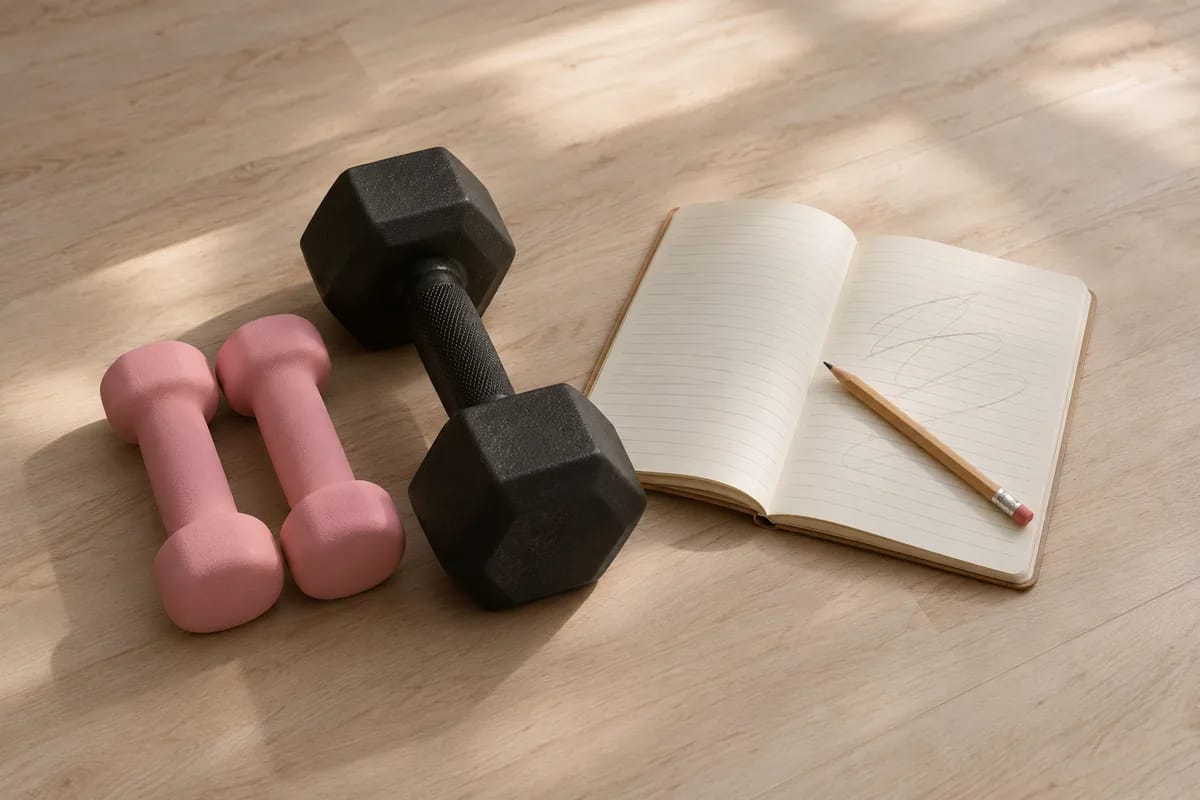
Do this tonight with the dumbbells you use most. It's our coaching rule of thumb, not a lab number.
Pick a move you know well
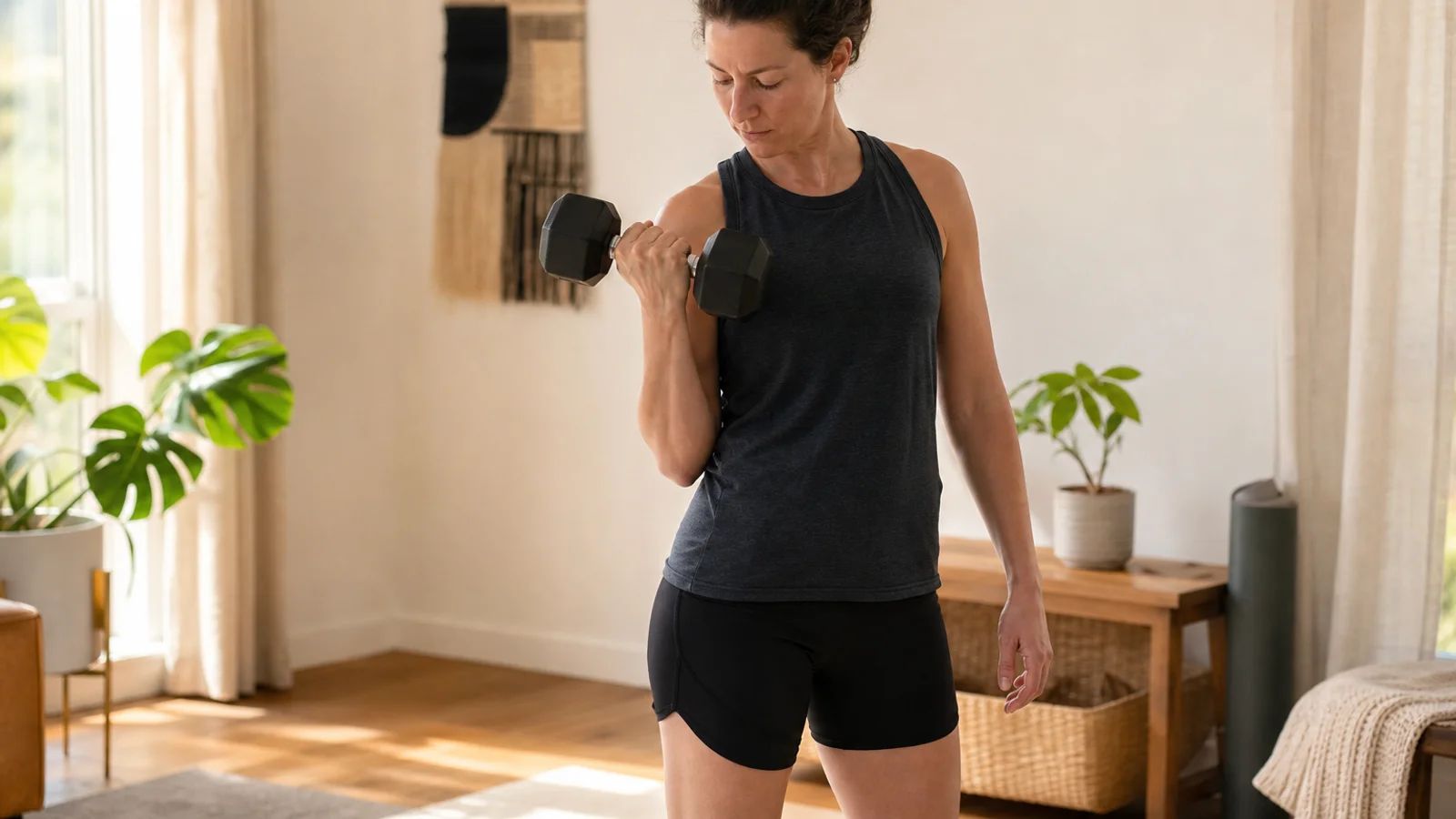
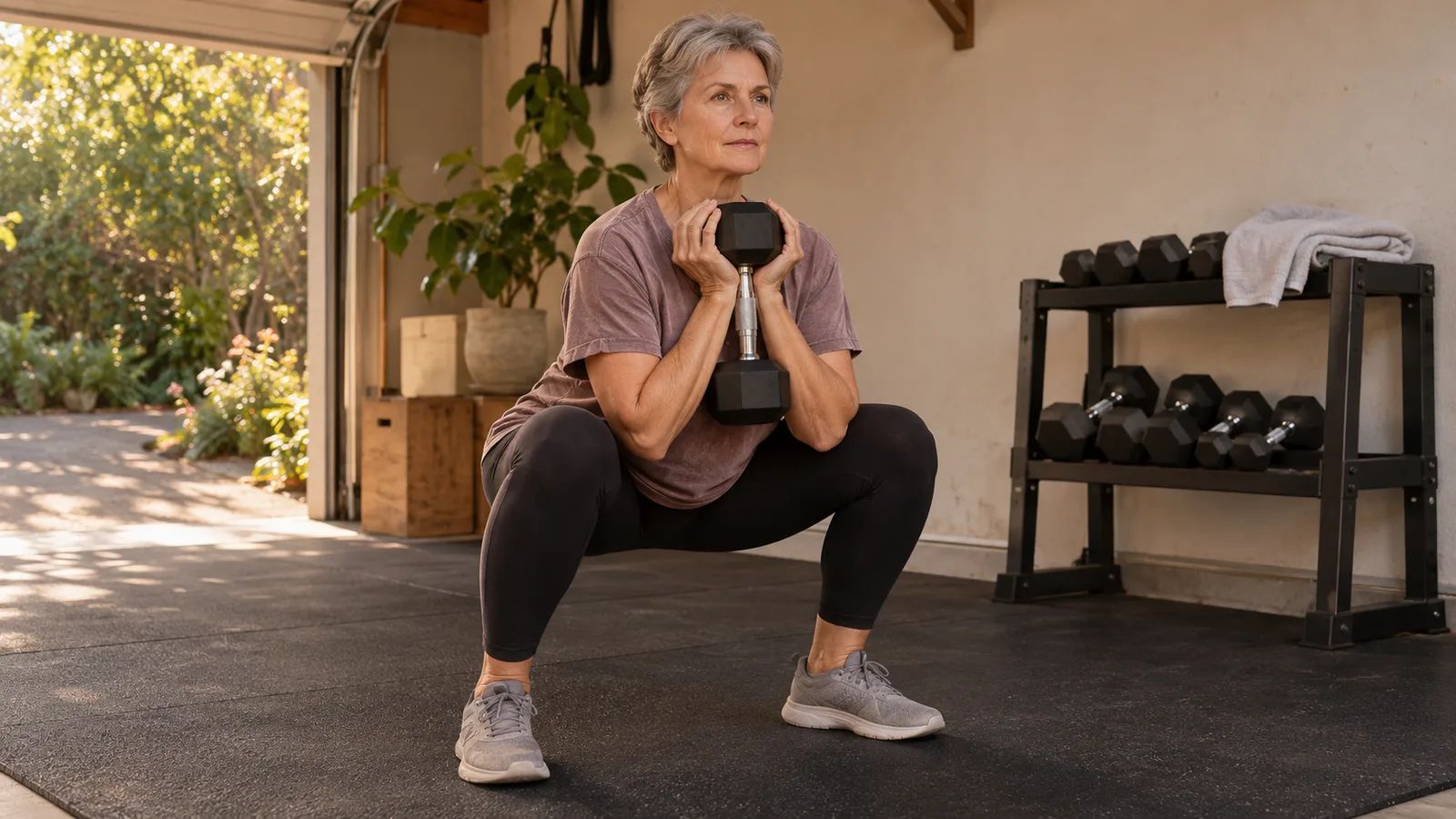
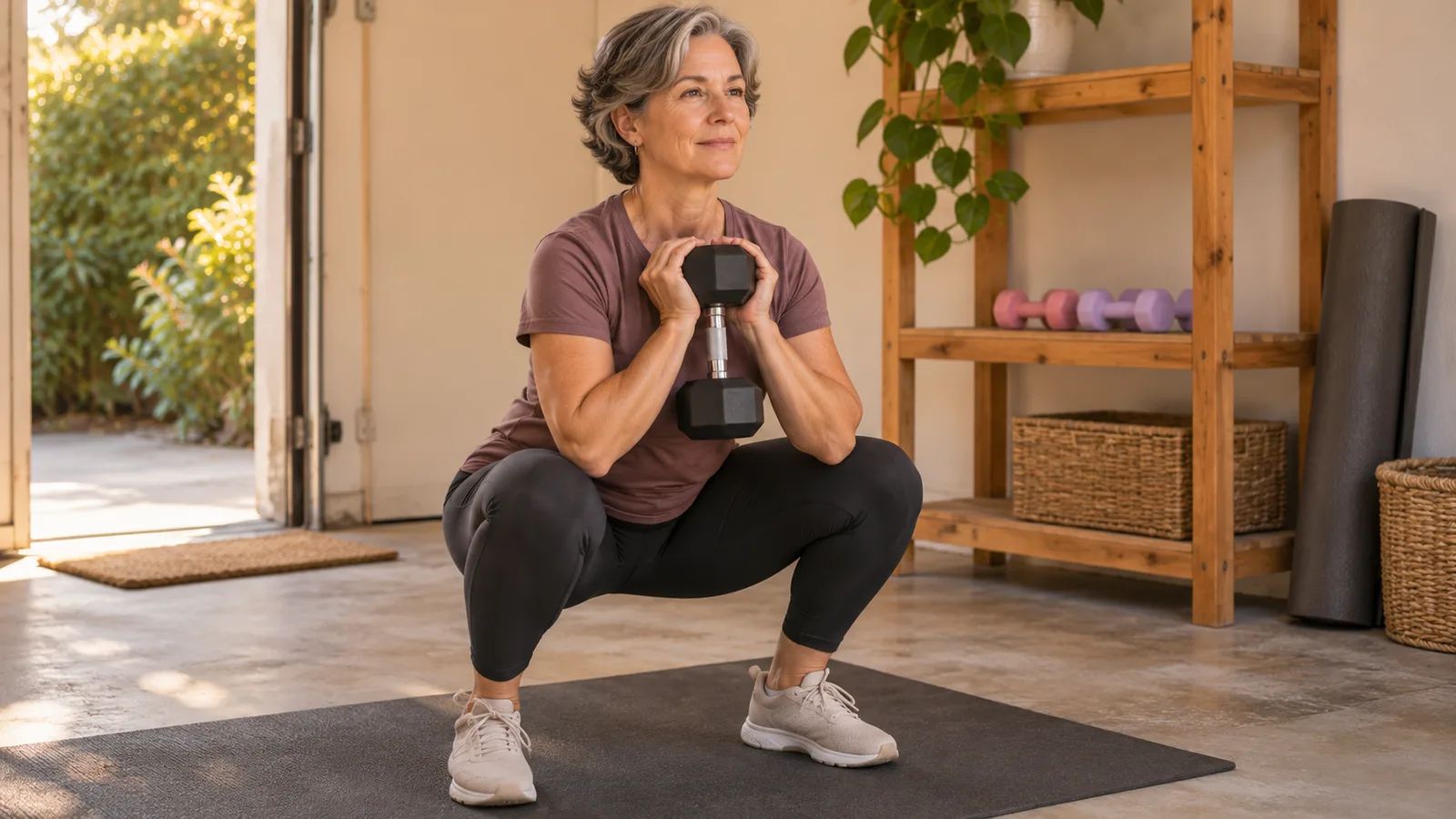
A biceps curl or a goblet squat (one dumbbell held at your chest) are safe ones to test. Use the weight you usually use.
Do as many clean reps as you can
Steady pace, lowering for about two seconds. Stop when the next rep would make you swing, lean back or cut the move short. That line is harder to see on yourself than it sounds: filming the set on your phone helps, and a coach watching helps more.
Read the number
10 to 15, with the last few slow and hard: the right weight to start the week below.
Under 10: drop one size for now.
Over 15: go up a size. A heavier weight does the same job in fewer reps.
Write the weight and the reps down
That's your start line. Next time, aim to beat it by a rep.
If your number was 40, you don't have to buy anything today. Slower lowering, pauses and one-arm or one-leg versions make a light dumbbell heavier, and progressive overload at home shows how far that goes before new weights are worth it.
Toned is two dials
One dial is how much muscle you have. The other is how much fat sits over it. Toned is the top right: enough muscle to give your arms and legs some shape, with little enough fat over it that the shape shows. You can be in any box and be healthy; this is only about the look you're after.
New lifters often move up and right at once, but it helps to know which dial matters most for you:
- You've lost weight and look smaller, but not firmer. Your muscle dial is the one. Lift, eat about what you eat now, and get enough protein. Eating less again is likely to take more muscle with it.
- You're slim, but nothing shows. Same dial, more so. Lifting is the whole plan, and eating a little more is fine.
- You can feel muscle, but it's under more fat than you'd like. Both dials. Lift exactly the same way, and eat a little less, slowly (the numbers are further down).
If you'd like a number instead of a mirror, the tape-measure method in our skinny-fat guide uses your waist and height and tells you whether to eat at maintenance or a little under.
A week that builds the toned look
Three full-body sessions a week, with a day off between them (say Monday, Wednesday and Friday). Every session is the same six moves. The first weights come from our starting-weights guide; start at the low end if you're new, the high end if you're active.
| Move | Cue | Sets × reps | First weight to try |
|---|---|---|---|
| Goblet squat | Dumbbell at your chest, sit between your heels | 3 × 8 to 12 | 8 to 20 lb (4 to 9 kg) |
| Romanian deadlift | Hips back, dumbbells slide down your thighs | 3 × 8 to 12 | 8 to 20 lb (4 to 9 kg) each hand |
| Push-up or floor press | Hands on a counter at first, or press lying on the floor | 3 × 8 to 12 | Body weight, or 5 to 15 lb (2 to 7 kg) each hand |
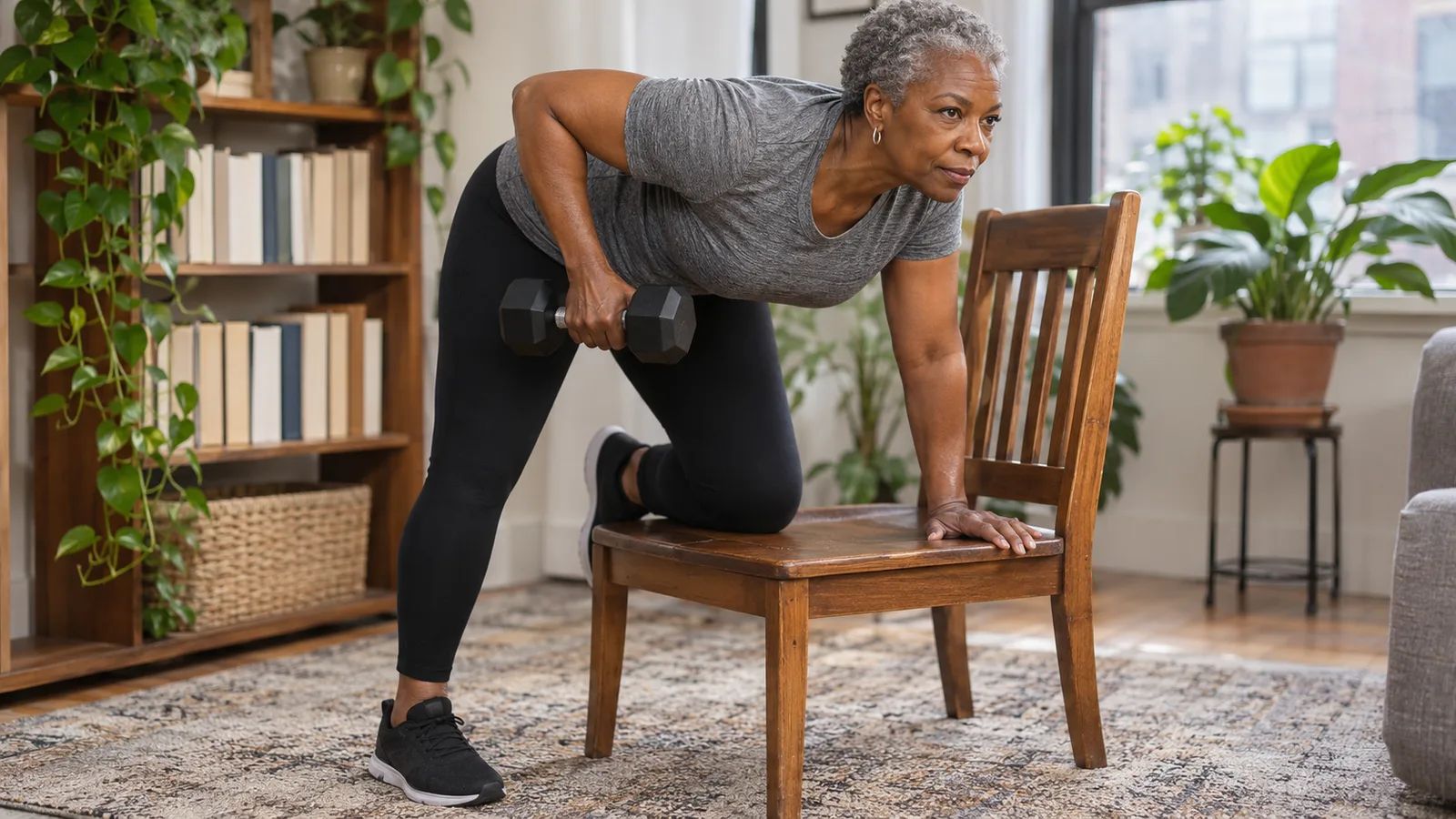
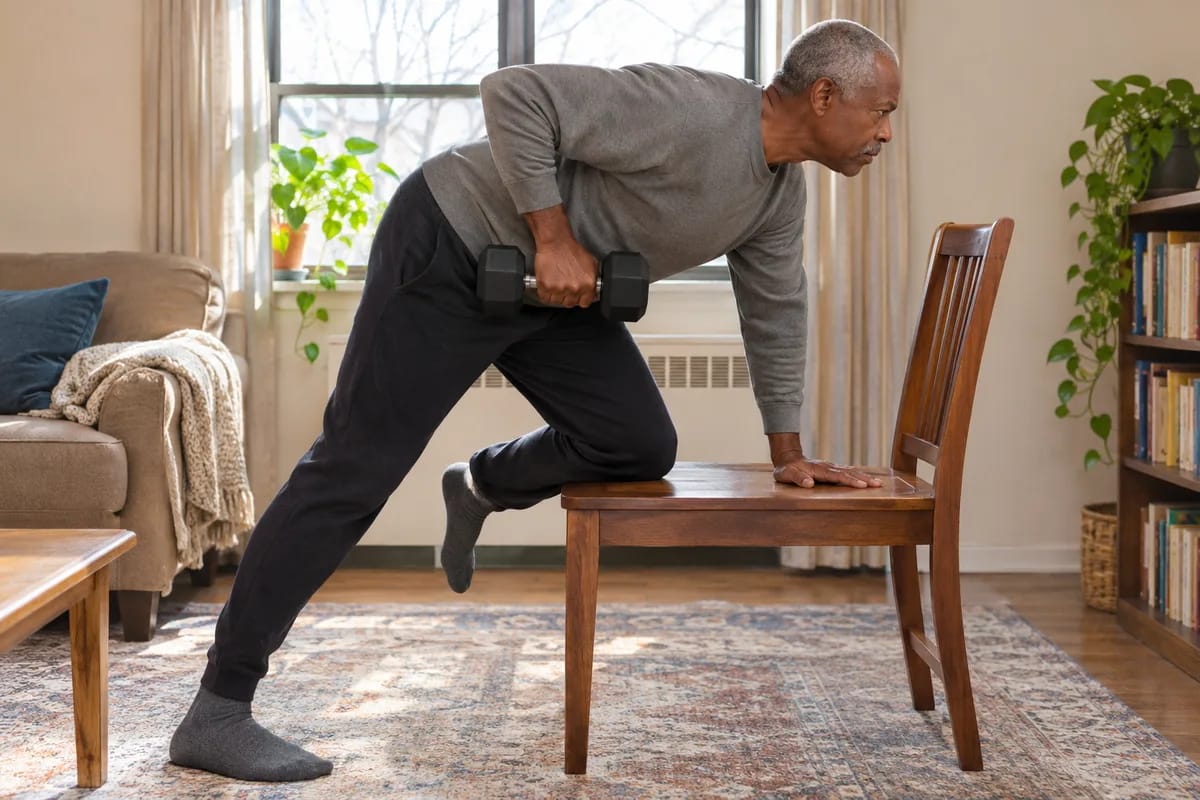
| One-arm row | Hand and knee on a chair, pull to your hip | 3 × 8 to 12 each side | 8 to 20 lb (4 to 9 kg) |
| Overhead press | Seated or standing, from your shoulders up | 2 × 8 to 12 | 5 to 15 lb (2 to 7 kg) each hand |
| Split squat | A lunge with your feet planted, hold a counter | 2 × 8 to 12 each side | Body weight first |
At a gym, swap in a leg press for the squat, a bench press for the floor press and a cable row for the dumbbell row. Everything else stays. No dumbbells yet? Run the same week with bodyweight squats and split squats, counter push-ups, a resistance band for the row and the press, and a backpack of books for the deadlift. If the Romanian deadlift or the push-up is new to you, our deadlift guide and our push-up guide take each from the first rep.
Three rules make this work, and they matter more than the moves:
- Stop each set with one to three good reps left. Hard, not grinding. The last two reps should slow down.
- Go up when the top of the range gets easy. When you get 12 on every set with reps to spare, use the next weight next time and start back near 8.
- Rest about one and a half to two minutes between sets. The whole session takes about 45 minutes with a warm-up.
Two sessions a week is a fine start and meets the US guideline for strength work.3 For a full program with a plan for each month, our four free plans cover home, gym and coming back after a break, for anyone, not only women.
"Toning" methods, honestly
None of these are bad. Each one does something real, just not always the thing you wanted from it.
| What you tried | What it does for the toned look | How to make it count |
|---|---|---|
| Barre and Pilates | Control, posture, trunk strength, a class you enjoy; loads muscles more lightly than lifting does | Keep the class, add two lifting days |
| Ab circuits | A stronger trunk; doesn't shrink belly fat4 | Two ab moves at the end of a lifting day |
| Walking, running, cycling | Heart, mood, a little extra fat loss; loads muscles far less than lifting | Keep it, alongside lifting |
You'll also see lists promising that tennis, swimming or bowling will tone your arms. They're lovely things to do, and they'll make you fitter. For the shape of your arms, a few hard sets of presses and rows will do far more.
Arms, stomach, thighs: where people want it
| Where | What gives it shape | Moves that build it |
|---|---|---|
| Back of the upper arms | Triceps, and the shoulders above them | Push-ups or floor press, overhead press, overhead triceps extension |
| Stomach | The muscles that wrap your trunk | Plank, dead bug, carrying heavy shopping bags, and every squat and deadlift |
| Thighs and bottom | Glutes, the fronts and backs of your thighs | Goblet squat, Romanian deadlift, split squat, hip thrust |
What you can't choose is where the fat comes off. Across 13 studies, training one area didn't burn the fat on that area.5 In one, people did around a thousand light leg presses a session with a single leg, three times a week for three months. They lost fat, just not from the leg they trained.6
So build the muscle where you want shape, eat for the dial you need, and let your body decide the order. If your stomach seems the slowest to change, that's not a sign the plan isn't working.
The fat dial is mostly food
If the muscle dial is the only one you need, the only food job is protein. If you'd like less fat too, there are two more.
- Protein: about 0.7 g per pound of body weight a day (1.6 g per kilo). For people who lift, more than that adds little.7 For a 150 lb (68 kg) person it's roughly 105 to 110 g a day.
- What that looks like: about 35 g at each of three meals, which is 4 oz (about 115 g) of roasted chicken breast, or two eggs with 8 oz (about 225 g) of plain Greek yogurt.8
- Eat a little less, slowly. Aim to lose no more than about 0.7 percent of your body weight a week: about 1 lb (0.5 kg) for a 150 lb person. In one study, lifters who lost weight faster than that gained no muscle.9 The simplest start: drop one regular snack or sugary drink a day, and check your waist after two weeks. If it hasn't moved, drop one more.
- Walk. It's the easiest extra there is, and it nudges the fat dial without getting in the way of your lifting days.
If you've had an eating disorder, if counting food pulls you somewhere unhealthy, or if you have a medical condition or take medicine that affects your weight or what you can eat, talk to your doctor before you start eating less or change how much protein you eat.
How long it takes, and how to tell it's working
Strength comes first: most people lift more within three or four weeks. By our coaches' estimate, a slight change in the mirror usually shows around month two or three, and an obvious one by month four to six, sooner if the fat dial was already low. Our results timeline goes week by week.
The mirror is the slowest judge you've got, so watch these, in roughly the order they move:
- Your weights. The numbers in your notebook. That's the first proof.
- Your tape measure. Waist, hips and the top of each arm, once every two weeks, same spot each time.
- Photos. Every four weeks, same light, same clothes, same spot in the room.
- The scale, last. If you're building muscle and losing a little fat, it can sit still for weeks while everything else improves.
If after six weeks your weights haven't gone up at all, the usual reasons are that the sets aren't getting hard enough or the sessions aren't happening. If neither fits, look at sleep, stress, illness or a steep calorie cut, and see your doctor if something feels off.
Toning with a coach watching every set
In our coaches' experience, toning stalls in one of two ways. The same 5 lb (2 kg) dumbbells in month twelve as in month one, because going up alone feels like a risk when you can't see your own form. Or the sessions quietly stop: a busy week, then another, and the dumbbells go under the bed.
Every Bespoke Fit session is a live 1‑on‑1 video call with your own coach, in our app on iPhone, Android or a browser, wherever you can prop a phone up. Here's what changes:
- Someone calls the weight. A class instructor watches a whole room, and a workout video can't see you at all. Your coach watches every set of yours, with the phone side-on so the whole movement is in view, sees when 12 reps has become easy, and tells you to go up. When your hips drift on a deadlift or a squat gets shallow, they say so mid-set. (What a coach can see through a phone.)
- Someone counting on you to show up. Each session is a set time with your coach waiting on the call, sent as a calendar invite with reminders beforehand. Skipping means telling a person, which is why the sessions happen.
- Your coach knows you. A head coach matches you to a coach on a 30-minute call first. Each coach has 12 members at most, and we hold to it: twelve people training two or three times a week for about an hour is already 24 to 36 hours of calls a week. So yours remembers last week and writes each workout onto your training calendar.
- The four signs live in the app. Your top lifts and records, measurements, weigh-ins and private progress photos, with a recap after each session of what you lifted.
One of our members put it like this:
"I was skeptical about doing training over video at my age, but it has been much easier than I expected. My trainer is patient and adjusts everything to what my body can handle. I have exercised more in the past two months than in the last ten years. My friends can see the difference."
Wanda, 70, a Bespoke Fit member
It's 14 days free, then $299/mo, for unlimited sessions of 45 to 90 minutes, and most people settle at around an hour. At three sessions a week that's about $23 a session; at two, about $34. An in-person trainer in the US usually charges $50 to $100 a session, depending on the city.10
What it doesn't do: we don't coach nutrition, so the fat dial stays yours, and nobody is in the room with you. If the rep test showed you're already lifting hard and adding weight on your own, keep going with the week above; it's free. And if $299 a month would strain your budget, the plan on this page is a real plan, not a teaser.
Common questions
Will lifting heavier weights make me bulky? Not by accident. Muscle grows slowly, even for people eating and training hard to add it on purpose. If you ever felt you were getting bigger than you wanted, you'd see it coming months ahead and could simply keep your weights where they are.
Can I get toned at home without weights? Yes. Squats, lunges and push-ups with your own body weight work for a good while, as long as you make them harder once 20 reps gets easy. For pulling moves, a resistance band is the cheapest help.
Is it harder to get toned after 50? It can be slower, but muscle keeps responding to lifting well into your 80s. Start at the light end of the weights in the table, let the rep test move you up, and give yourself a few extra weeks before you judge the mirror.
Do I need cardio to get toned? Not to build the muscle; lifting does that. US guidelines suggest 150 minutes a week of moderate activity like brisk walking, which is good for your heart and mood. Do the cardio you enjoy, alongside lifting rather than instead of it.
Sources
-
Schoenfeld, B.J., Grgic, J., Ogborn, D. & Krieger, J.W., 2017. Strength and hypertrophy adaptations between low- vs. high-load resistance training: a systematic review and meta-analysis. Journal of Strength and Conditioning Research. 21 studies, all sets to momentary failure; low load was 60% of one-rep max or less. Muscle growth was similar; heavy loads built more maximal strength. ↩
-
Lasevicius, T. and colleagues, 2018. Effects of different intensities of resistance training with equated volume load on muscle strength and hypertrophy. European Journal of Sport Science. 30 men, 12 weeks, each limb trained at a different load; at 20% of one-rep max a front-thigh muscle (vastus lateralis) grew 8.9% against 19.5% at 80%, and the elbow flexors 11.4% against 25%. The authors call 20% "suboptimal". ↩
-
Centers for Disease Control and Prevention. Adult activity: an overview. At least 150 minutes of moderate-intensity activity such as brisk walking a week, and 2 days of muscle-strengthening activity that work all major muscle groups. ↩
-
Vispute, S.S., Smith, J.D., LeCheminant, J.D. & Hurley, K.S., 2011. The effect of abdominal exercise on abdominal fat. Journal of Strength and Conditioning Research. 24 sedentary adults, seven ab exercises five days a week for six weeks: no change in belly fat or waist size, though ab endurance improved. ↩
-
Ramirez-Campillo, R., Andrade, D.C., Clemente, F.M., Afonso, J., Pérez-Castilla, A. & Gentil, P., 2022. A proposed model to test the hypothesis of exercise-induced localized fat reduction (spot reduction), including a systematic review with meta-analysis. Human Movement. 13 studies, 1,158 people aged 14 to 71: localized training "had no effect on localized adipose tissue depots, i.e., there was no spot reduction." ↩
-
Ramírez-Campillo, R. and colleagues, 2013. Regional fat changes induced by localized muscle endurance resistance training. Journal of Strength and Conditioning Research. 11 young adults trained one leg with 960 to 1,200 reps of leg press at 10 to 30% of one-rep max, three times a week for 12 weeks. Whole-body fat mass fell 5.1%, with no significant change in the trained or the untrained leg. A small study; the untrained leg was the comparison, with no separate non-training group. ↩
-
Morton, R.W. and colleagues, 2018. A systematic review, meta-analysis and meta-regression of the effect of protein supplementation on resistance training-induced gains in muscle mass and strength in healthy adults. British Journal of Sports Medicine. 49 trials of protein supplements alongside resistance training, 1,863 people; gains in lean mass levelled off at a total daily intake of about 1.6 g of protein per kilo of body weight. The extra gain from protein was smaller in older people. ↩
-
Our arithmetic from USDA FoodData Central values per 100 g: roasted chicken breast 31 g, whole egg 12.6 g (a large egg is about 50 g), plain low-fat Greek yogurt 9.95 g. Brands vary. ↩
-
Garthe, I., Raastad, T., Refsnes, P.E., Koivisto, A. & Sundgot-Borgen, J., 2011. Effect of two different weight-loss rates on body composition and strength and power-related performance…. International Journal of Sport Nutrition and Exercise Metabolism. Title shortened. 24 competitive athletes who lifted four times a week, assigned a target of 0.7% or 1.4% of body weight lost a week (the faster group actually averaged about 1%). Lean mass rose 2.1% in the 0.7% group and was unchanged in the faster group. The diets lasted about 5 to 9 weeks. ↩
-
Bark, 2026. How much does a personal trainer cost?. bark.com, "The average personal trainer cost is $50-90 per session", last updated 16 January 2026. RightFit Personal Training, 2026. How much does a personal trainer cost?. Medians from its trainer listings, updated 2 November 2026: $85 an hour in-home and $80 at the trainer's facility, with New York at $100. Both read 12 November 2026. Our per-session figures are $299 divided by about 13 or 8.7 sessions a month. ↩