How many reps should I do? 8 to 15 for most people
Most people do best with 8 to 15 reps a set, stopping with 2 or 3 still in you. When to go lower or higher, by goal and by exercise, and how to tell.
In this article8
The short answer
For most people, 8 to 15 reps a set, stopping when you have 2 or 3 good reps left. Anything from about 6 to 30 builds muscle if the set ends near your limit. Chasing the heaviest lift you can? We'd use 3 to 8 on that one.
If a plan told you 3 × 10 and you wondered whether that's right for you, it almost certainly is. Here's how to check, and when to change it.
Your number, by goal
| Your goal | Reps a set | Good to know |
|---|---|---|
| New to lifting, or stronger and healthier all round | 8 to 15 | Long enough to learn the move, short enough to judge |
| Bigger muscles | 6 to 15, some sets up to 30 | The whole range works. The middle is the most time-efficient1 |
| The most weight on one lift | 3 to 8 on that lift | Heavy sets build top-end strength best.1 The 3 to 8 is our pick. Keep other moves at 8 to 15 |
| Losing fat | 8 to 15 | The rep count doesn't decide fat loss. Pick the range you'll keep doing |
| "Toning" | 8 to 15 | There's no toning range. Toned means a bit more muscle and a bit less fat, so the everyday 8 to 15 does it |
| Over 50, or starting from nothing | 10 to 15 at first, then 6 to 12 | Lighter for the first weeks, heavier once the moves feel steady2 |
| Bands or body weight only | Whatever leaves 2 or 3 in you | Counts as real strength work, as long as the last reps are hard |
What makes any number on this page work is where you stop. You don't need to go until you can't move the weight. The American College of Sports Medicine's 2026 guidelines say finishing with 2 or 3 reps in reserve is enough, and suggest at least two sets of each exercise.3
Two or three sets of each is plenty. Rest until you could repeat the set about as well as the last one. In our coaching that's usually one to three minutes, the longer end on big leg moves.
Your number, by exercise
The move matters as much as the goal. Here's where we'd start you. It's coaching practice, not a study finding, and the reasons sit under the table.
| Kind of move | Examples | Reps a set |
|---|---|---|
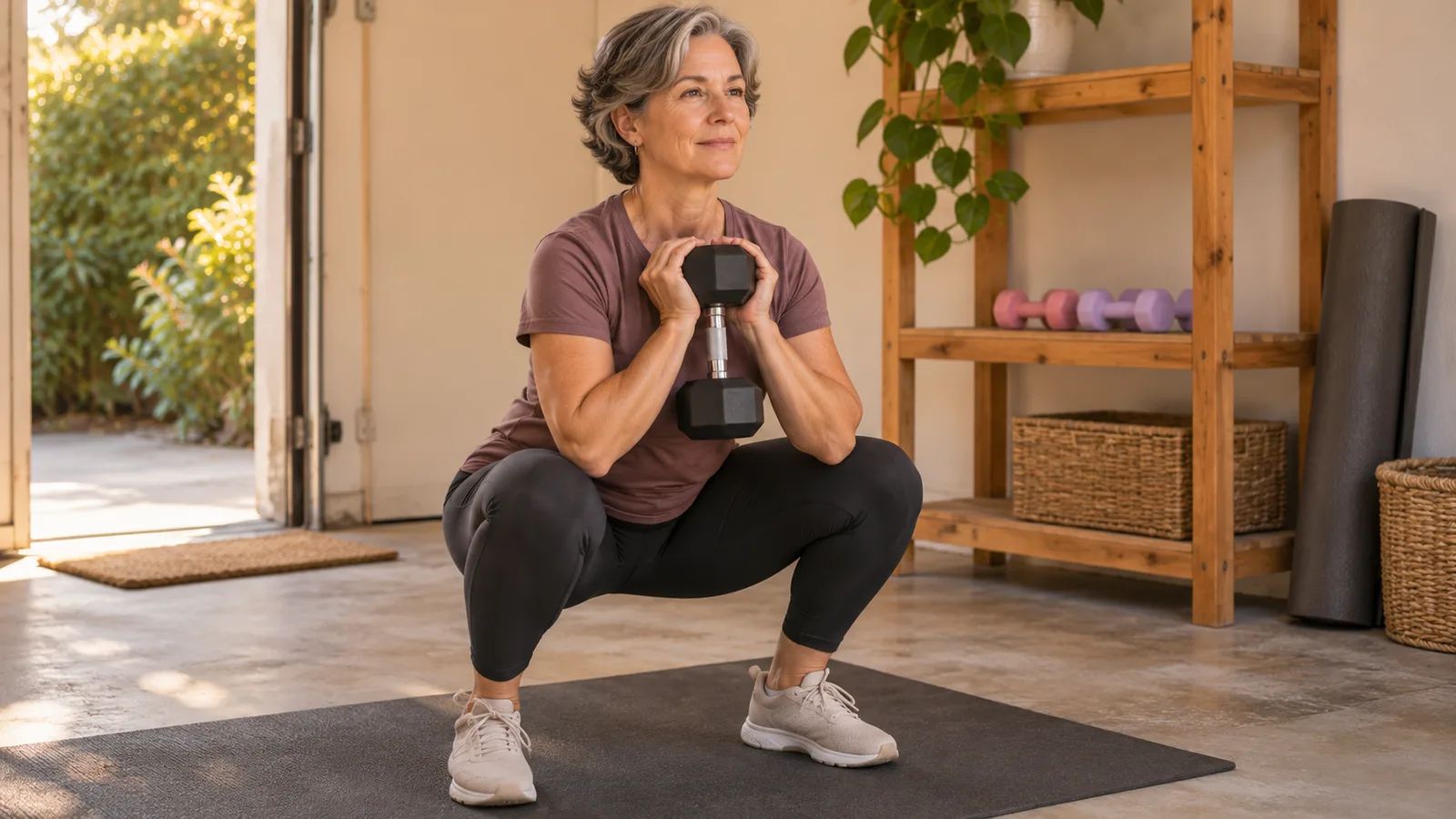
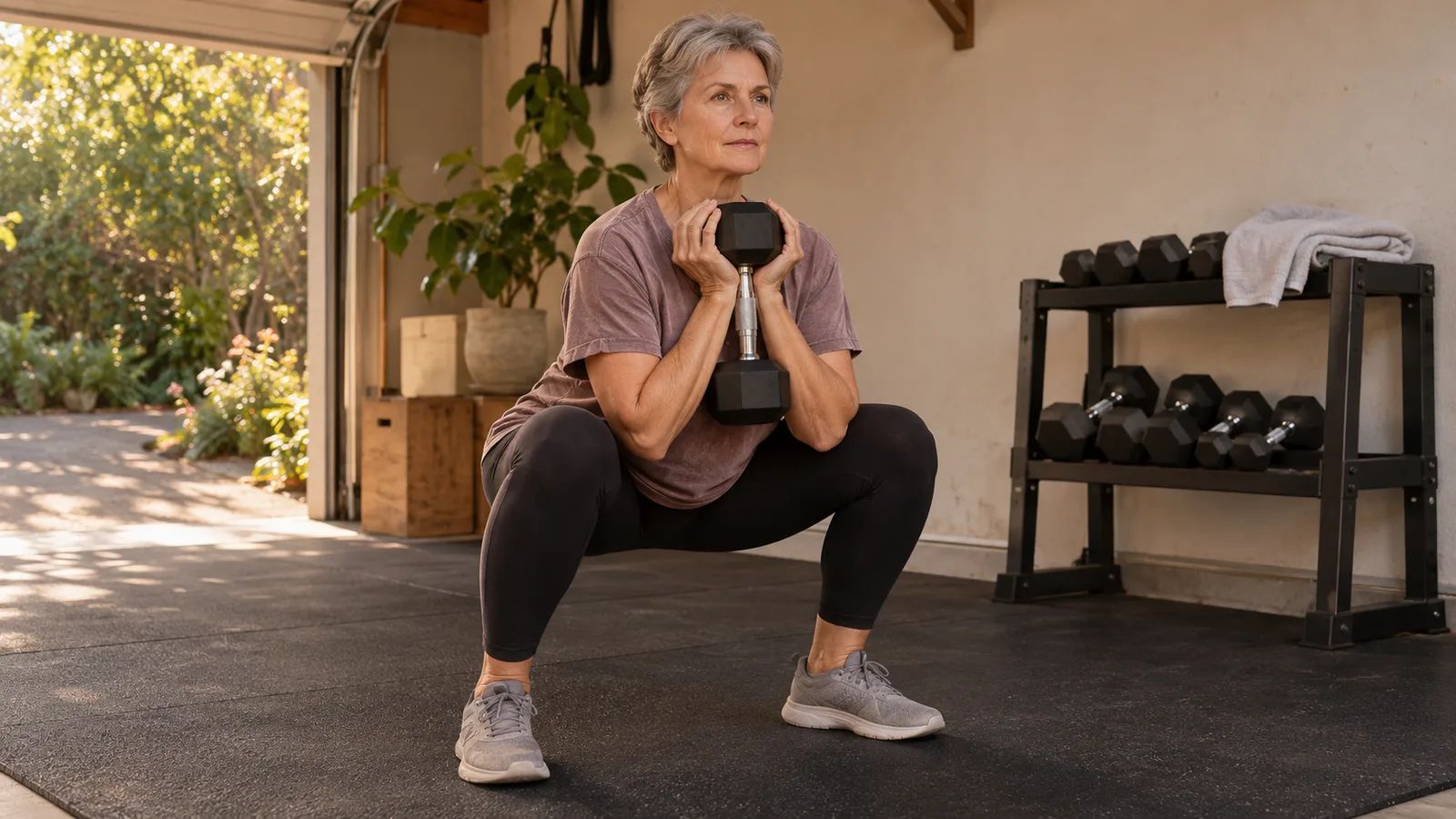
| Big leg and hip moves | Goblet squat, split squat, Romanian deadlift, step-up | 6 to 12 |
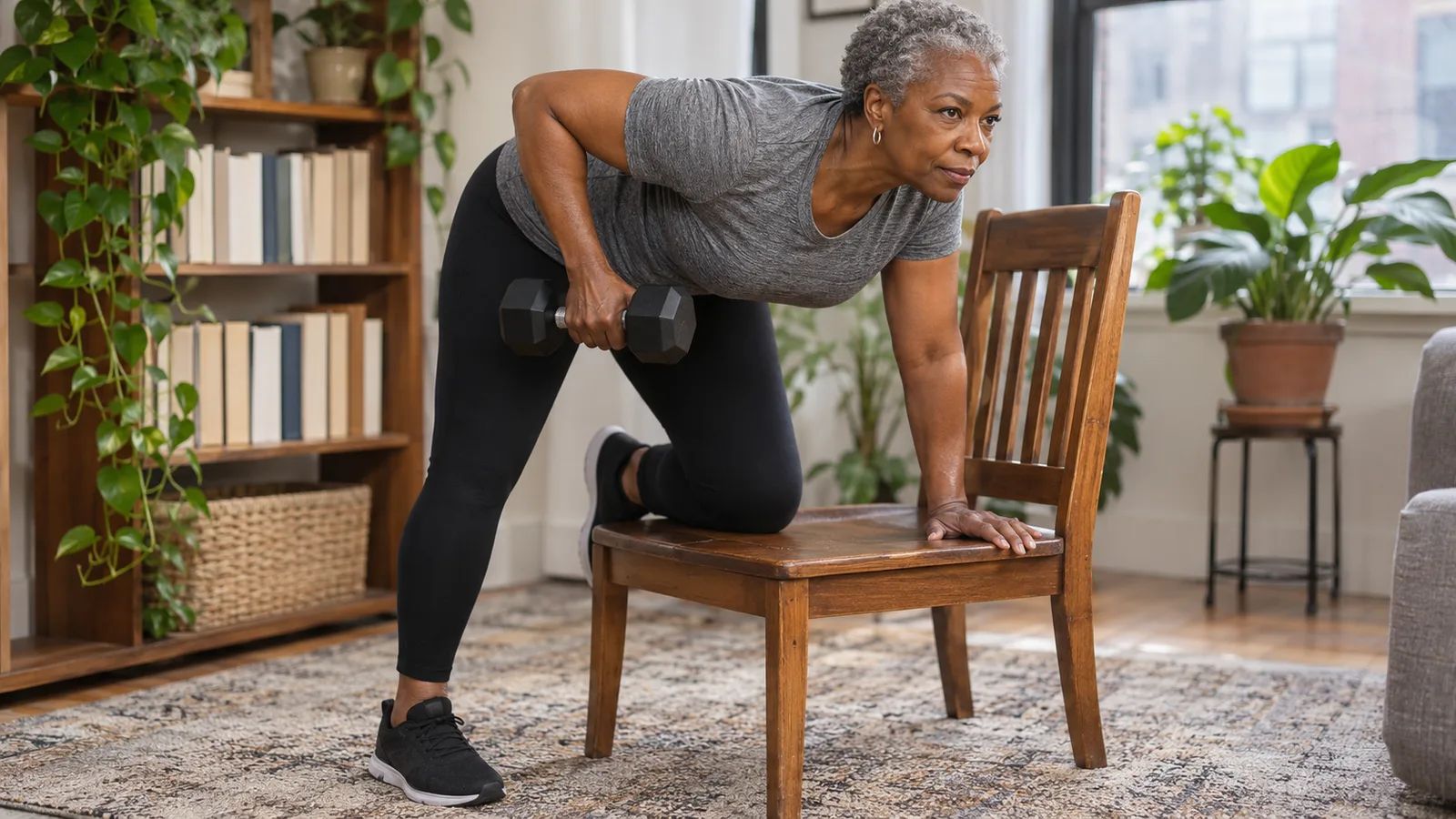
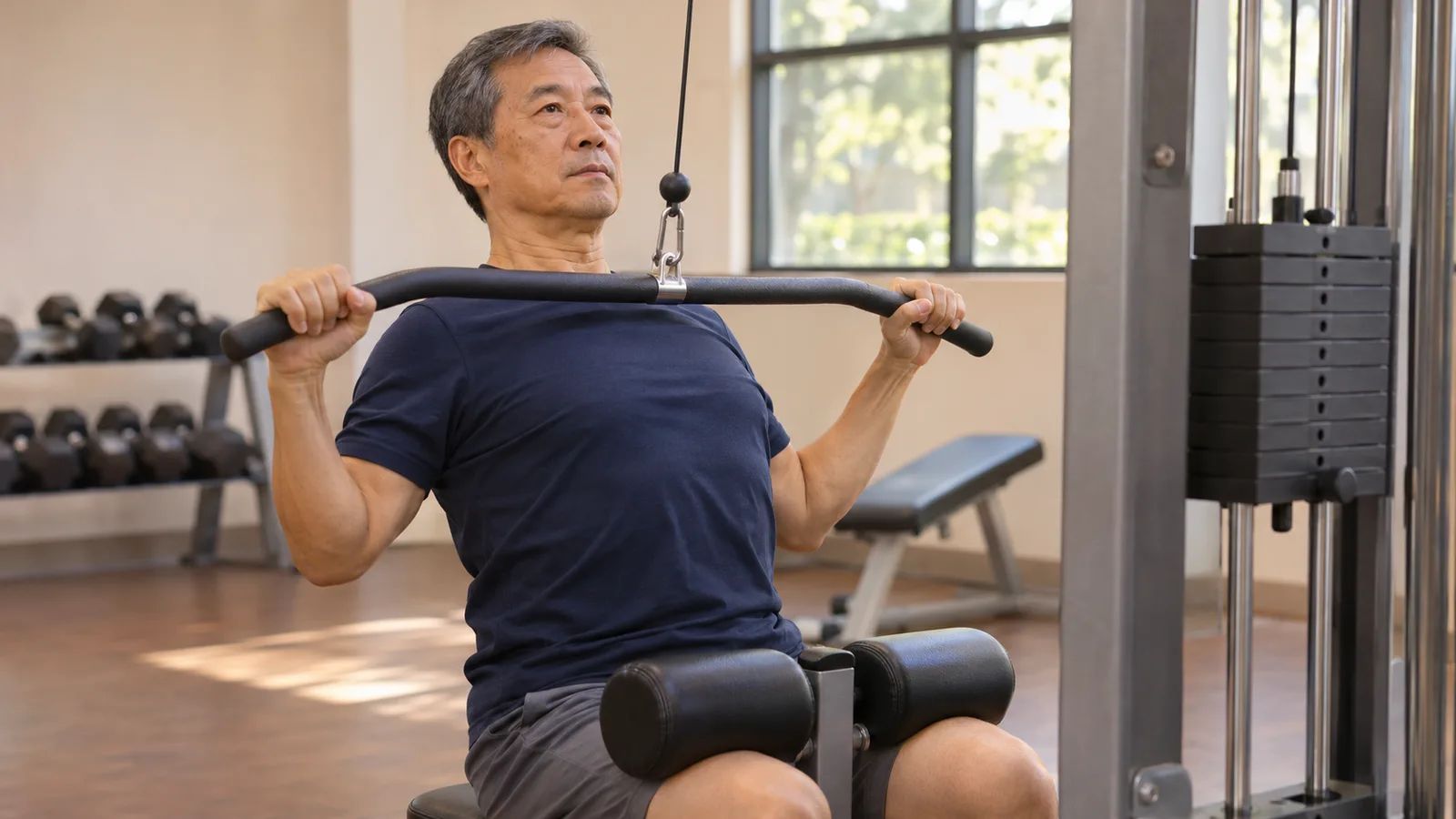
| Presses and pulls | Floor press, overhead press, one-arm row, lat pulldown | 8 to 12 |
| Small moves | Lateral raise, biceps curl, triceps extension, calf raise | 12 to 20 |
| Body weight and bands | Push-up, glute bridge, band row | 8 to 25 |
Start from your goal's range, then lean each move toward this column. A beginner's goblet squats might land at 8 to 12 and their curls at 12 to 15.
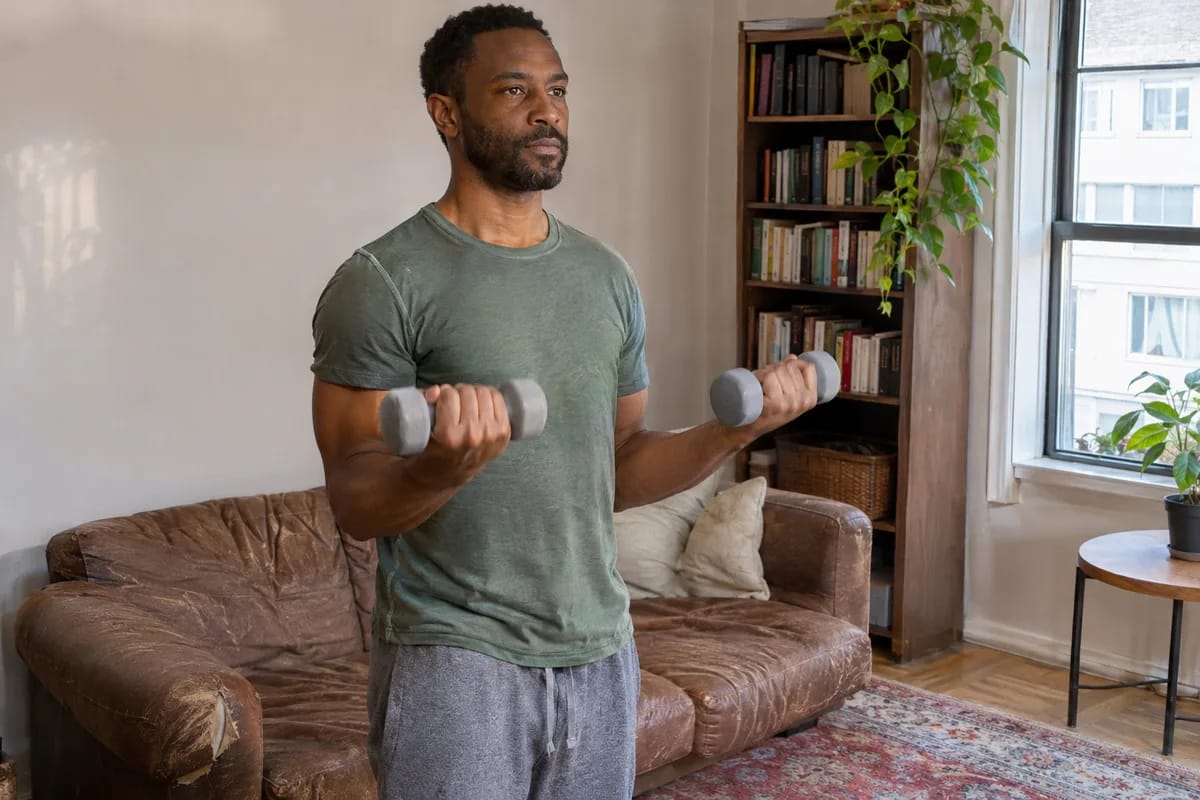
Why the moves differ:
- Big moves run out of breath and form before they run out of muscle. By rep 15 of a split squat, most people are puffing and the front knee starts to wander. Shorter sets keep every rep looking like the first.
- Long sets are harder to judge. In studies, people's guesses about how many reps they had left got noticeably worse once a set went past 12.4 On a curl, a wrong guess costs nothing. On a loaded squat, it costs form.
- Small dumbbells jump in big steps. Going from 5 lb to 8 lb (about 2.3 to 3.6 kg) is a 60% jump. A range that runs up to 20 gives you room to grow into the next pair. Plenty of people also simply find curls and raises feel better with more reps.
Why you've seen two different answers
Search this and many pages give you a chart: 1 to 5 reps for strength, 8 to 12 for size, 15 and up for endurance. Others say reps don't matter. Each is half right.
When researchers pooled the studies that tested the chart, the strength part held up: heavier sets built more strength than light ones.5 The size part didn't. Light, moderate and heavy loads grew about the same muscle, as long as each set was taken hard.5
Schoenfeld and colleagues, 2021; Lopez and colleagues, 2021; Halperin and colleagues, 2022
So reps barely matter for muscle, and they do matter for your heaviest lift. The middle of the range is the practical pick because it saves time: very light sets take many more reps and tend to feel worse.1
How to tell the weight fits your reps
Right for your reps
- You reach the bottom of your range without a fight
- The last two reps are slower, but look like the first
- You could do 2 or 3 more, and you'd rather not
Change the weight
- You can't reach the bottom of the range: go lighter
- Your form changes to finish, like a rounding back or caving knees: go lighter
- You hit the top of the range and could keep going for ages: go heavier next time
People tend to guess they have fewer reps left than they really do, by about one rep on average.4 So if a set feels like it has 2 left, it probably has 3, and you can push one rep further than it feels. The guess gets better with practice, and rating effort with reps in reserve shows how to train it. Picking a weight from scratch? How much weight a beginner should lift has starting numbers for each move.
One line between effort and harm: a burn or heavy ache in the muscle is normal. A sharp or pinching pain in a joint is a stop sign, not a rep target.
When to change the number
Change the weight, not the range. When you reach the top of your range on every set, go up by the smallest step you have next session and start again near the bottom. Coaches call this double progression.
Say your row range is 8 to 12 with a 20 lb (9 kg) dumbbell. In week one you get 10, 9 and 8. A few weeks later it's 12, 12, 12. Next session you pick up the 25 lb (11 kg) and get something like 9, 8, 8. You're back at the bottom of the range, and stronger than when you were last there. Tracking progressive overload shows how to keep the record on one index card.
If the heaviest dumbbells you own give you more than about 25 reps, stop adding reps and make each one harder: lower the weight for a slow count of three, pause at the bottom, or switch to a one-leg or one-arm version. Progressive overload at home has a harder version for each common move.
Over 50, or starting from nothing
Same rules, a gentler first month, and one real difference: stay clear of the very last rep. The National Strength and Conditioning Association picks its ranges for older adults partly to spare the joints,2 and the 2026 ACSM guidelines say lifting to failure may be a bad idea for some older people, partly to protect the blood vessels and partly because form slips near the end.3 If you have a heart condition or high blood pressure, ask your doctor how hard to push.
Lighter weights are a fine place to stay a while, too. In studies of people in their late 60s, heavy loads tended to build a little more strength, but lighter ones still brought real gains as long as enough reps were done.6 For a full first three months, see starting to lift at 50 with zero gym background.
With a coach counting the reps
Everything above works on your own. Two parts are hard to do alone: judging the 2 or 3 reps you have left, and knowing when you've earned the heavier dumbbell. That's what a person watching is for.
At Bespoke Fit every session is a live 1‑on‑1 video call with your own coach, in our app on iPhone, Android or a browser. You prop your phone where it sees all of you, and your coach watches through the camera.
- They call the last reps. You'll misjudge reps left by about one, more on long sets, and caving knees or a rounding back are invisible from inside the set. Your coach watches the reps slow and the form start to go, and tells you to stop or do one more.
- They move you up. Your coach writes each exercise and its rep target on your training calendar, and you log every set in the app. Once you've hit the top of your range, the next session they write has the heavier dumbbell in it.
- They watch your heart rate. It's live on their screen from an Apple Watch or a Bluetooth strap, and they use it to decide how hard you go and when you're ready for the next set.
If you're new, your coach picks your starting weights, so you never have to guess your first dumbbell. Each coach has 12 members at most, and we hold to that when we assign coaches.
It's 14 days free, then $299/mo, for unlimited sessions of 45 to 90 minutes; most people settle at around an hour. At three sessions a week, that's about $23 a session.
If you already judge your sets well and like running your own plan, the two tables above and a notebook will take you a long way. The same goes if $299 a month would strain your budget. And we don't coach nutrition, so for fat loss the food side stays with you.
Common questions
On a split squat or one-arm row, do I count each side? Yes. Ten reps of a split squat means ten on one leg, then ten on the other, and both sides should end with 2 or 3 left. Start with your weaker side, so the stronger one doesn't set a pace the other can't match.
What if I can't do 8 of something, even with the lightest weight? Use an easier version and build up to the real one. Push-ups go against a kitchen counter, squats go down to a chair, and a light band can stand in for a dumbbell. Once you get about 12 with 2 or 3 left, step to the next harder version.
Should I change my rep range every few weeks? You don't have to. The 2026 ACSM review found no clear muscle-growth advantage in planned changes over a steady plan that keeps adding weight, and for strength it couldn't say either way. Change the weight when you've earned it, and change the range only if a move feels better higher or lower.
Sources
-
Schoenfeld, B.J., Grgic, J., Van Every, D.W. & Plotkin, D.L., 2021. Loading recommendations for muscle strength, hypertrophy, and local endurance: a re-examination of the repetition continuum. Sports. Traces the rep chart to DeLorme; finds similar muscle growth across loads of about 30% of max and up, including studies comparing sets of 6 to 10 with sets of 20 to 30, "independent of age and training status"; heavy loads "clearly requisite" for maximal strength; moderate loads, in its words, "the most efficient means" to build muscle, mainly because they take less time; light loads cause more discomfort. The "about 6 to 30 reps" range is our reading of this review. ↩ ↩2 ↩3
-
Fragala, M.S. and colleagues, 2019. Resistance training for older adults: position statement from the National Strength and Conditioning Association. Journal of Strength and Conditioning Research. Full text (PDF), Table 1: 10 to 15 reps at a lower resistance for beginners, 6 to 12 for strength in healthy older adults, a rep range that avoids going to failure to reduce joint stress. The statement covers older adults; applying it from 50, and to anyone starting from nothing, is our coaching call. ↩ ↩2
-
Currier, B.S., D'Souza, A.C., Singh, M.A.F., and colleagues, 2026 (Phillips, S.M., senior author). American College of Sports Medicine position stand. Resistance training prescription for muscle function, hypertrophy, and physical performance in healthy adults: an overview of reviews. Medicine and Science in Sports and Exercise. Near-failure training, or 2 to 3 reps in reserve, is enough; at least two sets per exercise; periodization not significantly better than a non-periodized program with progressive overload; lifting to failure may be inadvisable for some older people. ↩ ↩2
-
Halperin, I., Malleron, T., Har-Nir, I. and colleagues, 2022. Accuracy in predicting repetitions to task failure in resistance exercise: a scoping review and exploratory meta-analysis. Sports Medicine. 12 studies, 414 people: reps left were underpredicted by 0.95 on average, and accuracy was worse on sets longer than 12 reps. ↩ ↩2
-
Lopez, P., Radaelli, R., Taaffe, D.R. and colleagues, 2021. Resistance training load effects on muscle hypertrophy and strength gain: systematic review and network meta-analysis. Medicine and Science in Sports and Exercise. 28 studies, 747 adults, all sets to failure: no difference in muscle growth between light (more than 15 reps), moderate (9 to 15) and heavy (8 or fewer) loads; strength gains bigger with moderate and heavy loads than with light ones. ↩ ↩2
-
Csapo, R. & Alegre, L.M., 2016. Effects of resistance training with moderate vs heavy loads on muscle mass and strength in the elderly: a meta-analysis. Scandinavian Journal of Medicine and Science in Sports. 15 studies, 448 adults averaging 68: heavy loads (about 80% of max) tended to give larger strength gains than light-moderate ones (about 45%), but lower loads may suffice for substantial strength gains when enough reps are done. ↩