3 day full body workout: a 12-week plan you can keep
Three full-body days a week, each with its own job: one heavy, one medium, one light. Gym and home versions, 12 weeks, and what to do when you miss one.
In this article8
Train three times a week with a day off after each session: Monday, Wednesday and Friday, or any three days spaced like them. Every session works the same four movements: a squat, a hinge (bending at the hips, like picking a box up off the floor), a push and a pull. What changes is the job each day does. Monday is heavy, 5 to 8 reps. Wednesday is medium, 8 to 12. Friday is light, 12 to 15.
Each day takes 40 to 55 minutes, counting a short warm-up and the rests listed, and every exercise has a gym version and a home version for dumbbells and a band. Below are the three days, 12 weeks of what to do, and what to do when a day goes missing.
The three days
Bar height is how heavy the weights are, and the numbers under each day are the reps. The days between are rest or easy movement.
For home you need a pair of adjustable dumbbells, a bench or a sturdy chair, and a long resistance band with a door anchor. Rest times are between sets of the same exercise. If a name is new to you, here's each move in a line.
Day 1: heavy (about 50 to 55 minutes)
| In a gym | At home | Sets × reps | Rest |
|---|---|---|---|
| Back squat or leg press | Goblet or Bulgarian split squat | 4 × 5 to 8 | 2 to 3 min |
| Bench press | Dumbbell floor press | 4 × 5 to 8 | 2 to 3 min |
| Chest-supported or cable row | One-arm dumbbell row | 3 × 6 to 10 | 2 min |
| Romanian deadlift, light | Dumbbell Romanian deadlift, light | 2 × 8 | 2 min |
| Suitcase carry | Suitcase carry down the hall | 2 × 30 to 40 steps a hand | 1 min |
The Romanian deadlift stays light on Monday because the squats already worked your legs hard. Pick a weight you could lift about 12 times, so these sets stop with about four reps left. That's the one deliberate exception to the effort rule below. The hinge gets its bigger turn on Wednesday.
Day 2: medium (about 45 minutes)
| In a gym | At home | Sets × reps | Rest |
|---|---|---|---|
| Romanian or trap-bar deadlift | Dumbbell Romanian deadlift | 3 × 8 to 12 | 2 min |
| Seated dumbbell shoulder press | Seated dumbbell shoulder press | 3 × 8 to 12 | 90 s |
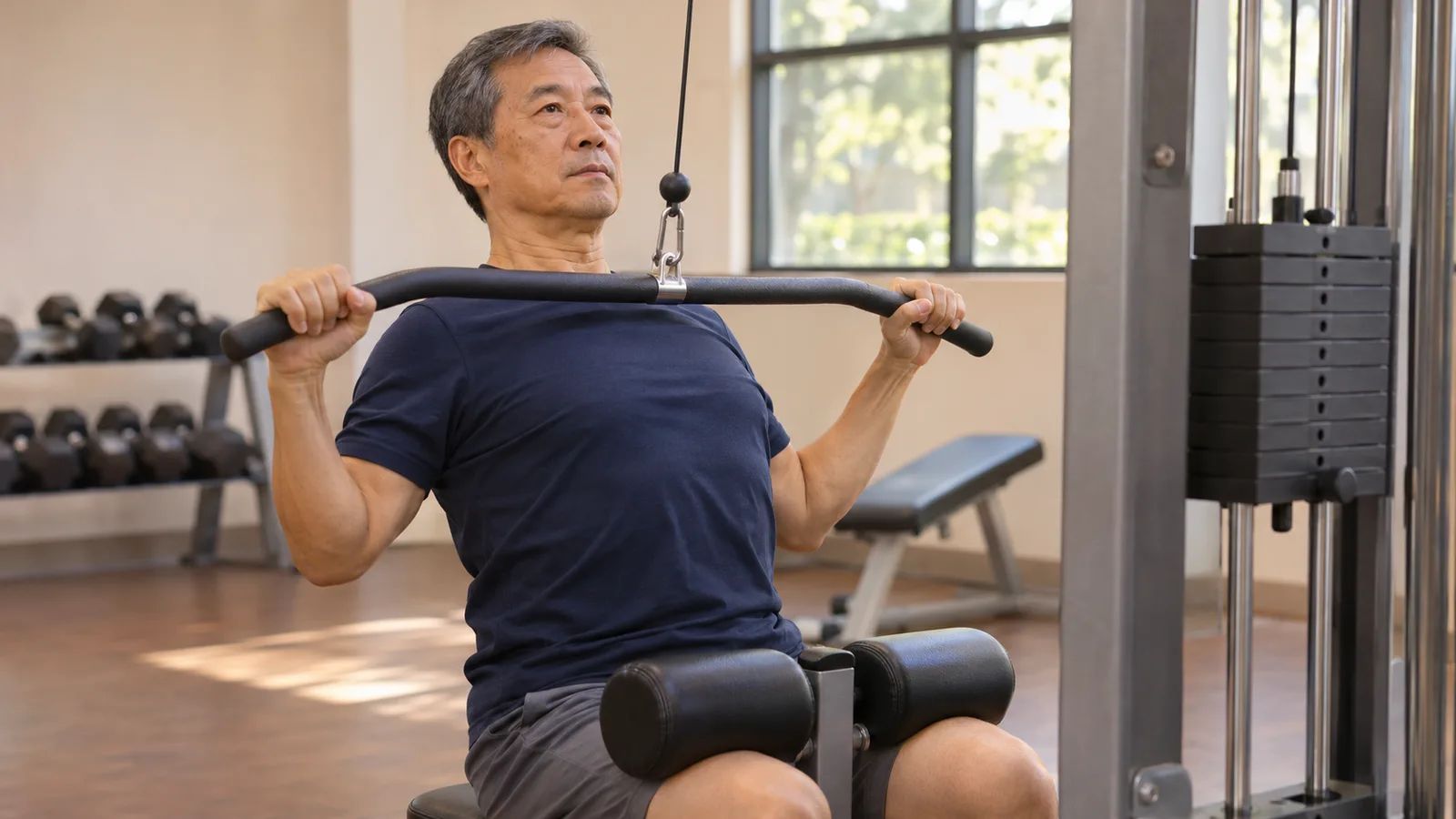
| Lat pulldown or assisted pull-up | Kneeling band pulldown | 3 × 8 to 12 | 90 s |
| Split squat | Split squat | 3 × 8 to 12 a side | 90 s |
| Dead bug | Dead bug | 2 × 6 to 10 a side | 45 s |
Day 3: light (about 40 minutes)
| In a gym | At home | Sets × reps | Rest |
|---|---|---|---|
| Leg press | Step-up onto a stair | 3 × 12 to 15 | 60 to 90 s |
| Incline dumbbell press | Push-up | 3 × 12 to 15 | 60 to 90 s |
| Cable row | Band row | 3 × 12 to 15 | 60 to 90 s |
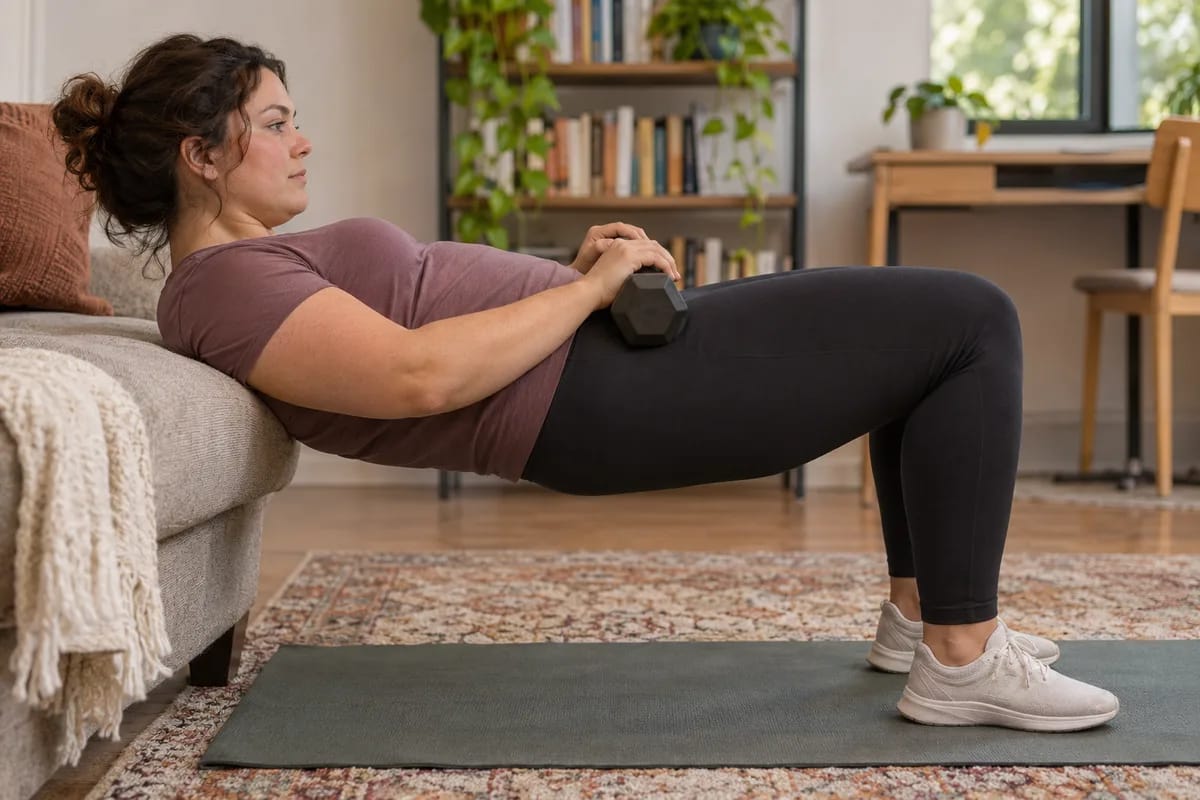
| Hip thrust or leg curl | Dumbbell hip thrust | 3 × 12 to 15 | 60 to 90 s |
| Optional: curl and lateral raise | Curl and lateral raise | 2 × 12 to 15 | 60 s |
Push-ups get easier with your hands on a kitchen counter and harder with your feet on a step. For the hip thrust at home, rest your shoulders on the edge of the sofa.
How hard: stop most sets when you could have done two or three more good reps.1 The last couple of reps slow down and take real effort, but your form holds. Light is the weight, not the effort: Friday's last reps should feel just as hard as Monday's. Weeks 1 and 2 stop a little earlier, and the 12-week table below says when one Monday set can go closer. If you're not sure how to judge it, here's reps in reserve, explained.
At home, heavy needs heavy dumbbells. Most home dumbbell sets don't go heavy enough for 5 hard reps of a squat or a press. If yours top out, run Monday's home column at 8 to 12 reps too, take three seconds to lower each rep, and switch the goblet squat for the Bulgarian split squat: the same dumbbell on one leg is a much bigger job.
Across the week, that's 10 hard sets of squatting, 10 of pressing, 9 of pulling and 8 of hinging. It's close to the 10 or more sets a week that the American College of Sports Medicine's 2026 review linked with more muscle growth.1 Weeks 1 and 2 sit well under it, on purpose.
Why the three days aren't the same
The fair worry with full body three times a week is legs. Squatting hard on Monday, Wednesday and Friday sounds like a week of stairs you take one at a time. Giving each day a different weight is how coaches get around that.
The light day still builds muscle. Muscle grows across a very wide range of weights, from about 30% of the most you can lift once up to 100%, as long as the sets are hard.1 So Friday's sets of 15 aren't a rest day in disguise.
Only one day takes a lot out of you. Heavy squats and presses are the most tiring work in the plan. With one heavy day and two easier ones, you arrive at each session ready to work instead of still flat from the last one. That's how coaches tend to program it, not a lab finding, but it's the main reason this layout feels easier than three copies of one workout. The heavy day also keeps strength in your week: loads of about 80% of your one-rep max or more build more top-end strength,1 and Monday's squat, press and row sit close to that.
What it won't do. Rotating the weights isn't magic. Pooled studies find that plans which vary the load build about the same muscle as plans that don't, with a small edge in strength.2 So one workout repeated three times a week works too. This version is just easier to recover from, and less boring.
Why full body instead of push, pull and legs on three days? With the same weekly sets, split and full-body routines build similar strength and muscle.3 The difference is what a missed day costs. On a three-day push/pull/legs, each muscle gets trained once a week, so missing legs day means no legs that week. Here, a missed day still leaves every movement trained twice. The best workout split for each number of days is its own article.
Start where you are
Brand new to lifting: run a beginner's plan for four weeks first. Or start this one gently: weeks 1 to 4 with 2 sets of everything, and Monday at 8 to 10 reps instead of 5 to 8. You'll get a heavy day once the movements feel familiar.
Back after a break, or a few months in: start at week 1 as written.
Lifting steadily for a year or more: start at week 5 and add one set to the first exercise on Wednesday and Friday.
Your first weights: for each exercise, pick a weight you think you could lift about four more times than the set asks. If the last rep flies, go up next session. If your form slips before the last rep, go down. The first two weeks are for finding your numbers, not testing them. There's more on how much weight to start lifting with if you want it.
If you have a heart or blood pressure condition, are pregnant, have had recent surgery or a joint replacement, or have joint pain that doesn't settle, check with your doctor or physical therapist before you start. If a move pinches, swap to the other column's version or a smaller range of motion.
The 12 weeks
| Weeks | What you do | How it should feel |
|---|---|---|
| 1 to 2 | 2 sets of everything. Stop each set with 3 or 4 reps left. Write down every weight. | Easy, almost suspiciously so |
| 3 to 4 | All the sets as written, 2 or 3 reps left | The last two reps slow down |
| 5 to 8 | Add reps, then weight (below) | Most weeks, something goes up |
| 9 to 11 | Keep climbing. On Monday, the last set of the first exercise can go to about 1 rep left | Monday feels heavy. Sleep starts to matter |
| 12 | An easy week: half the sets, same weights | Fresh by Friday, and itching for more |
Adding weight. Keep the same weight until every set reaches the top of its rep range with 2 or 3 reps still left. Next session, go up by the smallest jump you have, often 5 lb (about 2 kg), and drop back to the bottom of the range. Here's what that looks like for Wednesday's dumbbell Romanian deadlift, at home:
| Week | Each hand × reps in 3 sets | Next time |
|---|---|---|
| 3 | 25 lb (11 kg) × 9, 9, 8 | Same weight, a rep more where you can |
| 4 | 25 lb × 10, 10, 9 | Same weight |
| 5 | 25 lb × 12, 11, 10 | Same weight |
| 6 | 25 lb × 12, 12, 12, with 2 or 3 left | Go up |
| 7 | 30 lb (14 kg) × 8, 8, 8 | Back at the bottom, climb again |
| 8 | 30 lb × 9, 9, 8 | Same weight |
The ACSM's general guide is a 2 to 10% increase once you can beat your target by a rep or two.4 Home dumbbells jump in bigger steps than that (25 to 30 lb is 20%), which is why the reps drop right back to 8. Legs usually move up faster than presses, and an overhead press can sit on one weight for weeks. That's normal. If your next dumbbell is a really big jump, the 3-hours-a-week plan has what to do about it.
Week 12 is part of the plan, not a break from it. After eleven weeks of creeping up, an easy week lets the tiredness drain out so you start the next block strong. You'll want to do more. Don't.
Week 13 and after. Go back to week 3 with your new weights, and change one exercise a day so it doesn't go stale: a front squat or a goblet squat for the back squat, a trap-bar deadlift for the Romanian deadlift, a step-up for the split squat. Run that for another 10 weeks or so. Once you've lifted steadily for six months, and if sessions run long and you can spare a fourth day, look at an upper/lower split.
If one lift stalls for three weeks running, same weight and same reps, take about 10% off it and climb back. That's a common coaching rule of thumb, not a study. If everything feels heavy at once, take the easy week early.
When a day goes missing
Life eats training days. The plan holds up if you treat the three days as a list, not a calendar: Heavy, Medium, Light, then Heavy again, whatever the weekday says.
| What happened | What to do |
|---|---|
| You missed one session | Do that day at your next slot and slide the rest along. Don't double up. The week can spill into the next one |
| Only two sessions fit this week | Do heavy and medium, skip light, and start next week with heavy |
| You can only train Saturday and Sunday back to back | Put the lighter day second: heavy then light, or medium then light. Never heavy then medium on consecutive days (our coaching view, not a study) |
| A week off for a holiday or a cold | Come back to the weights of your last full week |
| Two to four weeks off | Take about 10% off and climb back to your old weights over a couple of weeks |
| Twenty minutes instead of fifty | Do the first two exercises of the day, then go |
| You're ill | Rest until you're well, and come back with the light day |
A two-session week still meets the US guideline of strength work on two or more days a week.5 And a week or three off costs less than it feels like. In one small study of young men training the bench press three times a week, a group that trained in 6-week blocks with 3-week breaks between them ended 24 weeks with about the same muscle and strength as a group that never stopped.6 It was only 14 people and one exercise, so don't plan breaks around it, but don't panic about one either. Here's how fast you lose strength when you stop lifting, in more detail.
Warming up
Five minutes of anything that gets you warm: the bike, a brisk walk, marching on the spot. Then two or three light sets of the day's first exercise, building toward your working weight. On the heavy day, add one more. That's it. You don't need a long stretching routine before lifting.
Monday, with someone watching
Everything above works with a notebook and a timer, and it costs nothing. The day people find hardest alone is Monday. Picking a weight you can lift 5 to 8 times with two or three reps to spare is guesswork at first. And under a heavy load, the rep where your knees start to cave or your back starts to round is the one you're least likely to notice yourself.
At Bespoke Fit, every session is a live 1‑on‑1 video call with your own coach, who has 12 members at most. Your coach writes your program onto your training calendar (it may look like this one, or quite different, depending on you), watches each set, and says "knees out" while you're still in the rep, not a day and a half later from a video you sent.
Sessions run 45 to 90 minutes at the same price, and most people settle at around an hour, which fits any of these days with a proper warm-up. It's 14 days free, then $299/mo for unlimited sessions, about $23 a coached hour at three a week. If that would strain your budget, or you want a spotter in the room for a heavy barbell, run the plan above on your own. It works.
Common questions
Is 3 days a week enough to build muscle? Yes, for most people. This plan trains the squat, hinge, push and pull two or three times each a week, and the US guideline asks for strength work on at least two days. The biggest lever for muscle is how many hard sets you do each week, not how many days you spread them over, and three sessions of under an hour hold plenty.
Can I add cardio on the other days? Yes. Walks, easy rides or swims fit on any day, and they're the easiest way to reach the 150 minutes a week of moderate activity US guidance asks for. Keep hard conditioning, like intervals or a long run, off the evening before the heavy day, or you'll feel it in your squats.
Is it OK to train if I'm still sore from the last session? Usually, yes. Mild stiffness tends to ease once you're warm, and the day after the heavy day is lighter by design. If a movement hurts rather than feels stiff, use the other column's version or a smaller range for that session, and if the pain keeps coming back, get it checked.
Sources
-
Currier, B.S., D'Souza, A.C., Singh, M.A.F., and colleagues, 2026 (Phillips, S.M., senior author). American College of Sports Medicine position stand. Resistance training prescription for muscle function, hypertrophy, and physical performance in healthy adults: an overview of reviews. Medicine and Science in Sports and Exercise. Muscle growth was similar from low (30% of one-rep max) to high (100%) loads; heavier loads (80% or more) enhanced strength; sets taken to 2 or 3 reps in reserve were enough; 10 or more sets per muscle a week were linked with better growth; periodization was "less important than previously hypothesized". ↩ ↩2 ↩3 ↩4
-
Moesgaard, L., Beck, M.M., Christiansen, L., Aagaard, P. & Lundbye-Jensen, J., 2022. Effects of periodization on strength and muscle hypertrophy in volume-equated resistance training programs: a systematic review and meta-analysis. Sports Medicine. 35 studies with volume equated: no difference in muscle growth; periodized plans gained more one-rep max strength than non-periodized ones (effect size 0.31). Undulating beat linear periodization for strength in trained participants (0.61, a borderline result) but not in untrained ones (0.06). ↩
-
Ramos-Campo, D.J., Benito-Peinado, P.J., Andreu-Caravaca, L., Rojo-Tirado, M.A. & Rubio-Arias, J.Á., 2024. Efficacy of split versus full-body resistance training on strength and muscle growth: a systematic review with meta-analysis. Journal of Strength and Conditioning Research. 14 studies, 392 healthy adults; similar strength and muscle growth when volume was equal. ↩
-
American College of Sports Medicine, 2009. Progression models in resistance training for healthy adults. Medicine and Science in Sports and Exercise. Recommends a 2 to 10% load increase once the current load can be lifted for one or two repetitions over the desired number. ↩
-
Centers for Disease Control and Prevention. Adult activity: an overview. CDC. At least 150 minutes a week of moderate-intensity activity, and muscle-strengthening activities on 2 or more days a week that work all major muscle groups. ↩
-
Ogasawara, R., Yasuda, T., Ishii, N. & Abe, T., 2013. Comparison of muscle hypertrophy following 6-month of continuous and periodic strength training. European Journal of Applied Physiology. 14 young men, bench press 3 × 10 at 75% of one-rep max, 3 days a week for 24 weeks; three 6-week training blocks with 3-week breaks between them gave similar overall gains in muscle size and strength to training continuously. ↩