Kettlebell swing: how to do it right and what weight to use
A kettlebell swing is a hip snap, not a squat or a lift. Step-by-step cues, what you feel when it goes wrong and the fix, and which bell to start with.
In this article8
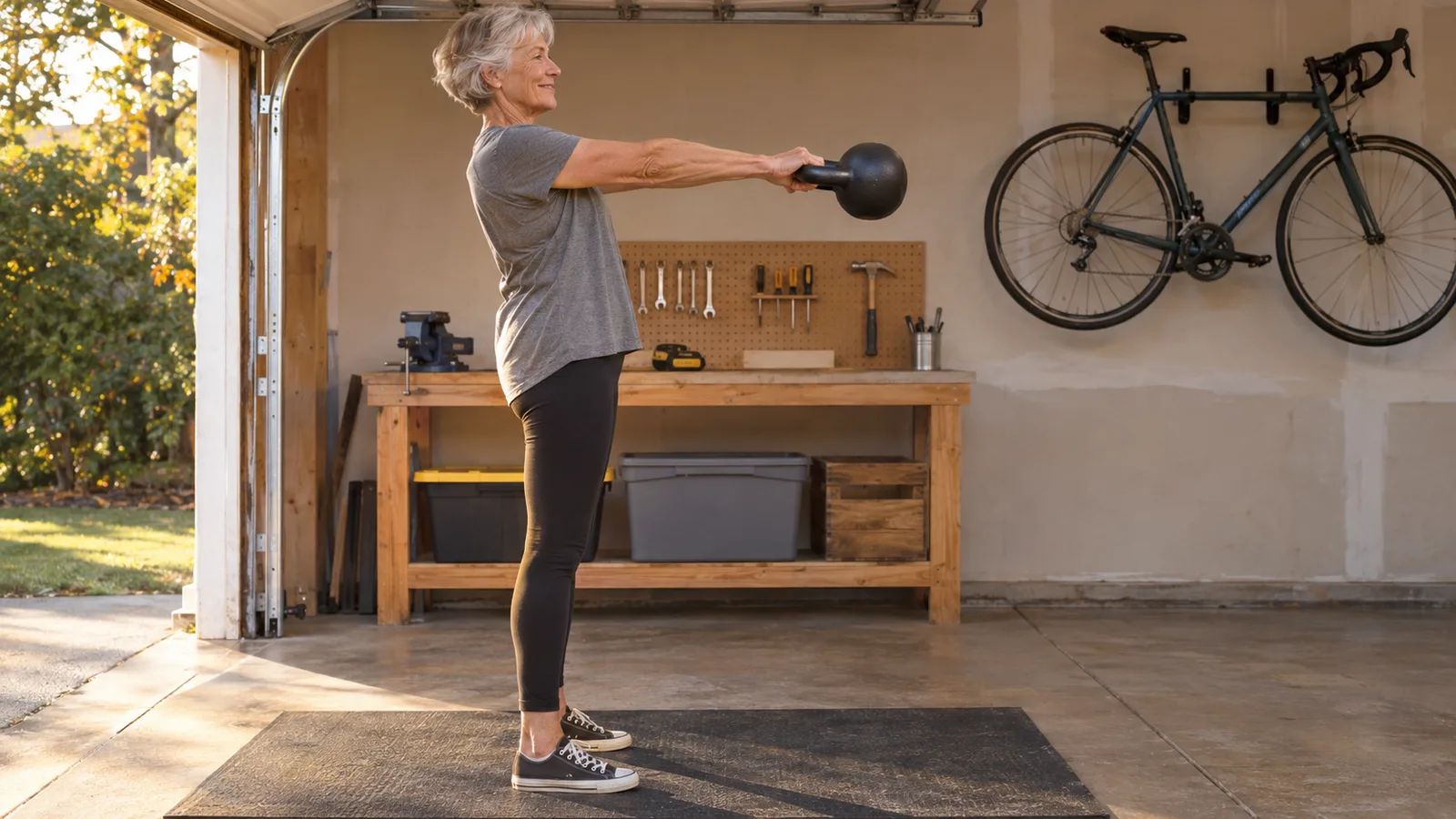
A kettlebell swing is a hip move, not an arm move. You push your hips back, snap them forward, and the bell floats up to chest height on the momentum. Your arms just hold on, like ropes. If it feels like you're lifting the bell, something's off, and the table further down says what.
The first few reps feel odd to almost everyone. It's one of the few lifts where you fling a weight forward and trust it to come back. Learn one position first and the rest follows. As for weight, most beginners start on an 18 or 26 lb bell (8 or 12 kg), depending on body weight; the bell table below says which.
Hinge, not squat
A lot of first swings are squats. The knees push forward, the hips drop and the fronts of the thighs do the work. In a hinge, the hips travel back, the shins stay nearly upright and the chest tips forward over the bell. Your back stays flat in both.
Check yours in 30 seconds with the wall drill. Stand with your back to a wall, heels about 6 inches (15 cm) from it, feet a little wider than your hips. Soften your knees, then push your backside back until it touches the wall, keeping your shins still and your back flat. Stand up by driving your hips forward. Easy? Shuffle forward an inch or two (2 to 5 cm) and repeat. If your knees keep diving forward to reach the wall, you're squatting.
How to do a kettlebell swing
Set the bell in front of you
Bell on the floor about a foot to a foot and a half (30 to 45 cm) ahead of your toes, feet a little wider than your hips. Hinge, grab the handle with both hands and tip the bell toward you. Too close to your toes and you end up lifting it straight up instead of hiking it back.
Hike it back, high
Like a football center hiking the ball, pull the bell back between your legs. Your forearms brush your inner thighs and the bell stays high, above your knees, not down by them.
Snap your hips forward
Push your feet into the floor and stand up fast by squeezing your glutes. Your hips do this, not your arms.
Stand tall and let it float
At the top you're a standing plank: legs straight, glutes and stomach tight, ribs down. The bell floats to about chest height on its own, arms long and loose. Don't lift it any higher.
Let it fall, then hinge late
Let the bell drop and stay tall until your forearms nearly reach your hips. Only then push your hips back. The bell passes high between your thighs and you go straight into the next rep.
Park it
After the last rep, don't stop the bell dead or let it drop. Hike it back once more, let it swing forward and set it down on the floor where it started. It's the step that keeps your back happy and your downstairs neighbors too.
Breathing: a sharp breath out as your hips snap forward, a breath in as the bell falls. Grip: fingers hooked loosely round the handle, not a white-knuckle squeeze. Shoes: flat soles or bare feet. A squishy running shoe lets you rock onto your toes.
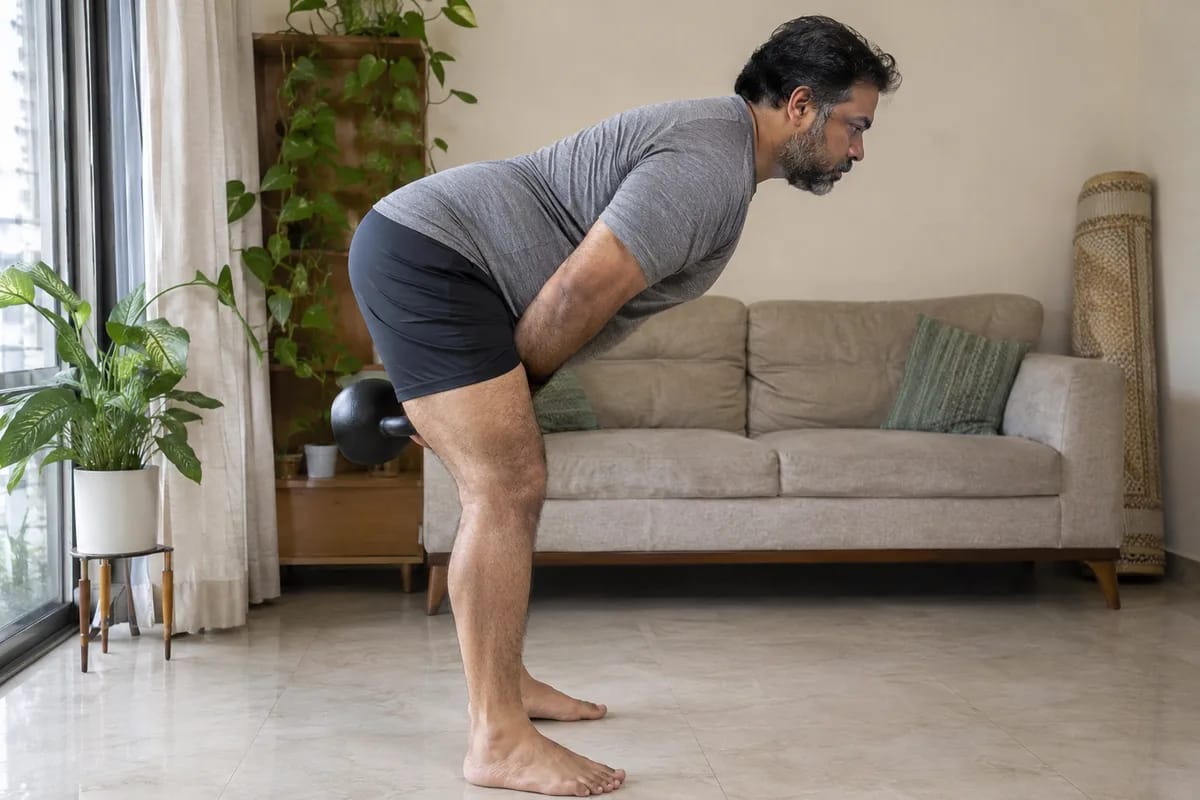
What you feel tells you what's wrong
| You feel | What's happening | Try this |
|---|---|---|
| An ache in your lower back | Your back is bending instead of your hips, usually because the bell drops low toward your knees | Hike it high: forearms to inner thighs, bell above your knees. Redo the wall drill |
| A pinch in your lower back at the top | You're leaning back to finish | Finish tall, like a plank: glutes tight, ribs down, eyes straight ahead |
| Burning shoulders or arms, or the bell flies to face height | Your arms are lifting it, often because the bell is too light | Let it stop at chest height. If it still flies, go up a bell |
| Mostly the fronts of your thighs | You're squatting it: knees forward, hips dropping | Knees bend only a little. Hips go back, as if to the wall |
| The bell pulls you onto your toes | Your weight is forward, or the bell started too far out | Weight through mid-foot and heels. Start the bell about a foot (30 cm) in front |
| Your grip gives out first | The set is too long for that bell | Stop at 10 and rest |
| Out of breath, but no ache anywhere | Nothing's wrong | That's the swing |
Some work in your low-back muscles is normal: they hold your spine still while your hips move, and you may feel them the next day. Pain that's sharp, lasts past the usual next-day soreness or runs down a leg is a sign to stop and see a doctor or physical therapist. Check with one before you start, too, if you have a known back or disc problem or a hernia, or you're pregnant or recently gave birth.
The fault you can't feel
From the inside, a squatted swing feels like a hinge and a lean-back feels like standing tall. So get eyes on it. Prop your phone side-on at hip height and film one set, set up like this, then hold it up against the three figures above. Or have someone watch while you swing. A Bespoke Fit coach on a live 1‑on‑1 video call watches every rep through your camera and says "hips back, not down" on rep three, not after the set.
Which kettlebell to start with
Go by your body weight and whether you already lift, not by whether you're a man or a woman.
| Your body weight | New to lifting, or coming back | Already strength training |
|---|---|---|
| Under 155 lb (70 kg) | 18 lb (8 kg) | 26 lb (12 kg) |
| 155 lb (70 kg) or more | 26 lb (12 kg) | 35 lb (16 kg) |
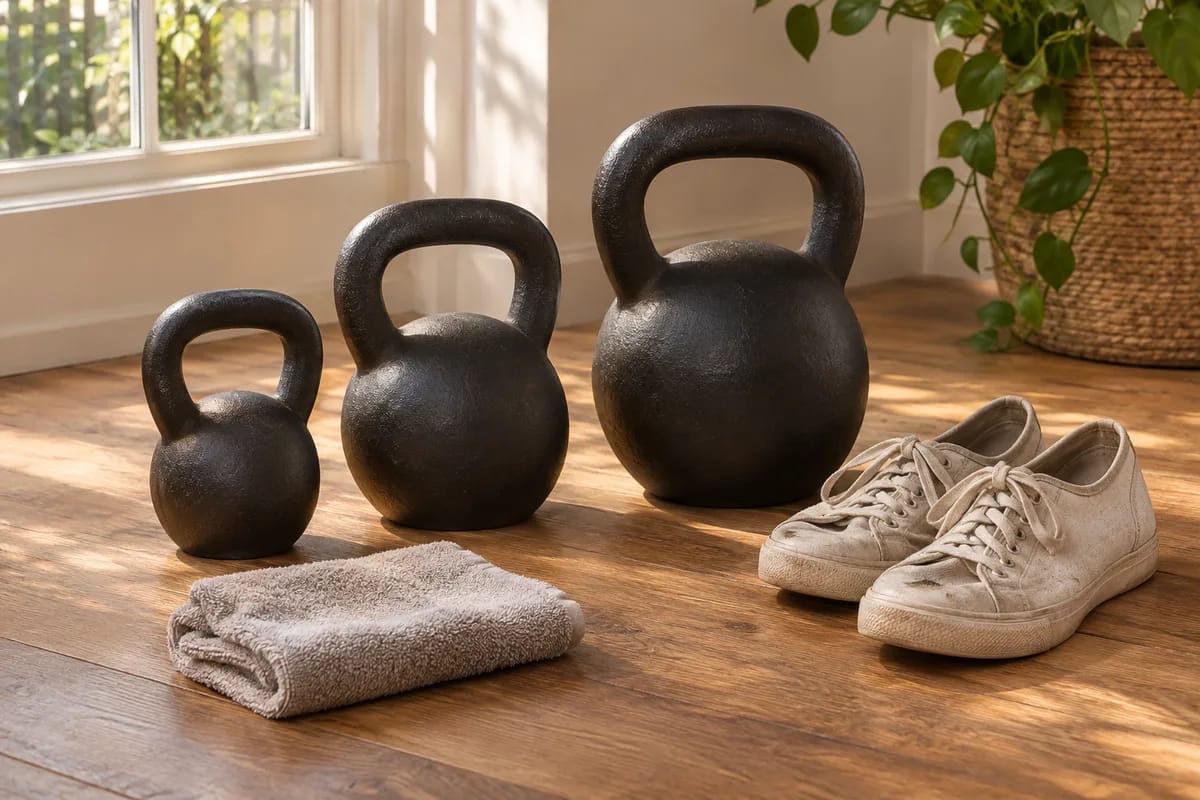
These are our starting picks, not a study's, and they lean light on purpose: you learn the shape before you add load. Your first few sets tell you if you guessed wrong: too light and it flies past chest height even with a good hinge; too heavy and you can't hike it back with a flat back. If you already lift and two bells both feel right, take the heavier: the swing runs on your hips, the biggest muscles you have.
Many kettlebells, Rogue's among them, are made in kilo sizes even when they're sold in pounds, which is why you see odd numbers: 18, 26 and 35 lb are 8, 12 and 16 kg.1 A lot of kettlebell talk online is in kilos too, so when someone says "the 16", they mean the 35 lb bell. Some budget bells come in plain 5 lb steps instead; take the size nearest the table. Either way the jumps are big: 26 lb is almost half as heavy again as 18 (more in how to pick a starting weight).
Your first four weeks
Swing two or three times a week, on days that aren't back to back: on their own, or after a strength session.
Week 1
Learn the shape
Wall drill, then 5 sets of 10 swings. Rest until your breathing settles, a minute or more. End a set early the moment the bell starts drifting low.
Week 2
More sets
7 sets of 10, resting about a minute.
Week 3
Shorter rests
8 sets of 10, resting 45 seconds.
Week 4
Your first 100
Start a timer. At the top of every minute, do 10 swings and rest for whatever's left of it. Ten minutes, 100 swings.
When 100 in 10 minutes feels smooth, and not before, move up one bell and go back to week 2. Adding a set beats moving up early.
What about 50 or 100 swings a day? Two or three swing days a week, like the plan above, is plenty for most people. If you like a daily habit, wait until week 4 feels easy, keep most days light, and build up slowly. Take the day off when your back is still tight from last time or your hike keeps drifting toward your knees. Daily swings will make your hips, grip and breathing fitter. They won't replace squats, presses and rows.
What swings do for you, and what they don't
The muscles. Your glutes do most of the work, helped by your hamstrings, the backs of your thighs. Your low-back muscles mostly hold your spine still, your stomach braces at the top and your grip hangs on. Many people credit swings with a stronger back, though a few find swings irritate theirs.2
Strength and power. In a six-week study, swinging twice a week made young men stronger and better at jumping, about as much as jump squats did: a good sign, if not a promise for everyone.3 Fast hip work like this trains the kind of power that fades first with age, a good reason to learn swings at 50 or 70 too, starting with the lighter bell in the table.
Cardio. Swings send your heart rate higher than the oxygen you're using would suggest, so your watch can make them look like harder cardio than they are.4 Count them as hard intervals and keep some steady walking or cycling in your week.
Belly fat. No exercise burns fat from the spot it works: in one trial, six weeks of ab exercises made no significant difference to belly fat or waist size.5 Swings help with fat loss the way any hard exercise does, by adding to what you burn across the week, alongside what you eat.
Russian or American swing?
The swing on this page is the Russian, or chest-height, swing. The American swing takes the bell overhead. The common coaching view is that the overhead finish asks a lot more of your shoulders without adding much for your hips, so learn this one first; plenty of people never need the other. When two hands feel smooth, try a one-arm swing: same hinge, but now your trunk has to stop the bell twisting you.
Two more swing questions
Are kettlebell swings bad for your knees? The swing is a hip move, so your knees bend only a little. Done as a hinge, it loads your hips and lower back: in a lab study, a heavier bell raised the load there and at the ankles, not at the knees.6 When knees ache after swings, the first thing coaches look for is a swing that has turned into a squat.
Can you do kettlebell swings with a dumbbell? Yes, with a solid, fixed dumbbell. Never use an adjustable or plate-loaded one, which can come apart mid-swing. Cup the top end in both hands so it hangs straight down and swing it the same way. It's more awkward to hold than a handle, but the hinge, the hip snap and the chest-height finish don't change.
Sources
-
Rogue Fitness. Rogue kettlebells, checked 12 November 2026. "The 35LB Rogue Kettlebell is actually spec'd to weigh exactly 16KG", within a stated 1% tolerance; size chart pairs 8, 12 and 16 kg with 18, 26 and 35 lb. ↩
-
McGill, S.M. & Marshall, L.W., 2012. Kettlebell swing, snatch, and bottoms-up carry: back and hip muscle activation, motion, and low back loads. Journal of Strength and Conditioning Research. Seven men plus one expert case study, 16 kg bell; about 50% of maximal contraction in the low-back extensors and 80% in the glutes, with fast activation-relaxation cycles; "many individuals credit kettlebell swings with restoring and enhancing back health and function, although a few find that they irritate tissues". ↩
-
Lake, J.P. & Lauder, M.A., 2012. Kettlebell swing training improves maximal and explosive strength. Journal of Strength and Conditioning Research. 21 healthy men aged 18 to 27, twice a week for six weeks; the swing group did 12 rounds of 30 seconds on, 30 off, with 12 kg under 70 kg body mass or 16 kg over. Half-squat 1RM rose 9.8% and vertical jump 19.8% across the swing and jump-squat groups, with no significant difference between them. ↩
-
Farrar, R.E., Mayhew, J.L. & Koch, A.J., 2010. Oxygen cost of kettlebell swings. Journal of Strength and Conditioning Research. Ten college-aged men, as many two-hand swings as possible in 12 minutes with a 16 kg bell: average 86.8% of maximum heart rate against 65.3% of VO2max. ↩
-
Vispute, S.S., Smith, J.D., LeCheminant, J.D. & Hurley, K.S., 2011. The effect of abdominal exercise on abdominal fat. Journal of Strength and Conditioning Research. 24 sedentary adults on a calorie-matched diet, against a control group; seven abdominal exercises, 2 × 10, five days a week for six weeks; no significant change in body fat, abdominal fat or waist circumference compared with the control group. ↩
-
Levine, N.A., Hasan, M.B., Avalos, M.A., Lee, S., Rigby, B.R. & Kwon, Y.H., 2022. Effects of kettlebell mass on lower-body joint kinetics during a kettlebell swing exercise. Sports Biomechanics. 30 recreationally active college-age adults swung bells of 10%, 15% and 20% of body mass; heavier bells raised loads at the low back, hip and ankle "while avoiding excessive moments about the knee". The study measured joint loads, not pain or injury. ↩