How to lift weights: form, breathing and your first session
Set your feet, brace, lower for 2 or 3 seconds and stop each set with 2 or 3 reps to spare. How to breathe, five moves to learn and your first session.
In this article8
The short version
Pick a weight you can lift about 10 times with 2 or 3 reps to spare. Set your feet, brace your middle, lower for 2 or 3 seconds, lift smoothly while breathing out, and end the set with those reps still in you.
That's the whole method, and it's the same for every lift, from a biceps curl to a deadlift. Learn it once with light weights and it carries over to dumbbells, a bar or a machine.
Will lifting hurt my back or knees?
Probably not. Even people who lift competitively, with loads you won't touch for years, appear to get hurt less often than people who play common team sports. When they do, it's mostly strains and irritated tendons in the shoulders, lower back and knees, not anything dramatic.1 Two habits in your control are simply good practice: add weight slowly, and end a set when your shape starts to go.
What's worth knowing is the difference between hard and wrong.
Normal, keep going
- Your muscles burn in the last few reps of a set
- You're breathing hard and your legs feel shaky the first time
- Your muscles are sore for a couple of days afterwards, which fades as you get used to it (what soreness does and doesn't mean)
Stop that move
- A sharp, stabbing or pinching pain
- Pain in a joint rather than the muscle
- Pain that gets worse with every rep
- You feel dizzy or faint
Stopping one move isn't stopping the session. Try a lighter weight or a smaller range, and if it still hurts, leave that move for today.
If you have a heart condition, blood pressure that isn't under control, a recent operation, or a joint that hurts when you load it, ask your doctor or physical therapist which moves and loads suit you before you start. Sore knees or hips from arthritis are often a reason to move more, not less, and lifting with arthritis covers how.
One rep, start to finish
Every tip you've read (feet, grip, breathing, speed) belongs to one sequence. Here it is for a lift that starts at the top, like a squat or a push-up. On a row or an overhead press you lift first and lower second; the steps are otherwise the same.
Set your feet
For most standing moves, about hip-width apart, with your weight spread over the whole foot: heel, big toe and little toe. It feels right when a light nudge wouldn't tip you.
Grip it firmly, wrist straight
Wrap your whole hand around the handle and keep the weight stacked over your forearm, not bending your wrist back. Firm, not white-knuckled.
Brace your middle
Tighten your stomach as if someone were about to poke it, without sucking it in or holding your breath. You should feel taller and more solid.
Lower it for 2 or 3 seconds
You're placing the weight, not dropping it. This is where your body learns the path, and the lowering does its full share of the muscle-building too.
Pause at the bottom, no bounce
A short pause. No bouncing out of a squat or off your chest. You should feel in charge at the bottom, not caught there.
Lift it smoothly
Push or pull at a steady pace, about a second. No need for slow motion, though if you've seen "four counts up, four down", that works too: anything from half a second to about 8 seconds a rep builds muscle about equally.2
Stand tall and reset
At the top, straight arms and legs are fine; just don't snap them straight. Breathe, check your feet and grip, and start the next rep.
How to breathe
If you've read "never hold your breath" on one page and "brace and hold it" on another, they're both right. They're describing different reps.
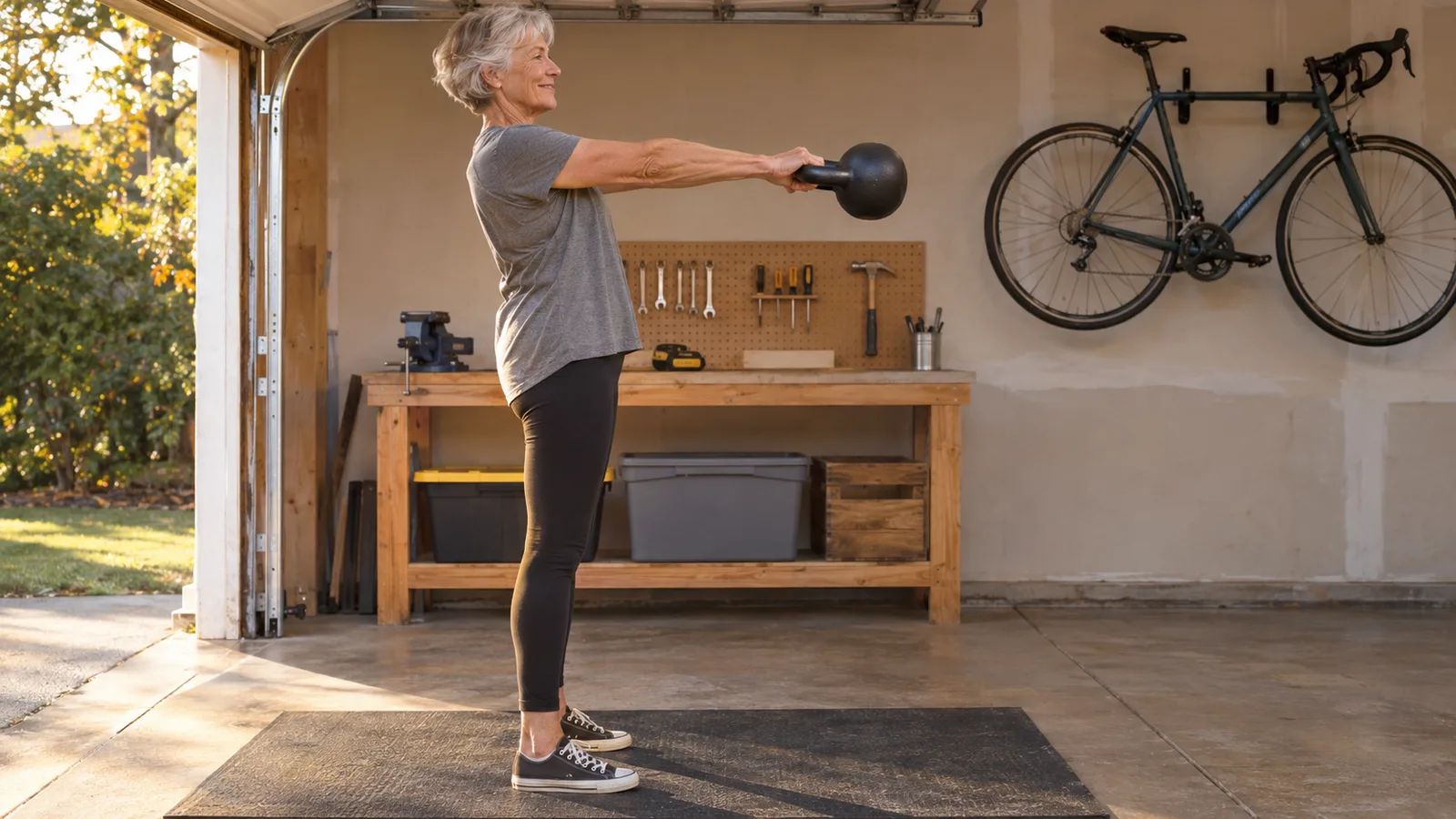
Easy reps, which is most of what you'll do at first: breathe with the weight. In as it comes down, out as you push or pull it up. Never hold your breath through a whole set.
Hard reps, the last one or two of a tough set: a short hold. Breathe in at the top, hold it through the bottom, and let it out once you're past the hardest part. The hold may help keep your trunk stiff, and it pushes your blood pressure up for those few seconds.3 If you're managing blood pressure or a heart condition, skip the hold and breathe out on every rep.
How heavy, and when to stop the set
Start with a weight you can lift about 10 times with 2 or 3 reps still in you. For most beginners that's 5 to 10 lb (2 to 5 kg) per hand for arm moves and roughly double for legs and back. How much weight to start with has numbers for each exercise and a three-set test to find yours.
The hard part is knowing you have 2 or 3 left without finding out the hard way. Watch for two signals:
- The rep slows down even though you're pushing just as hard. That's often a sign you're getting close. Finish the one you're on, maybe one more, and stop.
- The shape changes: your back rounds, your knees cave in, your hips shoot up before your chest, your elbows flare. Stop now, even if you think you have more. That rep is practicing the wrong thing.
Rating your effort in reps in reserve explains the scale coaches use to judge how many reps you have left.
When you get 10 reps on both sets with 2 or 3 still in you, two sessions running, move up to the next weight, usually 2.5 to 5 lb (1 to 2 kg) heavier. Progressive overload without the spreadsheet shows how to keep track.
Five moves that cover your whole body
Nearly every exercise is a version of one of these five movements.
Squat
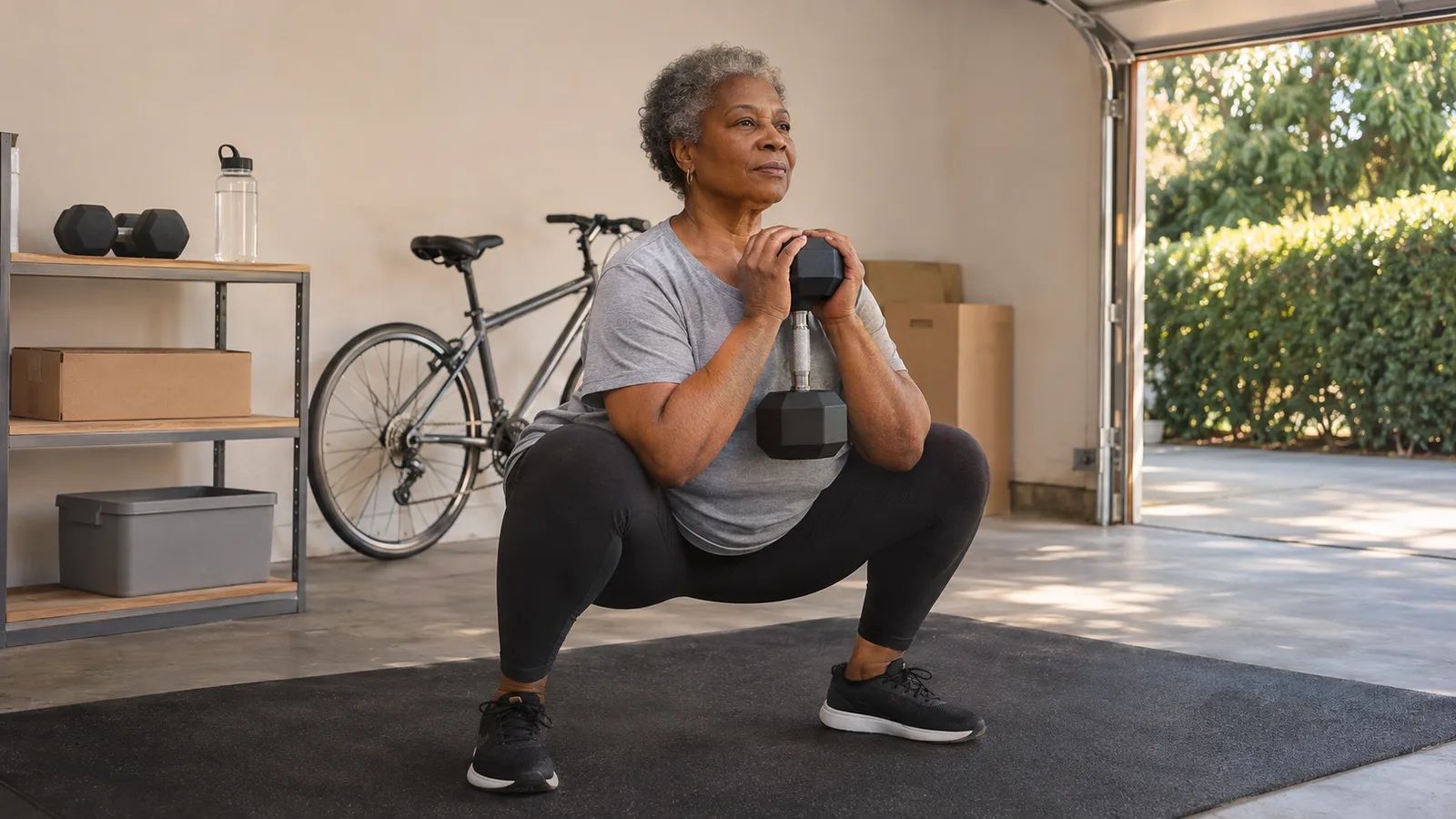
Start with a goblet squat: one dumbbell held upright against your chest, feet a little wider than your hips. At a gym, the leg press trains the same pattern.
Think: sit down between your heels, knees pointing the same way as your toes.
Watch for: heels lifting, or knees falling inward.
Your knees are allowed past your toes, and in a squat they often will go a little. Holding them back tends to tip you forward and likely shifts more of the load to your hips and lower back.4 Go as deep as you can while keeping the shape. If a full squat isn't there yet, squat down to a chair and use a lower seat as the weeks go by. The dumbbell leg workout builds on this.
Hinge
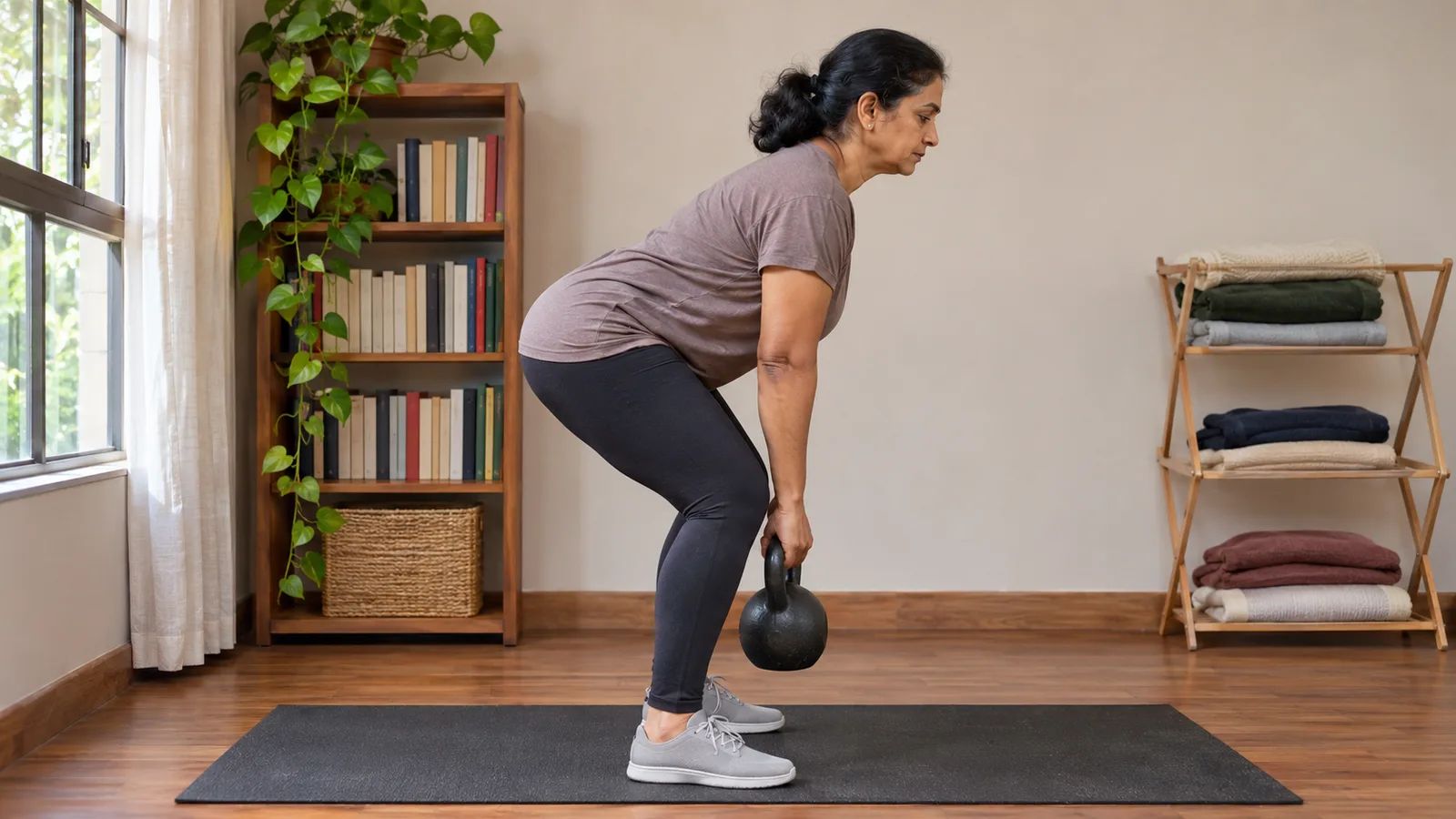
Start with a dumbbell Romanian deadlift: stand tall, a dumbbell in each hand resting against the front of your thighs, knees soft.
Think: push your hips back as if shutting a car door behind you, weights sliding down your thighs until you feel a stretch along the back of your legs. Then push your hips forward to stand.
Watch for: bending your back instead of your hips, so it rounds as the weights pass your knees.
It's the move people worry about most for their back, so learn it slowly. Deadlift form takes it further.
Push
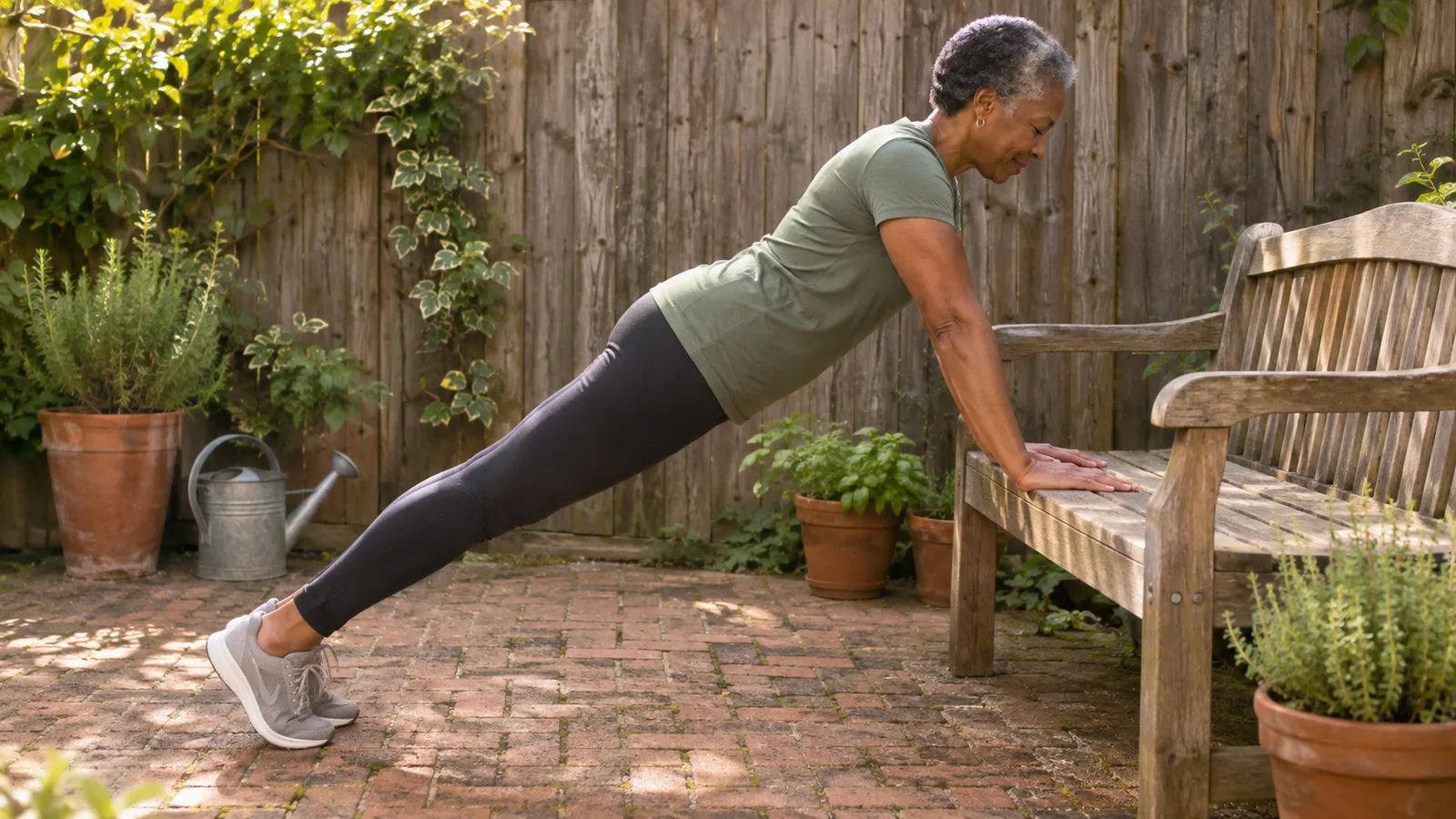
Start with a push-up against a kitchen counter, then work down to lower surfaces as it gets easy. A dumbbell floor press, or a chest press machine at a gym, works the same muscles.
Think: elbows angled back, not straight out to the sides.
Watch for: elbows flared wide, or reps that stop halfway. How to do a proper push-up has the full progression.
Pull
Start with a one-arm row: one hand and the same-side knee on a sturdy chair, a dumbbell in the other hand, back flat. At a gym, a cable row or lat pulldown.
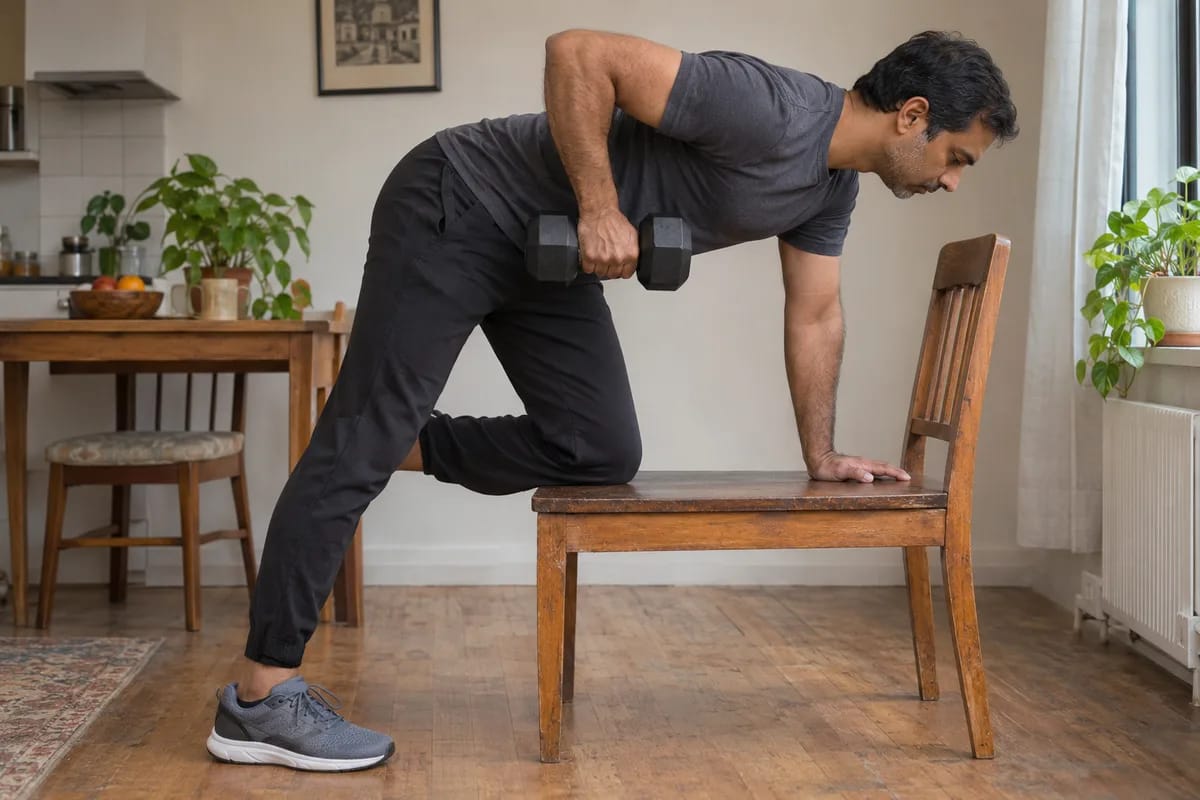
Think: pull your elbow toward your back pocket.
Watch for: shrugging your shoulder up to your ear and yanking. The dumbbell back workout has more rows to try.
Carry
Start with a farmer's carry: the heaviest pair you can hold for 30 seconds without leaning, then walk.
Think: tall and quiet, shoulders down.
Watch for: leaning to one side, or shuffling.
Your first session
About 40 minutes. At home, a light pair of dumbbells, about 5 to 8 lb (2 to 4 kg), and a heavier pair, about 12 to 20 lb (6 to 10 kg), cover all five moves; one adjustable pair does both. At a gym, use its lightest options.
| Minutes | What you do |
|---|---|
| 0 to 8 | Warm up: 5 minutes of brisk walking, marching or an easy bike, then a few slow squats and hinges with no weight. (More on warm-ups) |
| 8 to 15 | Practice: 5 slow reps of each of the first four moves, no weight or the lightest you have. Just the shape |
| 15 to 35 | Work: 2 sets of 8 to 10 reps of the squat, hinge, push and pull. Rest 1 to 2 minutes between sets. Your first set is a guess; adjust the weight for the second |
| 35 to 40 | Carry: two walks of about 30 seconds, then you're done |
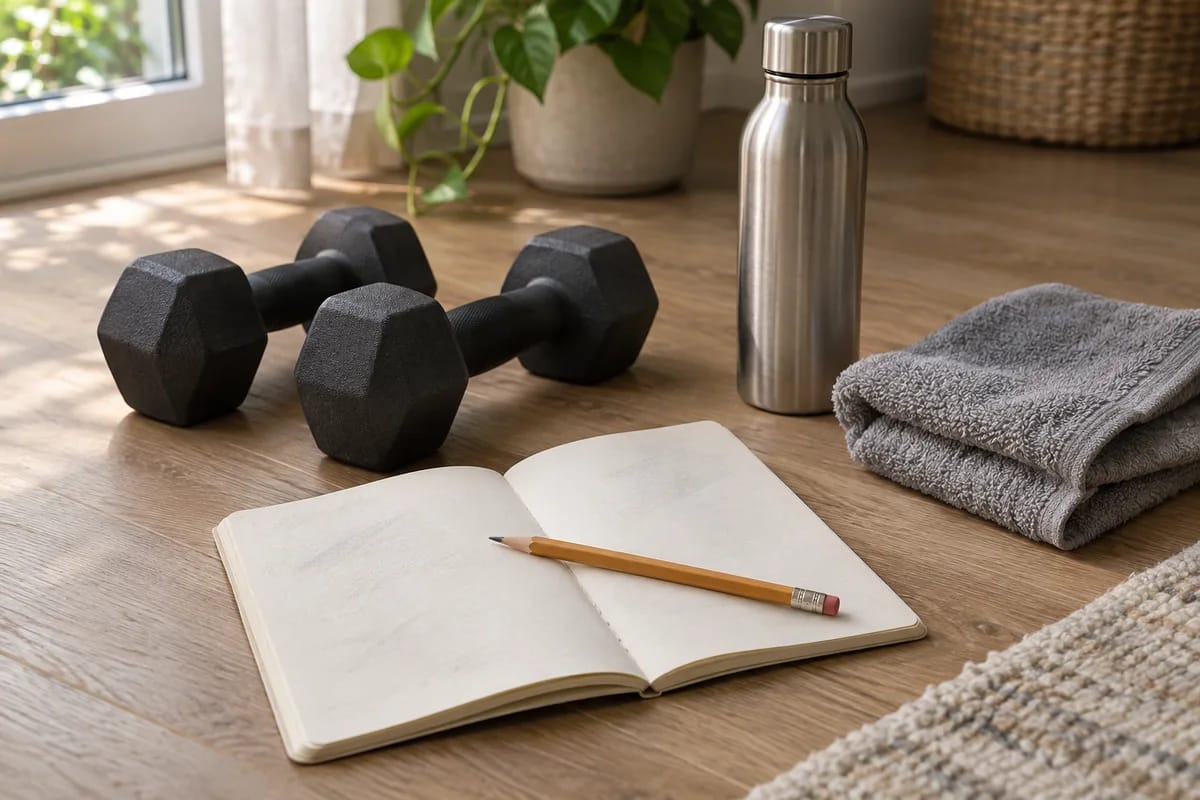
Write down each move, the weight and the reps, plus one note if something felt off ("knees caved on the last two"). That line is where next session starts.
After that, twice a week is enough to count. US guidelines ask adults for muscle-strengthening work on at least 2 days a week, covering the major muscle groups,5 and this session does exactly that. Leave a day between sessions. For the next four weeks laid out session by session, use the beginner workout plans.
Expect the first couple of weeks to feel awkward, then noticeably less so. That early jump is mostly your nervous system learning the moves, and it comes fast.
Learning it with someone watching
Everything on this page is easy to read and hard to see in yourself. You can't watch your own back mid-rep, a mirror only shows you the front, and a video tutorial can't tell you your heels lifted on rep seven. Filming yourself helps, though you only spot the fault once the set is over (what filming catches and what it misses).
At Bespoke Fit, every session is a live 1‑on‑1 video call with your own coach, in our app on iPhone, Android or a browser. You set your phone where it sees the whole move, side-on for a hinge or a row, facing you when it's your knees or balance that matter, and your coach watches every rep.
Picture a first Romanian deadlift with a pair of 15 lb (7 kg) dumbbells. On the third rep your lower back starts to round as the weights pass your knees. Your coach says "push your hips back toward the wall behind you", and the fourth rep is right. Not in a reply after the session, but on the next rep, while you still remember how the last one felt.
The two judgments this page leaves you to make alone are the ones a coach takes off your hands. Your coach watches the last reps of each set and calls the weight, so "stop with 2 or 3 left" stops being a guess, and they decide when it goes up. They write your program too: you open today's workout in the app and log it set by set, and the app keeps your top lifts and records, so the writing-down from earlier is done for you. Each coach has 12 members at most, so yours remembers the cue that fixed your squat last week.
A session is also a set time with a person waiting on the call, so on the evening you'd rather skip, it still happens. That matters as much as form: a new routine usually fails through skipped weeks in month two, not a rounded back.
I was skeptical about doing training over video at my age, but it has been much easier than I expected. My trainer is patient and adjusts everything to what my body can handle. I have exercised more in the past two months than in the last ten years. My friends can see the difference.
Wanda, 70, a Bespoke Fit member
You start with a 30-minute call with a head coach, who matches you to one of our coaches. Sessions run 45 to 90 minutes, and most people settle at around an hour.
One flat price covers as many sessions as you want: 14 days free, then $299/mo, and the 14 days start at your first session, not when you sign up. Twice a week that's about $35 a session; three times, about $23. A gym trainer in the US usually charges $50 to $100 an hour6 (what trainers cost).
It isn't the right buy for everyone. If this page, your phone camera and some patience are getting you there, keep going; it's free. If $299 a month would strain your budget, the beginner plans linked above cost nothing. If you want someone in the room to spot a heavy barbell, an in-person trainer suits you better, because we coach on video. And we don't coach nutrition.
Common questions
Is 20 minutes of weights enough? Yes, for a start. Two or three 20-minute sessions a week, built on four of the moves above with 2 sets each, is a real program. When your sets start running past the slot, that's the moment to add time, not before.
What is the 3-3-3 rule in weight lifting? It's an informal gym rule of thumb, and people use it to mean several different things. One common version is 3 exercises, 3 sets each, 3 days a week. That's a fine way to run the sessions on this page.
How long does it take to see results from lifting weights? Strength comes first, often within a few weeks, mostly because your body gets better at the moves. Muscle starts growing early too, but slowly, so it takes longer to see, and how much longer varies a lot from person to person.
Should I start with machines or free weights? Either works. A machine guides the path of the weight, which makes it an easy place to learn a pattern like pressing or rowing. Dumbbells work at home and make each side do its own share. Plenty of people use both for years.
Sources
-
Keogh, J.W. & Winwood, P.W., 2017. The epidemiology of injuries across the weight-training sports. Sports Medicine. A review of injury studies in bodybuilding, powerlifting, weightlifting, strongman and similar sports; most of the studies looked back rather than forward, so the rates are rough, and they vary by sport. ↩
-
Schoenfeld, B.J., Ogborn, D.I. & Krieger, J.W., 2015. Effect of repetition duration during resistance training on muscle hypertrophy: a systematic review and meta-analysis. Sports Medicine. Based on eight studies; the authors note there are few controlled studies of very slow reps. ↩
-
Hackett, D.A. & Chow, C.M., 2013. The Valsalva maneuver: its effect on intra-abdominal pressure and safety issues during resistance exercise. Journal of Strength and Conditioning Research. The breath hold raises pressure in the abdomen, which may help trunk stiffness, and raises blood pressure while lifting; the authors call its health risks unconfirmed. ↩
-
Fry, A.C., Smith, J.C. & Schilling, B.K., 2003. Effect of knee position on hip and knee torques during the barbell squat. Journal of Strength and Conditioning Research. A small study: seven weight-trained men squatting a barbell loaded to their own body weight. ↩
-
Centers for Disease Control and Prevention. Physical activity guidelines for adults. Adults need muscle-strengthening activity on at least 2 days a week, working the legs, hips, back, abdomen, chest, shoulders and arms. ↩
-
Bark, 2026. How much does a personal trainer cost?. bark.com, "between $50 and $90 per session" in the US, updated January 16, 2026; and RightFit Personal Training, 2026, How much does a personal trainer cost?, city medians at a trainer's own studio from $70 (Houston) to $100 (New York), updated November 2, 2026. Both read November 12, 2026. ↩