Dumbbell workouts at home: 3 plans for 2 to 4 days a week
Dumbbell workouts for 2, 3 or 4 days a week: every move with sets, reps and rest, which pair suits which move, and what to do when yours gets too light.
In this article8
Lift with dumbbells two, three or four days a week. Each workout is five or six moves, 2 or 3 sets each, hard but never to your absolute limit. Pick the plan that matches the days you can count on, and you can start today with the pair you already own.
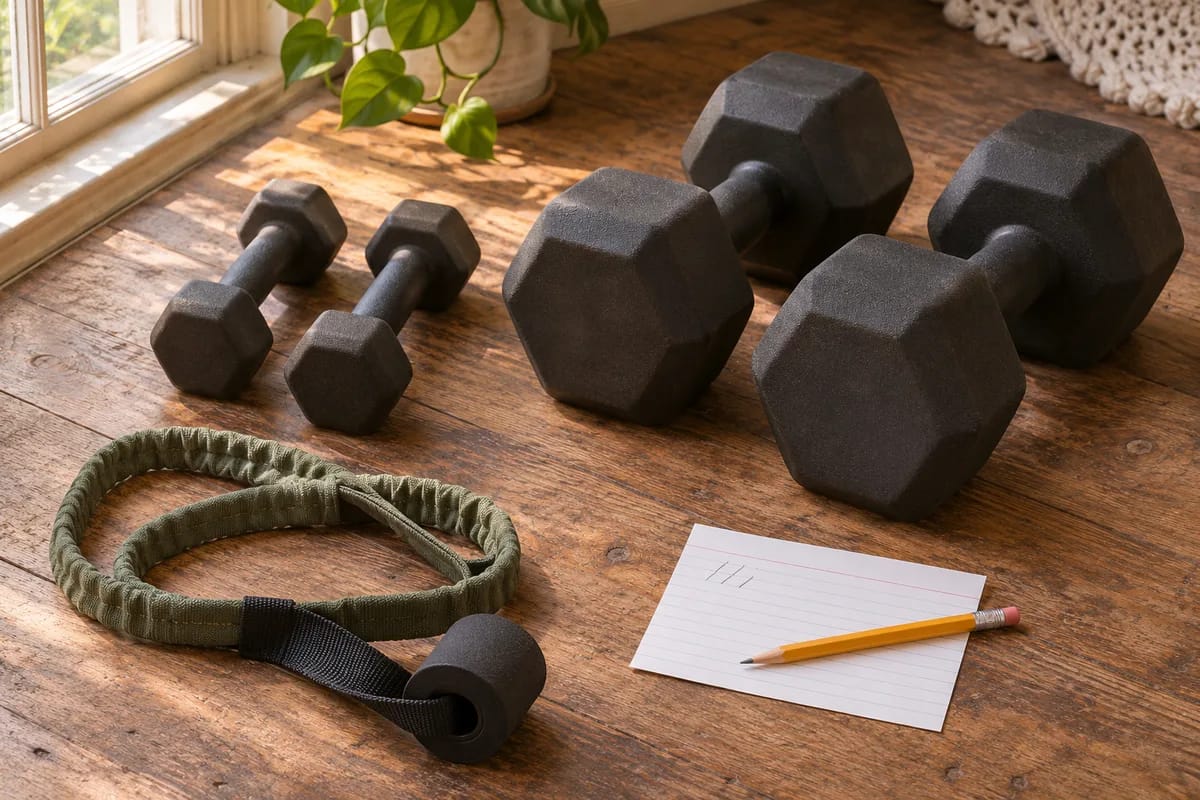
Many people own one or two pairs, not a rack, and the pair that feels too light for squats is too heavy for shoulder raises. So each move below says "heavy" or "light", meaning your two pairs. One pair, or none yet? The table after the plans covers both.
Pick your plan
| Days you can count on | Workouts | Example week | Each session |
|---|---|---|---|
| 2 | Full body A and B | Mon, Thu | 35 to 45 min |
| 3 | Full body A, B and C | Mon, Wed, Fri | 35 to 45 min |
| 4 | Upper and Lower, twice each | Mon, Tue, Thu, Fri | 40 to 50 min |
Count the days you'd manage in a busy week, not a good one. Two days works fine; each muscle gets fewer hard sets a week, so progress comes more slowly. Torn between two? The workout split guide settles it with two questions. If you've never lifted before, do the four weeks in workout plans for beginners first, then come back here.
If you have a heart, lung or metabolic condition, have had recent surgery, are pregnant, or have a joint that hurts under load, check with your doctor or physical therapist first. The beginner plan's health check walks through the questions.
The workouts
Two rules hold for every table below:
- Warm up for five minutes. March in place or walk, then do one light set of the first two moves.
- Pick a weight that gets you into the rep range, and stop each set with two or three good reps left. That's hard work without grinding to failure, which the American College of Sports Medicine's 2026 review found doesn't add to the gains.1 Reps in reserve explains how to judge it.
Full body A
| Move | Sets × reps | Rest | Pair |
|---|---|---|---|
| 1. Goblet squat | 3 × 8 to 12 | 90 sec | Heavy, one dumbbell |
| 2. Floor press | 3 × 8 to 12 | 90 sec | Heavy |
| 3. One-arm row, hand on a chair | 3 × 8 to 12 each arm | 60 sec after both arms | Heavy |
| 4. Glute bridge | 2 × 12 to 15 | 60 sec | Heavy, one across your hips |
| 5. Suitcase carry | 2 walks of 30 to 40 sec each hand | 60 sec | Heavy, one dumbbell |
Short day: the first three moves, 2 sets each. About 20 minutes.
Full body B
| Move | Sets × reps | Rest | Pair |
|---|---|---|---|
| 1. Romanian deadlift | 3 × 8 to 12 | 90 sec to 2 min | Heavy |
| 2. Overhead press | 3 × 8 to 12 | 90 sec | Light |
| 3. Split squat | 3 × 8 to 12 each leg | 60 to 90 sec | Light or heavy |
| 4. Two-arm bent-over row, or band pull-down | 3 × 10 to 12 | 60 to 90 sec | Heavy, or a band |
| 5. Curl, then triceps extension, back to back | 2 × 10 to 15 each | 60 sec | Light |
Short day: moves 1 to 4, 2 sets each. Skip the arms.
Full body C (three-day plan only)
| Move | Sets × reps | Rest | Pair |
|---|---|---|---|
| 1. Reverse lunge | 3 × 8 to 10 each leg | 60 to 90 sec | Light or heavy |
| 2. Kickstand Romanian deadlift | 3 × 8 to 12 each side | 60 to 90 sec | Heavy |
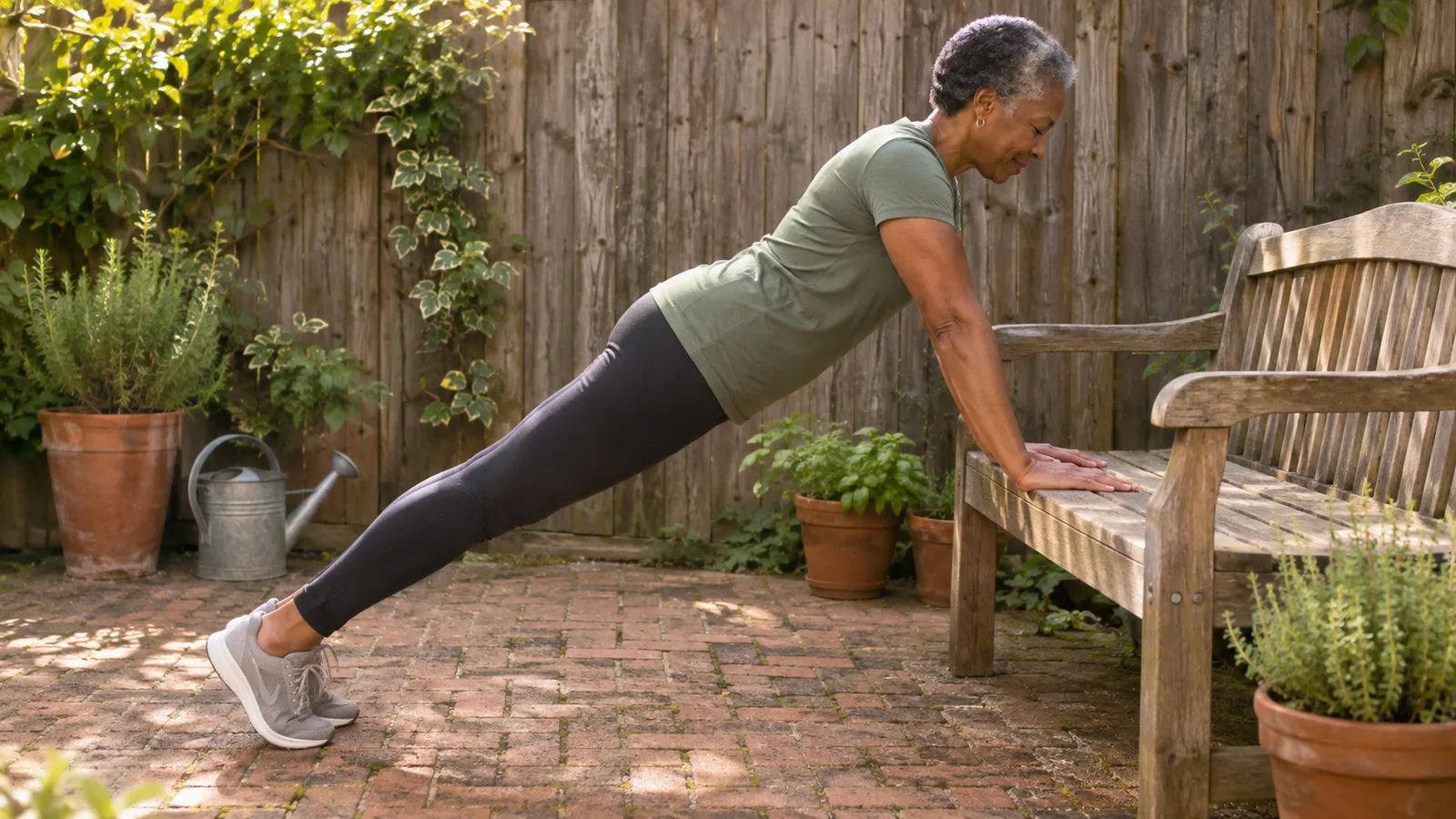
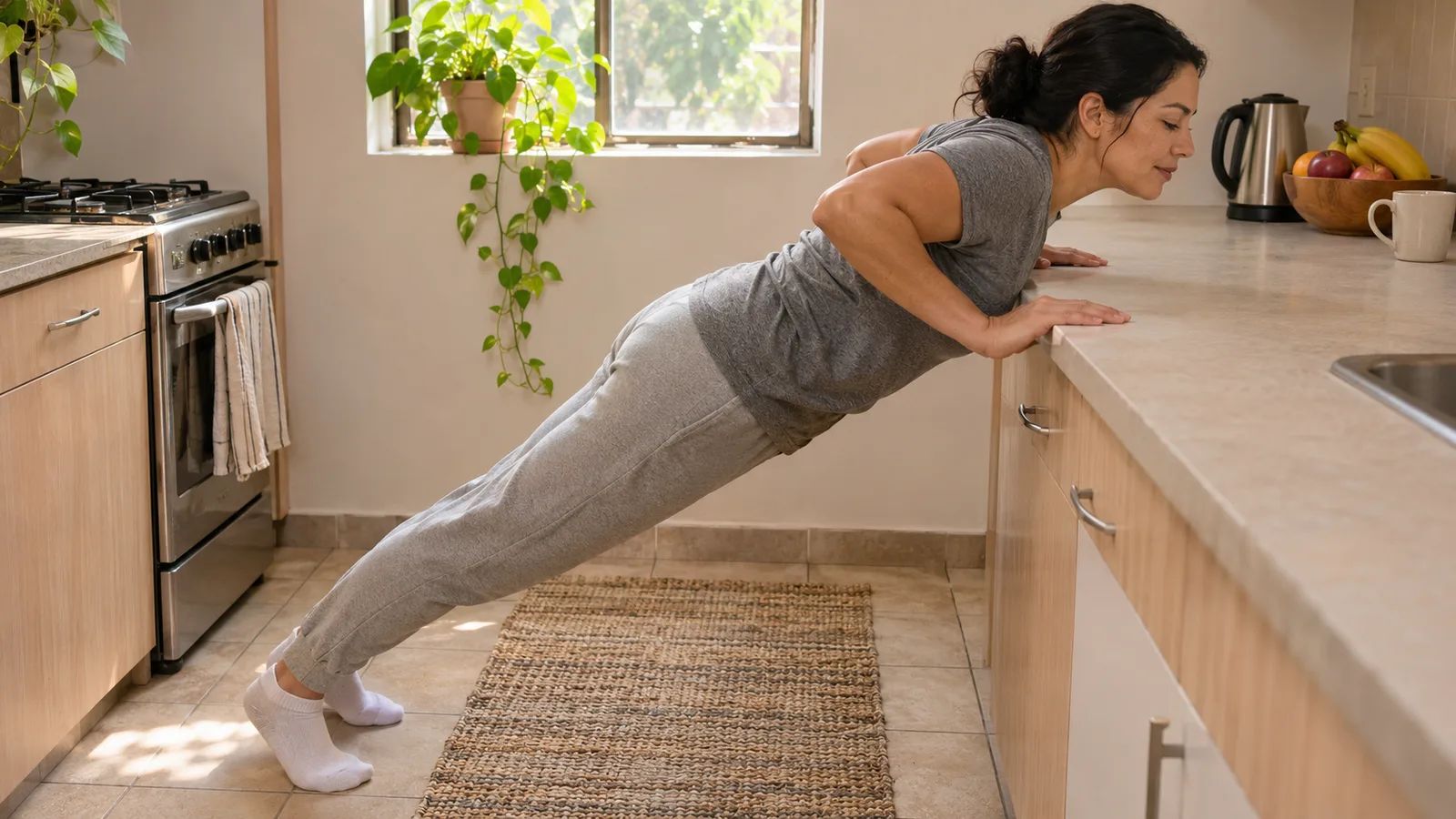
| 3. Push-up, hands on a counter, a chair or the floor | 3 × 6 to 15 | 60 to 90 sec | None |
| 4. One-arm row, hand on a chair | 3 × 8 to 12 each arm | 60 sec after both arms | Heavy |
| 5. Lateral raise | 2 × 12 to 15 | 45 sec | Light |
Short day: moves 1, 3 and 4, 2 sets each.
Upper (four-day plan)
| Move | Sets × reps | Rest | Pair |
|---|---|---|---|
| 1. Floor press | 3 × 8 to 12 | 90 sec | Heavy |
| 2. One-arm row, hand on a chair | 3 × 8 to 12 each arm | 60 sec after both arms | Heavy |
| 3. Overhead press | 3 × 8 to 12 | 90 sec | Light |
| 4. Band pull-down, or two-arm bent-over row | 3 × 10 to 15 | 60 sec | A band, or heavy |
| 5. Lateral raise | 2 × 12 to 15 | 45 sec | Light |
| 6. Curl, then triceps extension, back to back | 2 × 10 to 15 each | 60 sec | Light |
Short day: the first four moves, 2 sets each.
Lower (four-day plan)
| Move | Sets × reps | Rest | Pair |
|---|---|---|---|
| 1. Goblet squat | 3 × 8 to 12 | 2 min | Heavy, one dumbbell |
| 2. Romanian deadlift | 3 × 8 to 12 | 2 min | Heavy |
| 3. Split squat | 3 × 8 to 12 each leg | 60 to 90 sec | Light or heavy |
| 4. Glute bridge | 2 × 12 to 15 | 60 sec | Heavy, one across your hips |
| 5. Suitcase carry | 2 walks of 30 to 40 sec each hand | 60 sec | Heavy, one dumbbell |
Short day: the first three moves, 2 sets each.
Want depth on one thing? The full-body dumbbell workout is a single session to do today, and the dumbbell leg workout and the dumbbell back workout each take one area further.
Which pair for which move
Your legs and back can handle far more weight than your shoulders and arms, so a single pair is nearly always wrong for half the workout.
| Move | Pair too light? Do this | Pair too heavy? Do this |
|---|---|---|
| Romanian deadlift | Kickstand version, then single-leg | One dumbbell held in both hands, or stop at your knees |
| Goblet squat | Split squat, then back foot on a chair | Squat to a chair seat |
| Suitcase carry | Walk longer, up to 60 sec | Walk shorter, or hug it at your chest with both hands |
| Rows | 2-second squeeze at the top, 3-second lowering | One arm at a time, free hand on a chair for support |
| Glute bridge | One leg, or shoulders on the edge of the couch (hip thrust) | Body weight only |
| Floor press | 2-second pause with your arms on the floor | Push-ups with your hands on a counter instead |
| Split squat and lunge | Back foot on a chair, or a 3-second lowering | No weight, one hand on a counter |
| Overhead press | 3-second lowering, or sitting on a chair | Press one dumbbell with both hands, held by its ends |
| Lateral raise, curl, triceps | Slower, and more reps | Full water bottles, or skip lateral raises for now |
When you make a move harder, keep the reps sensible. Once a set takes more than about 20 to 25 reps, it's mostly a test of patience, so switch to the harder version.
Buying dumbbells? Choose the light pair by your overhead press and the heavy pair by your row or Romanian deadlift: each should be a weight you can lift 10 to 12 times with effort to spare. As a first guess for a newcomer, our starting points are a light pair of 5 to 8 lb (about 2 to 3.5 kg) and a heavy pair of 10 to 20 lb (about 4.5 to 9 kg). How much weight to start lifting with has the numbers move by move and a three-set test, and the first $300 of a home gym compares dial pairs and fixed pairs.
How to do each move
What each move is, then the commonest fault and its fix.
- Goblet squat. Hold one dumbbell upright against your chest and sit down between your heels, elbows inside your knees. Heels lifting? Hold the weight higher and widen your stance a little.
- Romanian deadlift. Knees soft, push your hips back as if shutting a drawer behind you, so the weights slide down your thighs. Stop when your hips stop moving back, usually around mid-shin, not at the floor. The kickstand version sets one foot slightly back, toes down for balance, so your front leg does most of the work. Deadlift form has the full set of cues.
- Rows. One-arm: lean forward with one hand on a chair seat, back flat, and pull the dumbbell toward your back pocket. Two-arm: hinge as for the Romanian deadlift and pull both at once. If your chest twists or jerks to heave the weight up, go lighter and pause a second at the top.
- Band pull-down. A resistance band anchored in the top of a closed door, pulled down to your chest: the home version of the gym's lat pulldown, and the one pull dumbbells do poorly. Leaning back to finish each rep? Use a lighter band.
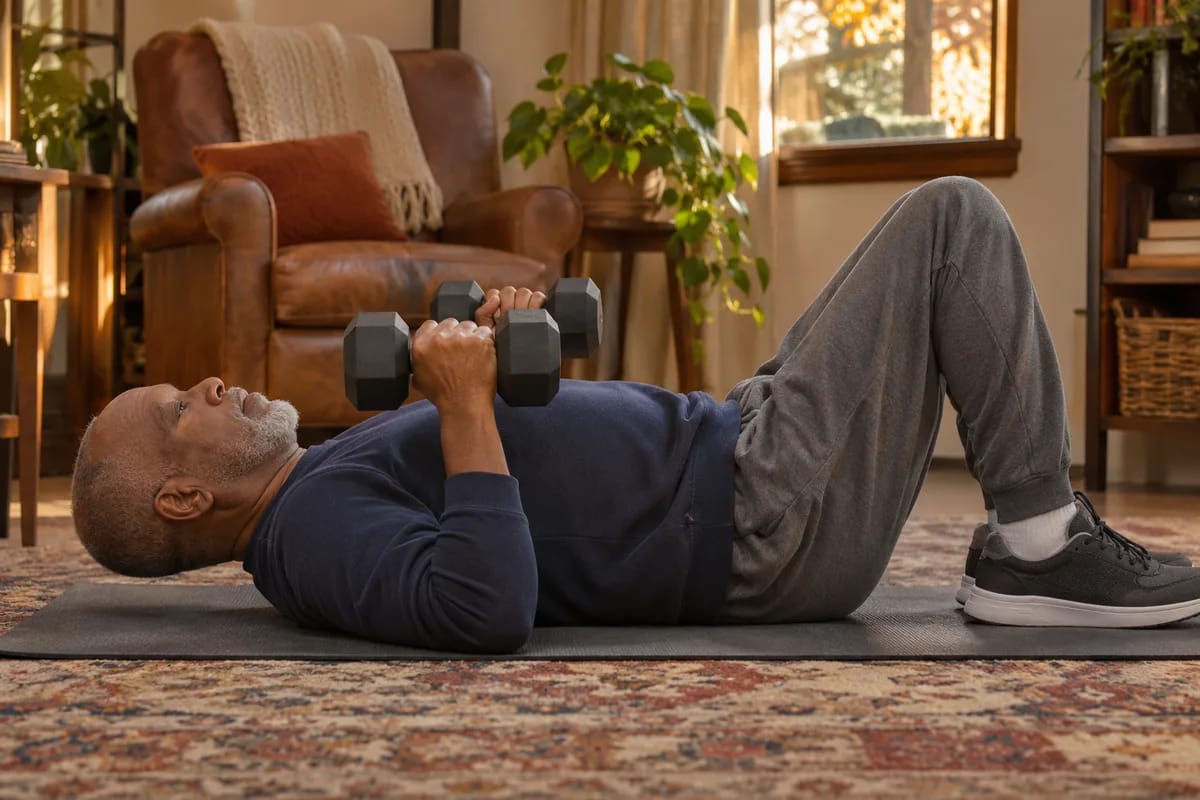
- Floor press. Lie on your back, knees bent, and press the pair up from your chest. Elbows flaring out in a T? Tuck them in, as in the setup below.
- Overhead press. Press the light pair from your shoulders until your biceps are by your ears. Leaning back to get it up? Squeeze your glutes before each rep, or press sitting on a chair.
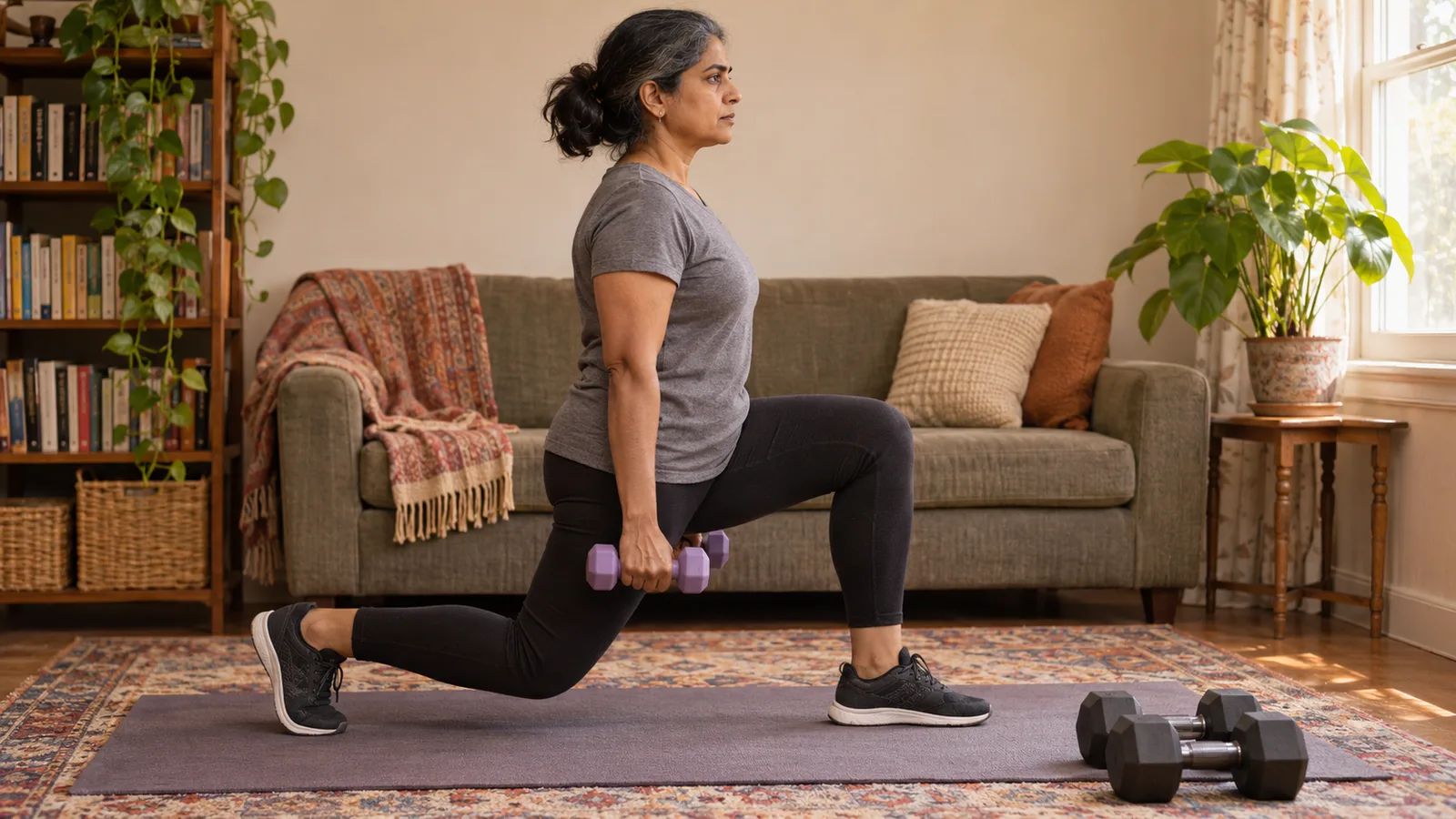
- Split squat and reverse lunge. Feet a long stride apart, drop straight down like an elevator. The lunge steps back into that position and returns. Front heel lifting? Lengthen your stance, and hold a counter if balance is the limit.
- Glute bridge. On your back, knees bent, a dumbbell across your hips, push through your heels. Stop when shoulders, hips and knees make a straight line, rather than arching your lower back.
- Suitcase carry. Walk with one dumbbell hanging at your side like a suitcase, switching hands halfway. Walk tall. If you lean toward the weight, take shorter, slower steps or use a lighter dumbbell.
- Lateral raise. Lift the light pair out to your sides, leading with your elbows, and stop at shoulder height. Swinging and shrugging means the pair is too heavy.
- Curl and triceps extension. Curl the light pair up with your elbows pinned to your sides. For the extension, hold one dumbbell by its end in both hands behind your head and straighten your arms toward the ceiling. Swinging, or elbows drifting wide? Go lighter.
- Push-up. Your body moves as one plank. If your hips sag first, put your hands on something higher. How to do a proper push-up takes you from the counter to the floor.
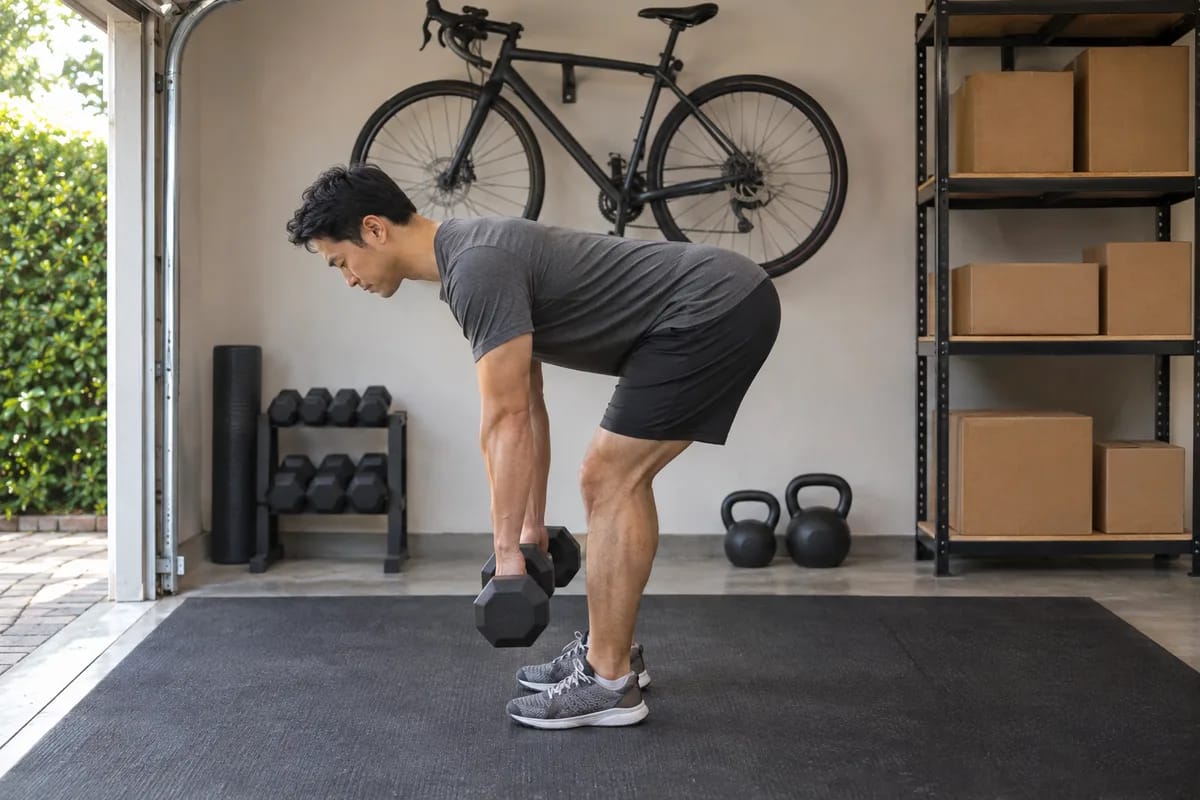
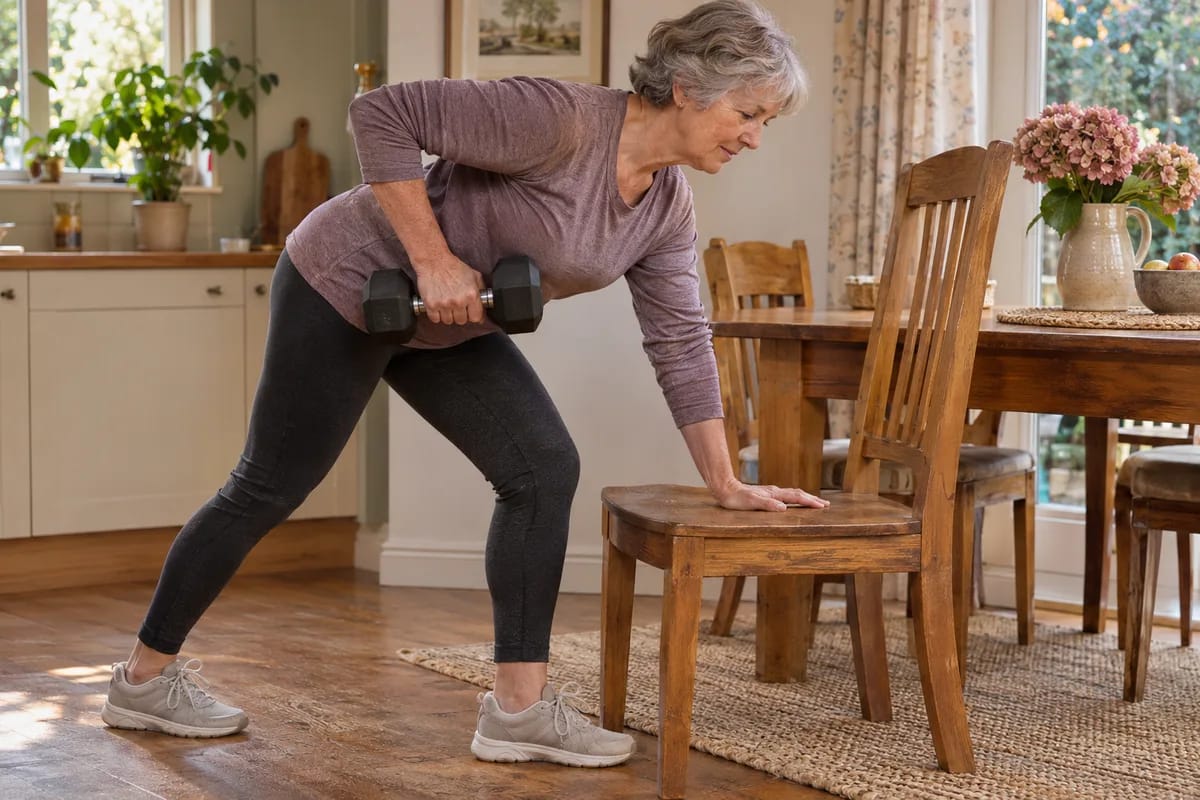
A muscle working hard is fine. A sharp or pinching pain in a joint means stop that move today and use the easier version next time. Prop your phone side-on and film one set of each move every couple of weeks: most of these faults show from the side and hide from the front.
Getting into a floor press with heavy dumbbells
This is the part videos cut. Lie down first and reach for heavy weights beside you, and your shoulders take the strain before the first rep.
Sit on the mat with a dumbbell standing on end on each thigh
Knees bent, feet flat, the dumbbells close to your knees.
Hug them to your chest and roll back
Keep them tight against you until your back and head are on the mat.
Set your upper arms on the floor, then press
Elbows at about 45 degrees from your sides. Press straight up from there.
Finish the same way in reverse
Lower them to your chest, bring your knees up, and rock up to sitting with the weights back on your thighs. Never drop them from arm's length.
The same goes for every move: bend your knees and set dumbbells down on the mat end first. Your floor and your neighbors will both be happier, and lifting in an apartment has the rest.
The weeks after this one
The plan stays the same. What changes is the work inside it, in this order:
- Reps first. Stay with the same weight until you hit the top of the range on every set with two or three still left. Small dumbbells go up in big jumps (5 to 8 lb, about 2 to 3.5 kg, is 60% heavier), so get everything you can from a weight before you leave it.
- Then the next pair up, and drop back to the bottom of the range.
- No next pair? The harder version from the table above, at the bottom of the range again.
Here's what that looks like for someone with a single 25 lb (11 kg) dumbbell on the four-day plan, where goblet squats come up twice a week:
| Session | Move and weight | Reps in each set |
|---|---|---|
| 1 | Goblet squat, 25 lb (11 kg) | 10, 9, 9 |
| 2 | Goblet squat, 25 lb (11 kg) | 11, 10, 10 |
| 3 | Goblet squat, 25 lb (11 kg) | 12, 11, 11 |
| 4 | Goblet squat, 25 lb (11 kg) | 12, 12, 12 |
| 5 | Split squat, the same 25 lb (11 kg) at the chest | 8, 8, 8 each leg |
Session 5 looks like going backwards. It isn't: one leg is now doing most of the lifting with the same weight. Progressive overload at home has full ladders of harder versions for every pattern.
On the four-day plan, every four to six weeks, do one easier week: same workouts, 2 sets instead of 3. On two or three days, take one only when you feel flat or your joints grumble. Deload weeks explains why it helps.
Can you build muscle with only dumbbells?
Yes. Light and heavy weights build similar muscle when the sets are hard, though heavier ones build more top-end strength.2 In the ACSM review, the type of equipment made no consistent difference to results.1 Muscle responds to hard sets, whatever they're lifted with.
Where dumbbells do run short:
- Legs and back outgrow them first. Your shoulders may be happy with a 15 lb (7 kg) pair for years while your Romanian deadlift wants a 60 lb (27 kg) pair. The harder versions buy a lot of time. Eventually, a heavier pair or a gym does better.
- There's no good dumbbell pull-down. Rows pull the weight toward you. Pulling down from overhead needs a band anchored over a door or a pull-up bar, which is why all three plans offer the band.
Training it live with a coach
Two parts of this page are hard to do on your own: judging how many reps a set really had left, and catching the faults that show from the side and hide from the front. That's why the advice above is to film yourself, and even then you only see it afterwards.
At Bespoke Fit, every session is a live 1‑on‑1 video call with your own coach. They watch each set through your camera, fix the floor-press elbow while the weight is still in your hands, swap in the harder version mid-session when your pair stops being enough, and write next week's workouts on your training calendar.
Each coach has 12 members at most, and yours was on the call for your last session too, so next week starts from what they saw, not from a log. It's 14 days free, then $299/mo, with unlimited sessions. If you already train steadily and like running your own plan, or $299 a month is more than this is worth to you, the tables above will serve you well.
Common questions
What are the five best dumbbell exercises? The goblet squat, the Romanian deadlift, a press (floor or bench), a row and the overhead press. Between them they cover squatting, hinging, pushing and pulling. Add the suitcase carry as a sixth. It's the one people forget, and it trains your grip and your trunk while you walk.
Can I do dumbbell workouts every day? You can move every day, but give the same muscles a day off between hard sessions. To lift on most days, run the four-day upper/lower plan, which never trains the same half of you two days in a row, and walk on the days between.
Do I need a bench? No. Every workout here works on the floor with a sturdy chair. The floor press stands in for the bench press, and the chair seat holds your free hand for one-arm rows. A bench adds incline pressing and a bit more range later on. It isn't needed to start.
Sources
-
Currier, B.S., D'Souza, A.C., Singh, M.A.F., and colleagues, 2026 (Phillips, S.M., senior author). American College of Sports Medicine position stand. Resistance training prescription for muscle function, hypertrophy, and physical performance in healthy adults: an overview of reviews. Medicine and Science in Sports and Exercise. An overview of 137 systematic reviews. Suggests sets near failure, such as 2 or 3 reps in reserve (with too little evidence for an exact target); found that going to failure did not enhance gains; linked 10 or more sets per muscle group a week with more growth; and found equipment type did not consistently change outcomes. ↩ ↩2
-
Schoenfeld, B.J., Grgic, J., Ogborn, D. & Krieger, J.W., 2017. Strength and hypertrophy adaptations between low- vs. high-load resistance training: a systematic review and meta-analysis. Journal of Strength and Conditioning Research. 21 studies in healthy adults, all sets taken to failure; similar muscle growth with light and heavy loads, more one-rep strength with heavy loads. ↩