Strength training for women over 40: a 3-day plan
A 3-day plan for women over 40 with starting weights in pounds, how to add weight, and why starting before menopause helps muscle and bone.
In this article9
The short answer
Lift two or three days a week, working your whole body each time: a squat, a hip hinge (a deadlift), a push, a pull, a one-leg move and a carry. Use weights heavy enough that you finish each set with only two good reps left.
Two days a week meets the US guideline for strength training,1 and under a quarter of women aged 45 to 64 say they manage it,2 so start there if three sounds like a lot. If you're new to lifting, a sensible start is around 8 to 20 lb (4 to 9 kg) for legs and back and 5 to 15 lb (2 to 7 kg) for arms. The table under the plan has a number for each move.
The 3-day plan
Do the days in order, with a rest day between each, say Monday, Wednesday and Friday. Walk on the days between if you can. Brand new to all of it? Do Days A and B for the first few weeks and add Day C once those two feel routine.
| Day | Move | Sets × reps |
|---|---|---|
| A, about 40 min | Goblet squat | 3 × 8 to 12 |
| Romanian deadlift | 3 × 8 to 12 | |
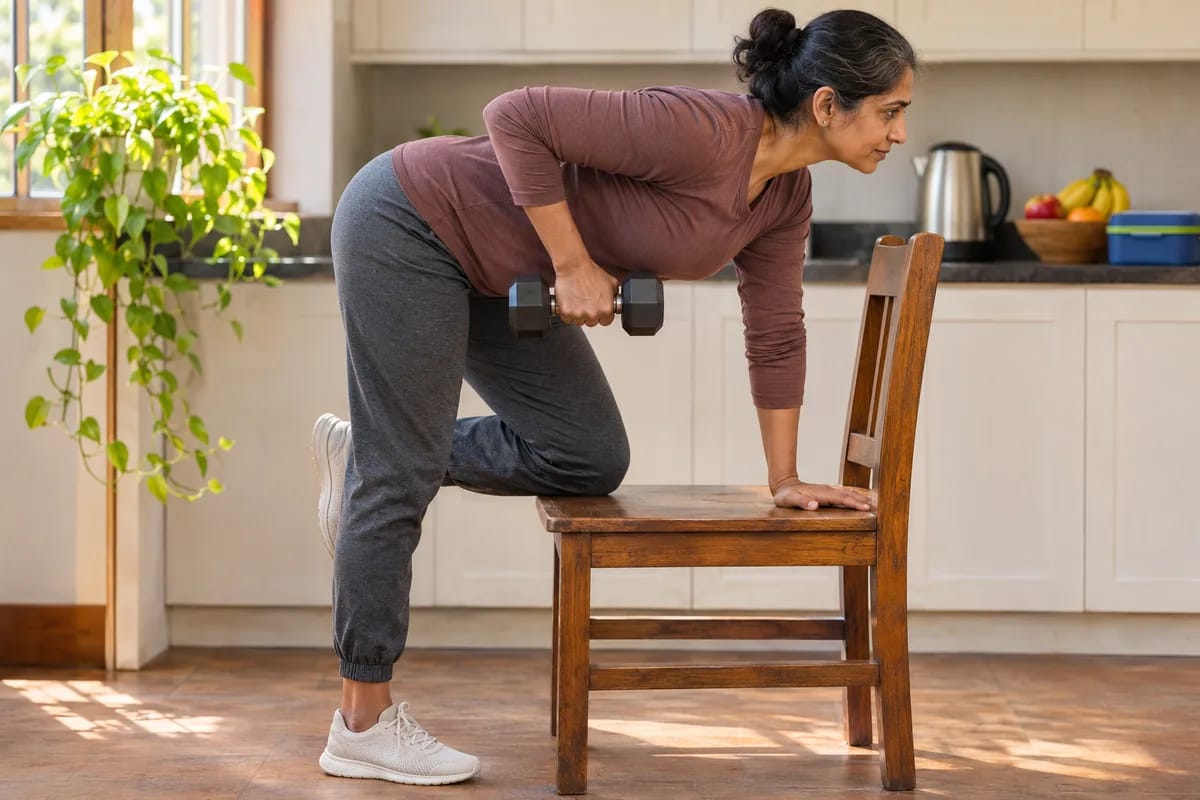
| One-arm row, hand on a chair | 3 × 8 to 12 each side | |
| Push-up, hands on a counter, bench or floor | 3 × 8 to 12 | |
| Farmer's carry | 3 × 30 steps | |
| B, about 40 min | Split squat, a hand on a counter | 3 × 8 to 12 each leg |
| Hip bridge | 3 × 10 to 15 | |
| Dumbbell floor press | 3 × 8 to 12 | |
| Bent-over row, both arms | 3 × 8 to 12 | |
| Dead bug | 2 × 8 each side | |
| C, about 20 min | Small hops | 2 × 10 |
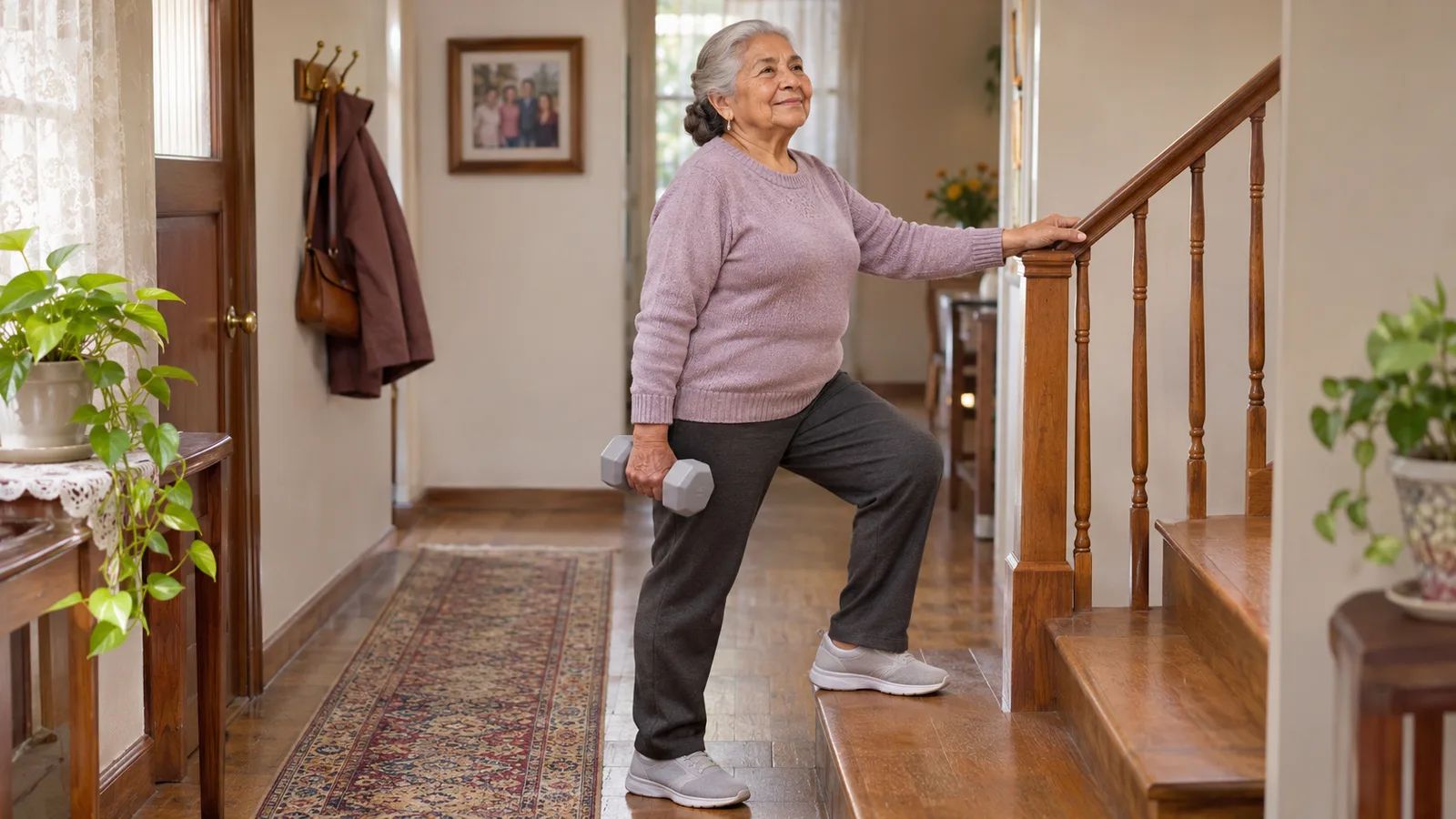
| Step-up onto a stair or step | 2 × 8 each leg | |
| Shoulder press | 2 × 8 to 12 | |
| One-arm row | 2 × 8 to 12 each side | |
| Suitcase carry | 2 × 20 steps each side |
How each set goes. Rest 60 to 90 seconds between sets, and stop each set with about two good reps left. The rep range is the standard one for beginners.3
Warm up with five minutes of anything that makes you a little warm (marching on the spot, the stairs, a brisk walk round the block), then do the first set of each move with a lighter weight.
What you need: two pairs of dumbbells or one adjustable pair, a sturdy chair, and a step or the bottom stair. At a gym, use the dumbbell rack and a bench. No dumbbells yet? A gallon jug of water weighs about 8 lb (4 kg), and a backpack with a few books in it does for squats and rows. That gets you through the first week or two.
Check with your doctor first if you have a heart condition, blood pressure that isn't under control, osteoporosis or a fracture from a minor fall, a recent injury or operation, or you're pregnant or recently had a baby. Stop and get checked if you feel chest pain, dizziness or breathlessness out of proportion to the effort. Joint pain (not the ordinary burn in the muscle) means swap to an easier version, and have it looked at if it keeps coming back.
The moves that sound fancier than they are:
- Goblet squat: hold one dumbbell upright against your chest, sit down between your heels, stand back up.
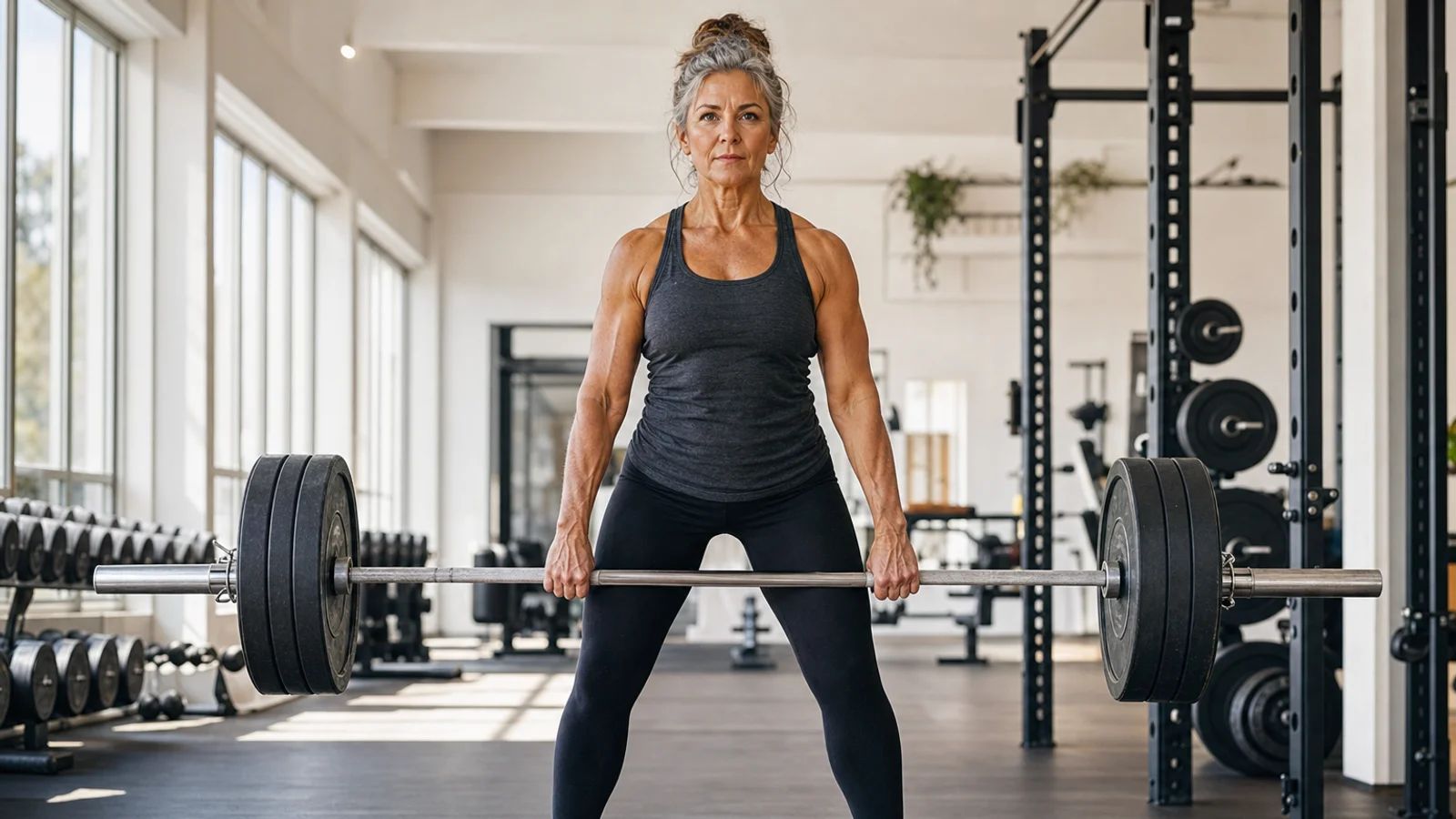
- Romanian deadlift (the hinge): stand with the weights in front of your thighs, push your hips back so the weights slide down your legs, and stand up again before your back starts to curl.
- Bent-over row: tip forward from your hips with a flat back, arms hanging, and pull both dumbbells up to your ribs.
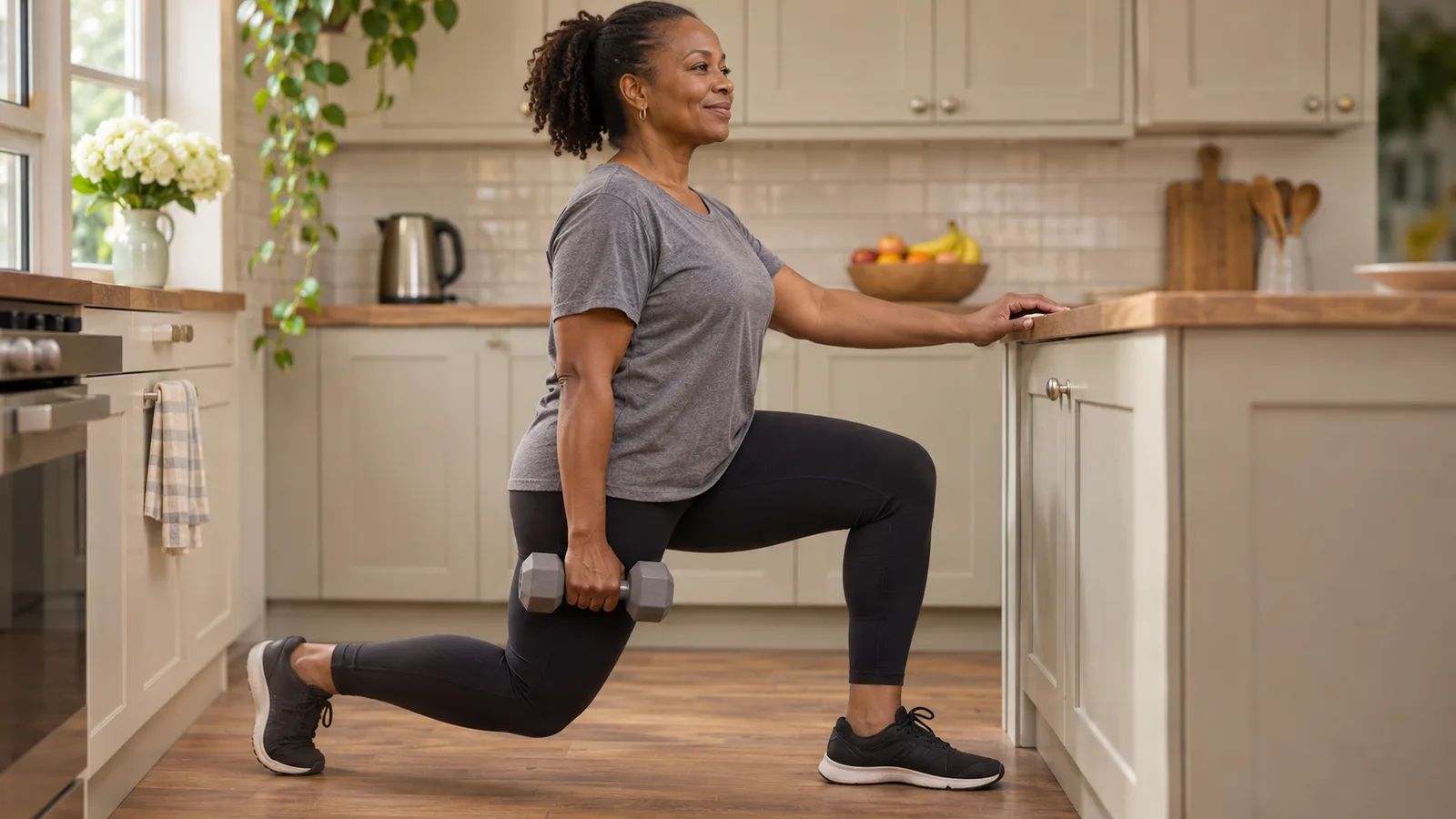
- Split squat: one foot well in front of the other, back heel up. Lower your back knee toward the floor, then push up through the front foot. A hand on the counter is fine; it's a leg exercise, not a balance test.
- Push-up: the higher your hands, the easier it is. Pick the height (kitchen counter, bench, floor) where 8 good reps are possible.
- Floor press: lie on your back with your knees bent and press the dumbbells up from where your elbows touch the floor.
- Farmer's and suitcase carry: walk tall with a heavy dumbbell in each hand, or in one hand for the suitcase version, which makes your middle work to keep you upright.
- Dead bug: lie on your back with your arms up and knees over your hips. Slowly lower the opposite arm and leg while your lower back stays on the floor.
- Small hops: little bounces on the balls of your feet, a few inches off the floor. More on why they're here further down.
How heavy, in pounds
These are coaching rules of thumb, not study numbers. Pick your end of the range: the left column if you haven't lifted in years, the right if you're active and just new to weights.
| Move | Never lifted, or not in years | Active, but new to weights |
|---|---|---|
| Goblet squat, one dumbbell | Body weight, then 8 to 12 lb (4 to 5 kg) | 12 to 20 lb (5 to 9 kg) |
| Romanian deadlift, per hand | 8 to 12 lb (4 to 5 kg) | 15 to 20 lb (7 to 9 kg) |
| One-arm row | 8 to 12 lb (4 to 5 kg) | 15 to 20 lb (7 to 9 kg) |
| Floor press, per hand | 5 to 10 lb (2 to 5 kg) | 10 to 15 lb (5 to 7 kg) |
| Shoulder press, per hand | 5 to 8 lb (2 to 4 kg) | 8 to 15 lb (4 to 7 kg) |
| Split squat, step-up, hip bridge | Body weight | Body weight, then the light pair |
| Carries | Your heaviest pair | Your heaviest pair |
The two-arm bent-over row usually takes a little less per hand than the one-arm row. Two pairs cover almost everything: a light pair around 5 to 8 lb (2 to 4 kg) and a heavier pair around 12 to 20 lb (5 to 9 kg). The full three-set test for finding your number is in how much weight a beginner should lift.
Is it heavy enough? The last two reps of a set should be slow and take real effort, but still look like the first rep. If the last rep felt as easy as the first, go heavier on the next set. If your form changed before you got to 8, go lighter. Left to choose, people pick on average about half the most they could lift once,4 so if you're torn between two, try the heavier one.
When to go up. Treat the rep range as a ladder. Keep the same weight until you can do 12 on every set with two reps still in you, then move to the next weight and start back at 8. Say you begin goblet squats with a 15 lb (7 kg) dumbbell and manage 3 × 8. Over the next few sessions it creeps to 3 × 9, 3 × 10, and eventually 3 × 12 feels the way 3 × 8 did. Then you pick up the 20 lb (9 kg) and you're back at 3 × 8.
If the next dumbbell feels like a cliff, and on small weights a 5 lb (2 kg) jump is a big one, do your first set with the heavier one and finish with the old one, adding one more heavy set each week.
Faults to look for, and the fix
A workout video shows the move done well. It can't show you your own set. Prop your phone side-on at about hip height and film one set of each new move, because the side view shows your back, hips and knees in a way a mirror doesn't.
| Move | What you'll see on the video | The fix |
|---|---|---|
| Goblet squat | Heels lift, or knees drift inward | "Heels heavy, knees out." Only sit as low as your heels stay down. |
| Romanian deadlift | Back rounds as the weights pass your knees | "Hips back." Let the weights slide down your thighs and stop where your back is still flat. |
| Split squat | Front heel lifts off the floor | Step the front foot further forward. |
| Rows | Shoulder shrugs up toward your ear | "Elbow to back pocket." |
| Push-up | Hips sag toward the floor | Raise your hands (counter, then bench) until your body stays in one straight line. |
| Carries | Leaning sideways, short shuffling steps | "Walk tall." Take normal steps. |
| Small hops | Loud, stiff-legged landings | "Land quiet," on soft knees. |
The Romanian deadlift fault is the easiest to miss, because the rounding starts below your line of sight.
Why the 40s are the decade to start
For women, muscle and bone don't fade at a steady pace. A long-running US study that measured women repeatedly through the menopause transition found the changes bunch up around the transition itself.5 Most women start the transition somewhere between 45 and 55, and the average age of menopause in the US is 52.6
Before the transition
Bone holds steady
Bone density barely changes before the transition or early in it.5 Get the lifting habit settled now.
As the transition starts
Fat gain speeds up, lean mass slips
The rate of fat gain doubled and lean mass, which is largely muscle, began to fall. Weight kept rising at the same pace as before, so the scale doesn't show it; a waistband might.7 Keep the weights challenging, because muscle is what's slipping.
Late perimenopause
Bone loss speeds up
Bone density at the spine and hip starts falling much faster, and keeps that pace for the first years after the final period.5 Keep loading and keep nudging the weights up. Strength training for women over 50 covers how heavy you can safely go.
About two years after the final period
Things level off
Fat gain and lean-mass loss both slow to roughly flat.7 What you built and kept through the transition is what you carry forward.
None of this is a cliff, and if you're reading this at 48 or 55 you haven't missed anything. Lifting still builds strength in people aged 65 to 79,8 and training in your 40s covers what changes and what doesn't. The point about the 40s is simpler: the years when muscle and bone slip fastest go better if you arrive at them already lifting.
Small hops, while they work best
Bone responds to impact as well as to weight. In a small British trial, women who hadn't reached menopause did small jumps, about 3 inches (8.5 cm) high, most days. After five months their hip bone density was up 2.8%, more than in women who didn't jump. Women past menopause who did the same jumps ended up no different from those who didn't.9 One small trial isn't settled science, but it's the clearest reason the hops are in this plan, and a good reason to start them before menopause rather than after.
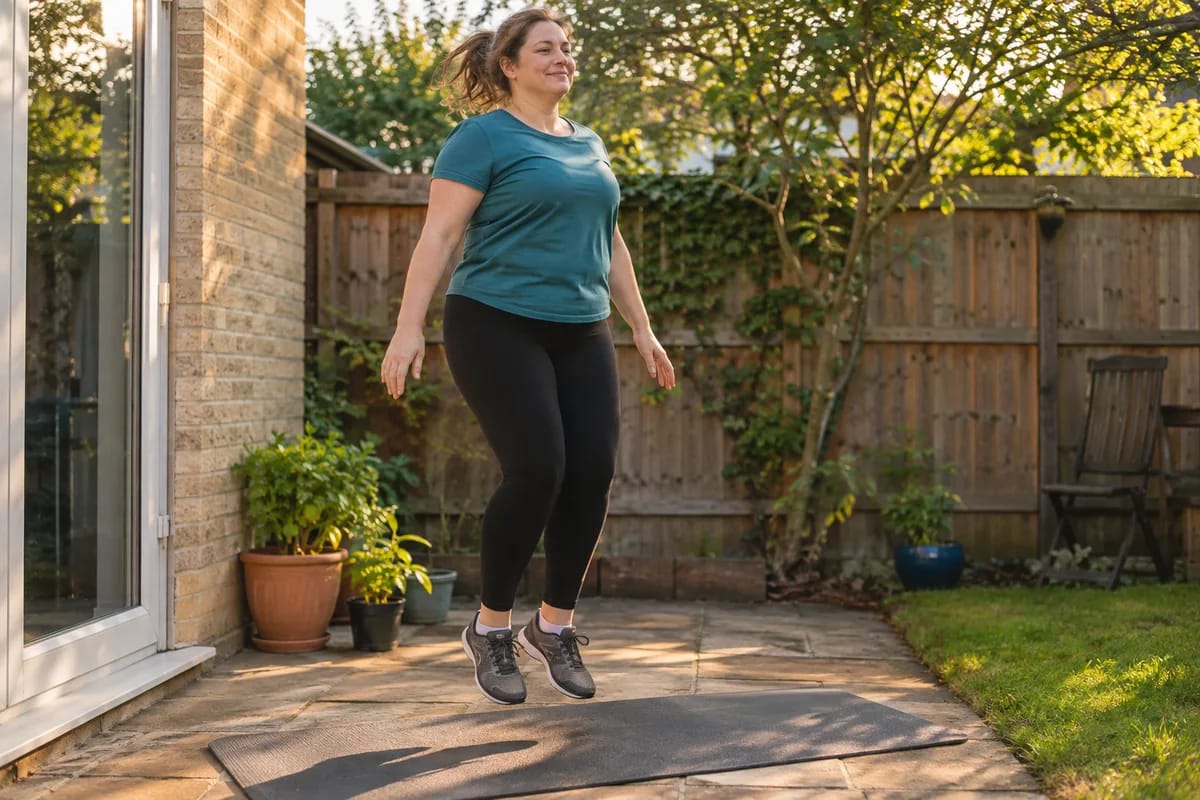
The trial's women did about 300 jumps a week, so Day C's two sets of 10 is a start, not a copy. If your knees, feet and pelvic floor are happy, build toward a set of 10 most days. They take under a minute.
If hopping makes you leak, drop to lower hops or skipping, and see a pelvic health physiotherapist if it keeps happening; it's exactly what they treat. Sore knees or ankles: do step-ups instead and try the hops again in a few weeks. Why bone needs load and impact rather than walking alone is in how lifting builds bone.
Light weights aren't the women's version
A lot of fitness advice for women still comes in pastel: tiny dumbbells, endless reps, nothing that makes you breathe hard. There's no separate women's version in the research. When researchers pooled the studies that put young and middle-aged men and women on the same program, women built muscle at the same relative rate as men, and gained more upper-body strength relative to where they started.10
What people usually mean by toned is a bit more muscle with a bit less fat over it, and that comes from this same plan, done for months, with weights that make the last reps hard. Muscle also needs protein to build on. While you're lifting, aim for about 0.7 g a day per pound of body weight (1.6 g per kilo), the point past which extra protein stopped adding muscle in the pooled trials.11 For a 150 lb (68 kg) woman that's about 105 g. How much protein you need after 40 turns that into meals.
Keeping it going in a full week
For a lot of women the 40s are the fullest decade: work at its busiest, kids still at home, sometimes a parent who needs help too. The plan has to survive that.
- Tie each session to something that already happens. After school drop-off, at lunch, before you start dinner. A fixed slot means you don't have to decide each time. There are more ideas in finding time with a baby or toddler and a strength session that fits a lunch break.
- Two days isn't settling. In older adults, lifting once, twice or three times a week built similar strength over six months.8
- Day C is the first thing to drop. Do a set of hops on some other day instead.
- A terrible week gets Day A only. One session keeps the habit alive until the next week is kinder.
- If symptoms are making some weeks harder than others, perimenopause training has a version of the week for good days and bad ones.
What a live coach takes off your plate
The plan above works, and it costs nothing. The parts it leaves to you are the hard ones: judging whether that really was two reps left, spotting your own back rounding on rep 9, deciding whether your knees and pelvic floor are ready for more hops, and turning up on a Wednesday when the week has gone sideways.
Those are the jobs a Bespoke Fit coach does. Every session is a live 1‑on‑1 video call with your own coach, in our app on iPhone, Android or a browser. You prop the phone side-on and train in your living room, spare room or garage.
- Your coach writes every workout onto your training calendar, weights included, and was on the call for every set you did last time. Whether that really was two reps left becomes their call, not yours. After each session a recap shows what you lifted and any records, the progress the scale and mirror miss.
- Faults get fixed mid-set. When the deadlift back starts to round, the split-squat heel lifts or a hop lands loud and stiff, your coach gives the cue while you're still moving, not in a video review a day and a half later. How well a coach can see your form over video has the detail.
- Your heart rate is on their screen, live from an Apple Watch or a Bluetooth strap. On a day you're running on bad sleep, how hard to push and when to rest gets decided from what your heart is doing, not from guesswork.
- Someone is waiting. Your coach books each session with you, it lands in your calendar with reminders, and a person is on the call at that time. That's what gets you there on the Wednesday that went sideways.
Each coach has 12 members at most, and we hold to that when we assign coaches, so yours remembers what you lifted last week. A head coach matches you to one after a 30-minute call, and you can meet the coaches first. Sessions run 45 to 90 minutes, and most people settle at around an hour.
"I was skeptical about doing training over video at my age, but it has been much easier than I expected. My trainer is patient and adjusts everything to what my body can handle. I have exercised more in the past two months than in the last ten years. My friends can see the difference."
Wanda, 70, a Bespoke Fit member
It's 14 days free, then $299 a month, with unlimited sessions, and you can cancel anytime. Two one-hour sessions a week works out to about $35 a coached hour, three to about $23. A local personal trainer usually charges $50 to $90 a session,12 and one trainer directory's median is $80 an hour at the trainer's own studio.13 What a personal trainer costs breaks those rates down.
Skip it if you already lift on your own week after week, if you can't promise a time in advance and need to train whenever a gap opens, if you want someone in the room or a gym floor, if you're after meal plans (we don't coach nutrition), or if $299 a month would strain things. The plan on this page is yours either way.
Common questions
Should I still do cardio?
Yes. The US guidelines pair two strength days with 150 minutes a week of moderate activity, and brisk walking counts. That's about 20 minutes a day, or three 50-minute walks on the days between lifting. If time is short, protect the lifting, because walking is easier to fit into the rest of your day.
Can I do this plan at a gym?
Yes, exactly as written, with the dumbbell rack and a bench. If you'd rather use machines, a leg press, a seated row and a chest press can stand in for the squat, row and press, with the same two-reps-left test. Keep the split squats, carries and hops, which machines don't replace.
How soon will I notice a difference?
Most people find the weights feel easier within a few weeks, well before anything changes in the mirror. Changes you can see take a few months of steady training. Bone is the slowest, and you can't feel it change; only a bone density scan measures it.
Sources
-
Centers for Disease Control and Prevention. Adult activity: an overview. Muscle-strengthening activity on 2 or more days a week working all major muscle groups, plus 150 minutes of moderate or 75 minutes of vigorous aerobic activity. ↩
-
National Center for Health Statistics, 2022. QuickStats: percentage of adults who met the federal guidelines for muscle-strengthening physical activity, by age group and sex, 2020. Morbidity and Mortality Weekly Report. Self-reported: 34.1% of women aged 18 to 44, 23.8% aged 45 to 64, 17.2% aged 65 and over. ↩
-
American College of Sports Medicine, 2009. Progression models in resistance training for healthy adults. Medicine and Science in Sports and Exercise. Recommends loads of an 8 to 12 repetition maximum and 2 to 3 days a week for novices. The set counts, rest times and the split across three days are our coaching rule of thumb, not something a study tested. ↩
-
Steele J and colleagues, 2022. Are trainees lifting heavy enough? Self-selected loads in resistance exercise: a scoping review and exploratory meta-analysis. Sports Medicine. 18 studies, 368 people; the average self-chosen load was 53% of one-rep max, which the authors note can still build strength in novices. ↩
-
Finkelstein JS and colleagues, 2008. Bone mineral density changes during the menopause transition in a multiethnic cohort of women. Journal of Clinical Endocrinology and Metabolism. 1,902 women of several ethnic backgrounds in the US Study of Women's Health Across the Nation (SWAN), followed for up to six annual visits. ↩ ↩2 ↩3
-
National Institute on Aging. What is menopause? ↩
-
Greendale GA and colleagues, 2019. Changes in body composition and weight during the menopause transition. JCI Insight. SWAN study, body composition measured by DXA scan. ↩ ↩2
-
Taaffe DR and colleagues, 1999. Once-weekly resistance exercise improves muscle strength and neuromuscular performance in older adults. Journal of the American Geriatrics Society. 46 healthy adults aged 65 to 79, training for 24 weeks. ↩ ↩2
-
Bassey EJ and colleagues, 1998. Pre- and postmenopausal women have different bone mineral density responses to the same high-impact exercise. Journal of Bone and Mineral Research. Randomised trials. In the premenopausal group, 31 women did 50 jumps a day, six days a week, averaging 8.5 cm (3.3 inches) high, against 26 controls; the postmenopausal groups showed no difference at 12 and 18 months. ↩
-
Roberts BM, Nuckols G and Krieger JW, 2020. Sex differences in resistance training: a systematic review and meta-analysis. Journal of Strength and Conditioning Research. ↩
-
Morton RW and colleagues, 2018. A systematic review, meta-analysis and meta-regression of the effect of protein supplementation on resistance training-induced gains in muscle mass and strength in healthy adults. British Journal of Sports Medicine. 49 trials, 1,863 people; total intakes above about 1.6 g per kilo a day added no further gain in lean mass. ↩
-
Bark, 2026. How much does a personal trainer cost?. bark.com: "The average personal trainer cost is $50-90 per session in the US", read November 12, 2026. ↩
-
RightFit Personal Training, 2026. How much does a personal trainer cost?. Updated November 2, 2026: median $80 an hour at the trainer's facility (2,576 listed rates) and $85 in-home (2,930), from one company's trainer profiles, read November 12, 2026. ↩