How parents of young kids actually fit training in
Naps end early and toddlers wake up mid-set. Here's how parents of babies and toddlers actually keep training at home, in short, interruptible sessions.
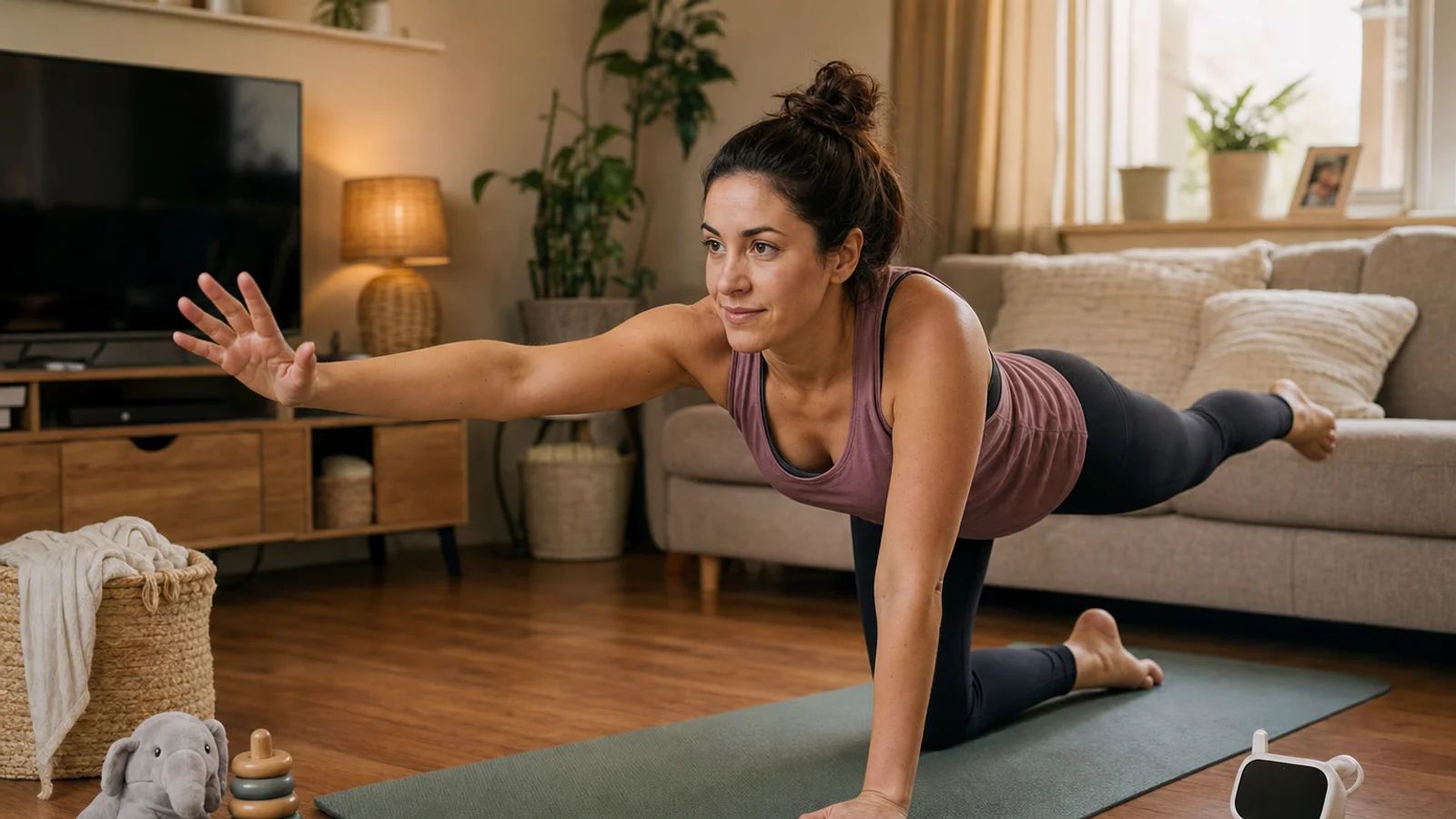
The parent who stays in shape after a baby arrives is almost never the one with the best plan. It's the one with the lowest standards for what counts as a workout.
It runs against everything we're taught about fitness rewarding structure and discipline. But with a toddler in the house, the disciplined-sounding plan is usually the one that quietly fails. The parent who blocks out a proper 90-minute gym trip, drive, warm-up, the works, gets maybe two of them in before real life eats the rest. The parent who does 20 messy minutes during a nap, three or four times a week, and shrugs when it gets cut short, is still training six months later.
Short and imperfect beats long and ideal, because short and imperfect is the version that actually happens.
Key takeaways
- A 20 to 30 minute session done consistently beats a 90-minute session you keep postponing. Consistency builds fitness, not any single heroic workout.
- Two windows actually work with young kids: during a nap, or after bedtime. Pick one and defend it before you plan anything else.
- Build every session full-body with a short warm-up, so any set can be the last one. An interruption then costs you a set, not the whole workout.
- Training at home removes the biggest failure point in most parent workout plans: leaving the house.
- Drop the guilt that a short session doesn't count. The linked post below covers why short sessions genuinely work.
Fewer requirements win
Every requirement you attach to a workout is a coin flip it has to win. A free 90-minute block: flip. The baby asleep and your partner home to cover: flip. Leaving the house and driving somewhere: flip. String four flips together and the odds that any single session survives are grim, even when you badly want to go.
The short home session has one requirement: 20 free minutes. One flip.
This is why willpower isn't the variable that decides things here. Two equally committed parents can land in completely different places. One built a plan with four failure points, the other built one with a single failure point. The second parent isn't more disciplined. Their plan just needs less to go right.
Fewer conditions, more workouts. The best training plan for a parent of young kids is the one with the least that has to line up.
If you want a weekly template built around blocks like this, how to make progress training three hours a week lays out how to spend the time so it adds up.
Pick your window: nap or after bedtime
Realistically, you get two.
The first is a nap. With a baby, you might still get a reliable morning nap. With a toddler, naps shrink and wander, then eventually vanish. The morning nap tends to stay the most predictable while it lasts, so if you're training in naps, build around that one. The trouble is naps end without warning, which is exactly why the session has to survive being cut short.
The second window is after bedtime. It's quieter and more protected, nobody's about to toddle in, but you're running on fumes by then, and a hard session can wreck the wind-down you need to fall asleep yourself. Lighter, steadier work fits this slot better than a max-effort grind.
Pick the window that matches your energy and your kid's rhythm, then treat it as your default. The plan that fails is "I'll train whenever a gap opens up." With young kids the gaps are random, and a random gap almost never turns into a workout.

Design sessions that survive an interruption
Build the session so stopping is never a disaster.
That means full-body over splits, a handful of compound movements, and the shortest warm-up you can safely get away with. Hit legs, push, and pull every session, and getting pulled away after two exercises still leaves you real, useful work done. Compare that to a long single-muscle day: get interrupted early and you've done half a warm-up and nothing else.
Interruptions get cheap for one reason: resting a long time between sets doesn't ruin a strength session. For heavy work, longer rest often helps more than it hurts.1 So if your kid wakes and you disappear for ten minutes to settle them, you didn't blow up the workout. You just took a long rest. Come back, do the next set, carry on. A set you've already finished is banked, gaps or no gaps.
Keep the equipment out and visible so restarting takes seconds, not a hunt through a closet. The lower the friction to resume, the more likely you actually do.
Treat every set like it might be your last one today. A wake-up then costs you a set, not a session.
Does a 25-minute session actually count?
Yes, and it counts far more than the zero you'd bank holding out for a perfect 90-minute slot this season of life isn't going to give you.
This is where a lot of fit-minded parents sabotage themselves. The old mental model says a workout under some threshold isn't worth changing into gym clothes for, so they skip it and wait for a "real" one. Through the baby and toddler years, that real one keeps not arriving, and the waiting quietly becomes not training at all.
I'm not going to re-argue the physiology here. A companion piece already does it properly: is 45 minutes enough for a real workout walks through why short, focused sessions do the job. The short version for a tired parent at 8pm: the session you actually do beats the one you're saving up for.
Home training removes the biggest excuse
Leaving the house is the single most expensive thing you can ask of a parent with young kids. Home training deletes it.
No commute. No childcare handoff to arrange. No packing a bag and timing it around a feed. You start the moment the nap begins and stop the moment it ends. You're right there if they wake too, which lowers the background anxiety that makes a lot of parents skip a gym trip they technically could have taken.
Take leaving out of the equation and a whole category of excuses disappears with it. They weren't weak excuses. They were real logistics that no longer apply.
Where this approach hits a ceiling
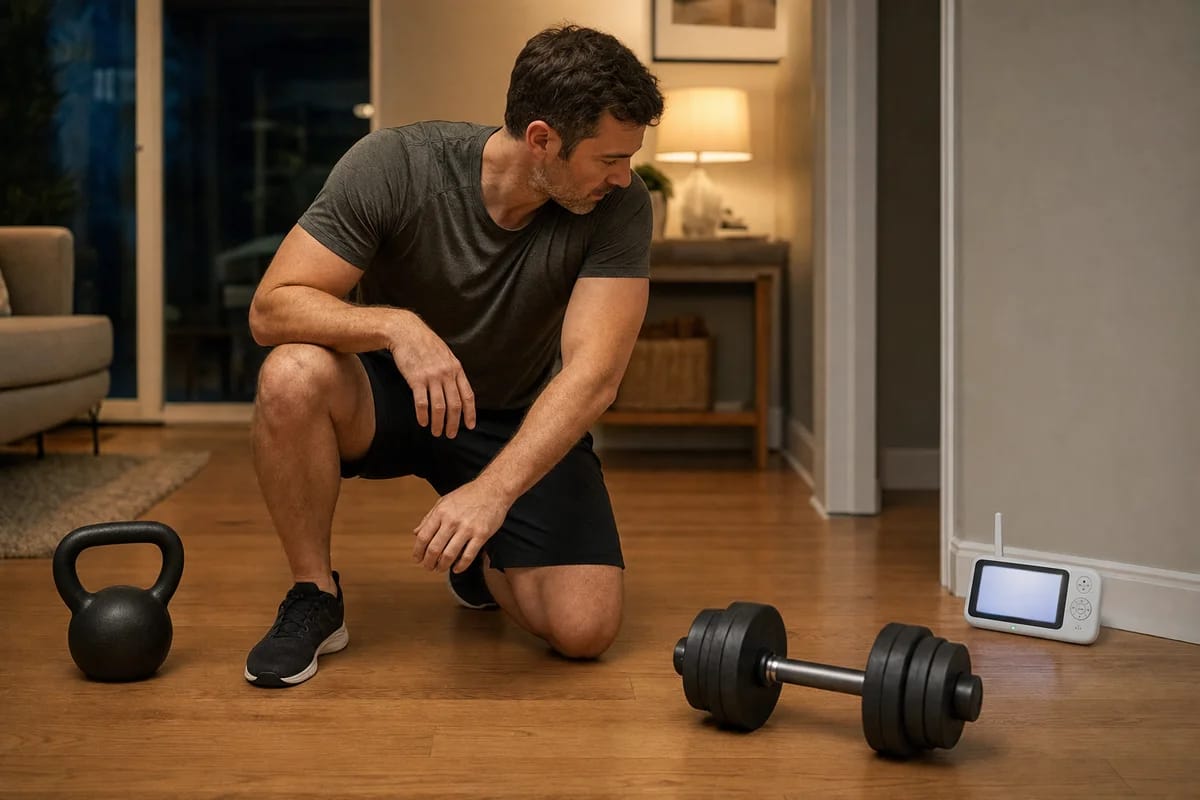
Short, interruptible sessions have limits. If your goal is a big powerlifting total, a marathon, or serious competitive numbers, you'll eventually need longer and more frequent training than nap windows allow. That's a real trade-off worth naming, not something to wish away.
Precise progression gets harder too when sessions keep getting chopped up. You'll lean more on how a set feels than a tidy spreadsheet, and some weeks the goal is just holding steady, not chasing gains. Keeping your baseline through a brutal sleep stretch is a win, not a failure.
This also assumes you have at least a little equipment, or a bodyweight plan, and a few square feet to move in. Not every home has that. And every kid is different: a newborn phase looks nothing like a settled two-year-old, so expect the plan to keep changing under you.
The weekly setup that actually works
- Pick one window, nap or after bedtime, and protect 20 to 30 minutes inside it. Stop chasing random gaps. They don't convert.
- Keep two or three pieces of equipment out and visible so setup takes under 60 seconds, not a five-minute dig through a cupboard.
- Build full-body sessions of 3 to 5 exercises, so any set you finish is banked volume even if the session ends early.
- Aim for 3 to 4 short sessions a week rather than one long one. Frequency is what covers you on the days that fall apart.
- Rest as long as you need between sets, even five minutes or more if a kid needs you. A long rest doesn't hurt a strength set.
- Track sessions done, not minutes trained. A logged 15-minute session still counts, and the count is what keeps you going.
Common questions
What do I do when my toddler drops naps entirely? Shift your default window to after bedtime, and keep a couple of five to ten minute micro-sessions in your back pocket for the days that's not enough. Two short blocks in a day still add up, and they're easier to defend than one long one.
Should I wake up early and train before the kids? Only if it doesn't come straight out of your sleep. For a chronically underslept parent, protecting sleep usually does more for your health and your training than a 5am session paid for with rest you couldn't spare.
Can I actually build strength on 20-minute sessions? Yes, with progressive overload and a bit of patience. Progress may run slower than it would for a well-rested person on longer sessions, but the direction is still up. The linked short-session piece above covers the evidence.
What equipment makes the most sense for a small space? A set of adjustable dumbbells or a couple of resistance bands, plus your own bodyweight, covers almost everything you'd want in these years. Small footprint, always out, nothing to drive to.
A cheap set of dumbbells, a full-body plan, a defended nap window, and the discipline to log the short ones is a complete system. Plenty of parents run it for years without any help.
Ask yourself this: when a session gets cut short or a whole week falls apart, do you actually reopen your log on your own, or does it just sit there until you quietly stop? If a defended window and a spreadsheet are enough to pull you back in, you've already got what you need. If what actually gets you back on the mat is knowing a real person is waiting on the other end of the camera, that's the piece a coach adds.
Bespoke Fit is unlimited live 1-on-1 training over HD video with a real coach, never an AI, and each session is a booked appointment with someone actually waiting for you. When a kid wakes up mid-session, your coach reschedules with no penalty. They know that's just a Tuesday. It's $49 your first month, then $299 a month locked in for life if you're one of the first 25 founding members, and $499 after those spots fill, with a 30-day money-back guarantee, no questions asked, if it doesn't earn its place. See how the live sessions actually run on the how it works page.
Sources
-
Grgic and colleagues, 2018. Effects of Rest Interval Duration in Resistance Training on Measures of Muscular Strength: A Systematic Review. Sports Medicine. ↩
More on