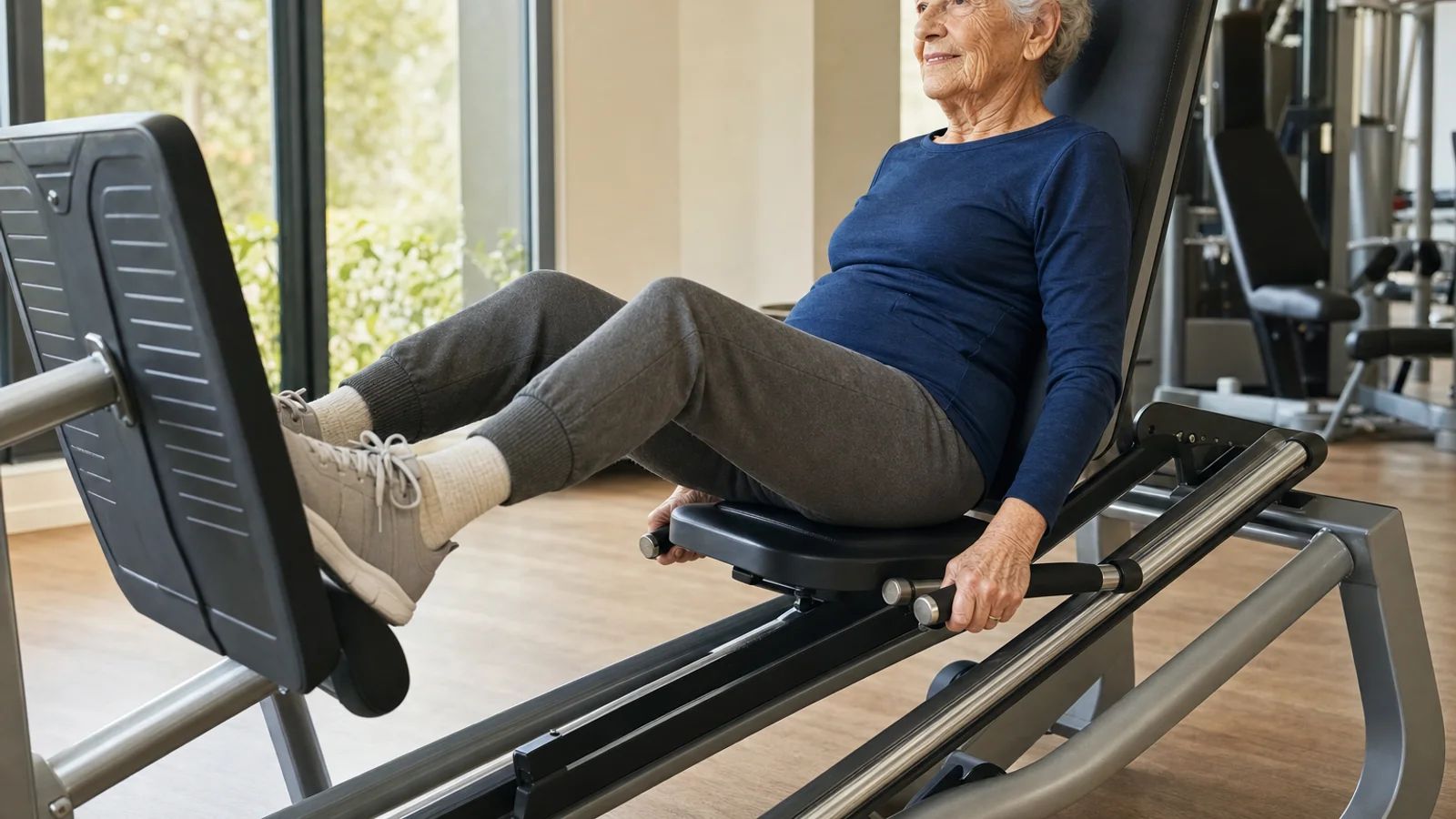
Do older lifters really need more recovery time
Gym lore says recovery falls off a cliff with age. The evidence is mixed, and your sleep and training history predict it far better than your birthday.
You've heard the claim: past a certain age, you need an extra day between hard sessions, then two, then three, because recovery just collapses. It sounds like common sense. It's mostly wrong.
When researchers actually time how fast strength comes back after a hard session, age turns out to be a weak predictor. Two things call it far better: how well you slept and how long you've been training. Your birthday barely factors in.
That's not the same as saying age does nothing. It just shows up somewhere else. Age barely touches how hard one session knocks you down. It shows up later, in how many hard sessions you can stack close together over a week.
Do older and younger lifters actually recover at different speeds?
Take the fairest version of the test: put a younger lifter and an older lifter through the same hard, muscle-damaging session and time how fast their strength returns.
Sometimes the older group does lag. Researchers ran 10 women around 20 and 6 women around 68 through a maximal eccentric knee-extension protocol, the kind of workout that leaves you sore for days, then tracked them for 72 hours. The older women came back slower on explosive strength, the fast, rapid-force part of a lift, but actually reported less soreness. Score one for gym lore, except the trial, run in 2026 and published in the International Journal of Exercise Science, was tiny (16 women total), and its own authors called the result preliminary.
There's a bigger problem than sample size, too. The younger women weren't just younger, they were also closer to their physical peak and more active on average. That mix-up runs through almost the whole field: an older, less-trained group gets compared to a younger, fitter one, and the entire gap gets pinned on age. The widely cited 2008 review in the Journal of Aging and Physical Activity said as much: it's premature to blame age itself until you control for how trained people actually are, and almost no study does.1
Most of the "older people recover slower" evidence compares two different things, age and training status, then blames only one of them.
Training history beats a birthday
Here's the factor gym lore skips over: whether your body has done this kind of work before.
Muscle keeps a memory for damage. A hard, unfamiliar session leaves you sore and weak for days. Do something similar again a few weeks later and it barely dents you. Sports scientists call this the repeated bout effect: a prior bout of similar work reduces strength loss and speeds up recovery the next time, because your muscle, connective tissue, and nervous system all adapt so the second hit lands softer. A review in Physiological Reports (2026) lays this out plainly across the aging literature.2
That's why a lifelong lifter in their 60s can shrug off a session that would flatten a fit 30-year-old who just started. The 30-year-old's body hasn't done this work before, so it eats the bigger hit. Age loses that matchup every time.
Training history shows up in the tissue, not just the recovery clock. Researchers tested 56 older adults averaging about 74, including 21 masters athletes, and found the athletes kept motoneuron excitability, the nervous-system wiring behind producing force, that their sedentary peers had lost, especially under high effort. The study ran in the Journal of Cachexia, Sarcopenia and Muscle in 2025, and it's a decent hint that decades of training preserve the hardware recovery depends on.3
One honest wrinkle: aging can blunt the repeated bout effect a little, so a 65-year-old's protection isn't quite as strong as a 25-year-old's. Blunted protection in a trained older lifter still beats no protection in an untrained younger one, though. Your training age matters more than your calendar age.

One bad night costs more than a decade of aging
If you want the thing that actually wrecks recovery, look at last night's sleep, not the year on your license.
A 2026 study in the Journal of Functional Morphology and Kinesiology tracked 24 resistance-trained adults, 12 men and 12 women, through a normal 8-hour night, a shortened night, and a night of no sleep at all. In the men, strength and power dropped by roughly 7 to 13 percent after the bad nights; the women's strength held steady, but their muscular endurance dropped by a comparable amount instead. Either way, that's a bigger single-day swing than years of aging produce.
The mechanism isn't a mystery. Sleep is when most repair happens, and the endocrine math is blunt: short sleep raises cortisol, a catabolic hormone that breaks tissue down, and lowers testosterone and growth hormone, the anabolic signals that build it back up (Journal of Clinical Medicine, 2025).4 Cut the sleep and the whole balance tilts toward breakdown right when your body's supposed to be rebuilding.
That study tested young adults, which argues against the age story more than for it. If a bad night knocks 10 percent off a trained 22-year-old, the sleep lever matters at any age. Here's where age sneaks back in, just sideways: sleep tends to get lighter and more broken as people get older, so an older lifter is more likely running on the exact kind of poor sleep that slows recovery. The problem is the sleep. The birthday is just along for the ride.

Where age actually shows up
Put the pieces together and a cleaner picture forms. The dramatic per-session slowdown mostly isn't real. What's real is quieter and takes weeks to add up.
Older lifters more often carry the things that genuinely drag recovery: lighter sleep, less consistent training, more wear in joints and tendons, a habit of stacking hard days without enough space between them. None of that is age itself, it just tends to travel with it. Strip those out and a well-slept, well-trained older lifter recovers a lot closer to a younger one than the stereotype predicts.
Where age does earn a real place is across the week, not inside a single session. As hard sessions pile up, slower tissue turnover means an older body can't absorb as many of them crammed close together. Training in your 50s: recovery is the new limiter covers how to lay out a week around that. This piece is the narrower answer underneath it: no, one session doesn't suddenly cost you extra days at 55, but yes, the weekly math does change.
None of this is a guarantee, either. Individual variation here is bigger than the age effect itself: some 60-somethings recover on a schedule that would've suited them at 30, and some 40-year-olds are wrecked for days by a single hard session. The cleanest older-versus-younger comparisons also lean on small groups and lab protocols like maximal eccentric exercise, which is rougher than most people's actual training, so they may overstate any age gap. And if you've been out of the gym for a long stretch, your recovery will suffer for reasons that have more to do with detraining than years. How fast you lose strength when you stop lifting covers that timeline.
Common questions
Do I need more rest days as I get older? Maybe, but not for the reason most people assume. A single hard session doesn't cost you extra days just because you're older. What changes is how many hard sessions you can stack close together in a week. If you're feeling run down, better sleep or more space between your heaviest days usually fixes it faster than a blanket extra rest day.
Why do I feel more beat up after workouts than I used to? Probably not age. The usual suspects are worse sleep, a recent break from training, or a jump in how hard or how often you're lifting. Check those first. If your sleep's solid and you've been training consistently, the soreness is likely just a harder session than you're used to, which happens at any age.
Does being older mean I recover slower than a younger person? The evidence is genuinely mixed. Some studies show older adults recovering explosive strength a bit slower after very damaging exercise, but most didn't match their groups for fitness, so part of that gap is deconditioning, not age. A well-trained, well-rested older lifter recovers a lot closer to a younger one than gym lore suggests.
Is it sleep or age that matters more? Sleep, and it isn't close on any single day. One poor night can drop strength by roughly 7 to 13 percent in men, or hurt muscular endurance by a comparable amount in women, a bigger hit than years of aging. Age tends to work through sleep, since sleep gets lighter as people get older, rather than acting as a direct brake on recovery.
Making the call in the moment
Knowing the principle is easy. Applying it in the moment is the hard part: is today's flat session a sign to back off, a rough night to push through anyway, or the bill coming due for two weeks of doing too much? That call comes from the evidence actually in front of you, not a rule of thumb.
Track your sleep and notice when a bad night, not your age, is why a session felt off. Ease back in gradually after any real layoff instead of chasing your old numbers on day one. Skip the extra rest day unless your strength, sleep, or joints are actually asking for it. Keep training instead of letting gaps pile up, since a trained body absorbs a hard week far better than a detrained one. Stay consistent with all four and you've covered most of what actually drives recovery.
What a coach changes is the speed of that call. Ours watch the real sets over live video, ask about the sleep before writing next week's session, and catch the two mistakes people default to: piling on a cautious rest day when a late night was the real problem, or grinding through the poor sleep that's actually holding recovery back. You can see how that runs on the how it works page. Founding membership is $49 your first month, then $299 a month locked in for life, with 25 of those spots total.
Sources
-
Fell J, Williams D, 2008. The effect of aging on skeletal-muscle recovery from exercise: possible implications for aging athletes. Journal of Aging and Physical Activity. ↩
-
Baumann CW, Ingalls CP, Nosaka K, Call JA, 2026. Beyond the first bout: Adaptations to repeated injuries across physiological and pathological conditions. Physiological Reports. ↩
-
Orssatto LBR, Scott D, Clark BC, Lim J, Daly RM, 2025. Intrinsic motoneuron excitability differentiates sarcopenic, nonsarcopenic and athletic ageing phenotypes. Journal of Cachexia, Sarcopenia and Muscle. ↩
-
Kaczmarek F, Bartkowiak-Wieczorek J, Matecka M, et al., 2025. Sleep and athletic performance: a multidimensional review of physiological and molecular mechanisms. Journal of Clinical Medicine. ↩